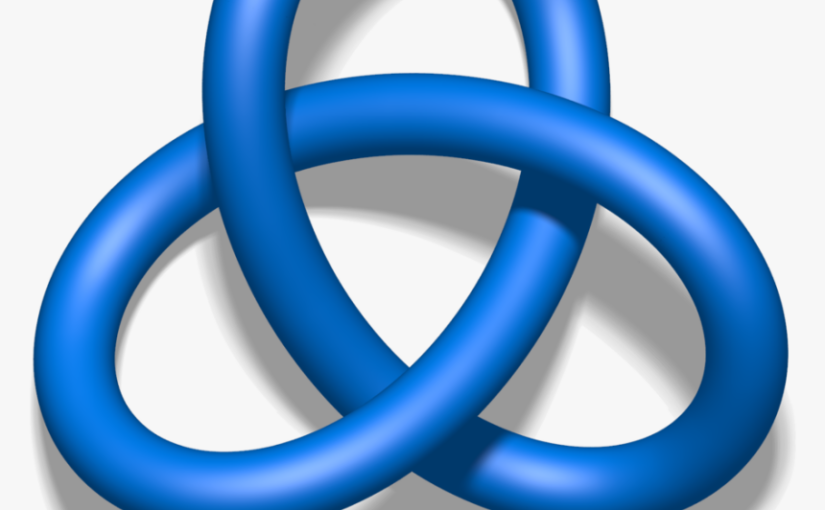
So far, I’ve been really astounded by the analogies that the narrator in Written on the Body makes about love. Each comparison seems to be a way to justify their current situation through a different lens. In this post I will be focusing on the paragraph on page 87 where the narrator talks about knots, and the larger implications that this analogy has on how the narrator views their relationship with Louise.
When the narrator claims that “the interesting thing about a knot is its formal complexity. Even the simplest pedigree knot, the trefoil, with its three roughly symmetrical lobes, has mathematical as well as artistic beauty” (87), I don’t think they are purely talking about the knot itself. Here, the narrator states three important things: 1) knots are complex, 2) a specific knot (the trefoil, pictured at the top of the post) has three lobes, and 3) the trefoil is beautiful. With the knowledge that they later bring this talk of knots back around to their relationship with Louise (see page 88), I don’t think it’s as much of a stretch to consider that this paragraph about knots relates back to the narrator’s love life. At this moment in time, the narrator considers their relationship with Louise to be much like the trefoil knot – complex and 3-sided (because Elgin is still in the picture at this point), but ultimately beautiful.
It is interesting that they continue by saying, “the challenge of the knot lies in the rules of its surprises. Knots can change but they must be well-behaved. An informal knot is a messy knot” (87 – 88). For the challenge of the knot, the narrator seems to think that the same occurs for relationships; it’s the surprises and how they are dealt with that “make or break” them (i.e. Louise telling Elgin that she’s been having an affair with the narrator and how they deal with that situation). Then there’s the word choice of “well-behaved” that really sticks out to me, I think this combined with the informal = messy bit is meant to say that much as a knot must be sturdy and held together tightly, so must a relationship if the people wish to stay together.
This is a lovely and complex metaphor that I did not pick up on during my initial read! I’m especially intrigued by your suggestion that the knot/relationship must be “sturdy” and “well-behaved” if it is to be successful. Knots, it seems, are very poorly behaved. Instead of being straight, a knot is curved. Knots are “queer,” like the narrator’s relationship with Louise and Elgin. From a third––or fourth––party perspective, a knot is messy and it needs to be untangled; a knot is not “normal.” To exist happily as a knot, the knot needs to be balanced. I suspect the crux of the trouble in the narrator’s relationship with Louise is Elgin, and his hesitancy to participate in a knot so messy, a life so “queer.”
The way you’ve unearthed this analogy is really interesting. I didn’t notice the relevance of the trefoil knot in my first read, but it makes total sense that the narrator would equate a relationship to something with three components at this point in the novel. As you and the first commentor noted, the use of “well-behaved” is also extremely interesting, because it implies normalcy and normativity. Of course, the phrase “tie the knot” means to marry, so perhaps the narrator sees their relationship with Louise (and Elgin) as tying the trefoil knot. Additionally, this analogy is a strong one because the narrator continues to discuss ropes throughout the novel. On page 88, as you mentioned, they transition into discussing “the hoop around our hearts” and what it means to have “enough rope” to kill the relationship (88). Later, the narrator states, “I hold on to love as a climber does a rope” (105). That is to say—they hold onto love like it’s life or death.
I love how you’re breaking down the trefoil knot as a metaphor for the narrator’s relationship. The complexity of the knot, its three lobes, and the way it has to be “well-behaved” to stay intact—all of this resonates so much with how the narrator sees love: not as something straightforward but as something intricate, sometimes tangled, but still beautiful. The fact that the narrator acknowledges the presence of Elgin in this structure makes it even more fascinating—love isn’t just between two people here, but something with external forces pulling at it.
What really gets me is your discussion of “well-behaved” knots versus messy ones. There’s this tension between control and chaos in the novel, and the narrator seems to believe that love, like knots, needs some kind of order to work. But relationships aren’t mathematical formulas, and this one especially isn’t neat—it’s inherently messy, tangled in secrecy, desire, and inevitable loss. The narrator wants love to be a knot that holds, but the reality is that knots also come undone. And that’s heartbreaking.
For me, personally, this really connects to the idea of knots in Judaism. Knots—like the ones in tzitzit (the fringes on a tallit)—are deeply symbolic. They represent obligation, remembrance, and connection to something greater. In Jewish thought, knots don’t just hold things together—they mean something. They bind people to each other, to tradition, to faith. So thinking about the trefoil knot in Written on the Body through that lens really hits me. It makes me think about how queer relationships, especially between women, can be these intricate, deeply tied things—full of meaning, full of love—but also subject to unraveling, whether through external pressures, emotional complexities, or just the sheer weight of loss.
And that really gets to me in light of my own breakup. Because, like, I felt that binding, that connection, that intricate weaving together of two lives. But knots can come undone, even when they’re tied with so much care. And maybe part of the pain of queer breakups—especially between women—is that the world doesn’t always recognize those knots as legitimate in the first place. But we know what they meant. And that’s its own kind of heartbreak.