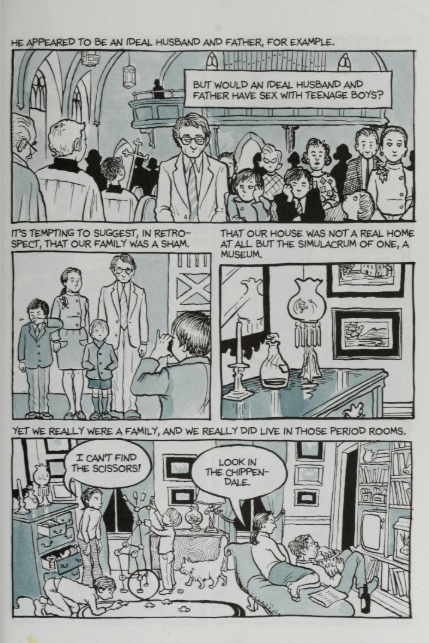
On page 17 of Fun Home, Bechdel reflects on the appearance of her family. The page begins with the line “He appeared to be an ideal husband and father” (Bechdel, 17). This line is followed by an image of her family in church, a public space, with her father looking down, dressed in a suit next to the rest of the family dressed in their Sunday best. However, despite the family’s appearance of being well dressed, the dialogue box includes the question “Would an ideal husband and father have sex with teenage boys” (Bechdel, 17). This question leads to the statement “It’s tempting to suggest, in retrospect, that our family was a sham” which is then followed by the family have their photo taken outside their church while still in the church outfits. This scene draws out the need for normalcy through appearances. This is because the family is well dressed enough to appear “normal” to be in a church service and to take family photos. Additionally, in this public moment, the camera is focused on their family symbolizing the way one moves from invisibility to hyper visibility. Society places an invisible camera on each individual person to make sure they’re always behaving “normally” which can feel exposing for one if facets of their identity don’t comply with what the camera wants. In Bechdel’s family, we see in the first drawing of the page the father is looking down, eyes appearing closed, while the mother looks up, shoulders back and head held high. The contrast between the parent’s body language indicates the mom, Helen, has a confidence in the space but, Bruce’s downturned expression hints at an un comfortability. However, this normal family unit particularly the sentiment of the father being an ideal husband and dad becomes complicated by the narration which questions if Bechdel’s father would still be considered ideal for having sex with younger men. The location of the church relates to the idea of confession present by Foucault because Bruce in this situation is hiding the truth of his affairs and seems confined within the church and the photograph due to the weight of his inner self and familial duties.
I love your analysis on this scene from Fun Home, especially your point about how the family is putting on a sort of performance for the camera. You also mention that her father is looking down, and I also noticed that he is doing this and looking out of the corner of his eye as the cross is passing him. We can assume that this is because of his guilt or shame, and/or the moment is heightend because they are in church. It also intresting to note, as you metnioned, how Bruce’s body language counters Helen’s. It shows the tension between them and how the family presents themselves public versus what is happening at home. Great analysis!
I really liked your close reading of page 17 — especially the way you connected the family’s outward appearance to themes of surveillance and visibility. Your observation about the contrast between Bruce and Helen’s body language is really sharp. It captures how much can be communicated through posture in a visual memoir like Fun Home, and how Bechdel uses those subtle cues to hint at deeper emotional and psychological tensions in the family. I also thought your connection to Foucault and the idea of confession was super interesting, especially in the context of the church. It made me think about how Bruce’s repression isn’t just personal but also structured by institutions — like the church and the family — that demand certain performances of identity. The whole idea of “the camera” you mention feels very Foucauldian too, like a panopticon that forces people to self-police.