Nobody Suspects a Thing: The Farce of Gender Performativity in “Octodad”

     In 2014, indie video game company Young Horses released Octodad: Dadliest Catch, perhaps the most unusual stealth game of all time. The game enables the player to assume the role of Octodad, an octopus not-so-subtly masquerading as a human husband and father. To the player, Octodad immediately stands out as an octopus. His bright yellow skin, suction-cup hands, and tentacle mustache hardly constitute humanoid features. However, the other characters in the game world seem entirely ignorant of Octodad’s performance. His wife lovingly kisses his tentacles without recoiling, and he inexplicably produces two human offspring with no cephalopodic features. As the game’s theme song proclaims, “Nobody suspects a thing.”

     Game studies scholar Bo Ruberg suggests that Octodad can be broadly read “as a video game about ‘passing’” (85). Queer theorists can read Octodad “as a queer subject struggling to pass as cisgender or straight” (102). Critical race theorists can interpret Octodad as “a racialized other—a person of color who must pass as an acceptable subject within a social system that believes that being normal and successful means being…white” (102). Meanwhile, disability studies theorists can analyze Octodad’s bodily differences. After all, “Octodad must quite literally contort his body to fit the design of the world around him” (102). In addition to these rich interpretations, I suggest that Octodad allows the player to act out the theatrics of gender performativity. Like drag, the game exaggerates the rigidity of gender roles in order to subvert and satirize them. Through the use of mechanical storytelling and unwieldy controls, Octodad offers a critique of gender performativity that could only be conveyed in the video game form.

Octodad: Dadliest Catch promotional artwork featured on the PlayStation Store’s website

     The setting of Octodad evokes the hauntingly heteronormative suburbia of 1950s America. Octodad’s home is quite literally enclosed by a white picket fence. His beautiful garden thrills with primary colors, complete with a seesaw for his daughter and a shed full of sports equipment for his son. Inside the home, Octodad’s wife works in the kitchen, washing dishes at a mint-colored sink. The cephaloprotagonist’s four-person household perfectly imitates the nuclear family. As the head of this unit, Octodad must fulfill a set of gendered expectations. But how is Octodad to know what gendered actions to perform? With no prior experience being a human man, Octodad must imitate the human men that surround him. 

Octodad mowing the backyard, courtesy of IGN

     In Gender Troubles, Judith Butler argues that humans imitate gender just as much as octopuses. To Butler, gender identity is nothing more than “a set of imitative practices which refer laterally to other imitations and which, jointly, construct the illusion of a primary and interior gendered self” (188). In other words, gender is an imitation of an imitation. Humans do not act out gender performatives because it is in their nature to do so. Instead, they copy other humans to assimilate into normalcy. As an octopus, Octodad emphasizes this mimcry. He does not contain an “interior and organizing gender core” (Butler 186). Rather, he imitates the media he consumes, the neighbors he encounters, and the expectations of a strange society. “Like the two stubby tentacles that make up his pseudo-manly mustache,” writes Ruberg, “Octodad’s gender is clearly a construct cobbled together from tropes” (96). Like the perfect American father of the 1950s cultural imagination, Octodad must brew coffee for his wife and flip burgers for his children. He mows the lawn and weeds the garden like his neighbors. He even forces his body into a three-piece suit to look like society’s ideal businessman. At every point, however, the game renders these heteronormative rituals farcical. Due to the difficult control schema, it is almost impossible to accomplish any of these tasks “naturally.” Octodad spills coffee beans, hurls burgers in the air, tramples flowers, throws mowers, and trips over—well, just about everything. The game’s ridiculousness implicitly reveals the performativity of these gendered rituals. Some may “come to believe” their own gender performance, but this does not make it any more innate or natural (Butler 192). Like Octodad’s suit, gender is a “thin veneer” that allows humans to function within a heteronormative society (Ruberg 96). “For Octodad,” though, “the clothing truly does make the man. Beneath it, there is only octopus” (96).

     Throughout the game, Octodad must navigate various obstacles all while maintaining his humanlike demeanor. Many levels are reminiscent of early slapstick comedy. For instance, Octodad must dodge banana peels in the supermarket and avoid puddles aboard a ship. These challenges may seem low stakes, but they all spell doom for Octodad. If he gets found out, he may be killed by a chef or, even worse, rejected by his newfound family. The player fails a level if the game’s “Suspicion Meter” rises too high. If Octodad crashes into furniture or careens into bystanders, people begin to suspect his performance. Once the meter rises too high, the player is forced to begin the level again from the beginning. Gender, Butler argues, is constructed by “a reenactment and reexperiencing of a set of meanings already socially established” (191). In other words, “gender requires a performance that is repeated” (191). In Octodad, the constant repetition of levels as players fail and then try again epitomizes the construction of gender. If players do not perform as a convincingly heteronormative man, they must attempt their tasks over and over. When they finally complete the level, they will have repeated it so many times that they have truly mastered the performance of masculinity. The usually nondiegetic function of game failure serves a narrative purpose. Mastery in the game equals a mastery of gender. Players “quite literally play at heteronormativity” (Ruberg 85).
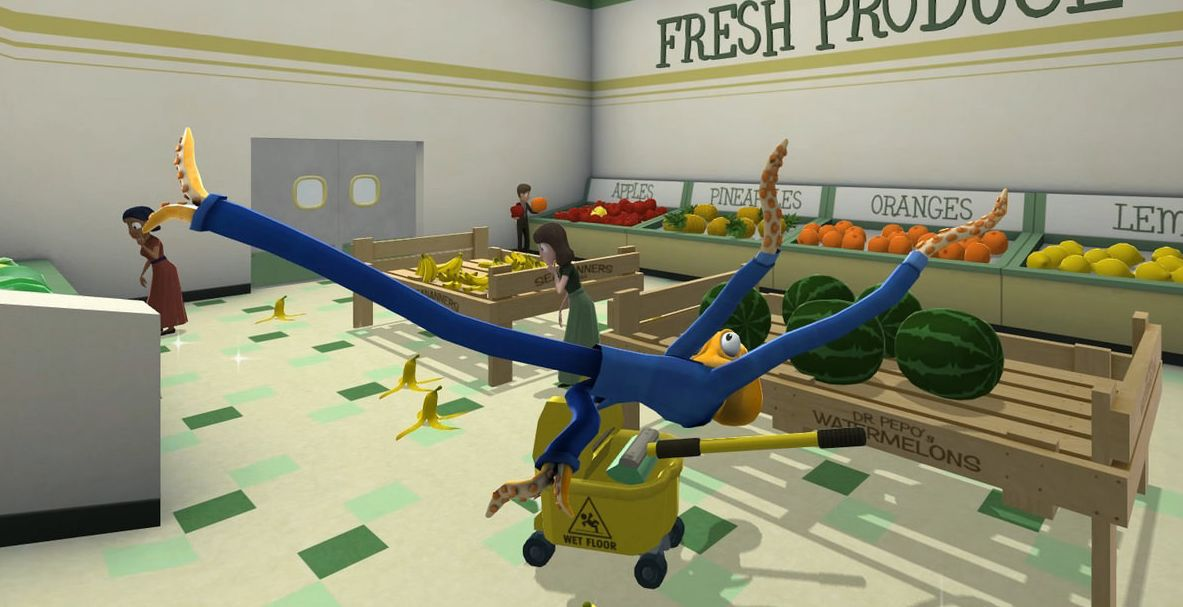
Octodad tripping in the grocery store, courtesy of SUPERJUMP

     The nondiegetic function of the meter also presents an intriguing social critique in itself. Though Octodad’s wife and children never grow suspicious of him, the Suspicion Meter remains visible even when he is at home alone with them. A dotted line always connects their line of sight to his body, demonstrating how Octodad tracks their shifting eyes. He anxiously awaits the day his ruse will be up, his identity exposed, even among those who love him most. This implies an internalized panoptical gaze; even when prying eyes are not watching, Octodad still acts in accordance with society’s rules. An “interior psychic space” has been “inscribed on the body” by society’s gendered expectations (Butler 135). Octodad cannot escape the gaze because it lives within him.

     Perhaps most interestingly, the game invites the player to recognize the ridiculousness of their own gender performance through the use of unwieldy controls. “The game celebrates a kind of queer, distinctly non-normative movement” through both the actions “seen on-screen” and “in the physical inputs of the player” (Ruberg 93). One does not master the controls of Octodad. Rather, one barely scrapes by, moving from level to level with extreme difficulty. The game has spawned countless rage compilation videos on YouTube and other social media platforms. Still, the game’s difficulty can and should be read as more than rage bait. Octodad’s “embodied controls” do not simply “represent difference” (85). Instead, they allow “players to inhabit that difference” (85). The game refuses to adopt any traditional control schema. Each of Octodad’s limbs must be moved individually by a different button, rendering even “a supposedly simple act like walking” absurd (91). The odd movements of Octodad’s legs mirror the unusual motions of the player’s thumbs. As Octodad struggles, so does the player, forcing them to reassess the control inputs they previously deemed “natural” or “intuitive.” Implicitly, then, the game calls the player’s own body into question. Is their own gender performance seamless, or does it involve just as much stumbling as Octodad’s? Are the actions they perform natural, or have they been learned like the buttons on a controller? What makes them all that different from an octopus desperately trying to convince everyone around him that he is a real, genuine man? Through controls alone, the game suggests that the player may have more in common with Octodad than they initially supposed.

     Octodad: Dadliest Catch presents a humorous yet harrowing portrayal of gender performance. Through nondiegetic functions like game failure and the Suspicion Meter, the game demonstrates how gender is constructed through repetition and internalization. Meanwhile, the difficult controls call attention to the player’s own shoddy gender performance. Despite its levity, the game also makes room for genuine empathy. Octodad struggles to fit into impossible boxes like countless queer humans before him. One does not need to dive into the sea to spot a fish out of water; one needs only step out the front door. 

Octodad after revealing his true identity to his family, courtesy of CBR. The family continues living as a nuclear unit, even after all has been revealed.

Works Cited

Butler, Judith. Gender Trouble: Feminism and the Subversion of Identity. Routledge, 2007. EBSCOhost, research.ebsco.com/linkprocessor/plink?id=d47e680a-1ff8-3819-96b2-0b70dd97b01c. Accessed 17 Apr. 2025.

Octodad: Dadliest Catch. Directed by Kevin Zuhn, Young Horses, 2014. Sony PlayStation 4 game.

Ruberg, Bo. Video Games Have Always Been Queer. New York University Press, 2019, doi.org/10.18574/nyu/9781479893904.001.0001. Accessed 17 Apr. 2025.

Queering Time in a Queer World: Deconstructing Chrononormativity in “Alice’s Adventures in Wonderland”

     In Time Binds, Elizabeth Freeman emphasizes the effects of “chrononormativity, or the use of time to organize individual human bodies toward maximum productivity” (3). By and large, society operates upon the assumption that everyone follows the same timeline; “marriage, accumulation of health and wealth for the future, reproduction, childrearing, and death and its attendant rituals” all occur in roughly chronological order (4). If an individual’s life does not follow this “sequence of socioeconomically ‘productive’ moments,” they are deemed a societal outcast (5). But what happens when no one’s life follows a rigid timeline? What happens when time stands still, folds in upon itself, or collapses? What happens when the chrononormative individual steps into a strange, unfamiliar world where queer time is the norm? Such is the case in Lewis Carroll’s Alice’s Adventures in Wonderland (1865). Though Alice attempts to impose chrononormativity upon the unusual inhabitants of Wonderland, they resist her inflexibility and seriousness. In a world where everyone is mad, time goes mad, too.

     Alice’s story begins on the shore of a lake when she notices a peculiar White Rabbit with pink eyes. When the Rabbit begins talking to itself, Alice does not find it “so very remarkable” or “so very much out of the way” (Carroll 7-8). It is only after the Rabbit takes “a watch out of its waistcoat-pocket” that “Alice start[s] to her feet” (8). As critic Gillian Beer points out, “[i]t’s the watch that startles Alice;” she does not find “an animal that speaks” all that remarkable, but she is roused by “the accoutrements of adult business, busy-ness” (xxviii). Alice’s violent reaction to the watch implicitly suggests that she has already become aware of the ticking clock of chrononormativity. By the mid-nineteenth century, the watch had become a “token of human respectability and worth” (xxix). Parents, teachers, and bosses all gave watches as gifts to the young to help usher them from immaturity to adulthood. Becoming an adult meant regulating yourself within a “state-sanctioned” timeline that served “the nation’s economic interests” (Freeman 4-5). When Alice hears the Rabbit fret that it will be “late,” she undoubtedly recognizes the fears of a society determined to regulate time (8). As a child inching toward adolescence, she understands that she must soon regulate herself in the same way. However, she soon finds that Wonderland is not as chrononormative as the Rabbit would suggest. 

     As Alice falls down the rabbit-hole to Wonderland, she finds that she has “plenty of time…to look about her, and to wonder what [is] going to happen next” (8). When time operates on a nonindustrial clock, individuals have more time to reflect on their surroundings, contemplate their situation, and enjoy the peculiarities of life. Still, Alice cannot discard the ideas she internalized growing up in a chrononormative world. When in Wonderland, she attempts to impose chrononormativity upon the residents. At the Mad Hatter’s tea-party, for instance, Alice tells the Hatter that he has “a funny watch” (60). After the March Hare fiddles with the mechanisms of the Hatter’s timepiece, it only “tells the day of the month” rather than “what o’clock it is” (60). Alice cannot fathom such a queer way of telling time. “‘I don’t quite understand you,’” Alice, feeling “utterly puzzled,” says to the Hatter (60). In response, the Hatter tells Alice that she does not know “Time” as well as he does (61). Outside of the confines of an industrial society, the Hatter can recognize time as a construct. “‘For instance,” the Hatter says, “‘suppose it were nine o’clock in the morning, just time to begin lessons: you’d only have to whisper a hint to Time, and round goes the clock in a twinkling! Half-past one, time for dinner!” (61) As the Queen of Hearts realizes, the Hatter is capable of “murdering the time” (62). When one steps out of a chrononormative timeline, one can see time for what it is: something to be manipulated, rearranged, and disregarded at will. The Hatter can throw a tea-party whenever he wants because he moves to his own rhythm. Not regulated by an industrial or reproductive clock, the Hatter makes what he wants out of life. He represents the positive potentialities of queering time. He represents an alternative “to the sped-up and hyperregulated time of industry” (Freeman 7). He represents freedom masquerading as madness.

     Unfortunately for Alice, she must leave Wonderland and step back into the world of chrononormativity. As her sister realizes, Alice will one day become a “grown woman” surrounded by “little children” (109). Once she leaves childhood, Alice will be expected to adhere to a chrononormative, state-sanctioned timeline. First, she will marry and then have children to share her stories with. Her childhood fantasies will become nothing more than entertainment for the next generation. In Wonderland, however, these rules do not apply, and these destinies are not prewritten. Time moves according to the residents’ whims. The Dormouse sleeps when it wants. The Queen of Hearts lets her croquet match last indefinitely. The Duchess even rewrites astronomy so it agrees with her peculiar perspectives: “‘If everyone minded their own business…the world would go round a great deal faster than it does’” (52). Alice initially recoils at such an idea, explaining that “the earth takes twenty-four hours to turn round on its axis” (52). Any alteration to this clock would surely be fatal. However, after spending so much time in Wonderland, Alice is not so sure of herself anymore. “Twenty-four hours, I think; or is it twelve?” she asks herself (52). She, too, realizes that time can bend without breaking, shift without shattering, and queer without quibbling. The clock is merely a tool, and often a faulty one at that. The earth moves to its own rhythm, regardless of human measurements. By keeping its own time, it always maintains the right time. Perhaps humans can (and should) do the very same.

Works Cited

Beer, Gillian. “Alice in Time.” The Modern Language Review, vol. 106, no. 4, 2011, pp. xxvii–xxxviii. JSTOR, https://doi.org/10.5699/modelangrevi.106.4.xxvii. Accessed 2 Apr. 2025.

Carroll, Lewis. Alice’s Adventures in Wonderland and Through the Looking-Glass. Penguin Classics, 2015.

Freeman, Elizabeth. Time Binds: Queer Temporalities, Queer Histories. Duke University Press, 2010.

Bros Before Mangoes: Queer Misogyny in “You’re the Only Friend I Need”

     In Alejandro Heredia’s “You’re the Only Friend I Need,” queer teens Fabio and Noel struggle to reconcile with their burgeoning identities. At multiple points in the text, this struggle manifests in a battle between femininity and masculinity, especially in the character of Fabio. By shedding light on the misogyny of gay men, Heredia interrogates the appropriation of femininity in the queer community. 

     Initially, Fabio demonstrates a vehement aversion to femininity. When a group of girls makes fun of him for eating a mango, for instance, he declares that he “fucking hate[s] girls” (Heredia 34). In Fabio’s mind, a few bullies come to represent every girl around the world. He judges using overgeneralizations, one of the many tools of the oppressor. Fabio also asserts his masculinity using the oppressive tool of violence. He gets into “a fist fight with one of the popular girls at school” after she calls him a slur (36). Taken symbolically, Fabio seems to spar with his own femininity. He attempts to quell rumors by pummeling the feminine energy inside himself just as he pummels his bully. However, his battle further exposes his queerness, solidifying him as a “girl-fighting maricon” (36). Similarly, when he “flips [the mango girls] a middle finger,” he only incites more laughter (34). With each struggle against femininity, Fabio further implicates himself in sissyhood. His fight is futile. He cannot dismantle patriarchal oppression using the tools of the patriarchy. 

     Fabio’s innate femininity blatantly contradicts his misogyny. When he and Noel start to “refer to each other in feminine pronouns,” the change “feels good” for both of them (36). According to Noel, “Fabio is unapologetic about his femininity” and “will throw it in anyone’s face” (36). Fabio even gets mad at Noel when his drag makeover does not look feminine enough. “You look like a boy. That’s not the point,” he says (39). These remarks and assertions seem discordant with Fabio’s earlier hatred of women. How can a boy who despises girls be “unapologetic about his femininity?” Fabio fails to recognize the hypocrisy of his views. He appropriates femininity and feminine culture, yet he despises women. In turn, Fabio harbors a deep-seated hatred for a fundamental part of himself.

     Though he fights against it, femininity fits Fabio like a glove. When he dresses in his aunt’s clothing, for instance, he looks “as if the blouse was made for his body exactly” (38). This is because it is. He is meant to embrace his feminine side, yet his misogyny prevents him from fully doing so. Even after Ren tells him to respect queer women’s gender identities, he refers to them using masculine pronouns. He refuses to immerse himself in femininity; he is not a girl, just something “adjacent” to one (40). Heredia suggests that Fabio can only achieve true happiness by placing himself in women’s shoes, both literally and figuratively. This is more than a radical form of empathy; it represents radical self-acceptance. Fabio can only settle into his identity when he discards the patriarchy’s rules. Queer self-acceptance hinges upon a new, more feminist way of being.

     Through the character of Fabio, Heredia suggests that gay men cannot comfortably reconcile with their femininity without first confronting their misogyny. By extension, his story implies that the liberation of the queer community cannot be wrought without the liberation of women, too. This intersectional approach to activism acknowledges the multiplicity of our own identities. We contain “multitudes,” and we must strive to accept each part of ourselves, whether masculine, feminine, or something in between (38).

The Christmas Conundrum: Rewriting the Family in “Written on the Body”

     For a brief period in the text, Louise and the narrator of Written on the Body share a quaint and domestic life together. With Elgin out of the picture, the two lovers can fully enjoy each other’s company and embrace the positive aspects of stable, affectionate monogamy. Notably, this domestic reprieve occurs during the Christmas season. Louise and the narrator, along with the rest of the world, get caught up in the holiday spirit. They cannot help but decorate their “flat with garlands of holly and ivy woven from the woods” (Winterson 99). Though they have “very little money,” they still find peace and cheer in “the season of goodwill” (99-100). Sadly for the two lovers, though, this fragile joy comes crashing down around them. By setting all scenes of domesticity at Christmastime, Winterson emphasizes the ubiquity of hegemonic ideals of domestic happiness.

     As Eve Kosofsky Sedgwick points out in Tendencies, Christmas marks a “time when all the institutions are speaking with one voice” (5). As all institutions repeatedly promote the monolith of Christmas, an increasing connection emerges between Christmastime and “the image of ‘the’ family” (6). Of course, Louise and the narrator do not conform to any traditional concept of what “the family” looks or acts like; their relationship begins with an affair, they do not share children, and they may both be women. Still, they enjoy the holiday season just like any other family. “We sang and played and walked for miles looking at buildings and watching people,” says the narrator (99). The couple’s singing calls to mind Christmas carols, while their playing evokes a childlike joy. Perhaps they also admire Christmas lights while taking their milelong walks. They even learn the quintessential lesson of Christmas: the importance of family. “A treasure had fallen into our hands,” says the narrator, “and the treasure was each other” (99). The statement is overly schlocky, romantic, and sentimental, especially for such a cynical narrator. In other words, the statement embodies all the cardinal aspects of Christmastime.

     Despite their poverty and unconventionality, Louise and the narrator remain “insultingly happy” (99). Their happiness does not just insult Elgin or Jacqueline. Rather, it insults the established order. The couple demonstrates that one does not have to adhere to conventional expectations in order to find fulfillment. However, their rebellion comes at a cost. Elgin arrives on “Christmas Eve” to inform the narrator that Louise has leukemia (100). He undercuts the couple’s happiness the night before the glorious day, the symbolic culmination of their joy. In a season characterized by brilliant lights and twinkling stars, Elgin casts “a shadow” over their contrived domesticity (100). His cruelty reveals that even the most “jovial” of seasons can have a “menacing” underbelly if you do not conform to societal expectations (100). The two lovers will never fit in, no matter how many garlands they string. Winterson illustrates that individual acts of resistance against hegemony only ever end in tragedy or martyrdom. To effect real change, the entire system must be discarded like the carcass of a Christmas turkey.