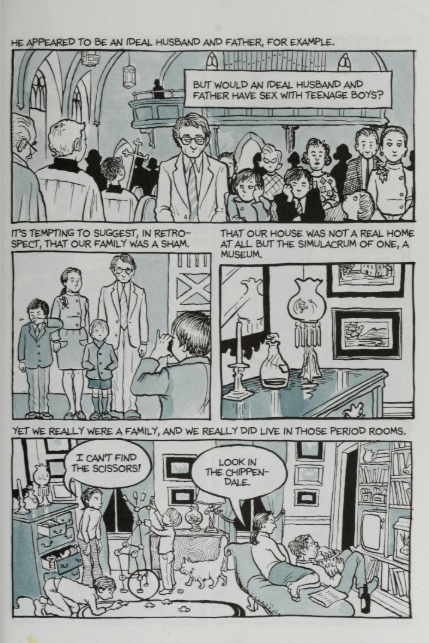
On page 17 of Fun Home, Bechdel reflects on the appearance of her family. The page begins with the line “He appeared to be an ideal husband and father” (Bechdel, 17). This line is followed by an image of her family in church, a public space, with her father looking down, dressed in a suit next to the rest of the family dressed in their Sunday best. However, despite the family’s appearance of being well dressed, the dialogue box includes the question “Would an ideal husband and father have sex with teenage boys” (Bechdel, 17). This question leads to the statement “It’s tempting to suggest, in retrospect, that our family was a sham” which is then followed by the family have their photo taken outside their church while still in the church outfits. This scene draws out the need for normalcy through appearances. This is because the family is well dressed enough to appear “normal” to be in a church service and to take family photos. Additionally, in this public moment, the camera is focused on their family symbolizing the way one moves from invisibility to hyper visibility. Society places an invisible camera on each individual person to make sure they’re always behaving “normally” which can feel exposing for one if facets of their identity don’t comply with what the camera wants. In Bechdel’s family, we see in the first drawing of the page the father is looking down, eyes appearing closed, while the mother looks up, shoulders back and head held high. The contrast between the parent’s body language indicates the mom, Helen, has a confidence in the space but, Bruce’s downturned expression hints at an un comfortability. However, this normal family unit particularly the sentiment of the father being an ideal husband and dad becomes complicated by the narration which questions if Bechdel’s father would still be considered ideal for having sex with younger men. The location of the church relates to the idea of confession present by Foucault because Bruce in this situation is hiding the truth of his affairs and seems confined within the church and the photograph due to the weight of his inner self and familial duties.
Author: jacksons
“We ain’t getting no younger, we might as well do it” – Jagged Edge
https://youtu.be/A9jZOoMaK5U?si=Mi6opSa55IMCRoV5
For this week’s blog post, I want to connect the YouTube video “Why I’m Not Married” by Gloom (Kassie) with Eve Sedgwick’s essay Christmas Effects from Queer and Now. In the video, Kassie addresses a recurring question she gets from friends, family, and followers: “Why aren’t you married, even though you got engaged five years ago?” The video opens with Kassie describing herself as someone with a “very defiant personality.” Since childhood, she explains, she needed to understand exactly why she had to do something and if she didn’t get a clear or compelling reason, her answer was simply no (2025). She follows this statement with an anecdote from elementary school. During a birthday celebration, her teacher asked each student to wish a classmate happy birthday. When it was Kassie’s turn, she refused. Even after being told to say it, she refused, which eventually led to the teacher calling Kassie’s parents to report her behavior. This anecdote might seem trivial, or like Kassie was just being a jerk, but it actually echoes the ideas Sedgwick covers in Christmas Effects. Sedgwick writes that certain times of year like Christmas can feel depressing because “all the institutions are speaking with one voice” (1993). Everything around us during that time of year seems to expect the same emotional response or behavior, and any resistance can feel isolating. Sedgwick uses Christmas as a metaphor, but the effect extends to other social institutions as well such as marriage. Similar to Christmas, marriage often carries expectations of conformity. It’s not just a romantic or legal union but a combination of a “normal” family unit: a shared surname, an economic unit, a legal unit, a system of companionship and a mechanism to care for children (1993). Kassie’s resistance to marriage, then, feels like a continuation of the same impulse that made her resist saying “Happy Birthday” as a child. It’s not that she opposes celebration, it’s the feeling of being pressured to participate in something simply because it’s expected. Kassie ends the video by revealing that her relationship feels good in its current form. The societal pressure to marry makes her question whether she ever truly wanted it in the first place. Similar to Sedgwick’s analysis of Christmas, Kassie’s story is a reflection on how societal expectations can blur the line between genuine desire and social obligation. Her answer to “Why aren’t you married?” is ultimately simple: she’s still figuring out if it’s something she wants, not just committing to something she’s supposed to do. She’s in no rush to throw a party where she’s the “last to arrive and the first to leave” even though the wedding is designed to be for her (2025).
It’s giving face
The inclusion of this scene in the collection demonstrates the coexistence of fear and courage that often accompanies the navigation of queerness, especially when approaching queer spaces. Noel, in this moment, hasn’t dressed up in the same feminine way as the rest of his friends, but Ren crafts a space where Noel can still engage with the experience in his own comfort zone, subtly encouraging him to embrace his cuteness while remaining true to himself. This interaction highlights Noel’s inner conflict: as he looks into the mirror, he sees a “creature of the night,” a birdlike, crow-like figure. Relating to the stigma of nightlife being something shame worthy. His discomfort with his appearance reflects a broader tension in queer identity, where the fear of not meeting societal standards of gender or beauty often battles with the desire to express one’s true self. The compact mirror, traditionally a tool of self-reflection, becomes a symbol of exposure and self reflection which Noel struggles with. Meanwhile, Ren’s gentle act of holding his chin and applying makeup, which may seem simple, represents a deeper intimacy and care. This small act of vulnerability contrasts with the looming fear Noel feels about potential violence from external forces, such as the threat of police brutality. This moment depicts the ways in which Queer people can craft spaces for one another. Ren creates a safe space for Noel to explore gender expression without the harsh judgment of the outside world, reinforcing how queer solidarity can provide the courage to move forward in the face of fear. Noel’s refusal to let his fear “paralyze” him further emphasizes the resilience embedded in the queer experience—courage isn’t the absence of fear, but the ability to continue despite it. Even with the threat of bodily harm through “meeting the baton” of homophobic cops, Noel is encouraged by Ren’s kindness.
Don’t you love when your secret lover compares you to a Sea Creature?
On page 73, a moment of physical and emotional closeness intertwines metaphors of water and nature, reflecting the narrator’s deep connection with Jacqueline. The recurring imagery of water, with its associations of fluidity, transformation, and desire, evokes a sense of immersion in this relationship. Jacqueline is described as ‘refilled each day with fresh tides of longing,’ suggesting the constant, overwhelming nature of the narrator’s desire. This metaphor not only represents desire’s intensity but also casts Jacqueline as familiar territory of the scent of “rock pools” the narrator explored as a child. Thus, symbolizing a space of comfort and desire for the narrator. The metaphor of Jacqueline being ‘refilled each day with fresh tides of longing’ illustrates the cyclical nature of desire, which is both ever-present and transformative. This continual replenishment suggests that the narrator’s feelings for Jacqueline are not static but evolve daily, amplifying the sense of constant yearning and emotional fluidity. The metaphor of tides also implies that this desire is something beyond the narrator’s full control, as tides can often sweep up people and things. In the tides, the narrator discovers Jacqueline’s “starfish” and “salt”. This sense of discovery and immersion highlights the narrator’s psychological state of being consumed by desire. Just like a deep sea diver takes time in exploring the ocean and its habitants, the narrator gives their lover the same level of exploration. Just as the ocean can both embrace and overwhelm, the narrator’s longing for Jacqueline creates an emotional pull that is as irresistible as it is unsettling because the sea contains a plethora, suggesting an internal conflict between yearning for closeness and the fear of losing control. The two began with the music “smooth as a tube lubricating” them across the floor but, they eventually slip deeply into the affair, like being plunged into the sea. Ultimately, the water metaphor serves not only to convey the depth of the narrator’s desire but also to underscore the natural, yet uncontrollable forces of intimacy. It reveals the tension between the allure of emotional connection and the inherent instability and unpredictability of love, which, much like water, is fluid and ever-changing.
