Nobody Suspects a Thing: The Farce of Gender Performativity in “Octodad”

     In 2014, indie video game company Young Horses released Octodad: Dadliest Catch, perhaps the most unusual stealth game of all time. The game enables the player to assume the role of Octodad, an octopus not-so-subtly masquerading as a human husband and father. To the player, Octodad immediately stands out as an octopus. His bright yellow skin, suction-cup hands, and tentacle mustache hardly constitute humanoid features. However, the other characters in the game world seem entirely ignorant of Octodad’s performance. His wife lovingly kisses his tentacles without recoiling, and he inexplicably produces two human offspring with no cephalopodic features. As the game’s theme song proclaims, “Nobody suspects a thing.”

     Game studies scholar Bo Ruberg suggests that Octodad can be broadly read “as a video game about ‘passing’” (85). Queer theorists can read Octodad “as a queer subject struggling to pass as cisgender or straight” (102). Critical race theorists can interpret Octodad as “a racialized other—a person of color who must pass as an acceptable subject within a social system that believes that being normal and successful means being…white” (102). Meanwhile, disability studies theorists can analyze Octodad’s bodily differences. After all, “Octodad must quite literally contort his body to fit the design of the world around him” (102). In addition to these rich interpretations, I suggest that Octodad allows the player to act out the theatrics of gender performativity. Like drag, the game exaggerates the rigidity of gender roles in order to subvert and satirize them. Through the use of mechanical storytelling and unwieldy controls, Octodad offers a critique of gender performativity that could only be conveyed in the video game form.
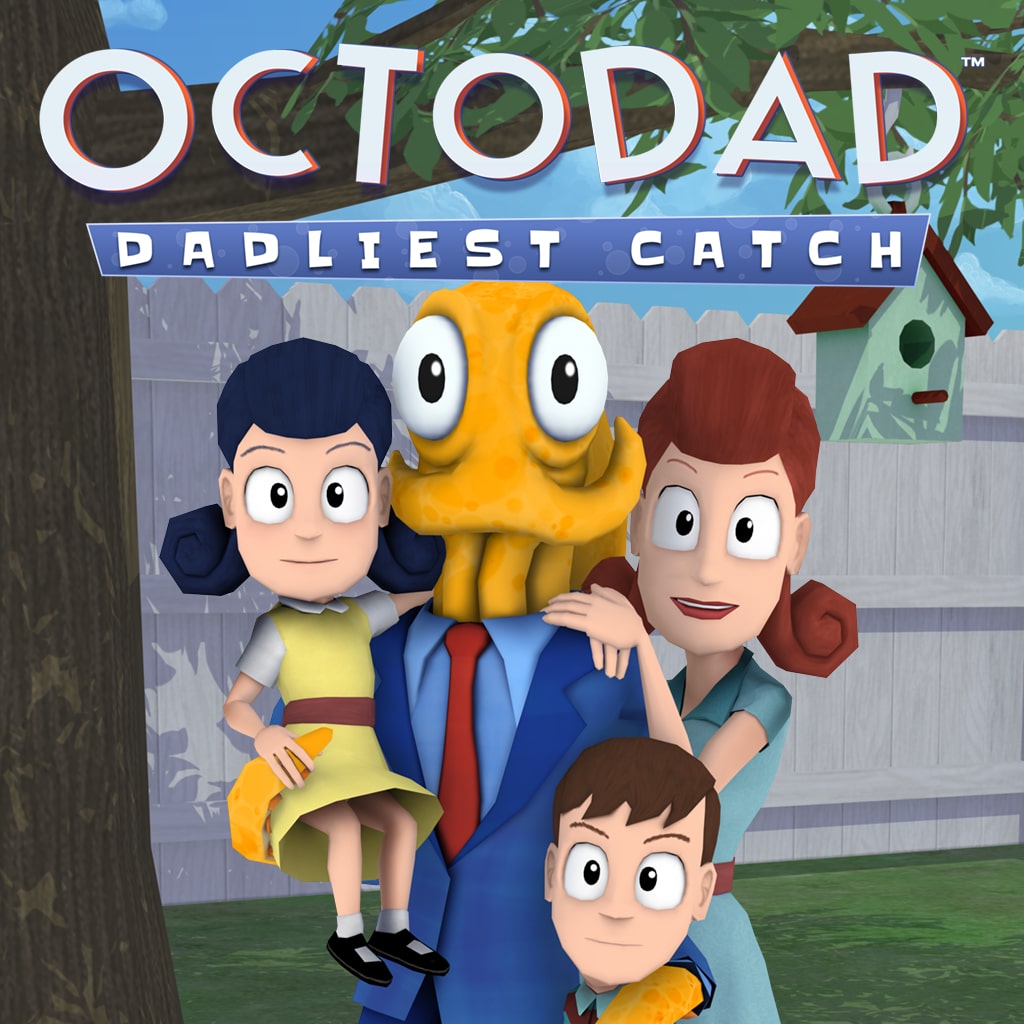
Octodad: Dadliest Catch promotional artwork featured on the PlayStation Store’s website

     The setting of Octodad evokes the hauntingly heteronormative suburbia of 1950s America. Octodad’s home is quite literally enclosed by a white picket fence. His beautiful garden thrills with primary colors, complete with a seesaw for his daughter and a shed full of sports equipment for his son. Inside the home, Octodad’s wife works in the kitchen, washing dishes at a mint-colored sink. The cephaloprotagonist’s four-person household perfectly imitates the nuclear family. As the head of this unit, Octodad must fulfill a set of gendered expectations. But how is Octodad to know what gendered actions to perform? With no prior experience being a human man, Octodad must imitate the human men that surround him. 

Octodad mowing the backyard, courtesy of IGN

     In Gender Troubles, Judith Butler argues that humans imitate gender just as much as octopuses. To Butler, gender identity is nothing more than “a set of imitative practices which refer laterally to other imitations and which, jointly, construct the illusion of a primary and interior gendered self” (188). In other words, gender is an imitation of an imitation. Humans do not act out gender performatives because it is in their nature to do so. Instead, they copy other humans to assimilate into normalcy. As an octopus, Octodad emphasizes this mimcry. He does not contain an “interior and organizing gender core” (Butler 186). Rather, he imitates the media he consumes, the neighbors he encounters, and the expectations of a strange society. “Like the two stubby tentacles that make up his pseudo-manly mustache,” writes Ruberg, “Octodad’s gender is clearly a construct cobbled together from tropes” (96). Like the perfect American father of the 1950s cultural imagination, Octodad must brew coffee for his wife and flip burgers for his children. He mows the lawn and weeds the garden like his neighbors. He even forces his body into a three-piece suit to look like society’s ideal businessman. At every point, however, the game renders these heteronormative rituals farcical. Due to the difficult control schema, it is almost impossible to accomplish any of these tasks “naturally.” Octodad spills coffee beans, hurls burgers in the air, tramples flowers, throws mowers, and trips over—well, just about everything. The game’s ridiculousness implicitly reveals the performativity of these gendered rituals. Some may “come to believe” their own gender performance, but this does not make it any more innate or natural (Butler 192). Like Octodad’s suit, gender is a “thin veneer” that allows humans to function within a heteronormative society (Ruberg 96). “For Octodad,” though, “the clothing truly does make the man. Beneath it, there is only octopus” (96).

     Throughout the game, Octodad must navigate various obstacles all while maintaining his humanlike demeanor. Many levels are reminiscent of early slapstick comedy. For instance, Octodad must dodge banana peels in the supermarket and avoid puddles aboard a ship. These challenges may seem low stakes, but they all spell doom for Octodad. If he gets found out, he may be killed by a chef or, even worse, rejected by his newfound family. The player fails a level if the game’s “Suspicion Meter” rises too high. If Octodad crashes into furniture or careens into bystanders, people begin to suspect his performance. Once the meter rises too high, the player is forced to begin the level again from the beginning. Gender, Butler argues, is constructed by “a reenactment and reexperiencing of a set of meanings already socially established” (191). In other words, “gender requires a performance that is repeated” (191). In Octodad, the constant repetition of levels as players fail and then try again epitomizes the construction of gender. If players do not perform as a convincingly heteronormative man, they must attempt their tasks over and over. When they finally complete the level, they will have repeated it so many times that they have truly mastered the performance of masculinity. The usually nondiegetic function of game failure serves a narrative purpose. Mastery in the game equals a mastery of gender. Players “quite literally play at heteronormativity” (Ruberg 85).
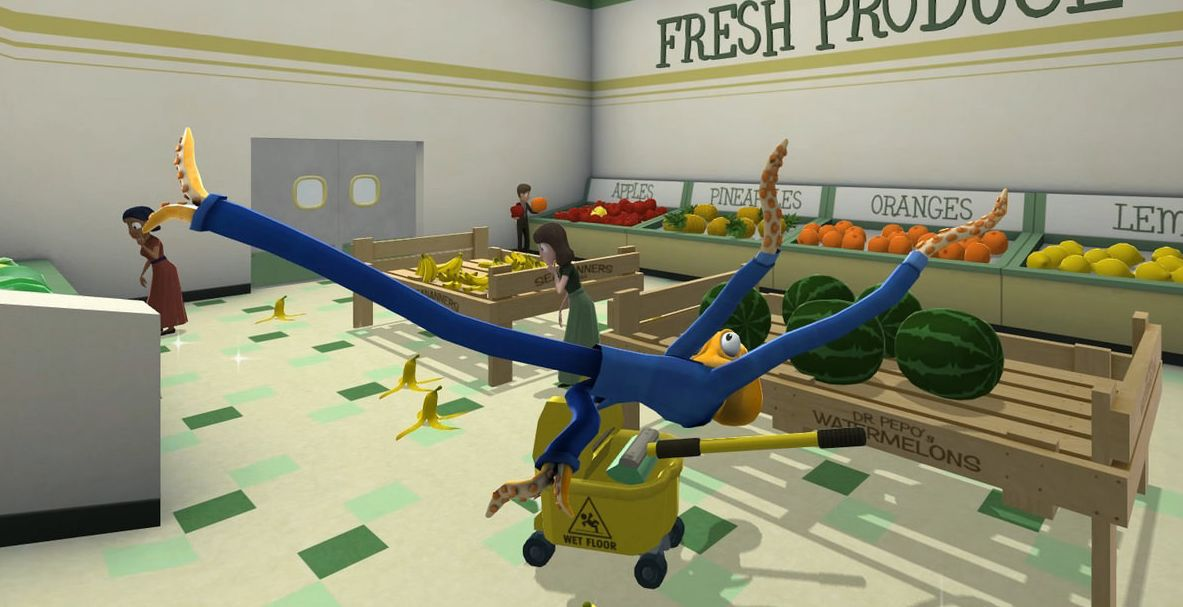
Octodad tripping in the grocery store, courtesy of SUPERJUMP

     The nondiegetic function of the meter also presents an intriguing social critique in itself. Though Octodad’s wife and children never grow suspicious of him, the Suspicion Meter remains visible even when he is at home alone with them. A dotted line always connects their line of sight to his body, demonstrating how Octodad tracks their shifting eyes. He anxiously awaits the day his ruse will be up, his identity exposed, even among those who love him most. This implies an internalized panoptical gaze; even when prying eyes are not watching, Octodad still acts in accordance with society’s rules. An “interior psychic space” has been “inscribed on the body” by society’s gendered expectations (Butler 135). Octodad cannot escape the gaze because it lives within him.

     Perhaps most interestingly, the game invites the player to recognize the ridiculousness of their own gender performance through the use of unwieldy controls. “The game celebrates a kind of queer, distinctly non-normative movement” through both the actions “seen on-screen” and “in the physical inputs of the player” (Ruberg 93). One does not master the controls of Octodad. Rather, one barely scrapes by, moving from level to level with extreme difficulty. The game has spawned countless rage compilation videos on YouTube and other social media platforms. Still, the game’s difficulty can and should be read as more than rage bait. Octodad’s “embodied controls” do not simply “represent difference” (85). Instead, they allow “players to inhabit that difference” (85). The game refuses to adopt any traditional control schema. Each of Octodad’s limbs must be moved individually by a different button, rendering even “a supposedly simple act like walking” absurd (91). The odd movements of Octodad’s legs mirror the unusual motions of the player’s thumbs. As Octodad struggles, so does the player, forcing them to reassess the control inputs they previously deemed “natural” or “intuitive.” Implicitly, then, the game calls the player’s own body into question. Is their own gender performance seamless, or does it involve just as much stumbling as Octodad’s? Are the actions they perform natural, or have they been learned like the buttons on a controller? What makes them all that different from an octopus desperately trying to convince everyone around him that he is a real, genuine man? Through controls alone, the game suggests that the player may have more in common with Octodad than they initially supposed.

     Octodad: Dadliest Catch presents a humorous yet harrowing portrayal of gender performance. Through nondiegetic functions like game failure and the Suspicion Meter, the game demonstrates how gender is constructed through repetition and internalization. Meanwhile, the difficult controls call attention to the player’s own shoddy gender performance. Despite its levity, the game also makes room for genuine empathy. Octodad struggles to fit into impossible boxes like countless queer humans before him. One does not need to dive into the sea to spot a fish out of water; one needs only step out the front door. 
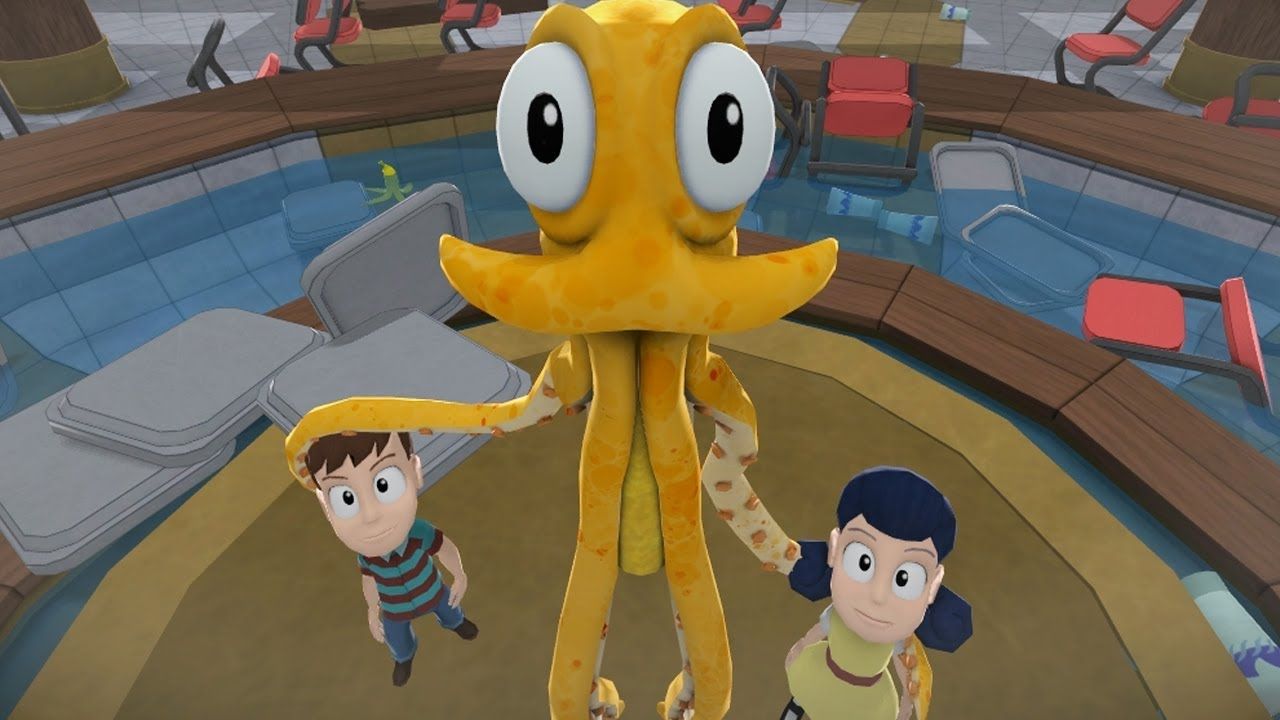
Octodad after revealing his true identity to his family, courtesy of CBR. The family continues living as a nuclear unit, even after all has been revealed.

Works Cited

Butler, Judith. Gender Trouble: Feminism and the Subversion of Identity. Routledge, 2007. EBSCOhost, research.ebsco.com/linkprocessor/plink?id=d47e680a-1ff8-3819-96b2-0b70dd97b01c. Accessed 17 Apr. 2025.

Octodad: Dadliest Catch. Directed by Kevin Zuhn, Young Horses, 2014. Sony PlayStation 4 game.

Ruberg, Bo. Video Games Have Always Been Queer. New York University Press, 2019, doi.org/10.18574/nyu/9781479893904.001.0001. Accessed 17 Apr. 2025.

You name this photograph

Your name is the only thing you have for your entire life. Your name is always with you, a part of you, and yet your name is invisible. A ghost limb, guiding you through the world as do your feet. But your heels can develop blisters, your toes can grow warts, your toenails can cut your skin if you let them get really long. What pain does the name inflict upon the soul, if it inflicts no pain upon the body?

Do our names decide our fates? Are our names the titles of our photographs, presenting themselves before the fragments of our person? Geryon doesn’t express himself through spoken language, yet language precedes, and helps him conceive, his photographs. In chapter 38 of Autobiography of Red, Geryon has a dream in the backseat of the rental car on the way to Huaraz. He dreams that “creatures that looked/like young dinosaurs (yet they were strangely lovely) went crashing/through underbrush and tore/their hides which fell behind them in long red strips. He would call/the photograph ‘Human Valentines.’” (Carson, 131). 

Geryon’s dream, his artistic vision, is nameless. Nor do the creatures he dreams about have names; they are “like young dinosaurs” (Carson, 131), but calling them dinosaurs would be wrong. They are living without language. Escaping language. The “long red strips” of “their hides” represent the traces of those who cannot speak in the “Human” world (Carson, 131). We see these animals, these quasi-humans, these humans with red wings, but we do not hear them. We see them, but we do not See or Understand them. 

“Human Valentines”: Their love for us expressed in our language, but expressing their vision. The name of the photograph precedes the photograph itself (maybe the photograph will never even be taken), but the name follows the essence of something, someone, that defies what I can write about, that defies what Geryon can say. 

Maybe we grow into our names, or grow with them. Maybe our art, our lives, are nameless. Maybe this is why people change their names. Maybe some people will never feel satisfied with language. Sometimes I fear I am one of those people.

How I Accidentally Made A Dance About Queer Time: Queer Time and Eating Disorders

As of writing this, in eight days my dance titled “My Friend Ana” will debut on Mathers stage for DTG’s Freshworks. My Friend Ana is a semi-autobiographical piece based on my experiences dealing with anorexia until entering treatment at age seventeen. This idea has been in my mind for over a year, and as these ideas were forming, I had never heard the term “Queer Time.” It wasn’t until this class I learned the term, but I’ve been experiencing queer time without knowing the name for years.

In class queer time was mentioned in the context of physical disability, which made me start to wonder if the same applies to mental illness. The more I thought the more I realized it does. For this blog post, I will be focusing specifically on eating disorders and mental illness is a very broad topic, and specifically anorexia nervosa, as that is what I have lived experience with.

One thing my mom always said to me was that I never had a childhood. I wrote a poem once about the last Halloween I went trick-or-treating and only pretending to take candy out of our neighbors bowls. I watched my mom start to cry and she said something about wishing I could just be a kid. This is one way anorexia caused me to experience queer time, by stealing my ability to have a true childhood. The theme of stolen childhood is that’s very present in my piece.

The second way I think My Friend Ana explores queer time is through the concept of ED treatment. I cite the beginning of my recovery to be when I left a partial hospitalization program in order to go back to high school. I think being in PHP was my greatest experience with queer time. My life was quite literally put on hold. The whole world moved on while I was stuck in a treatment center for eight hours a day, trying to get better. I think any type of rehab program is one of the only times where life is put on pause. It was the summer before my senior year of high school. I could barely work and wasn’t making money, all my friends were touring colleges, and my cheerleading teammates had pre-season. When I got home each day I was so exhausted and sick that I didn’t want to do anything else. I couldn’t be a functioning member of society, because my only job was to recover. I think this fits perfectly with the part of queer time that talks about not being a participating member of society.

Finally, the physical symptoms of EDs also contribute to queer time. As previously mentioned, when I was going through treatment, I was constantly sick. I was also constantly sick during the depths of my ED. I wasn’t very good or productive in school, partially because of my eating disorder. I slept more than anyone else I knew because my body was so exhausted. And I struggled maintaining a lot of relationships because I was practically sleepwalking for four years. Anorexia took away my ability to not exist within queer time, I was physically incapable of leading a “normal” life. Another crucial element of queer time is that of the nuclear family. One of the most common arguments I’ve heard about why queer couples shouldn’t get married is because they can’t reproduce. Typically the counter argument for this is that their are straight couples who also can’t reproduce. This applies because in its most severe cases anorexia can lead to infertility.

After a lot of thinking I believe most(if not all) eating disordered people experience some version of queer time. Both the disorder and the recovery from the disorder cause the afflicted person to lose a sense of “normal” time in some way. When I set out to choreograph My Friend Ana, I did not have this theme in mind. I think that’s because it came so naturally to the piece. Queer time was my version of normal for so long. There is a reason queer and trans people are more likely to have EDs than our straight and cis peers. Queer and trans people have been told for years that something about is wrong. Everyone develops EDs for different reasons, but this is a contributing factor for many queer eating disordered people. So it makes a lot of sense to me that this is one way someone can experience queer time.

Come see my piece!

https://www.onthestage.tickets/show/dickinson-college-theatre-and-dance-department/679a562de042530f58d15b9c/tickets#/productions-view


Queer here, now, then, there

“What is time made of?” 

“Time isn’t made of anything. It is an abstraction. Just a meaning that we impose upon motion.” 

Autobiography of Red warps time in a different manner than our other texts have. With Cereus Blooms at Night and Written on the Body, and even LOCA, time has moved non-chronologically, shifting between past and present fluidly (in its prose), but sometimes abruptly in execution. Here, however, time moves from past to present, Geryon and Herakles age, and life continues on. From the wired telephone to the television, society has advanced as well. Despite the linear progression of the story, however, something about the dynamic of time is still off. These characters are not originally of the time in which this narrative is set. They are figures from the past that have been thrust into the future, remolded to fit in that world, but still inherently their original selves. In retelling this myth, Carson has suggested that these characters can –and do– exist independently from time, and can live at any time –just as queer people have and do

In this way, Carson has queered time by weaving the past and present together (merging ancient myth with present time), and has also rendered time irrelevant (also queering time, but differently). The second example of queer time –in which time means nothing– is not only evident in the narrative composition, but also thematically within the story. Geryon is not only fixated on what time is and why, but his main hobby –photography– is disrupting time by pausing and preserving it. With his photos, the “then” becomes permanent through the photograph. That moment is then able to occupy a type of existence in continuity for the rest of time, not just when the moment originally happened, just as Herakles and Geryon occupy a time period in this narrative long past when their original myth takes place.

“Inside Things” or “Outside Things”? The Ambiguous Space of Dialogue in Autobiography of Red

I find the way that dialogue works in Autobiography of Red by Anne Carson compelling and confusing at the same time, reflective of what Carson wants the reader to question or think about. The choice of how to represent dialogue and distinguish which characters are speaking is a very deliberate one, it has to be,  because the novel is in verse. And, because the narration of the novel is ambiguous and nuanced. An example of this use of dialogue in verse that stuck with me is a scene of one-sided conversation between Geryon (who doesn’t speak) and his mother:

Nobody sees him around, is it true he lives in a trailer park– that where you / go at night? / Geryon moved the focal ring from 3 to 3.5 meters. / Maybe I’ll just keep talking / and if I say anything intelligent you can take a picture of it. She inhaled. / I don’t trust people who / move around only at night. Exhaled. Yet I trust you. I lie in bed at night thinking, / Why didn’t I / teach the kid something useful. Well–she took a last pull on the cigarette– / you probably know / more about sex than I do — and turned to stub it in the sink as he clicked the shutter” (40).

Carson establishes the dialogue system early on in the novel — what is said out loud is in italics, and you can pretty much contextually estimate or guess who exactly is speaking, at least most of the time. However, in this section, dialogue gets a bit lost in the room. There are two people present: Geryon and his mother. But Geryon doesn’t speak or reply, he’s just there, listening. And so, as the mother continues her reverie, there is an increasing feeling of Geryon’s vocal absence, and his immersion in his camera. Perhaps that is why her speech gets jumbled. The line “Why didn’t I / teach the kid something useful” (40), is unexpectedly not italicized. It’s immediately noticeable because at that point, the italics have become recognizable as speech versus inner thought. So, Carson is having us question: where did those words come from?

There is a possibility, I think, that in that moment the space, mental or physical, between Geryon and his mother is blurred. Perhaps, since we as the readers receive the story from Geryon’s perspective, that is something that Geryon himself projects upon his mother. Or, more simply, that sentence is not said out loud, but something that the mother says inside her own head. A moment where lines are blurred, conventions or systems of thought or verse strayed away from. Is this a moment of queer space, perhaps?

What even this small moment, even a small difference in form like italics, plays with is the complexity of Geryon’s “inside” and “outside,” that is established early on. When are we inside Geryon’s head and which moments are outside?


Seeing Red (or not…)

I love the use of color in this book. Often, Carson does not use colors beyond what we think of in the rainbow today (minus indigo) as well as white, black, and I believe pink. But, importantly, she does not use shades of these colors to describe specific variants. I like that because there is such a large emphasis on color, especially red. There are those who can see red and those who cannot (not literally, of course). But I do believe it is important to note that Herakles does not often say red, if at all. Which is ironic considering Geryon loves him. A few pages before Ancash sees Geryon’s wings, we get this point where Herakles – and I swear he jumps out of nowhere in each scene – interrupts a conversation and talks about the parrots in the house. He says, “Yes she has a room full of parrots at the front of the house. / Must be fifty birds in there. / Purple green orange blue yellow it’s like an explosion” (Carson 123). He literally lists every single color except for red. In my opinion, this signals his inability to change. This sentence would be less odd if 1) he did not mention 5/6 colors of the rainbow and 2) he did not mention parrots. Personally, when I think of parrots, I think of those red ones with blue and yellow feathers often seen with pirates. There are many different species of parrots, but it is clear that the lack of red in Herakles’s words was intentional. Although, he was not talking about Geryon, it becomes evident that Herakles doesn’t know what red means in the metaphorical sense, which is thus portrayed by his lack of physically acknowledging its existence. Back when they were kids, in his dream, Herakles thought of Geryon as yellow. This dissonance between who Geryon actually is and what Herakles sees is evident through these colorful words. Ironically, Herakles is bad at “reading” people. It seems he either does not care or is willfully ignorant about the feelings of others. He never seems to connect with anyone. On the other hand, the conversations between Ancash – who actually says and sees red – and Geryon are more emotional and trusting than the conversations including Herakles. In fact, Herakles often interrupts the conversations between Geryon and Ancash. Interestingly, Geryon says “In the photograph the face of / Herakles is white,” noticing the line break emphasizes “Herakles is white” (144). Other things described as white in Autobiography of Red include Lima and specific days while Geryon is there. There is this gloomy, almost upsetting, use of white as a verb. White is like the absence of color. The absence of red. An inability to see. In the end, it all demonstrates Herakles’s lack of change and inability to actually see people.

Neurodiverse Recognition in Autobiography of Red

Psychology is an important topic in Autobiography of Red, even when it is not explicit nor centralized. Geryon grows up feeling different, illustrated by the dread of leaving home, vague injustice at school, and his red wings (Carson 36). He prefers imagery to words. In Geryon’s world, colors have influential connotations and his senses intermingle. Others perceive his emotions as morose or overly complex (looking at you, Herakles). As a child, he is derogatorily called stupid, only to later find his calling in philosophical thought. 

Something charming about Autobiography is the universality of Geryon’s story. He is embarrassed by desire and has an occasionally dry sense of humor; he struggles to belong but ultimately succeeds. Carson humanizes the monster of Greek mythology, and in doing so makes Geryon’s perspective resonate with neurodiverse individuals. It is done with that tinge of universality—Geryon can be read as expressing dyslexia, synesthesia, anxiety, or autism, to put labels on some topics a psychiatrist might tell him about in 2025. There are myriad interpretations and truths to Geryon’s mental landscape, and no interpretation is incorrect. Personally, I would like to posit that he is displaying obsessive-compulsive disorder.  

From the beginning of Autobiography, onwards, so much of Geryon’s behavior is familiar to me. His behavior aligns with some commonly understood OCD symptoms, such as his brain getting “jammed then restarted” when faced with odd numbers (Carson 91) and feeling the need to clean up after others (Carson 102). On a street in Buenos Aires, Geryon reads all the headlines of a newspaper—which could be curiosity in a foreign place or attention to detail, but we are reading it through an OCD lens (Carson 106). In the scene at the tango bar, Carson explicitly states, “Geryon had a bad thought” (101). From my point of view, ‘bad thoughts’ are evocative of intrusive thoughts, which typically feed obsessions and necessitate compulsions. A strong point of evidence is Geryon’s two instances of picking a scab, then his lip. He tries to hide his hands, but his mother notices and says, “Don’t pick at that […] leave it alone and let it heal” (Carson 30). Soon after, they are spending time together and she says, “Don’t pick your lip Geryon let it heal,” implying that this is a pattern (Carson 34). I cannot tell you how many times my mother has fondly batted my fingers away from my lips, so this instantly stood out to me. After all, skin-picking disorder is often classified as a subset of OCD. 

Then, the less commonly understood OCD symptoms Geryon displays. His loyalty to both justice and facts could be interpreted as a site of morality-based OCD. He has a rich inner world, which he prefers and cultivates compared to the outer world. His line “you can’t be alive and think about nothing” portrays his worldview as someone prone to overthinking (Carson 103).  

I would like to put this story in conversation with OCD experiences, but my chief conclusion is that Autobiography makes space for marginalized people through Geryon’s experiences with ostracization. He feels abnormal not only because of his wings but because of the way he is on the inside, too, and that is highly relatable. In the same way certain pages of the dictionary may be wrinkled and smudged, speaking to years of individuals with questions about their identities, Autobiography is a wrinkled and smudged book where I have searched for and found myself.  

Works Cited 

Carson, Anne. Autobiography of Red: A Novel in Verse. Vintage Contemporaries, 1999.  

Fama, Jeanne M. “What Is Skin Picking Disorder?” International OCD Foundation, International OCD Foundation, 29 Nov. 2022, https://iocdf.org/about-ocd/related-disorders/skin-picking-disorder/. 

“Obsessive-Compulsive Disorder: When Unwanted Thoughts or Repetitive Behaviors Take Over.” National Institute of Mental Health, U.S. Department of Health and Human Services, 2023, www.nimh.nih.gov/health/publications/obsessive-compulsive-disorder-when-unwanted-thoughts-or-repetitive-behaviors-take-over. 

Mala and the Reclamation of the Self

“By writing I put order in the world, give it a handle so I can grasp it… I write to record what others erase when I speak, to rewrite the stories others have miswritten about me, about you… To discover myself, to preserve myself, to make myself, to achieve self-autonomy.”
—Gloria Anzaldúa, Speaking in Tongues: A Letter to 3rd World Women Writers

It is undeniable that Mala endures deeply horrible experiences throughout her life. Like many of my classmates, I wept while listening to her story. Throughout her childhood she is denied personal agency, and her entire life, she fights to reclaim who she is. However, through her coping mechanisms, which are often misinterpreted or dismissed by outsiders of Paradise, we witness her gradual reconstruction of the self in the face of ongoing trauma and chaos. 

 Immediately after reading Cereus Blooms at night, I had a hard time soaking in the general message of the book and the relationship Paradise has with queer individuals because of the intensity of Mala’s story. But reading Gloria Anzaldúa’s Speaking in Tongues: A Letter to 3rd World Women Writers helped me see Mala’s small, everyday acts not as strange behaviors, but as intentional, protective resistance for herself. Now, it is clear that maybe the whole point was the recognition that small acts of defiance and coping mechanisms make this ultimate change for ourselves and others. Anzaldúa frames writing as a vital tool of resistance for herself. One that allows her to define herself on her own terms, rather than be shaped by the limited narratives imposed on Chicana and women of color. Although Mala is a fictional character, she is an example of the intended audience Anzaldúa writes to: women of color, 3rd world women, and all those who survive by carving out space for their truth. Mala and Popoh, as a dark-skinned girl navigating an abusive household, embodies that struggle. Through her fight to survive, she asserts fragments of autonomy and selfhood, even when the Paradise community refuses to recognize them. 

At face value it was easy for me to dismiss the coping mechanisms of Mala when they are first introduced, for example, the way she builds a wall of her furniture each night. At first I was confused by what the reason was but I didn’t necessarily try to understand immediately. Yet we are thrown back into her past when in fighting for her reclamation against her father she did this to protect herself. In sake of fear and self preservation she is working hard to protect that little girl inside of her. Just like when she makes a necklace out of snail shells, there’s always a part of her that’s holding on to what Aunt Lavinia told her about protecting snails. “Protect a living snail and when it dies, it doesn’t forget. Snails, like most things in nature, have long memories.” In a way, Popoh does this not just for the sake of nature, but also with the hope that it will bring her good fortune. By valuing the life of something as small as a snail, she’s holding on to the belief that these small acts might help change her life for the better.

In class, we debated whether Cereus Blooms at Night ends happily. For me, it does. I felt an immense sense of relief for Mala. She is no longer alone out of necessity. She is no longer feared, but loved by Ambrose, Otoh, and Tyler, who braids her hair. She is now surrounded by safety with those who love her. Though the relationship between Mala and her sister is not explicitly resolved, there is resolution in Mala’s newfound peace. She is no longer fighting for survival. She is at home with people who love her. And while I haven’t previously touched on Tyler and Otoh’s bond, it felt comforting to witness the possibility of a new beginning of a queer love and community, now rooted in safety and care. That, too, felt like a kind of reclamation.

queering summer camp!

The Robbers Cave psychological experiment, taking place in 1954 under the supervision of psychologist Muzafer Sherif, aimed to understand the relationships between two groups of participants when separated and then brought together. These participants were twenty-four “normal” eleven-year-old boys from Arizona, bussed to Robbers Cave National Park and permitted to befriend one another. In an effort to standardize his experiment and control any outstanding factors, Sherif specifically recruited boys who were White, middle-class, sociable, and Protestant, among other descriptors.

When I committed to writing a play for the Mermaid Players’ First-Year Play Festival, I had a general idea of how I wanted to approach the Robbers Cave experiment. Influenced by works such as Clare Barron’s Dance Nation, I knew I wanted to work creatively beyond the confines of Sherif’s narrow population. The experiment, whose outcomes are often compared to William Golding’s Lord of the Flies, has been widely applied within the field of social psychology, although these results represent a rather minute section of the larger population. Everland, then, functions to take this isolated experiment and apply it to a more diverse, contemporary group of performers and audience members.

Everland is set at an unnamed summer camp and features four campers: Mason, Craig, Cutler, and River. These boys are supervised by the unnamed Counselor, a force written to represent the broader influence of society on the impressionable next generation: in other words, the normal. At odds most directly with normalcy is River, a boy whose embrace of his emotions and desire to prioritize friendship earn him scrutiny. The Counselor, in response to River’s frustration at his treatment, only tells him that “summer camp is for brave boys” and that “if [he wants] the other campers to treat [him] well, [he has] to play their game,” (Booth 3).

On a surface level, this shallow acknowledgment of toxic masculinity does not do much for the audience. However, this play was finished following casting decisions, and the actor portraying River—my dear friend Forrest—very much felt that his gender identity greatly influenced how he approached the role. Thus, I began to explore River’s potential as a force that queers the narrative of Everland. Within the confines of an experiment designed to function within the “normal,” what does it mean for queerness to embed itself into the narrative? How do characters rebel against the normalcy forced upon them?

With this information, River moves away from being a sacrificial lamb and becomes a more significant narrative force. Through Mason, Craig, and Cutler’s interactions with him, they are made to question their own understandings of just how fulfilling “normal” really is. Cutler questions River’s motives in writing home, but softens his harsher attitude, ultimately concluding that he “[doesn’t] wanna see them be mean to [him]” (2). Mason, shortly after critiquing River’s performance as a catcher, confesses in his nightly prayer that he “[doesn’t] know if [they] can win without [River]” and asks for forgiveness (4). Ultimately, these characters become more three-dimensional as a direct result of River’s queerness. His refusal to conform enriches the narrative, directly expressing the consequence of the Counselor’s “normalcy.”

“We ain’t getting no younger, we might as well do it” – Jagged Edge

https://youtu.be/A9jZOoMaK5U?si=Mi6opSa55IMCRoV5

For this week’s blog post, I want to connect the YouTube video “Why I’m Not Married” by Gloom (Kassie) with Eve Sedgwick’s essay Christmas Effects from Queer and Now. In the video, Kassie addresses a recurring question she gets from friends, family, and followers: “Why aren’t you married, even though you got engaged five years ago?” The video opens with Kassie describing herself as someone with a “very defiant personality.” Since childhood, she explains, she needed to understand exactly why she had to do something and if she didn’t get a clear or compelling reason, her answer was simply no (2025). She follows this statement with an anecdote from elementary school. During a birthday celebration, her teacher asked each student to wish a classmate happy birthday. When it was Kassie’s turn, she refused. Even after being told to say it, she refused, which eventually led to the teacher calling Kassie’s parents to report her behavior. This anecdote might seem trivial, or like Kassie was just being a jerk, but it actually echoes the ideas Sedgwick covers in Christmas Effects. Sedgwick writes that certain times of year like Christmas can feel depressing because “all the institutions are speaking with one voice” (1993). Everything around us during that time of year seems to expect the same emotional response or behavior, and any resistance can feel isolating. Sedgwick uses Christmas as a metaphor, but the effect extends to other social institutions as well such as marriage. Similar to Christmas, marriage often carries expectations of conformity. It’s not just a romantic or legal union but a combination of a “normal” family unit: a shared surname, an economic unit, a legal unit, a system of companionship and a mechanism to care for children (1993). Kassie’s resistance to marriage, then, feels like a continuation of the same impulse that made her resist saying “Happy Birthday” as a child. It’s not that she opposes celebration, it’s the feeling of being pressured to participate in something simply because it’s expected. Kassie ends the video by revealing that her relationship feels good in its current form. The societal pressure to marry makes her question whether she ever truly wanted it in the first place. Similar to Sedgwick’s analysis of Christmas, Kassie’s story is a reflection on how societal expectations can blur the line between genuine desire and social obligation. Her answer to “Why aren’t you married?” is ultimately simple: she’s still figuring out if it’s something she wants, not just committing to something she’s supposed to do. She’s in no rush to throw a party where she’s the “last to arrive and the first to leave” even though the wedding is designed to be for her (2025).