
Intro:
Although I had a strong idea as to what my final essay was going to be about, my research process was anything but simple. I chose to focus on the poems, “Bury Me in a Free Land,” “Because I could not stop for Death,” and “Shiloh: A Requiem” to highlight themes of death and division in poetry written before, during, and after the Civil War. I knew that the task of finding primary resources would not be easy, but I had no idea the effort that I would have to put in to uncover even a few letters by the poets I am writing about. From this endeavor, I learned that in order to discover quality sources, one must be open to new research methods, exercise patience, and be careful not to get discouraged along the way. I know that I will remember these important lessons throughout my college career.
“Bury Me in a Free Land”:
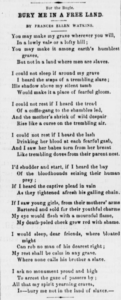
In my search for primary sources concerning Frances Ellen Watkins Harper’s “Bury Me in a Free Land,” I encountered many barriers. One of the largest challenges that was posed to me was finding a source in which Harper spoke or wrote about the poem. In fact, I was entirely luckless in securing one such resource. Slightly disappointed (after an hour of fruitless searching), I decided to change my method. I was confident that I could argue her intent in writing “Bury Me in a Free Land” even without a primary source describing the topic, but I knew I would need to prove her commitment to the abolitionist cause using resources other than the poem. For this, I searched first on JSTOR, then on Google Scholar, and finally on the MLA Library website. None of these websites yielded the results that I wanted (at least not for free). I was beginning to give up hope as I typed, “Frances Ellen Watkins Harper primary sources” in the Google search bar. It was my final resort after my searches across the more refined databases for “Frances Ellen Watkins Harper letters”, “Frances Ellen Watkins Harper diaries”, and “Frances Ellen Watkins Harper newspaper articles” had failed. To my surprise, I found a webpage that had compiled a list of sources concerning Harper, one of which was from the Library of Congress, a verifiable source. It was a book written by William Still which contained a large amount of Harper’s letters, many detailing her incredible dedication to the abolition movement. From this unlikely success, I knew that I would have to keep my mind open to possibilities different than the ones I had originally imagined as I continued my research.
“Because I could not stop for Death”:
On the topic of letters, I struck gold when I found a book of Emily Dickinson’s letters on the Waidner-Sphar Library website. As I planned to write on Dickinson’s personal connections with death and how it influenced her poems to support the claims I plan to make in my final essay (most of which are still in the works), I knew that I would have to use own words. In his book, The Heart of American Poetry, Edward Hirsh mentioned a letter that Dickinson wrote indicating a fear of death, so I was certain that the papers I required had to be recorded somewhere. [1] However, on almost every database I searched, I could only find her letters to her dear friend, Susan Gilbert. Though their relationship seemed interesting and worth researching, I had to move on. Finally, on the MLA Library website, I found the link to a review of a book of Dickinson’s letters. It wasn’t much, but it was a start. Using the book’s title, which was available in the review, I searched for and found it on the Waidner-Sphar Library website. After searching for references to death in the e-book’s search bar and finding the most helpful to my research to be in the third chapter, I downloaded it. I have no doubt that it will be instrumental in the writing of my final essay; I am glad that I exercised patience in finding it.
Fortunately, my next source did not require much patience. I wanted to find some of Dickinson’s writings about the Civil War and was hoping for letters. After searching through a book of Dickinson’s letters, I found none that specifically mentioned the Civil War. This surprised me, but I moved on. I looked for poems that she had written during the Civil War era on JSTOR and found several, including some with clear references to the war. This source will be extremely helpful in my final essay as it will aid me in determining Dickinson’s thoughts on the Civil War. The same can be said for another source that I found that exhibits Dickinson’s collected works. Her entire list of published works is compiled here, including poems that mention death and war. I obtained this source by looking on Google Scholar and then the Waidner-Sphar Library website (after I found Google Scholar’s edition to be behind a paywall). Both of these sources will be vital in forming my thesis.
“Shiloh: A Requiem”
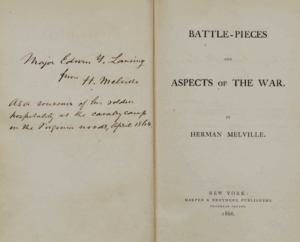
As I was looking for primary sources for Herman Melville, I stumbled upon two recently discovered letters of his. I was excited at the notion of being able to use these letters in my essay, however, after reading them, I realized that they had nothing to do with my essay topic. Disheartened, I kept searching. Half an hour later, I came across one of Melville’s poetry books on the Waidner-Sphar Library website. The online access link on the library page took me to the American History Archives, where a copy of the book resides. In the book, I found a few poems in mind that I can use to support my thesis. This finding serves as a lesson to not be discouraged during the research process, even if a source turns out to be unusable – there will likely be an even more suitable source just waiting to be discovered.
Although I will not be able to implement Melville’s newly uncovered letters in my essay, I did encounter a compilation of his letters that I will certainly make use of. To find these letters, I searched first on JSTOR, then the MLA Library, and finally the Waidner-Sphar Library website. When none of these databases yielded satisfactory results, I turned to Google Scholar. There, I found a collection of Melville’s letters and poems, with several of these poems relating to the Civil War. This source will be incredibly helpful in my process of developing a thesis for my final essay as I will be able to gain a wider understanding of Melville’s perspective on the aftermath of the Civil War. It was very fortunate that I thought to use Google Scholar to search for this resource, as I do not think my paper would be as strong as I hope it will be without these letters and poems.
Conclusion:
After hours of hard work, I finally completed my preliminary research for my final essay. I am thankful that I was able to use various research methods, exhibit patience, and defeat discouragement in my search for primary sources. This may be the most thoroughly researched paper that I have ever written, and I am proud of the progress I’ve made in developing new research skills. I hope that I will be able to carry them over into future classes so that I may better my writing from a historical perspective.
[1] Hirsch, Edward: The Heart of American Poetry, New York: Library of America, 2022. [PRINT]
Bibliography:
Dickinson, E., Miller, C., & Mitchell, D. The Letters of Emily Dickinson (1st ed.). Harvard University Press, 2024 [WAIDNER-SPHAR LIBRARY WEBSITE]
Dickinson, Emily. The Collected Poems of Emily Dickinson. First Avenue Editions ™, 2016. [WAIDNER-SPHAR LIBRARY WEBSITE]
Gifford, Don. “EMILY DICKINSON AND THE CIVIL WAR.” Hungarian Journal of English and American Studies (HJEAS) 8, no. 2 (2002): 13–24. [JSTOR]
Still, William. “The Underground Railroad.” Philadelphia: People’s Publishing Co., 1879 [LIBRARY OF CONGRESS]
Melville, Herman. Battle Pieces and Aspects of the War. New York: Harper & Brothers Publishers, 1866 [HISTORIC ARCHIVES]
Minnigerode, Meade. Some Personal Letters of Herman Melville and A Bibliography. New York: The Brick Row Book Shop, Inc., 1922 [GOOGLE BOOKS]
Be the first to reply