
Intro
The first Native American poet laureate Joy Harjo serves as a pillar to the preservation of indigenous history through her naturalistic and spiritualistic writing style. As a member of the Muscogee Nation Harjo is able to hone her craft to the recognition of Native history which is often overlooked or misrepresented. Harjo’s Poem, “Rabbit Is Up to Tricks” [1] was written in 2004. In the poem she uses the spiritual and folkloric character of the trickster Rabbit to tell a story of colonization and assimilation. The word “survival” is mentioned throughout various reviews of her work from both the National Poetry Foundation [2] and the Indian Quarterly Review [3]. This is because her poems follow the belief that the only way to truly allow a culture to survive genocide and adversity, is by perpetuating the culture and spirituality of a peoples. Joy Harjo uses Native American folklore, songs, and language to contrast her grief ridden recounting of the genocide and survival of Native Americans.
Text
The poem “Rabbit Is Up to Tricks” by Joy Harjo is made up of 37 parable-like lines that tell the narrative of the creation of a “clay man” by the character Rabbit. The Native Languages Organization [4] describes the Rabbit to be a commonly mischievous character in native folklore. Stories like “How Rabbit Brought Fire to People” [5] involve Rabbit mischievously stealing fire from weasels to warm the

rest of the world. Harjo uses the knowledge that Rabbit is a character often associated with children’s tales to invite readers into her poem. The poem begins with the line, “In a world long before this one, there was enough for everyone,” Harjo evokes Edin adjacent imagery of an idyllic time before ours, this portrait of perfection is then torn down by what follows, “until somebody got out of line.” Harjo sets the tone immediately with this rapid shift. The second line feels like a bad premonition for what is to come. The following sequence of events are described as Frankensteinian by Edward Hirsch [6] Rabbit creates a clay man. Lines 10-15 follow a parallel sequence where Rabbit shows the clay man how to steal and the man obeys. Harjo uses parallelism to compare how both the man and the Rabbit feel power in a way that Edward Hirsch describes as “Bureaucratic.” [7] The repetition of the sections “He wanted all…” in lines 19-21 build a palpable physicality to the later described “insatiable” nature of the clay man. The collecting of these repeated phrases mimic the greed of the clay man to want more. The final lines from 29-37 describe the assimilation of the stories, songs and languages of Native Americans. Rabbit no longer has a home and has only made things worse. He tries to reason with the clay man but only realizes, leading to the devastating button of the poem, “He’d made a clay man with no ears.” The narrative format of the poem, combined with its parallelism and repetition, all work together to tell the story of how greed and want killed and betrayed an entire culture and its people, while also including culturally significant characters to keep the story embedded in Native American folklore.
Context
We get a primary example of the colonial exploitation described in the poem in 15th century New England. According to the NIH NLM Native Peoples Concepts of Health and Illness [8] The explorer John Cabot, amongst other English fishermen, worked together to drain the resource of cod from the regions where the Passamaquoddy, Abenaki, Mi’kmaq, Penobscot, and Maliseet tribes were already living. Not only were these tribes blatantly drained of their most lucrative resource, but they also were being affected by the European deceased that was incredibly fast spreading and deadly. This depletion of stolen vital resources is elaborated upon within Joy Harjo’s spoken and sung version of the poem in her album Winding Through the Milky Way [9]. In the recorded version there are additional lines in between 31-32, 32-33, and 34-35 which emphasize the destruction that the greed of the clay man caused to the environment. In this version the following lines appear in between 29-31 “Forests were being mowed down all over the world. The earth was being destroyed to make more, and the Rabbit had no place to play,” the second line was not included in the printed version but adds a hopeless disparity to the line “and Rabbit had no place to play”. The recorded version emphasizes the environmental effects that displacement and genocide have on the Native land. Native Americans have historically been manipulated and exploited to serve the selfish interests of settlers. Decades later in 1920 the Oklahoma based Osage Nation was exploited and
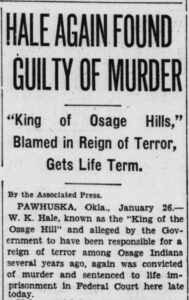
(Library of Congress)
murdered by settlers drawn to the Nations thriving location-based oil resource [10]. National Resources and Environment author Rennard Strickland estimates that 250-300 Osage People were murdered from 1920-1926 [11]. This Period of Osage history is known as the Osage reign of terror [12] and is a devastating example of the corruption and abuse that settlers and corporations – clay men – have inflicted upon Native communities. Like the clay man, business officials and politicians whose motives were led by the same insatiable greed mentioned in the poem, caused the grotesque genocide of hundreds of Osage. Joy Harjo uses her poem to reclaim and grieve all that has been selfishly and unjustfully stolen from Native Americans. Her culturally grounded storytelling style reclaims the history of Native Genocide in a way that simultaneously accomplishes to depict the loss and preservation of Native American Culture.
Subtext
In his book Meaning of Folklore Alan Dundes delves into the idea of “Folklore as a mirror of culture” [13] He talks about how the folklore of a culture “reveals the areas of special concern.” within that culture. He elaborates on the idea that folklore is a way in which historians could view a culture from an insider’s perspective instead of an outsider’s perspective. With this it’s understandable that characters like Rabbit would be utilized as a tool to explain the harrowing truth of the forceful relocation and genocide of Native Americans. One of the key
features about this poem is the fact that it was written with a cohesive narrative. It evokes the form of a children’s story, it includes a commonly used character, Rabbit, from the stories that Native Americans still share to this day. Edward Hirsch explains “The rabbit story no longer mimics a tale that you might tell children for their entertainment. It’s for adults now.” [14] stories are used throughout one’s entire historical education, we’ve heard stories of war, politics, civilization, and conquering. Joy Harjo uses this story to re-teach children about the genocide of Native Americans. These children have perhaps heard stories like the discovery of America the most. She teaches her audience to un-learn the original narrative they’ve been fed for their whole lives. She uses the culturally significant character of rabbit as a connection to Native Survival, while also demoting the fictitious narrative built by the leading inaccurate storytellers of this history.
Conclusion.
Joy Harjo’s poem “Rabbit Is Up to Tricks” uses naturalistic and folkloric imagery and characters to ground her recollection of Native American genocide and assimilation. She uses a story-like structure to mimic the folktales that we are familiar with to contrast the devastating true story behind the poem. She utilizes this form to her advantage by using her poem as a means to completing the task of re-writing the common narrative told to both children and adults alike, about the abuses dealt to Native communities. In the recorded spoken and sung version of her poem she places emphasis on the long lasting environmental and cultural effects that settlers have inflicted upon Native communities. Joy Harjo teaches readers the unforgettable truth of Native American history, while ensuring that the linguistic and literary traditions of Native Americans remain as evidence of survival. There is an emphasis to avoid further genocide of Native customs and cultural traditions.
[1] Joy Harjo, “Rabbit Is Up to Tricks,” 2025, FYS: American History Through Poetry [WEB].
[2] Poetry Foundation, “Joy Harjo,” Poetry Foundation [WEB]
[3] Joy Harjo, and Mary Leen. “An Art of Saying: Joy Harjo’s Poetry and the Survival of Storytelling.” American Indian Quarterly 19, no. 1 (1995): 1–16. [WEB]
[4] Native Languages, “Native American Rabbit Mythology,” Native Languages [WEB]
[5] Glenn Welker, “How Rabbit Brought Fire to The People,” Indigenous Peoples’ Literature, [WEB]
[6] Edward Hirsch, The Heart of American Poetry, (New York: Library of America, 2022), 443
[7] Hirsch, 444
[8] NIH NLM, “AD 1503: Foreigners come for cod; carry disease to New England,” Native Voices, Native Peoples’ Concepts of Health and Illness, [WEB]
[9] Joy Harjo, “Rabbit Is up to Tricks,” YouTube 2015. [WEB]
[10] Jon D. May, “Osage Murders,” Oklahoma Historical Society, [WEB]
[11] Rennard Strickland, “Osage Oil: Mineral Law, Murder, Mayhem, and Manipulation.” Natural Resources & Environment 10, no. 1 (1995): 39–43. [WEB]
[12] Federal Bureau of Investigation, “Osage Murders Case,” Federal Bureau of Investigation, [WEB]
[13] Simon J. Brunner, ed. “Folklore as a Mirror of Culture.” In Meaning of Folklore: The Analytical Essays of Alan Dundes, 53–66. University Press of Colorado, 2007. [WEB]
[14] Hirsch, 444
Be the first to reply