TEXT: Frost, The Gift Outright (1942)
- 16 lines of blank verse in iambic pentameter
- Probably written in the mid 1930s; first recited in public in 1941 (just before Pearl Harbor), and then published in A Witness Tree (1942)
- Recited most famously at John F. Kennedy’s presidential inauguration ceremony on January 20, 1961
CONTEXT: American Exceptionalism
“The 1930s and 1940s were trying times. A global economic crisis gave way to a global war that became the deadliest and most destructive in human history. Perhaps eighty million individuals lost their lives during World War II. The war saw industrialized genocide and nearly threatened the eradication of an entire people. It also unleashed the most fearsome technology ever used in war. And when it ended, the United States found itself alone as the world’s greatest superpower. Armed with the world’s greatest economy, it looked forward to the fruits of a prosperous consumers’ economy. But the war raised as many questions as it would settle and unleashed new social forces at home and abroad that confronted generations of Americans to come.” —American Yawp, Chapter 24
-
- Robert Frost’s full name was Robert Lee Frost; the poet’s father revered the former Confederate general who had died in 1870, four years before Frost’s birth
- Frost’s personal life was full of tragedy during the years just prior to the publication of this poem, including the death of his wife in 1938 and the suicide of his son in 1940
- National hardships also loomed in the background of this presumably celebratory poem, including the Great Depression and World War II
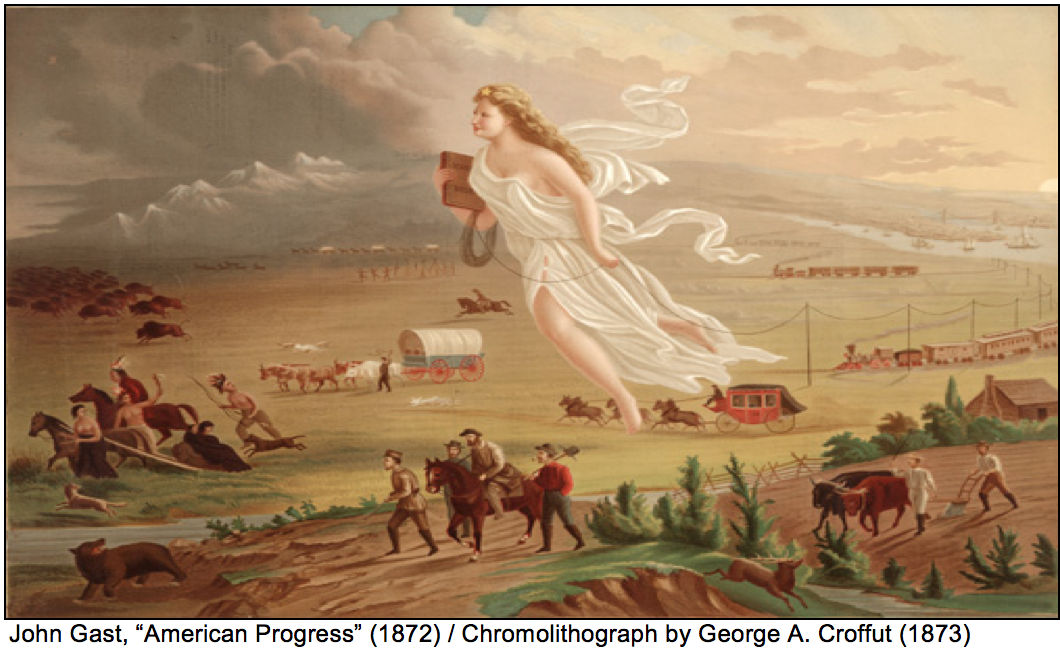
- Some critics believe that in this poem Frost celebrated American independence and national expansion, suggesting that the “gift” of the continent was divinely inspired, what some nineteenth century partisans called “Manifest Destiny” and what modern partisans often label “American exceptionalism”
- Prof. Pinsker on the complicated story behind the slogan Manifest Destiny:
- When John Kennedy asked Frost to read the poem, he requested that he change the last line from “would become” to “will become.” Kennedy’s slogan as the incoming president in 1961 was “New Frontier.” His inaugural address asked Americans to “pay any price, bear any burden, meet any hardship, support any friend, oppose any foe to assure the survival and the success of liberty.”
- Communists, like Joseph Stalin, had derided “American exceptionalism” in the 1920s and 1930s, but they meant something quite different
- Scholars and partisans have been debating the meaning of “American exceptionalism” for decades, especially since the 1980s. President Ronald Reagan famously invoked the idea without using the phrase in his Farewell Address (1989) by recalling John Winthrop’s 1630 sermon to the Puritans arriving in Massachusetts:
- Donald Trump in his second inaugural address on January 20, 2025 also alluded to the concept of American exceptionalism: “America will soon be greater, stronger, and far more exceptional than ever before.” And now many of the cultural battles erupting in Trump’s second term and concerning the presentation of American history in classrooms and museums derive from the longstanding debate over the meaning of American exceptionalism.
SUBTEXT: Debating Frost
“Like Virgil, Frost was ‘versed in country things’ and created his rural poems in troubled times. He had a flair for the dramatic lyric and an ear well tuned to the American vernacular, to what he called ‘sentence sounds.'” –Edward Hirsch, Heart of American Poetry, 151
“Robert Frost is an endlessly surprising poet, a tricky, devastating moralist.”–Hirsch, 157
In “The Gift Outright,” “freedom’s story” doubts happy endings. The conclusion exposes parallel uncertainties about “the land”: “such as she was, such as she would become.” Wary of what has been, the line is necessarily wary of what is to be, because any future will rewrite the past. Both include, therefore, the poem’s racist assumption of a white, European, landowning “we” and its racist ignorance of how the same Europeans worked to eradicate Native American culture and perpetuate slavery. —Siobhan Phillips
METHODS CENTER —Plagiarism
Complete Academic Integrity module no later than 9/15
- Understand the difference between paraphrase and plagiarism
- When you’re not quoting, don’t look at your sources. Use your own words to summarize the point. That’s legitimate paraphrase.
- And then when you are paraphrasing an important idea or unique fact, cite your sources even though you are using your own words.