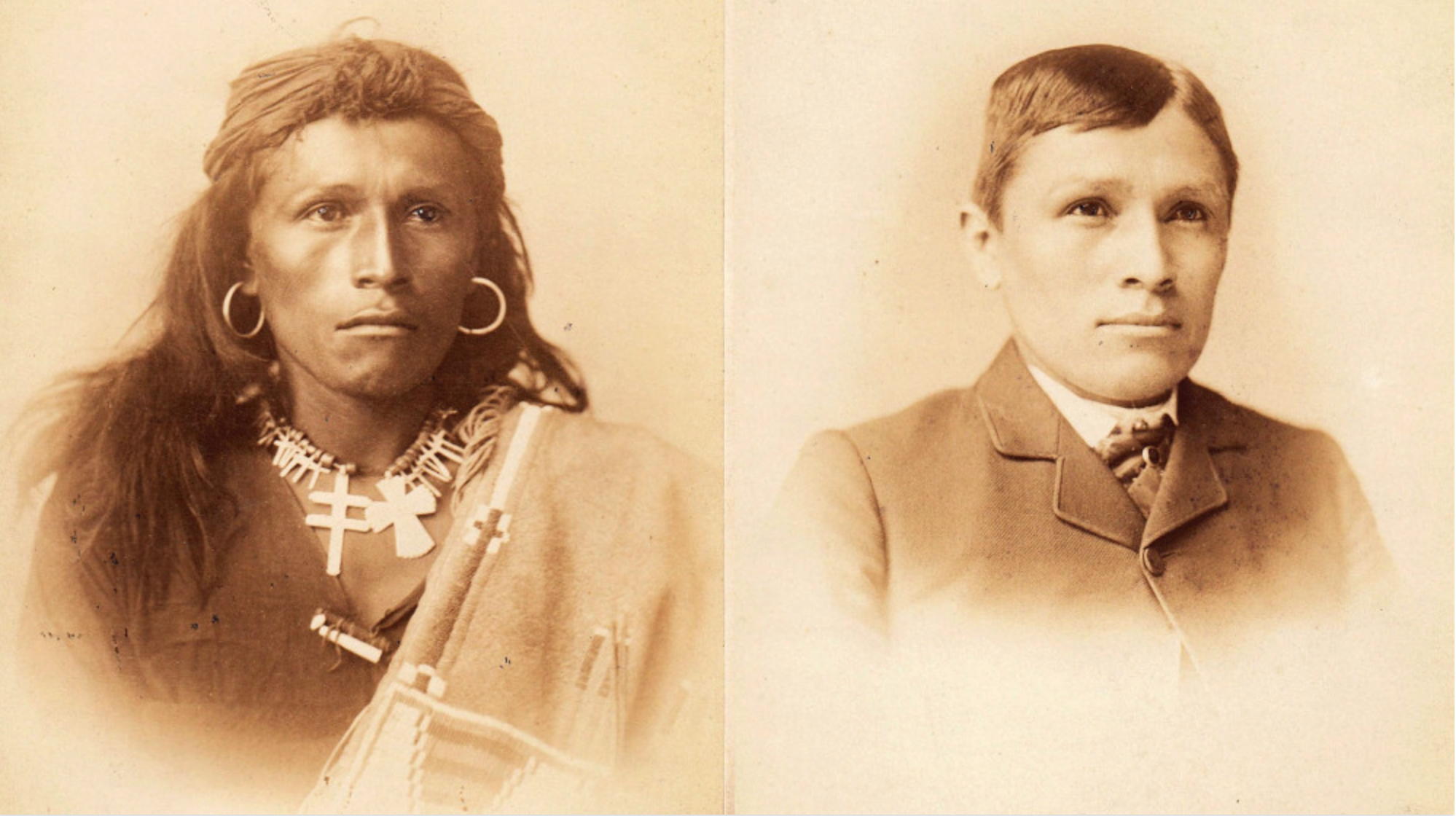
Tom Torlino, in 1882 (left), and 1885 (right)
To find out what happened to Tom Torlino and his descendants, see HIST 204
TEXT: Harjo, “Rabbit Is Up to Tricks” (2018)
CONTEXT: Closing Frontiers
“Indigenous Americans have lived in North America for over ten millennia and, into the late nineteenth century, perhaps as many as 250,000 Native people still inhabited the American West.1 But then unending waves of American settlers, the American military, and the unstoppable onrush of American capital conquered all. Often in violation of its own treaties, the United States removed Native groups to ever-shrinking reservations, incorporated the West first as territories and then as states, and, for the first time in its history, controlled the enormity of land between the two oceans. The history of the late-nineteenth-century West is not a simple story. What some touted as a triumph—the westward expansion of American authority—was for others a tragedy. The West contained many peoples and many places, and their intertwined histories marked a pivotal transformation in the history of the United States.” —American Yawp, Chapter 17
SUBTEXT: Understanding Harjo
- What or who do folktale characters like Rabbit and clay man represent in Harjo’s poem?
- Is this a poem of grief or defiance? How does Harjo’s sense of native identity compare or contrast to Tom Torlino’s?
METHODS CENTER: Narrative Framing
- Understand why frameworks matter