

TEXT: Hayden, “Middle Passage” (1945, 1962)
- Epic-style poem in free verse with more than 150 lines divided into three sections
- Adopts voice of white slave ship captains and pilots to reveal story of black victims and revolutionaries (like Joseph Cinquez –also Cinque– or Sengbe Pieh)
- Originally published in W.E.B. DuBois’s journal, Phylon, in 1945 and then revised and republished in Hayden’s 1962 volume of poetry entitled: Ballad of Remembrance
- Provides good example of modernist poetry, an approach that complicates traditional narrative storytelling with multiple voices, collages of sources, and other techniques

CONTEXT: African Slave Trade
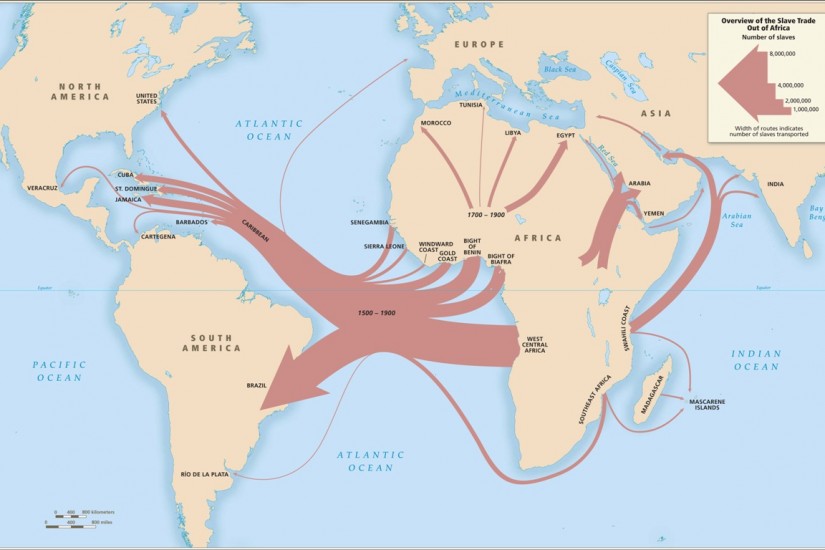
“Recent estimates count between eleven and twelve million Africans forced across the Atlantic between the sixteenth and nineteenth centuries, with about two million deaths at sea as well as an additional several million dying in the trade’s overland African leg or during seasoning. Conditions in all three legs of the slave trade were horrible, but the first abolitionists focused especially on the abuses of the Middle Passage.” —American Yawp, Chap. 3: II
- Hayden was from Detroit and studied at the University of Michigan under poet W.H. Auden before becoming an English professor and later consultant in poetry (poet laureate) at the Library of Congress
- To write his epic on the “Middle Passage,” Hayden spent years researching the African slave trade
- SLAVERY: The trans-Atlantic slave trade was a uniquely catastrophic event in human history. Forms of slavery and coerced labor had always existed but the “Middle Passage” created a new context for what Americans eventually began calling their “Peculiar Institution.”
- Chattel slavery (property) + kidnapping + relocation = race-based chattel slavery in the Americas, 1500s to 1800s
- Involuntary servitude (forced labor or traditional slavery) = universal
- Indentured servitude (contract labor) = 18th & 19th centuries
- Wage servitude (paid labor without regulation) = industrial era
- KEY DATES
- 1619 // First record of Africans sold in Virginia (see story of Angela)
- 1772 // Somerset case (Somerset v Stewart decided by Lord Mansfield in Great Britain)
Clip from History channel’s remaking of “Roots” (2016)
- FEATURED DATABASE: Slavevoyages.org
SUBTEXT: Black History or American History
- “Robert Hayden wrote this devastating historical poem about the slave trade, “Middle Passage,” in the early 1940s when there was virtually no interest in revisiting the dark truths of American history. It is a landmark for American poetry, a breakthrough in subject matter comparable to “The Love Song of J. Alfred Prufrock” and “Sunday Morning.” It stands as a barrier-breaking poem –lyric, narrative, dramatic– that coolly and forcefully leads us to confront one of the most fundamental horrors of the American past.” –Edward Hirsch, Heart of American Poetry, 141
- “Hayden’s revisionary tactics also becomes evident in the way that he exposes Christian hypocrisy by quoting a Protestant hymn that Edward Hopper wrote especially for seafaring men (“Jesus, Savior, Pilot Me”), which the poet spaces out, capitalizing and emphasizing each individual word…” –Hirsch, 245
- “It took iron discipline for Hayden to chronicle the fears and stay with the viewpoint of the cruel enslavers….” –Hirsch, 246
- “All of this prepares us for the longest single stretch of the poem, the narrative account in blank verse of the [1839] uprising about the Amistad, whose name ironically means ‘Friendship,’ a Spanish ship carrying fifty-three enslaved people from Havana to Principe, Cuba.” –Hirsch, 247
METHODS CENTER: Historical Thinking
- Understand the difference between empathy and sympathy
- Recognize the value of context; “the past is a foreign country” (L.P. Hartley, 1953 and David Lowenthal, 1985)
- Put to work in your first close reading assignment