
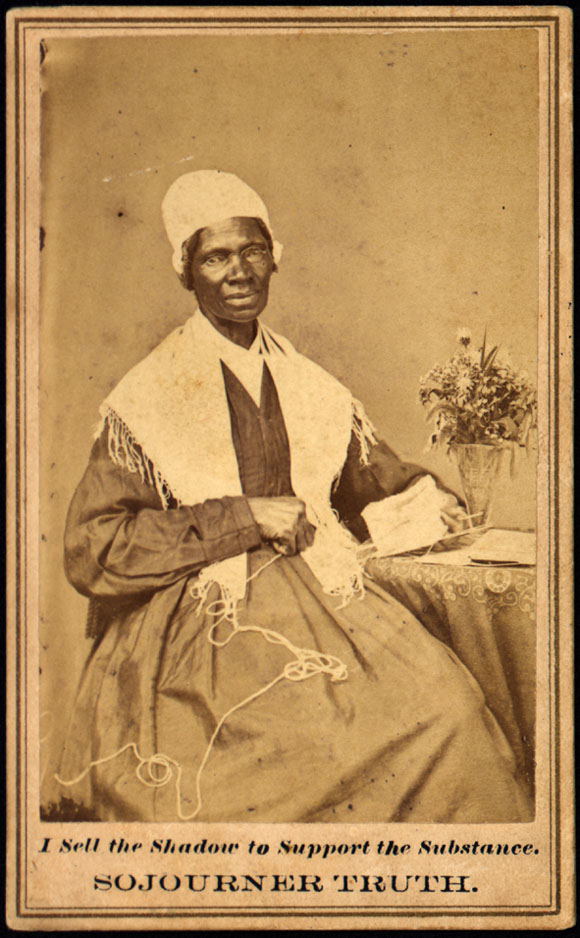
TEXT: Truth, “I Am a Woman’s Rights” (1851)
- Short speech delivered by Truth at a Woman’s Rights Convention in Akron, Ohio and transcribed by Marius Robinson for the abolitionist newspaper, Anti-Slavery Bugle
- A different version of this speech appeared in 1863 with a refrain that now has become famous: “Arn’t [or Ain’t] I A Woman?”
CONTEXT: Role(s) of Antebellum Women
- Women’s roles changed during the Second Great Awakening, not only because of new revival opportunities in mainstream Protestant denominations but also because of the emergence of new religious sects and utopian communities
- The Market Revolution also altered women’s roles in society, encouraging a new Cult of Domesticity (sometimes also called True Womanhood) for middle and upper class women
- 1848 also marked a turning point in political organizing for women with the Seneca Falls Convention (against coverture) and Elizabeth Cady Stanton’s powerful Declaration of Sentiments
SUBTEXT: Portraying Sojourner Truth
Actress Kerry Washington performs “Ain’t I A Woman?” version
- How does Washington’s modern portrayal of Sojourner Truth illustrate some of the arguments inside Nell Irvin Painter’s biographical essay? (see “Sojourner Truth in Life and Memory: Writing the Biography of an American Exotic,” Gender & History (Spring 1990): 3-16.)
METHODS CENTER —Wikipedia
-
- Understand the roles of tertiary or reference sources
- Begin using American National Biography (ANB) via the library database finder