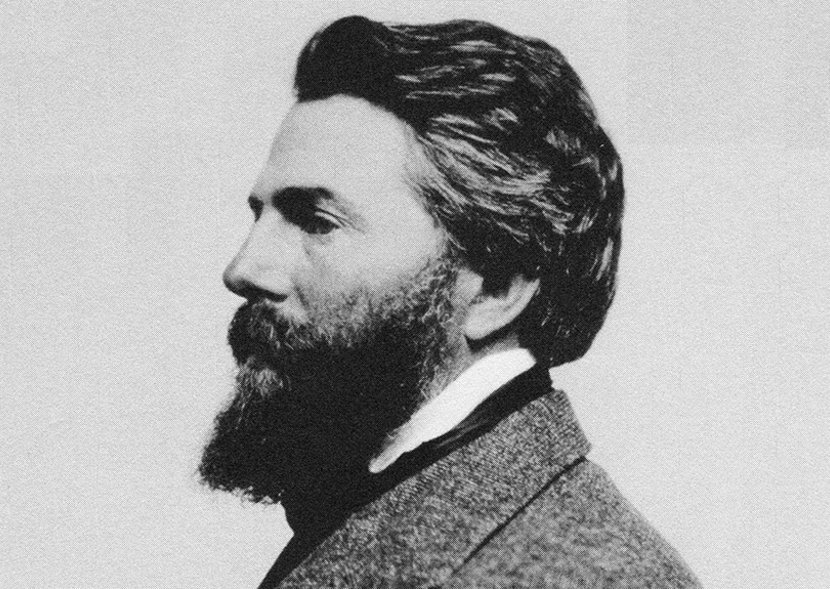
Herman Melville (1819–1891) was born in New York to a family with a distinguished American pedigree –his paternal grandfather had participated in the Boston Tea Party while his maternal grandfather (from Albany) had been a military hero and high ranking officer in the Continental Army during the American Revolution. But Melville’s childhood was difficult as the family struggled with unexpected financial setbacks and especially after his father died when he was thirteen. Melville worked in various jobs but eventually found a career in the whaling industry and ended up traveling the world in his 20s and 30s. He then wrote about these experiences, culminating in his masterwork, the novel Moby-Dick (1851). Melville was a published author and respected by critics, but he was unable to earn enough income to support his family, even after he turned mostly to magazine journalism and short story writing. During the Civil War, Melville lived in the North, and continued to pursue various money-making endeavors. He also began writing poetry. He published his first volume of poem, Battle-Pieces and Aspects of the War, in 1866. “Shiloh: A Requiem” appeared in this collection. The poem described one of the bloodiest and most important battles of the early phase of the war, the Battle of Shiloh in April 1862. The battle took place near Pittsburg Landing, along the Mississippi River, in southwestern Tennessee. Union general Ulysses Grant’s Federal troops defeated Confederate forces, but only after nearly retreating in the face of a surprise attack. There were nearly 24,000 casualties in total, including about 3,400 dead across both armies. Melville’s poems were not well regarded in his lifetime and he spent most of the rest of his career working in the U.S. Customs office in New York. He died in near obscurity in 1891.
Shiloh: A Requiem (April 1862)
Skimming lightly, wheeling still,
The swallows fly low
Over the field in clouded days,
The forest-field of Shiloh—
Over the field where April rain
Solaced the parched ones stretched in pain
through the pause of night
That followed the Sunday fight
Around the church of Shiloh—
The church so lone, the log-built one,
That echoed to many a parting groan
And natural prayer
Of dying foemen mingled there—
Foemen at morn, but friends at eve—
Fame or country least their care:
(What like a bullet can undeceive!)
But now they lie low,
While over them the swallows skim,
And all is hushed at Shiloh.