Field Guide for Greenlandic Birds


Archive for March, 2018

White Tailed Eagle

Posted in Eagles on March 21, 2018 by macpherc
https://www.birdguides.com/news/white-tailed-eagle-reintroduction-project-support-withdrawn/

Scientific:
Haliaeetus albicilla groenlandicus 

Order:
Accipitriformes
Family:
Accipitridae
Genus:
Haliaeetus

English: European Eagle, European Sea Eagle, Gray Eagle, Gray sea Eagle, Gray Sea-eagle, Grey Eagle, Grey sea Eagle, Grey Sea-eagle, White-tailed Eagle, White-tailed Fish-eagle, White-tailed Sea Eagle, White-tailed Sea-eagle, White-tailed See-eagle, White-tailed-Eagle

Danish: Havørn

Greenlandic: Nattoralik

Height: 70-90 cm

Weight: 3.5-5kg (male); 4-7kg (female)

Wingspan: 200-240 cm

Fun Facts: White-tailed Eagle is assumed to have reached Iceland and Greenland after the last glaciations about 5-8000 years ago.

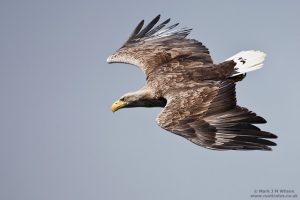
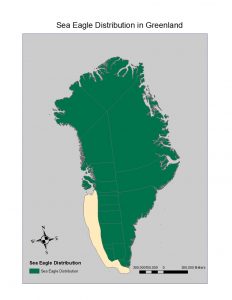
The total population in Greenland is estimated to be 150 -200 pairs. White-Tailed Ealges are a resident of Southwest Greenlandic coast. While under the same subspecies, Greenlandic White-Tailed Eagles on average are a little larger than White-Tailed Eagles from other areas of the world.

White-Tailed Eagles diet on fish, carrion and larger water birds, such as the fulmar. Recently, researches have discovered carcinogenic chemicals, DDT and PCBs, in the eggs of Greenlandic White-Tailed Eagles. While surprising, it is believed the DDT and PCB is a result from White-Tailed Eagles feeding on the migratory fulmars.


White-Tailed Eagles have been protected in Greenland since the year 1973.

Stein Ø. Nilsen, XC361310. Accessible at www.xeno-canto.org/361310
References :

Avibase The World Bird Database (2018). Haliaeetus albicilla. Found at https://avibase.bsc-eoc.org/species.jsp?lang=EN&avibaseid=A41145DF107BF497.

Greenland Institute of Natural Resources (2011). Haliaeetus albicilla. Found at http://www.natur.gl/en/birds-and-mammals/birds/white-tailed-eagle/

Farquhar, C. Craig. 2009. White-tailed Hawk (Geranoaetus albicaudatus), version 2.0. In The Birds of North America (P. G. Rodewald, editor). Cornell Lab of Ornithology, Ithaca, New York, USA.
Common Eider

Posted in Ducks, Geese, Waterfowl on March 21, 2018 by macpherc

https://www.birdzilla.com/bird-identification/

Scientific:
Somateria mollissima

Order:
Anseriformes
Family:
Anatidae
Genus:
Somateria

Danish : Ederfugl

Greenlandic : Miteq siorartooq

Length: 19.7-27.9 in (50-71 cm)

Weight: 41.6-107.2 oz (1180-3040 g)

Fun Fact: Common Eider broods assembles to form a “crèche,” a creche can vary from   a couple to over 150 ducklings.


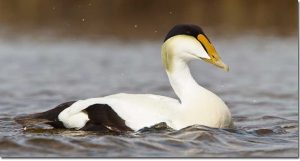
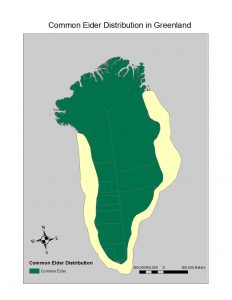
Background: Common eiders are the largest duck found in the northern hemisphere.  Common Eiders wintering in West Greenland were estimated in 1999 to number around 500,000 birds, but the number has likely risen since then. Common Eiders are widely distributed all across West Greenland, with the largest concentrations in North West Greenland. The Common Eider is also distributed as a breeding bird in Northeast and Southeast Greenland.

Mats Rellmar, XC373764. Accessible at www.xeno-canto.org/373764.

References :

Aviabase: The World Bird Database (2018). Somateria mollissima. Found at https://avibase.bsc-eoc.org/species.jsp?avibaseid=B77377EEB852D0AF

Merkel, F. Rasmussen, L. Somateria mollissima.Greenlands Institute of Natural Resources. 2016.

Goudie, R. Ian, Gregory J. Robertson and Reed, A. 2000. Common Eider (Somateria mollissima), version 2.0. In The Birds of North America (P. G. Rodewald, editor). Cornell Lab of Ornithology, Ithaca, New York, USA.
Sibley, David Allen. 2014. The Sibley guide to birds, second edition. Alfred A Knopf, New York.

Brent Goose

Posted in Waterfowl on March 21, 2018 by macpherc

https://www.hbw.com/ibc/species/brent-goose-branta-bernicla

Scientific:
Branta bernicla

Order:
Anseriformes
Family:
Anatidae
Genus:
Branta

Danish : Knortegås

Greenlandic : Nerlernaq

Length : 56-61cm
Wingspan : 110-120cm
Weight : 1.3 to 1.6 kg

Martin St-Michel, XC295512. Accessible at www.xeno-canto.org/295512

References :

Avibase: World Bird Database. Branta bernicla. Found at https://avibase.bsc-eoc.org/species.jsp?avibaseid=3163ED86A508BB83

BirdLife International (2018) Species factsheet: Branta bernicla. Downloaded from http://www.birdlife.org

Lewis, T. L., D. H. Ward, James S. Sedinger, Austin Reed and D. V. Derksen. 2013. Brant (Branta bernicla), version 2.0. In The Birds of North America (P. G. Rodewald, editor). Cornell Lab of Ornithology, Ithaca, New York, USA.
Sibley, David Allen. 2014. The Sibley guide to birds, second edition. Alfred A Knopf, New York.

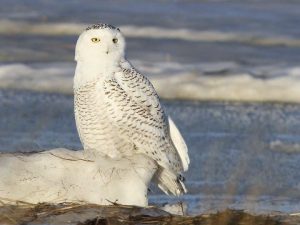
Snowy Owl

Posted in Owls on March 21, 2018 by macpherc

https://en.wikipedia.org/wiki/Snowy_owl

Scientific:
Bubo scandiacus

Order:
Strigiformes
Family:
Strigidae
Genus:
Bubo

Danish : Sneugle

Greenlandic : Uppik

Length: 20.5-27.9 in (52-71 cm)

Weight: 56.4-104.1 oz (1600-2950 g)

Wingspan: 49.6-57.1 in (126-145 cm)

Tero Linjama, XC343145. Accessible at www.xeno-canto.org/343145.

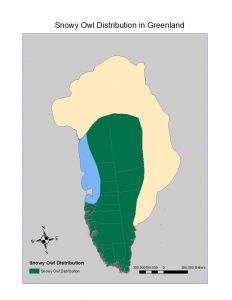
Blue: Native non breeding

Yellow: Native Breeder

References:

Avibase: The World Bird Database (2018). Bubo scandiacus. Found at https://avibase.bsc-eoc.org/species.jsp?lang=EN&avibaseid=5B23B360E7DEC4A9

Holt, D. W., M. D. Larson, N. Smith, D. L. Evans and D. F. Parmelee. 2015. Snowy Owl (Bubo scandiacus), version 2.0. In The Birds of North America (P. G. Rodewald, Editor). Cornell Lab of Ornithology, Ithaca, NY, USA. https://doi.org/10.2173/bna.10

Sibley, David Allen. 2014. The Sibley guide to birds, second edition. Alfred A Knopf, New York.

Partners in Flight. 2018. Avian Conservation Assessment Database. 2018.


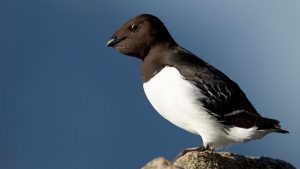
Little Auks

Posted in Murres, Puffins, Waterfowl on March 20, 2018 by macpherc

http://www.bbc.co.uk/programmes/b03dx98q

Scientific:
Alle alle alle

Order:
Charadriiformes
Family:
Alcidae
Genus:
Alle

English: Arctic Auklet, Dovekie, Little Auk, Little Auk/Dovekie, Sea Dove

Danish : Søkonge

Greenlandic : Appaliarsuk

Length: 7.5-9.1 in (19-23 cm)

Weight: 4.7-7.2 oz (134-204 g)

Wingspan: 15.0 in (38 cm)

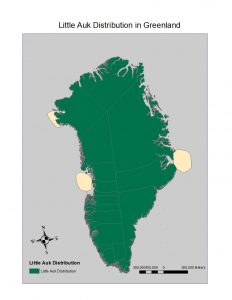
Fun Facts: Little Auks reside along the both the East and West Coast of Greenland. While Auks resemble penguins they are not particularly related. One of the main differences is that all existing species of Auks can fly, though they have to flap their stubby little wings at extremely fast speeds to stay airborne.

A famous Greenlandic delicacy is Kiviak- which consists of 500 fermented auks stuffed into a seal, left to ferment for two to three months. It is eaten for special occasions.

Fernand DEROUSSEN, XC135910. Accessible at www.xeno-canto.org/135910.

References:

Avibase : The World Bird Database (2018). Alle Alle Alle. Found at https://avibase.bsc-eoc.org/species.jsp?lang=EN&avibaseid=B0932D89F1F74318

Sibley, David Allen. 2014. The Sibley guide to birds, second edition. Alfred A Knopf, New York.

Montevecchi, William A. and Iain J. Stenhouse. 2002. Dovekie (Alle alle), version 2.0. In The Birds of North America (P. G. Rodewald, editor). Cornell Lab of Ornithology, Ithaca, New York, USA.
 

Gyrfalcon

Posted in Falcons on March 20, 2018 by macpherc
http://www.environmentalaska.us/gyrfalcon.html

http://www.environmentalaska.us/gyrfalcon.html

Scientific:
Falco rusticolus

Order:
Falconiformes
Family:
Falconidae
Genus: Falco

Danish: Jagtfalk

Greenlandic : Kingavik, Kissaviarsuk

Length: 18.9-25.2 in (48-64 cm)

Weight: 28.2-74.1 oz (800-2100 g)

Wingspan: 48.4 in (123 cm)


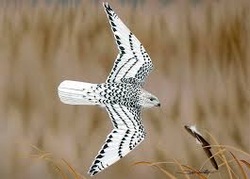
Fun Fact: The Gyr Falcon is the largest falcon in the world, and the second largest bird species in Greenland after the Sea Eagle.

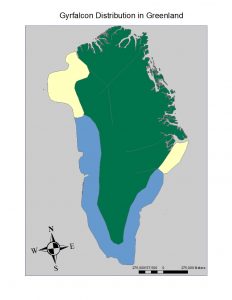
The Greenland breeding population (different from the resident population) is believed to be within the range of 225 to 500 pairs. They are found all around Greenland’s West Coast, with different land segments generally used for breeding or residentially, and alongside the the South East Coast. Gyr Falcons most numerous in West Greenland. Southern breeders are sedentary while birds from the north tend to migrate south in winter. Their primary diet consists of smaller migratory birds, such as Snow Buntings, Lapland Longspurs, as well as larger fowl such as Common Eider and Loons. In Northeast Greenland Lemmings make up an important share of the food.

Andrew Spencer, XC189210. Accessible at www.xeno-canto.org/189210. (https://www.xeno-canto.org/189210)

Blue on the map above represents Native non breeding colonies


References :

Avibase The World Bird Database (2018). Falco rusticolus. Found at https://avibase.bsc-eoc.org/species.jsp?lang=EN&avibaseid=E19252A76FC7845B

Booms, Travis L., Tom J. Cade and Nancy J. Clum. 2008. Gyrfalcon (Falco rusticolus), version 2.0. In The Birds of North America (P. G. Rodewald, editor). Cornell Lab of Ornithology, Ithaca, New York, USA.
Partners in Flight. 2017. Avian Conservation Assessment Database. 2017.

Arctic Tern

Posted in Gulls, Terns on March 19, 2018 by macpherc

https://www.jw.org/en/publications/magazines/awake-no4-2017-august/the-arctic-tern/

Scientific:
Sterna vittata

Order:
Charadriiformes
Family:
Laridae
Genus:
Sterna

Other Languages:

Latin : Sterna paradisaea

Danish :   Havterne

Greenlandic : Emakatilak, Imeqqutaalaq


Length: 11.0-15.3 in (28-39 cm)

Weight: 3.2-4.2 oz (90-120 g)

Wingspan: 25.6-29.5 in (65-75 cm)

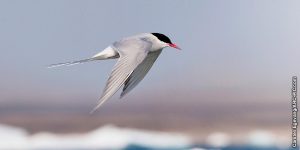
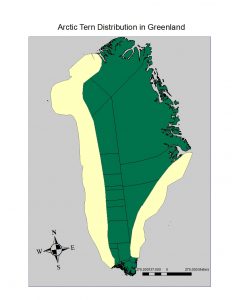
The arctic tern is a small tern species with a sharp red bill, red legs, and deeply forked tail. A colony can contain everything from a few couples of mating birds to 20,000 couples, and it is estimated that there’s as many as 65,000 mating couples are currently in Greenland. There is a very high population of Arctic Terns around the Baffin Bay, on the Southwest Coast of Greenland.

Karl-Birger Strann, XC401938. Accessible at www.xeno-canto.org/401938

References:

Lepage, Dennis. Avibase The World Bird Database (2018) Sterna paradisaea

Sibley, D. A. (2014). The Sibley guide to birds, second edition. Alfred A. Knopf, New York, USA.

Hatch, Jeremy J. 2002. Arctic Tern (Sterna paradisaea), version 2.0. In The Birds of North America (P. G. Rodewald, editor). Cornell Lab of Ornithology, Ithaca, New York, USA.
BirdLife International (2018) Species factsheet: Sterna paradisaea.


Purple Sand Piper

Posted in Waterfowl on March 19, 2018 by macpherc

https://www.allaboutbirds.org/guide/Purple_Sandpiper/lifehistory

Scientific:
Charadriiformes

Order:
Charadriiformes

Family:
Scolopacidae

Genus:
Calidris


Danish : Sortgrå Ryle

Greenlandic: No translation

Size

Length: 7.9-8.7 in (20-22 cm)

Weight: 1.8-3.7 oz (50-105 g)

Wingspan: 16.5-18.1 in (42-46 cm)


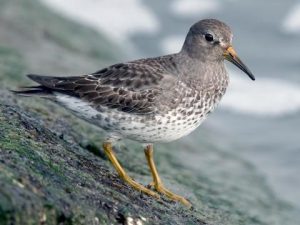
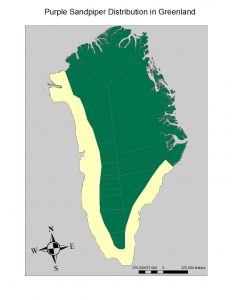
The Purple Sandpiper is a resident of Greenland’s southern Coast, as well as breeds alongside the entire West Coast of Greenland. The bird is recognizable by it’s dark brown winter plumage and it’s elongated, curved mostly black beak. The purple sandpiper predominantly feeds on small crustaceans, insects, spiders and some vegetative matter.


Jens Kirkeby, XC312419. Accessible at www.xeno-canto.org/31241


References :

Avibase The World Bird Database (2018) Charadriiformes. https://avibase.bsc-eoc.org/species.jsp?avibaseid=0A0B84313ACFFB2F

BirdLife International (2018) Species factsheet: Calidris maritimahttp://www.birdlife.org on 21/04/2018

Payne, Laura X. and Elin P. Pierce. 2002. Purple Sandpiper (Calidris maritima), version 2.0. In The Birds of North America (P. G. Rodewald, editor). Cornell Lab of Ornithology, Ithaca, New York, USA.
Sibley, David Allen. 2014. The Sibley guide to birds, second edition. Alfred A Knopf, New York.