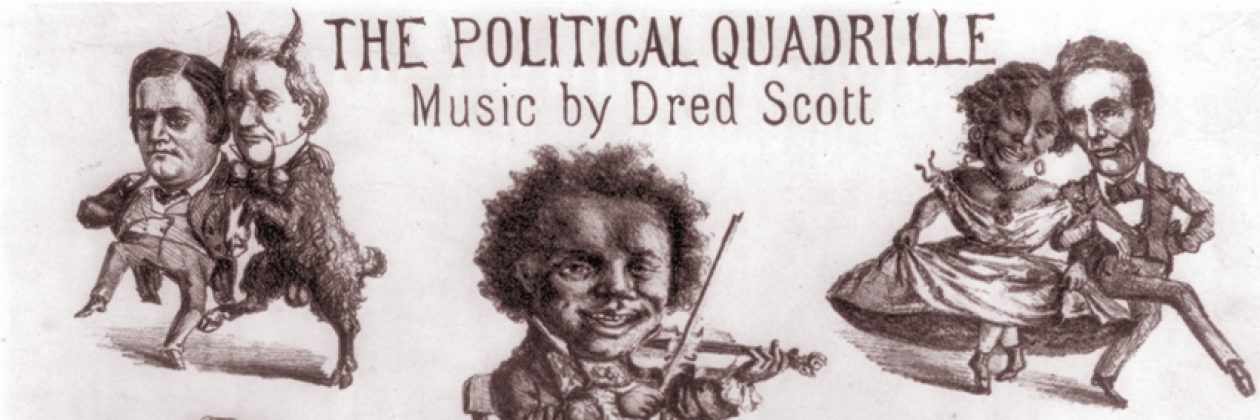
Alexander Hamilton, America’s first secretary of Treasury and one of the authors the Federalist Papers wrote in No. 78, “The complete independence of the courts of justice is peculiarly essential in a limited Constitution.” In the spring of 1857 this great principle of the separation of powers appeared to be violated in the Dred Scott decision when Chief Justice Taney, President-elect Buchanan and Justice Grier surreptitiously intervened in the Dred Scott decision. As Don E. Fehrenbacher believes, these three men conspired to make Dred Scott “a pawn in the political game” [1]
On March 4, Buchanan rose to give his inaugural address, he walked over to his friend Justice Taney for a brief chat. While no one knows exactly what the two proslavery Democratic leaders said, hostile Republican newspapers quickly reported the whispering between Buchanan and the Chief Justice [2]. During his inaugural address, Buchanan reported that the Supreme Court was going to settle the status of slavery in the territories to which he would “cheerfully submit” to the Courts ruling “whatever this may be” [3]. Regardless of what was said, Buchanan was the first president in advance to endorse the result of a Supreme Court decision, especially in an inaugural address.
The whisperings did not go unnoticed especially by two staunch Republicans Abraham Lincoln and William Seward. They made several attacks on the Supreme Court, President-elect Buchanan, former President Pierce and Democrat Franklin Pierce for conspiring in the Dred Scott case. In reference to Chief Justice Taney, Seward blames Pierce for not removing “a partial and tyrannical judge” [4]. He claimed Buchanan involved himself in the interests of slavery and “Before coming into office, he approached or was approached by the Supreme Court of the United States…” who “forgot their own dignity” [5]. Seward pointed to whisper as the reason why the Dred Scott case turned into a proslavery campaign.
Three months later Lincoln spoke to a similar conspiratorial accusation. Lincoln stated in his House Divided Speech “we find it impossible not to believe that Stephen and Franklin and Roger and James all understood one another from the beginning, and all worked upon a common plan or draft drawn up before the first lick was struck” [6].
It is highly unlikely that Chief Justice Taney informed President-elect Buchanan how the Court would rule in the Dred Scott case seconds before being sworn in. Their conversation was too brief and Buchanan had prepared his speech well before it was delivered. Also, through the correspondence between Grier and Buchanan, it was clear that, “Buchanan already knew what the decision would be Chief Justice Taney also knew that Buchanan knew , to which Taney knew that Buchanan knew, and Buchanan knew that Taney knew” [7]. Hence, there was no reason Taney would need to tell Buchanan the Court’s decision. There was, however, a real conspiracy undiscovered by most contemporaries but now apparent to historians that examines the secretive correspondence in January and February of 1857 between Buchanan and key members of the Supreme Court.
President-elect Buchanan wrote to his dear friend Associate Supreme Court Justice John Catron on February 3, 1857, asking if the Supreme Court would rule on the Dred Scott case before his inauguration. On Tuesday, February 10 Catron told Buchanan that the case would be settled at the end of the month and it was likely that some of the justices were going to discuss the territorial question [8]. Catron therefore suggested that Buchanan could safely state in his inaugural address that the Supreme Court was going to “decide and settle a controversy which has so long and seriously agitated the country” [9].
Needing a northern justice to deny the constitutionality of the Missouri Compromise [10] to protect slavery in the territories, Catron advised Buchanan to reach out to Justice Grier. Of the two northern Democratic justices Grier and Nelson, Nelson had already written his opinion while Grier had not fully developed his. Thus, Catron told Buchanan to “drop Grier a line, saying how necessary it is… to settle the agitation by an affirmative decision of the Supreme Court…” [11]. Buchanan, not worried about the ethical appearance of this correspondence, eagerly persuaded Justice Grier to “have a judicial decision on the terrirorial issue” [12].
On Monday, February 23, Catron reported to Buchanan that the two northern justices and the five Southern justices were ready with their opinions and he proclaimed, “I want Grier speeded.“ [13]. Grier, on the same day, replied to the letter from Buchanan that he would join with the southern justices in writing the majority opinion. Grier, said that he shared the letter to their “mutual friends Judge Wayne and the Chief Justice,” who both agreed to have “an expression of the opinion of the Court on this troublesome [territorial] question [14]. Grier reinforced that no other justice would know “about the cause of anxiety to produce this result” and although this was “contrary to our usual practice” it was appropriate for the President-elect to know the real state of the matter [15]. All members involved believed their efforts were directed at preserving the union from ant-slavery extremists .
Buchanan may have violated the integrity of the Supreme Court with his desire to settle the slave question in the territories once and for all. The ruling in the Dred Scott case not only plagued the reputation of the Court but also the President-elect. Use this website to determine for yourself whether or not this “plot” was a hazard to the country.
[1] Don Edward Fehrenbacher, Slavery, Law and Politics: The Dred Scott Case in Historical Perspective, (Oxford, Oxford University Press, 1981), p. 152
[2] Quist and Birkner., 23
[3] Quoted in John W. Quist and Michael J. Birkner, James Buchanan and the Coming of the Civil War, (University Press of Florida, 2013),p. 23, James Buchanan, Inaugural Address, March 4, 1857, In James D. Richardson, A Compilation of the Messages and Papers of the Presidents, vol. 5, (New York: Bureau of National Literature, 1897), 2692
[4] Carl B. Swisher, The Taney Period, 1836-64. Vol. V, (New York: Macmillan, 1974), p. 647
[5] Ibid., 646
[6] Ibid., 468
[7]Quist and Birkner., 38
[8] ,Kenneth M. Stampp, America in 1857, (Oxford, Oxford University Press, 1990),p. 91
[9] Ibid., 92
[10] The Missouri Compromise decided in 1820 admitted Missouri as a Slave state and Maine a free state. It also stated, with the exception to Missouri, slavery was prohibited in the Louisiana Territory north of the 36 30′ latitude. Congress used this to determine if a state could allow or deny slavery in the territories west of the Mississippi. Many northern and southerners viewed this compromise as a huge victory for slavery.
[11] Stampp p. 92
[12] Stampp, p. 91
[13] Quoted in Carl Brent Swisher, The Taney Period, 1836-64. Vol. V, (New York: Macmillan, 1974), p.617, John Catron to James Buchanan, February 23, 1857, Buchanan Papers
[14] Stampp, p. 92
[15] Ibid., 92