Month: May 2019 (Page 2 of 5)
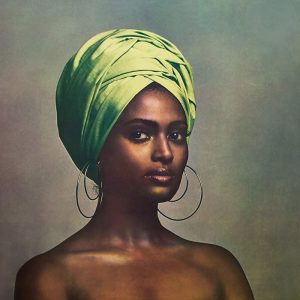
( Photo of actress Zeudi Araya Cristaldi, IMDV)
The Representation of Black Women in Italian Cinema
On October 7th, 1938 Fascist regime’s race laws that asserted racial principles that included the superiority of the Italian race on the basis of biological differences between Italians and the black colonial persons and Jewish minorities. Earlier on in the 1800s in media that depicted Italy’s view of Africa included indigenous black women. This indicat[ed] that colonialism had found a powerful instrument for capturing the Italian imagination through depictions of African females as dark, large-breasted black Venuses. Beyond increasing sales and promoting territorial conquers the eroticization of native women as nude or seminude black Venuses emphasized a desire to be subjugated. (Caponetto R.G 25). Sara Baartman ; 1770s – 29 December 1815 was the most well known of at least two South African Khoikhoi women who, due to their large buttocks, were exhibited as freak show attractions in 19th-century Europe under the name Hottentot Venus—”Hottentot” was the name for the Khoi people, now considered an offensive term, and “Venus” referred to the Roman goddess of love (Qureshi 240). Black Venuses are black women who have enlarged features, thus making them the center of attention on the screen. In the 1980s Italian cinema started to compete with television and the sales began to decline. The 1980s Italian cinema crisis can be compared to the 1800s propaganda mentioned earlier Similar to the propaganda used in the early 1800s; black women were offered roles on screen for low budget, erotic films. Black women were treated merely as figures to be eroticized and racially fetishized while their stories were told through Italy’s depiction of black women as it compares to Africa. Exoticism refers to the quality of being unusual and exciting because of coming (or seeming to come) from far away, especially a tropical country. In Italian Cinema, white men see black women as exotic. Racial fetishism involves fetishizing a person or culture belonging to a race or ethnic group. This can include having strong racial preferences in dating (Bhabha 20). Since the 1970s Italian Cinema crisis, which debuted black women in low budget exotic films, white Italian directors have eroticized their narratives similar to the fascist era, thus making it hard for them to control their own narratives on screen. Time to Kill, La Ragazza Dalla Pelle Di Lunaand Black and Whiteare examples of films produced by white directors that have eroticized, fetishized and eroticized the beings of black women on the screen.
Time to Kill is a drama war film directed by Giuliano Montaldo produced in 1989. Drama war films typically have soldiers, tanks, camp scenery, and action packed scenes. In Time to KillLieutenant Silvestri suffers a toothache and decides to reach the nearest camp hospital earlier. En route to the camp his vehicle has an accident and stops near a rock. Silvestri continues to travel by foot but never seems to find a physician. During his adventure, he finds a young man who directs him to an allegedly shorter route to the main camp. He eventually finds rapes a young Ethiopian woman.
La Ragazza Dalla Pelle Di Lunais a drama romance from 1974 directed by Luigi Scattini. Typical Romance movies include high key lighting, while drama movies use low-key lighting; La Ragazza Dalla Pelle Di Lunahas both, In dramas sound is used to drive the scene. La Ragazza Dalla Pelle Di Lunatells the story of Alberto, an engineer, and Helen, a magazine photographer, has been married for a few years, but their marriage is in crisis. Then they decide to take a trip to Seychelles, where they will betray one another. Alberta meets Simona, a black woman in Seychellas.
Black and Whiteis a dramedy romance directed by Cristina Comencini tells the story of a computer technician Fabio, who is married to a cultural mediator. Fabio falls in love with a black woman named Nadine from Senegal.
Time to Killand La Ragazza Dalla Pelle Di Lunaare films from the Italian film crisis era. Black and Whiteis a contemporary film, which gives Nadine, a black woman a lead part, but only to assert the superiority of the Italian race.
Time to Kill
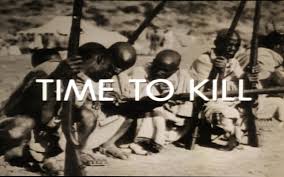
(photo in opening credits of Time to Kill)
19:50– When Lieutenant Silvestri first notices her there is an AB shot sequence with a series of close-ups and medium shots. These shots are used to highlight her features Her body is highlighted, as it is wet and glistening. She is continuously wiping just her arms and breasts. Her face is darker than the rest of her body because her body matters more than what she looks like. The shots are back and forth to put the viewer’s attention to Lieutenant Silvestri’s gaze at the Ethiopian woman, which makes it seem as if she is seducing him. Lieutenant then hands the woman a bar of soap, which suggests that her way of cleaning was wrong. This is a hint at colonialism.
20:04– While asking for directions, he begins to remove his clothing, which allows the viewers to assume that he plans to have sex with her. The camera is in a slight Dutch angle, which makes the viewers feel as if they are peeking in on a secret. Lieutenant immediately assumes that the Ethiopian woman is property; therefore, she has no agency.
22:40– Here at a straight on full shot the viewers notice that Lieutenant continues to touch the Ethiopian woman, as she shakes her head no. The sun still remains to illuminate only her body and everything else even lieutenant’s face is in the dark.
23:54-There is a close up as he rapes her, and she doesn’t have the words to say stop. This is an example of the black Venus and exoticism. She does not have the words because that is Italy’s view of its exploration of Africa. This is the idea that black bodies serve as figures, something unreal. An example of black women not existing as a part of civilized culture because they are not human beings, they are animals.
24:50– Lieutenant begins to feel bad, so he offers her money and when she says no he seemingly understands after he gets what he wants. The angle also changes; they seem to be at the same level.
25:20- At a Dutch angle, he hands her a bible and they are framed in the lower thirds, making it awkward for the viewers. After taking away her innocence, it is difficult for the viewers to become comfortable with their interactions. Especially since Lieutenant is offering her goods after abusing her. The POV shots seem to go from slightly tilted down for Lieutenant and slightly tilted up for the Ethiopian woman to be on the same level suggesting that they are equal.
The Ethiopian woman in Time to Killdoes not have the language to protect herself against the rape of Lieutenant Silvestri. Through the use mediums and close-ups to highlight her naked body parts and facial features, it can be concluded that the Ethiopian woman is portrayed as an animal, simply a body and not as a human being,. She is there to satisfy the fetish of the viewers.
La Ragazza Dalla Pelle Di Luna

(Photo from a close-up in La Ragazza Dalla Pelle Di Luna)
4:03– At a medium AB sequence, Alberto notices Simona and immediately stops listening to the staff in the airport. Simona doesn’t say award she smiles as she has slight lighting on her face to illuminate her facial features and a shirt that highlights her bust. The camera does a dramatic zoom, alluding to his amazement of her “exotic” beauty. In the POV shots, the camera is slightly looking down on her and slightly up in her POV shots. This puts Alberto in power.
4:21– When Alberto sees Simona again, in the extreme close-up her hair is blowing and the lens has a slight flare suggesting that Simona is unreal, apart of Alberto’s dream.
26:07– At this point, there is extreme close-up to highlight Simona’s features as he is fantasizing them. Alberto’s hands cover her face as if she is an object or a piece of art. He is fetishizing her. This is an example of Racial Fetishism. This is the idea that the black woman is art, an object to explore instead of being a human being.
27:03-Simona’s red nails in this medium close up shot suggest promiscuity. The long unnatural nails with red paint allude to prostitution and darkness.
30:26– The camera is at an establishing wide shot, Alberto and Simona are on the beach having sex. Simona is barely clothed. This makes Simona seem exotic and exciting for the viewer’s eye. This scene accentuates Simona’s breasts and body parts, presenting her as the black Venus.
In La Ragazza Dalle Pe Di Luna, Simona is generally wrapped in cloth, which hints at the fascist view of blackness. The fascist era provided the assumption that all black women are from Africa and should be presented this way.
Black and White

(Screen grab of Nadine and Curt from Bianco e Nero)
12:20- The camera is at a medium full shot while it pans across the room. Nadine is packing the viewer gets a glimpse at Nadine’s wall decorations and bedspread. The bed spread and picture on the wall has African Adinkrah symbols. This suggests that Nadine is exotic and from Africa because she is black,
32:17– At a medium shot AB sequence Fabio begins searching through Nadine’s desktop. Her family photos seem normal, until 32:27where her photo is closer than the others, which seems to make the background darker. This suggests that Fabio is falling in love with a black woman, which represents darkness.
Black and Whiteis different from La Ragazza Dalla Pelle Di Lunaand Time to Killbecause Nadine is given a lead role, but her words are not an accurate representation of black culture or women. Her words are used to assert the superiority of the Italian race,
In Time to Kill, La Ragazza Dalla Pelle Di Lunaboth films made during the Italian cinema crisis, the use of medium AB shots, lighting to highlight the skin and body figures, extreme close-ups and dramatic zooms are used to depict black women on screen through the eyes of Italy’s view of Africa. The black women in these two movies have a lack of speaking roles and are seen as objects, therefore black Venuses. In Black and White, although Nadine has a speaking role, it is used to assert the superiority of Italian beauty standards. There are also hints of exoticism as Nadine’s home and shots have objects that suggest African roots. In all three movies, Black women are the center of attention. Black women are being eroticized and racially fetishized by Italian men.
Italian Cinema since the crisis in the 1970s has made the fetishizing, eroticizing and of Black women normal in films. Black women actresses in Italy are limited to specific roles and standards thus limiting their work in the field. In the movies, Black and White(Romantic Comedy), La Ragazza Dalla Pelle Di Luna(Drama) and Time to Kill(Drama) there are running themes of eroticism and fetishization through the use of close-ups and medium angles, dramatic zooms, water hitting the body, and rolling around on the beach, highlights of the facial features and body types of black women, most of the women are not clothed, and lastly the lack of character development. In Time to Killand La Ragazza Dalla Pelle Di Luna, movies made in the 70s, the women are there as sex objects as they are silent almost the entire time. The idea that blackness is not apart of society, In Black and White, made in the 2000s, there is progress as Aissa has speaking parts, she uses them to prove that Italian beauty standards are superior to her own. There are also hints of exoticism in her bedding, and objects in her home. Lastly, Fabio sees her as a fantasy, something unreal. Italian Cinema has not made much progression in its depiction of black women.
Bibliography
- Another “Hottentot Venus” featured at a fête given in 1829 for the Duchess of Berry:Poster Archived 30 August 2011 at the Wayback Machine
- Bianco e Nero. Dir. Cristina Comencini. Rai Cinema, 2008. Film
- Bhabha, Homi K. (June 1983). “The Other Question: Difference, Discrimination and the Discourses of Colonialism”. Screen. 24(6): 18–36. doi:1093/screen/24.6.18.]
- Caponetto R.G. (2015) Art of Darkness: The Aestheticization of Black People in Fascist Colonial Novels. In: Fascist Hybridities. Italian and Italian American Studies. Palgrave Macmillan, New York
- “EXOTICISM | Definition in the Cambridge English Dictionary.” EXOTICISM | Definition in the Cambridge English Dictionary, dictionary.cambridge.org/us/dictionary/english/exoticism.
- La Ragazza Dalla Pelle Di Luna. Dir. Luigi Scattini. Aquilla Cinematografica, 1974. Film
- Philip Morgan (10 November 2003). Italian Fascism, 1915-1945. Palgrave Macmillan. p. 202. ISBN978-0-230-80267-4.
- Time to Kill.Dir. Guiliano Montaldo.Republic Pictures, 1989. Film
- Qureshi, Sadiah (June 2004). “Displaying Sara Baartman, the ‘Venus Hottentot'”. History of Science. 42(136): 233–257

by Mia Merrill
My video essay compares the cult classic horror film Suspiria, directed by Dario Argento in 1977, to the 2018 adaptation of the story, directed by Luca Guadagnino. While the films are completely different in many ways, both are full of images of violence against women. What does the new Suspiria have to say about women’s power, agency, and bodily autonomy? Are reclamations of agency in the 2018 Suspiria negated or lessened by the film’s perpetuation of the male gaze?
[ensemblevideo contentid=TPoF4xZ_ZEej87TCk8R7og]
This is a transformative video for educational use only. The content of this video is protected by the Academic Fair Use clause (Section 107) of the U.S. Copyright Act of 1976. For further information, see: copyright.gov/circs/circ21.pdf
by Kate Levangie
[ensemblevideo contentid=g9WM5OzDfE2R_uxcr79a5g]
This is a transformative video for educational use only. The content of this video is protected by the Academic Fair Use clause (Section 107) of the U.S. Copyright Act of 1976. For further information, see: copyright.gov/circs/circ21.pdf
by Melody He
[ensemblevideo contentid=PDFQDDDIWUGWj2rYig7yoQ]
This is a transformative video for educational use only. The content of this video is protected by the Academic Fair Use clause (Section 107) of the U.S. Copyright Act of 1976. For further information, see: copyright.gov/circs/circ21.pdf
Hi everyone, here is Melody’s podcast. Through this interview, you will know more about the effect of gender and ethnicity in Italian cinema and learn about casting choice of black women. If the audio quality of interview is not good enough, you will find the summary of interview in the end of this podcast.
In film, the most powerful device in constructing the interpretation of a character by the audience is the gaze that is crafted by the director. When women in film are constructed this is most often by a male director, leaving the product to showcase a woman who is presented as a sexualized spectacle. The films Yesterday, Today, and Tomorrow (1964) by director Vittorio De Sica as well as Gabriele Mainetti’s They Called Him Jeeg Robot (2015) are a continuation of the problems facing female depiction in film. Through the objectifying male and pedophilic gazes of each respective film, the woman’s purpose in relation to the audience is left to be determined by the male behind the camera. However, it is the film Arianna (2015) which embodies a queer gaze, that offers a very different interpretation of the female identifying experience on camera, though still crafted in part by male director, Carlo Lavagna.
The cinematic gaze in film is what constructs a narrative by using the camera angles to depict a type of interpretation for the audience. The result is the effect on the audience and how the characters are interpreted based on this construction. This is not up to interpretation by the spectator as “the gaze is…prepared” (Morawski 40). The impact that a gaze can have on characters can vary, as it can both leave an empowering position as well as a vulnerable or exploited stance as well. Because the gaze is manifested in the production process, it is critical that the person crafting the gaze be reflective of the power dynamics at play in their decision making (Morawski 40).
The film Yesterday, Today, and Tomorrow is a prime example of what the male gaze intends to accomplish. As Laura Mulvey writes, “film reflects, reveals, and even plays on the straight, socially established interpretation of sexual difference which controls images, erotic ways of looking and spectacle” (6). Of the many sensual scenes in the film by De Sica, there is none more telling of this objectification by the male gaze than the famous striptease by actress Sofia Loren in the story of a Roman prostitute named Mara. She is the definition of a woman’s portrayal as reduced to a mere spectacle of lust and desire of the male audience. As Mulvey goes on to assess, there is a sense of a “primordial wish for [the] pleasurable looking” that Loren is able to aptly satisfy as she literally performs for not only the male in her frame, but also the male audience to which she is also exhibiting her sexuality (8). And while this confidence that Loren could be considered empowering, this showcases that the relevancy of this empowerment is rendered moot by the fact that Loren is not doing this for herself; it is to allow the “curiosity…to look [and] intermingle with a fascination” (Mulvey 8).
The male gaze, as Mulvey analyzes is centered upon the “active/male and passive/female” dichotomy (9). Interestingly enough, this is actually quite the opposite in this film as Loren is actively seducing and Mastroianni is passively receiving her sensuality. He remains in the same position the entire time he is watching her, while Loren is the one moving in different spaces throughout the room. Their presence on the screen is in fact “coded for a strong visual and erotic impact” (Mulvey 9). This is evident especially in this film, because despite the two preceding story lines, this is the story that encapsulated the entirety of the work and specifically the striptease itself. Promotional works often centered Loren’s final character front and center. In this photo the seductive nature of the male gaze on Loren is so pronounced not just in its placement, but also because it is the only story colorized on the poster.
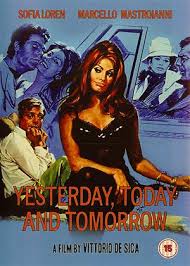
Promotional Poster for Yesterday, Today and Tomorrow (1964)
The camera angles throughout the striptease end up reflecting the two perspectives to which the male gaze is embodying. First the male on the screen and second, the male audiences that the film is attracting and pandering to with this elicit scene. The third angle captures Mastroianni’s reaction, but these shots from Loren’s perspective are minimal at best, indicating that her viewpoint is not the focal point of this narrative. The duality of the angles also reflects this theory of the two male perspectives due to the fact that the spectator is identifying with the male on the scene who is receiving the seduction, in this case, by Loren. As Mulvey point out, this male is effectively a proxy or a “screen surrogate” to the male audience member (10). Loren therefore cannot make an appearance as anything other than an “isolated, glamorous, on display [and] sexualized” muse (11).
When considering another take on a more recent film regarding female interpretation through a gaze, They Called Him Jeeg Robot is not much better at showcasing a changing perspective on the female body. The issue here is that although Aleesia is an adult woman, she is presented as a child with her mental and behavioral state. As Danielle Hipkins addresses that despite the character’s mentality as a girl, it was far more problematic that the directors decided to “cast a 30-year-old woman to play this girl-woman-child.” It makes the whole situation seem confusing as her behavior does not reflect the sexuality that is being exuded simultaneously. In the scene surrounding Alessia’s first night in the care of Enzo, her sleeping body is immediately sexualized with nudity. It is further punctuated by the camera’s angles to depict the viewing of her body from a higher angle. This ends up framing the audience effectively as an adult viewer looking down on a child. The fact that her character is played by an older woman than her mental state would suggest is criticized by Hipkins as it is clearly intentional in the choice of this problematic dichotomy of a girl-woman for the director (269).
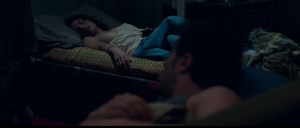
Aleesia Sleeping in They Called Him Jeeg Robot (2015)
Throughout later scenes, the audience sees Alessia’s childlike demeanor continue to be sexualized by her body, which includes the different gestures she would make. At one point she is eating a yogurt from the pack without a spoon, focusing the attention on her fingers in her mouth, again sexualizing the mundane. In this scene, she is continuously depicted as a child sexualized, as she is found watching the TV on the floor in the morning which is reminiscent of a child’s behavior. However, because she is scantily dressed combined with her glances up at Enzo that are a cross between childishly lost and “archly seductive”, leave her in a space that is ultimately exploited at the time of her rape (Hipkins 269).
The nudity and the general construction of seduction through innocence is a problematic way to view the characterization of a woman in any sense. The fact that this is further stipulated as a result of a man behind the camera, is even more so considering that even in the fifty years following Yesterday, Today, and Tomorrow’s overt objectification of Loren through the cinematic lens, once again this occurring in a distinct and revolting fashion on a character that is being sexualized along, if not for her childlike behavior.
However, with Arianna we see that there is a chance for a different kind of interpretation of the female body with the queer gaze regarding the intersex condition of the main character. The queer gaze is distinct from the previous conceptualizations of the female body, especially as it is able to create a dialog about queer identity without the traditional sexualization of the unknown or unfamiliar (Anderson). Although there is just as much nudity and even sexual scenes that present themselves, they are never done in a way that is voyeuristic or indicative of an objectifying stance.
Director Carlo Lavagna dictates this way of creating the conceptualization of the titular character’s body by ensuring that he was taking on the perspective of a woman not only himself, but also looking for guidance from other members of his production team (Lavagna). The gaze here in the scene where Arianna is exploring her body, is not done in a lucrative fashion, but rather in a way that allows the discovery to be presented as simply that, regardless of its sexual origins. The eroticism that could certainly be developed by a more careless director is evident, as the angles do not sexualize Arianna, but allow her the space to understand herself.

Arianna in the Pools, Arianna (2015)
The implications surrounding this paradigm shift for a gaze that was previously contingent on the exploitation of the female image is what is the most astounding. Although They Called Him Jeeg Robot and Arianna were both released in the same year it is interesting to see that despite this, the films were both dependent on the approach of the director and their ability to be cognizant of their interpretation of the woman before their lens. That being said, although this is a wonderful change, the reality is the visual conceptualization of women is still dependent on a man’s ability to see them as more or as just a sexual object.
Works Cited
Anderson, Tre’vell. “What Hollywood Can Gain by Placing the ‘Queer Gaze’ in the Spotlight.”
“Arianna: the Woman Who Was Borne Three Times.” Cineuropa.
De Sica, Vittorio, director. Yesterday, Today and Tomorrow. Compagnia Cinematografica Champion, 1963.
“De Sica and His Dynamic Duo Do What They Do Best: Close-Up on
‘Yesterday, Today and Tomorrow.’” Mubi.com.
Hipkins, Danielle. “Performing ‘Girl’ Against Girlpower: The Case of Lo Chiamavano Jeeg Robot (Mainetti, 2015).” The Italianist, vol. 37, no. 2, 2017, pp. 268–272.
Lavagna, Carlo, director. Arianna. Ring Film, 2015.
Mainetti, Gabriele, director. They Call Him Jeeg Robot. Goon Films, 2015.
Morawski, Jakub. “The Cinematic Gaze of the Other: How Are Images Watching You?” The International Journal of the Image, vol. 7, no. 4, 2016, pp. 35–41., doi:10.18848/2154-8560/cgp/v07i04/35-41.
Mulvey, Laura. “Visual Pleasure and Narrative Cinema.” Feminisms, 1975, pp. 438–448.
Rojo, Amara V, and Nicoletta Marini-Maio. “An Interview with Carlo Lavagna .” 8 Apr. 2019.
Screenshot from They Called Him Jeeg Robot on Netflix. 13 May 2019.
by Sarah Tran
[ensemblevideo contentid=g_5Iwf_twEe4OueJAz5lZA]
This is a transformative video for educational use only. The content of this video is protected by the Academic Fair Use clause (Section 107) of the U.S. Copyright Act of 1976. For further information, see: copyright.gov/circs/circ21.pdf
Challenging the Patriarchy
Women throughout history have been defined by their reproductive system. Furthermore, they are reduced to roles such as housewives, nurturer, and sexual creatures. Due to this, there has long been a stereotype that puts women under men, thus, creating the patriarchy and the stigma that women are incapable. These roles and stereotypes are emphasized everywhere, especially in films. It then becomes hard for women in the film industry to gain recognition even though there has been an increase in women directors. Specifically in the Italian film industry, “however, women filmmakers are increasingly changing the landscape of global cinema, through works that challenge both traditional gender roles and dominant cinematic genre models” (Carlorosi 175). Susanna Nicchiarelli is an example of a woman who is challenging this stereotype. Nicchiarelli in her films she is challenging the standards imposed by society for women by demonstrating the truths in her films. In her films, she uses imperfections to drive the story and to show the truths of women and their lives. It is unlike the other films that typically focus on the male gaze, sexualized women, and roles imposed by the patriarchy.
In Susanna Nicchiarelli’s Cosmonaut (2009) the opening scene shows Luciana and the other children around her age at a church. They are preparing to walk down the aisles to the priest for their first communion. In this opening scene, Luciana and Fiorella are juxtaposed where Luciana is shown frowning and unhappy and Fiorella is shown smiling and even saying “this is the best day of my life!” The close up of their face emphasizes their unhappiness and happiness. It also allows the audience to resonate with either girl’s emotions for the occasion, whether they are uninterested or interested in this typical Catholic tradition. They then begin to walk and Luciana has an epiphany and begins to walk in the opposite direction of the group. Once she reaches the other end of the church she blows out the candle and finally smiles. It is at this moment that Luciana goes against the standards of society and turns away from it. The blown out candle symbolizes the end of Luciana following these imposed society standards, beginning with religion where she will follow her own beliefs. Furthermore, she exits the building and begins to take off her accessories from communion, symbolizing the process of rejection and rebellion.
Once, Luciana is home and taking off the dress in the bathroom she communicates with her mother through closed doors. The camera goes back and forth between the mother who is trying so hard to get her to go back to communion and the daughter who is clearly done with it. Her mother tells her she looks lovely and still has time to go back. However, Luciana objects her mother and tells her “over my dead body,” clearly taking her stance. Her mother than questions why she is doing this and Luciana replies with a confident stance and volume “because I am a communist!” This scene between Luciana and her mother shows the two different types of women in society. The one who follows the standards and the one who defies it. Luciana’s mother tries to coerce Luciana to go back to the communion by commenting on her looks. This trope is typically associated with women and how their looks matter to them and effects what they do. However, Luciana is unlike the typical women who follow society’s standards and is unphased by this comment because she continues to undress and oppose her mother. Later, in the movie, as Luciana continues to follow her beliefs and create her identity she begins to drift away from her mother.
After an eventful night out, Luciana gets home late and is met by her mother. Before her mother can even speak her stepfather looms behind her and interrogates Luciana and point out how late it is. Throughout this whole conversation, her mother is only able to say a few words or none at all before her stepfather steps in. Luciana is informed that her brother was injured and it was her fault for not being there with him and instead always with her “big fat boyfriend.” Luciana then comments back, “at least he’s not a lousy fascist like you.” The stepfather then comes completely into the room and slaps Luciana and Luciana looks at her mother and says “you’re happy now, aren’t you?” This scene is very important because it defines the patriarchy seen in a typical family and the consequences of opposing it. Luciana’s mother is shown timid with her arms crossed or hugging one arm while the stepfather looms over her and takes control of the conversation. As the new stepfather, he is behind the mother trying to impose his authority onto Luciana and at the same time, he manages to impose his authority over his wife and takes control of the situation although he is not completely in frame. Once Luciana crosses the line and insults the stepfather he steps into the room and into the frame and punishes her. When Lucaiana asks her mother if she is happy, Luciana is asking if this is what she wanted from the marriage and if she’s happy following the patriarchy because she has no power and has done nothing to support her daughter or stop the argument.
Then, Luciana leaves the house and the next scene shows her entering Marisa’s house. Here Luciana feels at home because she is with people who have the same beliefs as her and she looks up to Marisa and says “I want to be like you: No kids and a life dedicated to the party.” Marisa juxtaposes Luciana’s own mother which creates a bigger gap in Luciana’s relationship with her mother. Thus, Luciana and her mother juxtapose the two different systems of society where one confirms and obeys it while the other one continues to oppose it. Furthermore, in Silvia Carlorosi’s “Gy-Neology and Genealogy of a Female Filmmaker: The Case of Susanna Nicchiarelli’s Films” in Italian Motherhood on Screen she talks about how the “traditional representations of women in Italian cinema often rely on the role model of an attentive — and beautiful — mother dedicated to her family, protective of her children, and subjected to a patriarchal order” (Carlorosi 177). Luciana’s mother follows this traditional representation of women in Italian cinema well, however, Luciana challenges this representation by challenging her stepfather’s patriarchal authority. From these scenes in Susanna Nicchiarelli’s Cosmonaut, we are able to see Luciana rebelling against the standards of society and the patriarchy.
In Susanna Nicchiarelli’s next movie, Discovery at Dawn (2012) Caterina’s sense of agency and independence from men opposes the standards of society. After Caterina discovers that the old phone in her old home still rings she calls an old number to discover that her past self picks up. Once Caterina hears her own name on the other side of the phone, the camera closes up on her face, allowing the audience to see her fast-paced breathing, the shock, and the many emotions in her face. The past Caterina then asks if this is an auntie and the present Caterina uses that to her advantage and says yes. She is then able to talk to her mother, however, she is so surprised that she is unable to talk and the scene cuts to the past event where the family goes to the university. This is the beginning of Caterina’s use of the phone to try and solve the disappearance of her father. After she finds out she is able to disguise herself as auntie to obtain information from her past self, Caterina sets off on her own to solve the mystery.
Later, with the help of her past self, Caterina is able to see what was inside the briefcase that her father was so worried about. In the suitcase was a newspaper of the woman he was having an affair with. From this clue, Caterina finds out where this woman is and goes to her. She waits outside and once she sees the woman she confronts her and interrogates her asking what happened to her father. She further pushes and blames her for what happened to her father and lays out an alibi. However, she does not succeed in getting what she wanted, instead, the woman tells her good luck when Caterina says “I’ll find proof” and “you’ll be sentenced for what you did to my father.” This scene shows Caterina’s dedication in trying to find out what happened to her father, where, like a detective, Caterina goes to the woman her father had an affair with and tries to corner her into confessing by proposing an alibi. Caterina does this whole investigation on her own with the help of Marco who is her father’s friend’s son. Caterina does not rely on her boyfriend and even disregards him so she could figure out this case. She does not listen to her sister when she tells her to leave it be. Furthermore, Caterina acts on her own accord.
After finding out her sister Barbara hid the briefcase Caterina discovers the passport and ticket her father hid in the briefcase. At this moment Caterina solves the mystery and confronts her sister Barbara about what she had done. After this scene, Caterina picks up the phone one last time and instructs the past Caterina to tell Barbara to get her father’s suitcase and tell her mother about the double lining that hid his passport and ticket. Caterina also tells past Caterina to tell her mother about the woman they saw her father with. Caterina is only able to tell past Catrina about this because she had revealed who she is. This last scene still shows Caterina in charge, even though her sister is there. Caterina is the one who tells the past Caterina what to do. Also, the scenes of the past show Caterina in charge as well, where Caterina is the one answering the phone and in charge of Barbara. Her agency has always been there. Just like in Cosmonaut they both have a strong stance since the beginning of their age. These films flow so well that the audience gets really encaptured into the story and rather than the cinematic techniques. The technique that helps the story move is the flashbacks of the past and the scenes with the past. It helps to put the plot into motion that the audience is able to see. After Caterina and Barbara solve the mystery about their dad, they head out to the beach and this scene is simultaneous with the past. In Susanna Scarparo’s “A New Dawn on the Past: Rethinking the ‘Years of Lead’ through a Female-Centred Cinematic Narrative” in Modern Italy she explains this scene in comparison to the title where “they literally stand with their mother on the beach, with their back to the holiday house, as they welcome the new day and admire a new dawn” (Scarparo 193). Scarparo points out that they are able to see a new day and new dawn which shows how they have overcome their grief about their father and are now able to move forward. Caterina on her own account was able to bring her mother and sister to equilibrium and freed them from grief. Her agency and independence helped her go against the typical roles that are assumed for women, where they are to be a housewife, timid, and obedient. Instead, in this movie Caterina takes charge and investigates her life, her new role is a detective and she solves the mystery in the end.
Finally, in Susanna Nicchiarelli’s newest movie, Nico 1988 (2017), Nico has agency and complete autonomy over her life. This movie of Nico a real-life pop star shows the truth about a pop star’s life. In the first radio interview, we see with Nico, the host describes her as a “femme fatale” and Nico immediately shuts the description down and tells him she doesn’t like it. They then continue the talk and Nico answers truthfully and honestly where she says Manchester reminds her of the ruins of Berlin after the war. Furthermore, she talks about taking a lot of LSD on live radio, which truly indicates how much she does not care. This scene is just of Nico and a microphone in a booth, which emphasizes the radio interview. Furthermore, the scene is shot from head to waist which allows us to see Nico’s fidgeting and uneasiness which indicates a withdrawal from drugs or her uncomfortableness. This scene shows the true thoughts and actions of a pop star from the very start. It immediately opposes the standards of society for a pop star. The film shows Nico’s unattractive side and becomes vulnerable which allows the audience to resonate and empathize with Nico.
Later on, Nico is at a hotel preparing for her performance when she asks Richard “am I ugly?” and he responds “yeah, really.” In response to Richard Nico says, “good. I wasn’t happy when I was beautiful.” This scene is very powerful because it shows how beauty, the standard for women, is not what makes Nico happy. She is against the standard for women and instead hopes the opposite will make her happy. The lifestyle of a beautiful pop star who was at her highest was not Nico’s best part in life. Furthermore, in this scene, Nico finishes up preparing by shooting up in her ankle while Richard is there, and she doesn’t care that he is. This shows how much autonomy she has without a worry about the public’s judgment. It leaves Nico vulnerable yet, powerful. She further asserts this in a final interview when she talks about her selectiveness where she says “I don’t need everybody to like me, I don’t care.” This scene shows the true Nico who is unlike the typical pop star who has to worry about whether or not their audience likes them. Instead, Nico is content with being who she is now and can care less about what people have to say about her and is living her life how she wants to. In the end, Nico finds happiness in being clean of drugs and reunited with her son. Unlike the other two films, there is no patriarchy in this film because Nico is always in control of herself and does whatever she likes with no worries about the consequences.
Susanna Nicchiarelli’s focus on imperfections and the reality of the women’s lives help break the stereotype that women are dependent on men. Although each film is different, they all show women in three different age groups that overcome the systematic oppression caused by men. Susanna is among few women filmmakers who innovatively have “strong figures of women who counteract the established patriarchal and male-dominated social relationships” (Carlorosi 176). These strong female figures challenge what society has imposed on women and bring to light the true strengths of women. In Danielle Hipkins “Why Italian Film Studies Needs A Second Take on Gender” in Italian Studies, she mentions how it is important to open dialogue about Italian feminism and that we “need to reconsider Italy’s cinematic past, to revisit the ways in which women played a role in its formation, beyond the tired question of their beautiful curves, to consider the representation of both men and women in the light of a rich body of theory” (Hipkins 234). Once we are able to break this stigma placed on women we will be able to fully appreciate what women are capable of.
Works Cited
Carlorosi, Silvia. “Gy-Neology and Genealogy of a Female Filmmaker: The Case of Susanna Nicchiarelli’s Films.” Italian Motherhood on Screen, edited by Giovanna Faleschini Lerner and Maria Elena D’Amelio, Palgrave McMillan, 2017, pp. 175–194.
Cosmonaut. Directed by Susanna Nicchiarelli, Filmswelike, 2009.
Discovery at Dawn. Directed by Susanna Nicchiarelli, Fandango 2012.
Hipkins, Danielle. “Why Italian Film Studies Needs A Second Take on Gender.” Italian Studies, vol. 63, no. 2, Oct. 2008, pp. 213–234.
Nico, 1988. Directed by Susanna Nicchiarelli, Magnolia Pictures, 2017.
Scarparo, Susanna. “A New Dawn on the Past: Rethinking the ‘Years of Lead’ through a Female-Centred Cinematic Narrative.” Modern Italy, vol. 22, no. 2, May 2017, pp. 183–196.
Tran, Sarah et al. Personal Interview with Susanna Nicchiarelli. 3 April 2019.