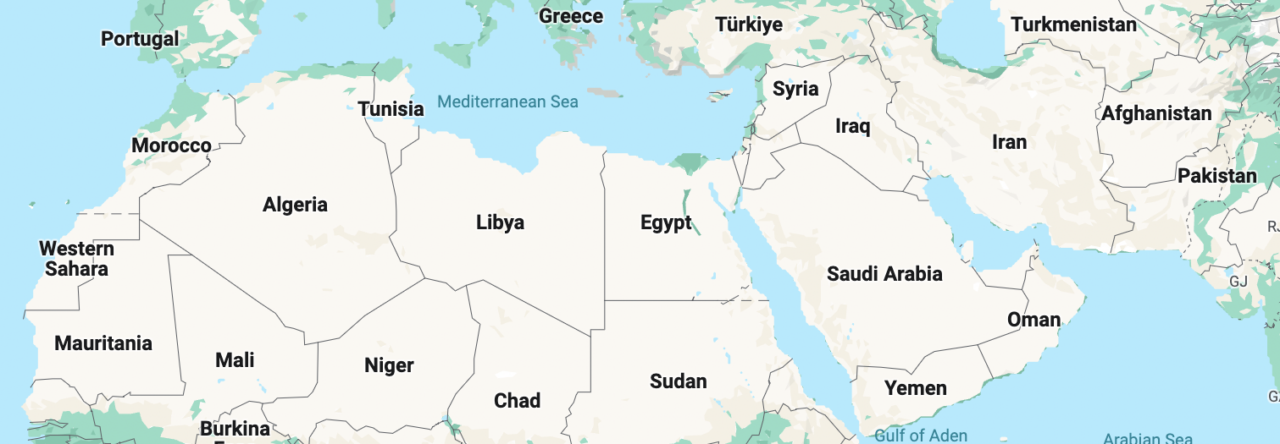
Misunderstanding the Region:
Lisa Anderson’s 2006 analysis on understanding democratization in the Middle East conveys the problems that arise when political scientists attempt to understand the region. Many of these problems originate in a lack of of understanding. The Middle East’s history and geography make it different from any other region. Political scientists have forgotten this when examining the region and have tried to force “western categories and western discourse” (Anderson 191) onto it. This has led to many studies on democratization in the region, but Anderson points out that this is due to bias. She argues that there is bias in political science when it comes to applying western theories because of American foreign policy (Anderson 209). The push for democratization worldwide has historically been a core component of American foreign policy. Naturally, the United States has wanted this for the Middle East as well. Since the region is not overwhelmingly democratic, the question of why has been at the top of political scientist’s minds. The problem arises when there is an “emphasis on democratization” (Anderson 209) and not much else. Anderson uses a metaphor to describe this way of thinking, like searching in the light for something lost (Anderson 208). Political scientists have tried to uncover the mystique around the lack of democracy, but there is not much one can do when such little democracy exists. There have been “glimmers” (Anderson 208) but nothing concrete to study. This leads to a lack of understanding and missed opportunity to truly understand the region. If research was not constantly trying to fit the Middle East into western boxes, there could be new discoveries.
How Do We Fix This?
A good way to compensate for these problems is to be aware of personal bias. This can often be very challenging to do, speaking from personal experience. As someone who was born and raised in the United States, went through American public school, and has taken many courses in American political science, it is easy to switch into a solely Western perspective. Even a majority of my past political science classes have focused on American politics or American foreign policy. It takes a lot of work to shift my thinking away from the American experience in the world and think about how other countries operate. I think awareness is a useful tool in fixing this bias. When I read about the Middle East, I try and focus on the unique factors that shape the region. It takes more effort than when I read about the politics of the United States, but Anderson states how we “may have to search a bit more in the shadows” (Anderson 210) when looking at the politics of the Middle East.
The Impact of the Arab Spring:
I think Anderson’s analysis would not change significantly due to the Arab uprisings in 2010 and 2011. She explains how some political scientists are “diehard optimists”(Anderson 201) and think democratization was “a matter of time” (Anderson 201) while others are pessimistic. In a way, both turned out to be true. There were glimmers of democracy when countries started to protest , but the fallback to repressive regimes also proves the point of the pessimists. If Tunisia was successful in changing to a democracy and did not slide back to the conditions that started the uprising, then Anderson’s analysis would change. A country in the Middle East becoming a true democracy would prove that democracy was waiting in the shadows all along. Political scientists would then apply their findings to the rest of the countries in the region and expect the rest to fall to democratization. The failure of the Arab uprisings shows that much of Anderson’s analysis still rings true. The complexity and mystique of the region is still there. The cases of democracy almost succeeding and then falling back to authoritarianism prove that this region does not “fit into the restrictive terms of political science” (Anderson 210). Political scientists should continue to evolve their way of thinking about democracy and the Middle East.
Works Cited:
Anderson, Lisa. “SEARCHING WHERE the LIGHT SHINES: Studying Democratization in the Middle East.” Annual Review of Political Science, vol. 9, no. 1, June 2006, pp. 189–214, https://doi.org/10.1146/annurev.polisci.9.072004.095345.
Image Credit:
NPR Staff. “The Arab Spring: A Year of Revolution.” Npr.org, 17 Dec. 2011, www.npr.org/2011/12/17/143897126/the-arab-spring-a-year-of-revolution.
Ed Webb
Quite persuasive! I’m a bit nervous about the term “mystique” since for me it evokes the tropes of Orientalism. But in other respects this makes a great deal of sense.
johnsohe
I was not aware of that connotation of “mystique” and will be more careful in the future with word choice!