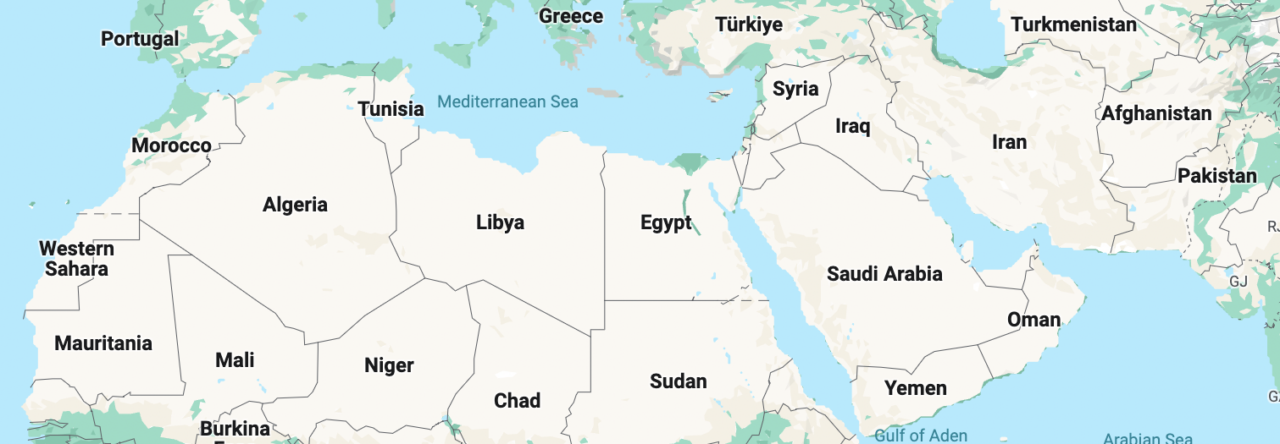
New Tools for a Unique Region
After finishing my first political science class centered on the MENA region, my understanding of authoritarianism and change in the region has grown immensely. Before this class, I only had a surface-level understanding of the different regime types, barely knew anything about their political economies, and tended to group many of the countries together. When considering everything I have learned, I think one the most important tools for studying authoritarianism and change in this region goes back to one of the first articles we read in this class. Lisa Anderson’s 2006 article, the topic of our first blog post, always comes back to my mind. I think her analysis should be considered by anyone studying political science in MENA. Her idea of a tool for understanding is a mindset shift. According to Anderson, political scientists tend to generalize the region with westernized theories and do not tend to ask the right questions (Anderson 2006). Especially in the United States, political scientists tend to relate everything back to democratization and the American experience, but this is not the case for everywhere else in the world. Anderson uses the metaphor of trying to look for a lost key in the light and not in the shadows, like how the political scientists constantly try and look for glimmers of democracy in the Middle East. This metaphor conveys the tool we need to better understand the region. Instead of looking at why democracy has failed, it is more important to look at why authoritarianism persists.
It All Goes Back to Political Economies…
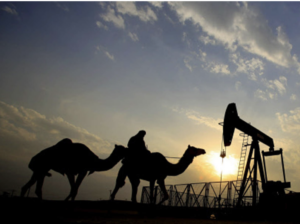
In my opinion, the most logical explanation for the persistence of authoritarianism is centered around political economies and resource wealth. While regime types and specific histories can be important factors in some cases, resource endowments make a more compelling argument. I think Michael Ross’ work on oil and democracy makes the best case for this. His arguments about rentierism, the spending effect, and group formation effect convinced me, and I was able to apply it to multiple countries when writing my midterm paper (Ross 2001).
A Look into Sources
Finally, I learned a lot about the different things one can learn from different kinds of sources. While certainly a tough read at times, Cammett, Diwan, Richards, and Waterbury provided a necessary baseline for everything from the regime types, political economies, history, and status of health and food in the region. I felt I needed to know a lot of this information because most of it was completely new to me. I think this source was more about understanding each country and the important factors for authoritarianism. Wedeen’s book provided a completely different understanding, which I also think was very necessary. Her book on Syria was a much more personal and detailed account. I liked learning about the story of M, getting more information about Syrian family structures and everyday life, and seeing the pictures, jokes, and political cartoons. A source like this is important when inserting humanity into studying authoritarianism and change. While meant to be comical, the political cartoons really emphasize the struggle and repression that Syrians faced. I think detailed books like this should be used in tandem with a more broad book like from Cammett, Diwan, Richards, and Waterbury.
Works Cited
Anderson, Lisa. “SEARCHING WHERE the LIGHT SHINES: Studying Democratization in the Middle East.” Annual Review of Political Science, vol. 9, no. 1, June 2006, pp. 189–214, https://doi.org/10.1146/annurev.polisci.9.072004.095345.
Cammett, Melani, Ishac Diwan, Alan Richards, and John Waterbury. 2018. A Political Economy of the Middle East. Routledge.
Ross, Michael L. 2001. “Does Oil Hinder Democracy?” World Politics 53 (03): 325–61. https://doi.org/10.1353/wp.2001.0011.
Wedeen, Lisa. 2015. Ambiguities of Domination : Politics, Rhetoric, and Symbols in Contemporary Syria : With a New Preface. Chicago: The University Of Chicago Press.
Image Credit: The Economic Times
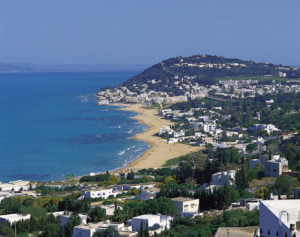 He talks about how there used to be about 2 cm of rise a year, and now people are seeing a 2-4 cm rise in the span of 6 months (Fekhi). Mere centimeters do not seem like cause for concern, but it is noticeable over time. One clip showed a waterfront hotel where the water was coming up to the steps, and a man said it seemed like the ocean was always getting closer when he looked at it. These testimonies make the situation much more real for viewers. It’s even more troubling when you consider that this was filmed nine years ago. A recent article from the Tahrir Institute For Middle East Policy reported that Tunisia’s Kerkennah islands could see a rise of 50 cm by the end of the century, and significant parts of the islands would disappear underwater (Tahrir). The other issue highlighted about salt is the fishing industry. Fishermen were interviewed and all shared similar experiences about the lack of fish. Historical overfishing and warming ocean temperatures have drastically reduced fish yields in the Mediterranean. As this continues, more people who depend on the sea to make a living will come up short.
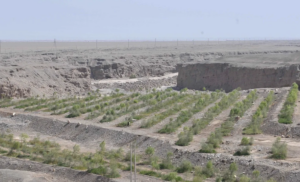 what that meant for people and their lives. One resident states how “the sand can annihilate a whole city” (Al-Faouar). As global warming increases, more land eventually becomes desert due to lack of rain. Wind pushes the sand around, often impacting agriculture. While sand seems not as damaging as other effects from global warming, the testimonials in the film argue differently. So many people highlighted how towns can shut down when there’s too much sand, the lack of crops, and fear for the future.
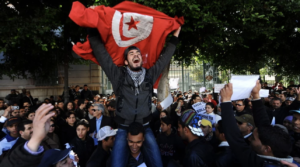 , but the fallback to repressive regimes also proves the point of the pessimists. If Tunisia was successful in changing to a democracy and did not slide back to the conditions that started the uprising, then Anderson’s analysis would change. A country in the Middle East becoming a true democracy would prove that democracy was waiting in the shadows all along. Political scientists would then apply their findings to the rest of the countries in the region and expect the rest to fall to democratization. The failure of the Arab uprisings shows that much of Anderson’s analysis still rings true. The complexity and mystique of the region is still there. The cases of democracy almost succeeding and then falling back to authoritarianism prove that this region does not “fit into the restrictive terms of political science” (Anderson 210). Political scientists should continue to evolve their way of thinking about democracy and the Middle East.