Category: Benjamin of Tudela (Page 1 of 2)

Medieval Map: The Tabula Rogeriana and the Itinerary of Benjamin of Tudela

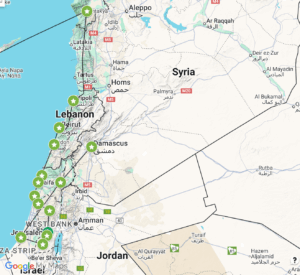
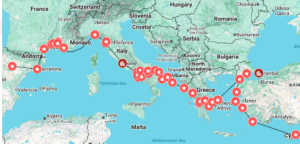
The Tabula Rogeriana, completed in 1154, was an atlas commissioned by the Norman king Roger III of Sicily by Al-Idrisi, a Muslim geographer. Though it was one of the most detailed and accurate world maps of its time, it is very different from our standard world maps in 2025, almost 900 years later. Having plotted parts of Benjamin of Tudela’s journeys on both the Tabula Rogeriana and a modern map, there are several significant comparisons to be made between the two experiences. It is of course much easier to plot many accurate points on a modern map using modern software; GPS systems do most of the work for us once we enter the name of a town or city. I was able to plot dozens of places that Benjamin of Tudela stopped fairly quickly in Google Maps, as long as the location still existed or I was able to estimate where it is now.

On the Tabula Rogeriana, the cities are marked and labeled, but since it is written in Arabic and the points are quite small, I was not able to mark the locations as precisely as on a modern map and instead had to estimate where to place the icons. In addition, the axis is switched, with South on top according to medieval Muslim theology. Many features of the map are misshapen and features are also missing, which made some places difficult to map. Rome, especially, was hard to figure out, because its shape in the Tabula Rogeriana is very different from our modern visualizations.

One of the reasons that the Tabula Rogeriana is laid out very differently is that it places Mecca at the center of the world, which, like the South-North layout was standard for medieval Muslim maps. All of the medieval maps that we have studied, across various religions and regions, are based on ideology as well as, or more so than, geographical accuracy. This shaped the way that medieval travelers would have perceived the world, as well, when religion was central to life and philosophy across Europe and the Middle East, where Benjamin traveled. Modern maps, in contrast, are utilitarian, based on standardized measurements of distance. Though there are various projections which change the size of the continents in relation to each other, they are not constructed to promote a certain worldview or belief system.

In the 12th century, travel was hard and dangerous, and most normal people did not spend very much time traveling through their lifetimes. Travel itself was an enormous undertaking. Now, travel is easy, fast, and widely accessible. In some ways this is reflected in the difference between the two maps. When broad travel was difficult and rare, limited to walking, riding, or ships, constructing a map that accurately reflected the world was nearly impossible. It took Al-Idrisi more than 15 years to complete the Tabula Rogeriana, and he relied mostly on older writings and accounts of contemporary travelers. Modern technology allows us to map the world perfectly and access information about any place in the world in an instant. I was able to be more comprehensive and precise while reconstructing Benjamin of Tudela’s route in Google Maps, but the Tabula Rogeriana is likely closer to his conception of the world and how he would have mapped his travels.


StoryMap page:
 

The Itinerary of Benjamin of Tudela: Baghdad


From Okbara, Benjamin arrives in Baghdad. He focuses primarily on two people in this section: the Caliph and the Head of the Captivity of Israel. Religion is the main subject here. He first introduces Caliph Emir al Muminin al Abbasi of the family of Mohammed. Baghdad in the 12th century was the capital of the Abbasid Caliphate, an empire which at its height controlled the entirety of the Arabian Peninsula and large swathes of the Middle East and North Africa. Benjamin compares his role in Islam like that of the Pope over the Christians, the most important figure in the religion, revered by all Muslims of the empire.

Benjamin of Tudela seems to admire Caliph al Abbasi greatly. He cites his benevolent attitude towards the Jews; he is “kind unto Israel” and has many Jewish attendants. He is well-versed in Jewish law and in Hebrew. Benjamin asserts that al Abbasi is truthful and trustworthy, speaking peace to all men. He calls him a righteous man, whose actions are all for good. He describes at length al Abbasi’s acts of charity. He built a hospital for the sick poor, where every man is treated at his own expense. In addition, there is a sort of mental hospital, where the Caliph provides for them also, even giving them money at their discharge. Strangely, the Caliph’s siblings and family are all imprisoned in their homes inside the palace, to prevent them from rising against him. However, Benjamin assures us that they reside in “great splendour” and are all living lives of great luxury. Perhaps this was a normal enough precaution for kings to take in Benjamin’s time that it did not seem unreasonable to him, or perhaps he admired the Caliph’s actions or patronage of the Jews enough that it did not matter to him. It is interesting that Benjamin of Tudela respects the leader of a different religion so greatly. Throughout the text it’s clear that being Jewish is the surest way for Benjamin to be assured of a person’s goodness, but obviously it is not the only way. He appreciates other signs of good character, like charitableness, peacefulness, modesty, intelligence, and an egalitarian approach to other religions, all traits which he believes al Abbasid possesses.

In Baghdad, there are 40,000 Jews, a very large population, as they live in security and prosperity under Abbasid rule. There are ten Academies in the city, and many great Jewish academics and sages. There is an office of the “Head of the Captivity of Israel”, who has authority over all the Jewish congregations and is appointed by the Caliph. Benjamin writes that this Head of the Captivity is honored by both Gentiles and Jews. He has authority over a large region, within which he gives communities the power to appoint Rabbis and Ministers who receive his authority, and from which he receives tribute. He owns land and receives revenue from Jewish markets and merchants. This position is also known as Exilarch, the hereditary head of the Jewish community, recognized by the ruler, and was present in the region for hundreds of years up until the fall of the Abbasid Caliphate. The safety of the Jews and the Caliph’s appreciation of them clearly assured their stability, as Benjamin says the Jews of Baghdad are well-educated and rich. There are nearly thirty synagogues in the city, crowned by the great synagogue of the Head of the Captivity. He says the city is a full twenty miles in circumference, with gardens and plantations, and prosperous trade, philosophers, and magicians. Overall, he speaks very highly of Baghdad and finds one of the most prosperous Jewish communities there.

The Itinerary of Benjamin of Tudela: Constantinople

Five days’ journey from Abydos is Constantinople, the seat of the Greek empire. Benjamin of Tudela briefly describes the structure of the government under King Emanuel, with his twelve ministers. As is typical for this account, Benjamin does not describe the practical or physical aspects of his journey—there is no indication of where he stayed, or for how long, or how he traveled to and from the city. He does describe the terrain surrounding the city and how it is situated on a peninsula, surrounded on one side by an arm of the Sea of Russia and the other side the Sea of Sepharad. It is eighteen miles in circumference, one of the larger cities he has visited.

He spends a large part of this excerpt talking about the merchant activity, wealth, and material possessions of Constantinople and the Greeks. We know very little about Benjamin of Tudela outside of his Itinerary, but a common theory is that he was a merchant of some kind. This passage certainly supports this conclusion, since he seems especially interested in trade and goods out of everything he saw in Constantinople. In fact, the majority of his writings on this city are devoted to those subjects. He says that Constantinople enjoys lots of merchant activity from all over: Egypt, Persia, Hungary, Russia, Babylon, and more. In terms of the architecture, he describes churches and palaces with pillars of gold and silver, inlaid with precious stones. He says that the King’s palace, Blachernae, was made of so many precious metals and jewels that it shone by moonlight. He is also concerned with the tributes received from all over the kingdom, the total of which he is told amounts to 20,000 gold pieces every year. These include silks and fabrics of purple and gold, the most precious and expensive colors. The inhabitants themselves are rich in gold and jewels and wear silks and embroidery. They ride horses and eat bread, meat, and wine. He says they “look like princes,” and calls it the richest land in the world.

In contrast are the Jews of Constantinople, who are relegated to a ghetto outside the city, behind and inlet, so that they must travel by sea to get in or out. He says that they are permitted to do business in the city, and that there are silkmakers and rich merchants among them, but overall their condition is poor. There are 2,000 Rabbanite and 500 Karaite Jews, divided by a fence. Benjamin sees that the Greeks hate the Jews, defiling their homes and beating them in the streets. These are some of the worst conditions of the Jewish population seen in his travels. Yet, he says, the Jews are good, kind, charitable, and cheerful despite their oppression. Wherever the place, Benjamin of Tudela speaks highly of Jews, even in unfamiliar lands or of different ethnicities, when he otherwise dislikes or distrusts the native populations. There was great allegiance among the Jewish diaspora of Benjamin’s time, and a great desire for communication between scattered groups of Jews, as noted in part II of the introduction: “In the sacred tongue they possessed a common language, and wherever they went they could rely upon a hospitable reception from their co-religionists. Travelling was, therefore, to them comparatively easy, and the bond of common interest always supplied a motive.” Interestingly, he writes that despite the widespread hatred of Jews the King’s physician, R. Solomon Hamitsri, is a Jew who lives in the ghetto, and through him the rest of the Jews enjoy some alleviation of their condition. In this time period the status of Jews was often extremely precarious, changing from one ruler to the next even within a single dynasty, region, or city. In these climates, individuals like R. Solomon could potentially bring their community up with them to a certain degree.

Two of the most common hypotheses for Benjamin’s reasons for traveling are present in this excerpt: first, the merchant theory, as mentioned previously, based on his great interest in trade, wealth, and goods in and out of Constantinople. Second, his interest in the conditions of Jews in each place he traveled, potentially writing a guide for his community on the safest places to live and move around.

The Itinerary of Benjamin of Tudela: Cairo

Benjamin of Tudela’s description of Cairo (Mizraim) is dominated by discussion of the Nile river. The importance the river has to all aspects of life in the city and its surrounding regions cannot be overstated. It is both a form of protection, eliminating the need for a city wall, and the center of their food production (99). He describes the rising and falling pattern of the river in great detail. The rising of the river is both an important cultural and agricultural event. He draws great attention to the pillar that measures the height of the flooding as a cultural oddity that only exists due to the unusual seasonal changes of the region. He also discusses the ways in which the river’s flooding affects how agriculture is practiced. Bountiful fish end up in farmlands and water covers the earth for two months (100). This pattern is the only thing that allows for any farming in the otherwise arid climate and if it ever fails to occur great famine spreads through the land. Benjamin’s focus on farming in this section differs from his previous descriptions because, while he occasionally had comments about the market goods in other areas, he paid little attention to the process of getting them to the cities. This may be because it was simply standard practice while the Nile creates notable differences, but it could also be a sign that he was only relating other people’s stories rather than his own. He also spends far less time discussing the topics that he usually focuses on like the built environment.
He does acknowledge the similarly unusual structure of the Jewish community in Cairo, another of his standard factors of note. They are divided into two different congregations, those who follow Babylonian customs and those who follow Israeli customs. Specifically, he notes the difference in how they divide the portions of the Torah with Babylonians doing one portion a week and Israelis doing one third of a portion each week (98). He also makes sure to state that the Babylonian method is the same as how the Jews back in his home country of Spain divide the portions. This offers his audience of Jews who may be looking to move to areas of less persecution an insight into which foreign communities are most similar to their own. Benjamin has been, perhaps surprisingly, sparse in his description of the actual religious practices of the Jewish communities he has been documenting because, despite all following the same religion, there were great differences in practicalities region to region. A Jew from Spain may find the observances of a Jew from Baghdad completely alien despite originating from the same text and following the same basic principles. While other elements that would be important to a potential immigrant such as the size of the Jewish community and their status within society are addressed, how easy it would be for a newcomer to fit in is left ambiguous. However, Cairo shows that despite the division of the Jewish community they can still come together for special occasions to practice as a single great unit.

The Itinerary of Benjamin of Tudela: Damascus

In this excerpt, Benjamin of Tudela enters Damascus and spends two pages describing it. He takes on a tone of admiration throughout most of the section, writing appreciatively about the city overall. He says that they trade “with all countries,” indicating wealth and cosmopolitanism. They seem to have rich architecture and large marketplaces. There is abundant water from the two rivers which flow into the city, and infrastructure that brings the water to houses and gardens. He describes building features of glass, gold, and silver. Particularly impressive to him are the Gami mosque and the palace. In the mosque there is a wall of crystal glass “of magic workmanship,” with an integrated sundial. It seems that he has not seen anything like this before either at home or in his travels so far. His journey took place during the Islamic Golden Age, during which such technological and artistic innovations flourished, and we experience it through Benjamin of Tudela’s outsider’s perspective.

It can already be assumed that Benjamin of Tudela, as a product of his upbringing in recently Muslim-controlled Navarre, would have been quite familiar with Islam and its cultural influences. It shows up in this excerpt; it does not seem as though the people or practices as particularly foreign to him, nor does he pass judgment on the people and practices as he does in other sections (such as the children of Ammon). For example, he admires their mosque, saying that there is no building like it in the whole world, and does not state any further opinions. In this passage, like in several of our other readings, there is a mention of the ancient giants which once ruled the world. A rib of one of these giants is said to be housed in the palace. He is told that this rib belonged to the King Anak, or so it said on his grave. It’s interesting that the biblical mythology of the giants was so prevalent across the Abrahamic religions in the medieval era, brought up frequently throughout the writings of all the travelers. It’s not something that’s brought up often in modern life.

As usual, Benjamin completes the passage by cataloguing the Jewish population in Damascus, noting population, particular important individuals, and relationship with others in the city. He does not explicitly discuss the state of Jewish rights in Damascus, but since three thousand Jews lived in the city at the time it was probably accepting to his people to a fairly high degree, and perhaps they enjoyed some privileges. Many Palestinian Jews came to Damascus escaping the crusaders, bolstering the Jewish population in the city before Benjamin of Tudela’s arrival. Damascus was under Seljuk rule at the time: he writes that the city is the beginning of the empire of Nur-ed-din, the king of the Turks. The place of Jews under Turkish rule often changed from king to king. It’s unclear based on this text alone exactly where Nur-ed-din stood. There are  several notable Jewish scholars in Damascus that he names, all of which work in some fashion for the Academy of the Land of Israel, including the head of the Academy. There are also 400 Cuthim (Samaritans) and a hundred Karaites, which are an alternative sect of Judaism. According to him, their relationship is peaceful, but they don’t intermarry. He doesn’t specify if this peaceful relationship extends between them and the rest of the Jews of Damascus, but he doesn’t mention any conflict either. As I’ve touched on in other posts, Benjamin of Tudela could have been writing a sort of guide for other Jews across the diaspora. The introduction to the Project Gutenberg edition speculates that wide-scale upheaval in Jewish communities during the era of the Crusades and of Christian encroachment into Spain may have motivated Benjamin to find places suited for asylum if needed and convey the information back to the Jews of Navarre. This seems like a reasonable extrapolation.

Benjamin of Tudela: Baghdad

For the first time in the text, Benjamin of Tudela spends more time talking about the people of a city than its architecture. Despite the grandeur of twelfth-century Baghdad, he spends comparatively little time discussing the monuments and far more time on the Caliph and the Head of the Captivity. Benjamin heaps praise on the Caliph with special note of his great charity. The Caliph is described as a generous and kind leader who treats the Jews in his city with grace as well as the Muslim citizens. He pays great attention to the hospitals run by the Caliph, especially their treatment of “the demented people who have become insane in the towns through the great heat in the summer” (59). That this care is worthy of note to Benjamin shows the rarity of care for the mentally ill in his own culture or the cultures he has traveled through to this point. The Caliph’s care for these people is a sign of his great benevolence. The scorching climate drives the reason from these people, but they are cared for and nursed back to health on the Caliph’s dime. Baghdad is depicted as a place where people are cared for, and its wealth is used for the direct benefit of the citizens. Even the Caliph himself is a man of hard work and virtue who “will not partake of anything unless he has earned it by the work of his own hands” (55). The public support channeled through the Caliph makes Baghdad one of the most uplifted cities Benjamin visits.
An even greater aspect in Benjamin’s eyes is the thriving and exalted Jewish community living in Baghdad. While in most previous sections, even the very short ones, he frequently lists Jewish leaders in the places he mentions, for Baghdad he lists all ten heads of the academies, the chief Rabbi, and the Head of the Captivity along with their pedigrees. Much attention is given to the Head of the Captivity as both the head of the Jews throughout the Middle East and Asia and as an important and high-ranking figure in the Caliph’s court. The office of the Exilarch commands respect from all members of the court regardless of religion upon threat of whipping (61). He occupies an exalted position which reflects a raised, or at least not oppressed, status onto the rest of the Jewish community. The honor he receives as well as the vast numbers of Jewish residents in Baghdad show the high quality of life they experience. The numbers of Jews he lists in each city increase as he travels through the Middle East. The numerous academies and high positions of respect and authority held by Jews make Baghdad a Jewish scholar’s dream, especially compared to the discrimination he had witnessed in other places along his journey. If Benjamin’s mission is to report to diasporic Jews where they might want to travel, then his account of Baghdad is his most glowing review thus far. It is a city of great learning with benevolent leadership and the center of Jewish religious authority.

The Itinerary of Benjamin of Tudela: Jerusalem

In this passage, Benjamin of Tudela describes the demographic makeup of Jerusalem, lists several landmarks of note, writes a bit about infrastructure, and describes the surroundings of the city, including the Mount of Olives, the Sea of Sodom, and the valley of Jehoshaphat. Reading this, we can get some idea of the conditions in and around the city at the time, and what the important religious sites were like. He came from just north of Jerusalem from “Mahomerie-le-Grand” or Gibeon, according to him three parasangs from Jerusalem (probably just over ten miles distance, a day or two’s journey). As is common with Benjamin of Tudela, he records no specifics about travel logistics, length of stay, or dates

Jerusalem is and was one of the holiest (if not the holiest) site in all three Abrahamic religions. Since long before Benjamin of Tudela it has been a place unique in all the world because of this. Though he calls the city small, he describes it as very religiously, ethnically, and linguistically diverse, inhabited by Jacobites, Syrians, Greeks, Georgians, Franks, and various others. Since Benjamin’s journey likely began in the mid-1160s, Jerusalem would have still been under Crusader rule for another decade or so, until 1187. He estimates that only 200 Jews remained in Jerusalem, probably a result of the policies of the Christian kings—Jews were deported or temporarily banned throughout much of this period. He does still describe Jewish and Muslim inhabitants, however, and Muslim, Christian, and Jewish holy sites. Jewish dyers did have singular access to the profession in exchange for a small annual tax, according to Benjamin. This was clearly not a high point of the Jewish population in Jerusalem, but perhaps not the darkest either. He notes that the few hundred Jews in the city all live together in one corner of the city, under the Tower of David. Isolation of Jewish communities, either self-imposed or decreed from above, has long been common, especially during hostile administrations. He also writes that there are old Israelite cemeteries just outside the city, but the Christians had been destroying the sepulchres and using the stones to build their own houses.

Since Benjamin of Tudela often writes in a fairly impersonal manner and does not typically discuss logistics or personal experiences, it’s difficult to tell what his experience of Jerusalem was like as a Jewish man, but it seems that he didn’t face any difficulties traveling freely in and out of the city from authorities, at least not ones he found worth mentioning. He talks briefly about some existing Jewish holy sites, including the wall of the court of the Temple, and the old pool used by priests where Jews write their names on the wall. Interestingly, he spends more time on an anecdote about the sepulchres of the kings of Judah than on any other aspect of the city. The story is an explanation of why the exact locations of the sepulchres are hidden and sealed up, as told to him by a Rabbi Abraham el Constantini. Rabbi Abraham is one of the infrequent individuals mentioned which Benjamin of Tudela has a personal exchange with; in other cases, he also relays stories as told to him by Rabbis, whom he clearly finds trustworthy as a whole. This makes sense: Rabbinical status would have implied respectability and learnedness to him.

This excerpt doesn’t directly explain the political and religious climate of Jerusalem at the time, but that theme does run through many parts of it, giving unique insight into the relationship between Christians, Jews, and Muslims from the point of view of a foreigner. It feels like a sort of uneasy accord. However, this is a fairly short piece of writing, and Benjamin of Tudela was simply a traveler, who probably didn’t spend very much time in Jerusalem. As usual, Benjamin is focused mostly on architecture, sightseeing, general lifestyles, interesting stories, and Jewish communities. At most places he stops, he at least briefly describes the condition of the Jewish population, if it exists, potentially indicating that his intended audience is primarily other Jews.

The Itinerary of Benjamin of Tudela: Jerusalem

Benjamin of Tudela’s account of Jerusalem focused primarily on the major sites of worship and the variety therein. He described the vast diversity of peoples found there as “Jacobites, Syrians, Greeks, Georgians and Franks, and of people of all tongues” (35). He claimed that these were the names the Muslim residents had for these peoples which shows that while he acknowledged the diversity of peoples in Jerusalem, he had little personal ethnographic interests. His attention quickly turned back to architecture, which has been his primary focus whenever he stopped to say more than the briefest description of a place. In quick succession, he mentions the Sepulcher, which is a holy place for Christians, the Dome of the Rock, a Muslim holy site, and the western wall, which is a Jewish holy site (36-37). The proximity of these locations makes the quick transitions easy; however, his description shows how tightly intertwined the members of the Abrahamic religions were in Jerusalem. Despite traveling in the wake of the second crusade, the city Benjamin describes has plentiful Christians, Muslims, and Jews all worshipping in the same areas. The differences are in the way each religion’s presence appears. Jewish structures are shown to be the base on which later developments are added. The Tower of David and western wall are relics of an ancient past which permeates the city despite the small Jewish population. Islamic structures are the ones built on top of the ancient ones. They are the contemporary rulers who hold the most current sway. Even though the sites Benjamin mentions are not themselves new, they are recent in comparison. Islamic influence is the driving force of change in Jerusalem which builds upon the Jewish past. The Christians, however, are presented as a primarily military presence. The remnants of the crusades appear in the hospital of St. John, the Temple of Solomon, and the combined seven hundred knights house between them. The Temple of Solomon is another ancient site that has been taken over by the crusaders. They are not described as contributing to the growth of the city, but rather as heavily armed pilgrims making dramatic shows of force.
This section also features a more narrative anecdote which stands out dramatically from Benjamin’s otherwise incredibly dry writing. He tells a story he heard about a pair of workmen who entered the sepulchers of the biblical kings and were scared off by the voice of God (38-40). This story shows a sense of wonder that Benjamin has for the holy land and the belief in an increase in miracles in this holy and historied place. Biblical lands deserve recent stories that reaffirm the divine nature of the sites. The story also reaffirms the place of the Jewish community as the guardians of ancient sites in Jerusalem, as when an issue arose with the restoration of the sepulcher the Patriarch turned to Rabbi Abraham (who supposedly told Benjamin this story himself) for assistance (40). Jewish scholars are framed as the ultimate authorities on ancient relics and how to handle them. Their sites form the foundation of the holy city and are protected by God himself.

Benjamin of Tudela Modern Map

Europe

Asia

Link to full map: https://www.google.com/maps/d/edit?mid=1KbMXk61iebYfY4LHM5QQkYRSbhjzPmw&usp=sharing


The main two categories are by region. I have mapped Benjamin of Tudela’s travels in Europe (red) and Asia (green). Important locations on which he spends the most time are marked in slightly darker colors with city icons.

« Older posts

© 2026 Mapping the Global Middle Ages


Academic Technology services: GIS | Media Center | Language Exchange

Theme by Anders NorenUp ↑