Category: Ibn Battuta (Page 1 of 2)

Medieval Travel Map: The Travels of Ibn Battutah

The Tabula Rogeriana was not a one to one accurate map, but considering it is a Muslim map it was ideal for plotting Ibn Battutah’s journey. Mecca was at roughly the center of this map as the most important city to the religion of Islam and the original goal Ibn Battutah had when leaving his home of Morocco for the first time. Besides the geography of the time being somewhat inaccurate, this map gets the general shape of landmasses correct. This made mapping the locations easier than most medieval maps and also makes it easier to read coherently, as long as the reader knows which way it is oriented. Once again because of the Islamic craftsmanship, this map is oriented with south at the top and north on the bottom. East and west are also flipped accordingly, which can cause some difficulty with locating things. The scope is also perfect for tracking Ibn Battutah, as his entire journey never leaves the bounds of this map. Morocco is far on the right hand side and the farthest east he goes is Peking in China, all of which is present there. For its time, the Tabula Rogeriana was considered a world map since the Americas had not been discovered yet. Some known land was omitted from this map of the world, namely the southern two-thirds of Africa. The map was centered around not just Mecca it seems but the entire Islamic world, as at the time the majority of this land was under Muslim control. Seeing as the only parts of Africa that made it in were the northern countries that were primarily Muslim, the continent was likely cut out pertaining to relevance for those that might be reading the map, as well as the cartographer’s own desires.

Ibn Battutah probably did not use maps much at all during his time travelling, mainly due to ease of access. It was also fairly easy to hire guides or rely on slaves that could speak the language of the foreign country they were navigating. Muslims at this time also relied little on written documents and more on memory, with Ibn Battutah’s entire travels even being recorded by his later recounts of them. If he did have some form of map, it was likely lost or stolen as happened to many belongings he travelled with over the years. Aside from the likelihood of him carrying a map, Ibn Battutah would have agreed with the way the Tabula Rogeriana shows the world. Being a jurist of his faith, Ibn Battutah’s whole journey revolved completely around his religion and how it should be practiced. His constant policing of his religion throughout the lands he travels falls in line with the Muslim centric view of the world seen in the Tabula Rogeriana. Mecca’s centrality would also likely please him, as the pilgrimage was so important to Ibn Battutah that he did it more than once in his lifetime. With Islam being such a big part of his life and in some ways his purpose, having the world displayed as it is in the Tabula Rogeriana would be validating to say the least.

As a jurist, Ibn Battutah saw the world in relation to the laws of Islam and its practice. His pilgrimage was the original intention of his journey, but after reaching Mecca he traveled farther to spread his faith and act as an advisor to foreign rulers. In the modern day, it is generally frowned upon to travel somewhere and critique local customs or be judgmental of cultural and religious differences. While it may have been his job, Ibn Battutah judges cultural differences often, sometimes openly to whatever government official is in front of him. Not only would the more cautious and respectful mindset modern travelers have be lost on him, but Ibn Battutah would likely find it difficult wanting to travel anywhere as the Muslim world is significantly smaller than when he was alive. Given the larger reach of Islam, he also encountered many Muslims wherever he went and was met with primarily Muslim countries and cities. Traveling today, he would not be received with Muslim hospitality in every city and not be given such special treatment either, resulting in miserable conditions for travel in terms of what he thought of as standard.

So considering Ibn Battutah’s journey in relation to not only the Tabula Rogeriana but also modern day maps, it appears that the medieval map would be preferrable for him. Not only would it be better in line with his beliefs, but the differences in the modern world make it hard to imagine Ibn Battutah traveling in it or using modern maps.
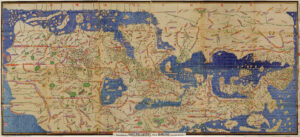
Ibn Battutah – Medieval Map

Storymap

The most significant difference between al-Idrisi’s Tabula Rogeriana and our modern Google Earth map, is, of course, its orientation: the Tabula Rogeriana is oriented south-up, and we in modern times are most accustomed to thinking of north as upwards. This difference reflects a variation in religious and cultural beliefs. Muslims, such as Muhammad al-Idrisi, the map’s creator, and Ibn Battutah, a well-traveled medieval jurist, would think of south as being downwards and closer to hell, because in Islamic cosmology hell was cold. On the other hand, our modern satellite maps, made in a culture dominated by those of European descent, continue to place the European continent at the top of the world. And because this culture is also largely dominated by Christianity, we might tend to think of the hotter southern lands as being more hellwards. Ibn Battutah might have thought of his journey as being relatively safe (at least, as safe as travel could be in that era), because he remained mostly in warmer, more “heavenly” zones, and didn’t journey terribly far into the hellishly cold northern climates. The Tabula Rogeriana also places Mecca as the center of the world, which is something Ibn Battutah likely would have internalized as well. A modern satellite map, however, has no center, and one can scroll across the whole map in one seamless loop.


The Tabula Rogeriana contains only the world that was known at the time, and focuses mainly on Europe, West Asia, and North Africa. It is most detailed around the Mediterranean, and becomes less detailed the further east it goes. Eastern cities such as Delhi, which Ibn Battutah visited during his travels, are nowhere to be found on the map. So embarking on such a journey could feel dangerous, as one is quite literally stepping into the unknown. Travel during modern times, on the other hand, is far easier to navigate, since satellite maps are able to provide an accurate image of an area, down to specific buildings and landmarks. Traveling is far less stressful and pathways are less unknown, because if one is lost, one can simply open the satellite map and use their location to pinpoint exactly where they are in relation to everything around them. Modern maps also allow us to view the entire world, because we are able to literally send a camera up into space and take pictures of everything, and so we have knowledge of entire continents and landmasses that were completely unbeknownst to the people of Ibn Battutah’s time. 


The Tabula Rogeriana is surprisingly accurate for a map made long before the era of satellite photography. To draw the shapes of the landmasses so faithfully, especially over such a large area, is an impressive feat indeed. That being said, the map is the most accurate along the coastlines of the Mediterranean. It would, after all, be far easier to draw a city located on the coast than to draw one further inland, where there may not be as significant a geographical feature to locate it by. While mapping Ibn Battutah’s journey on the Tabula Rogeriana, I had a far easier time locating the coastal cities he visited. With the inland ones, though, I sort of had to take my best guess and zoom in, and then scan around a lot until I found a phonetically similar name (as I cannot read Arabic, I used a version of the map that had been helpfully transliterated into the Latin alphabet). For travelers such as Ibn Battutah, moving away from the coastline may have felt more like entering uncertain territory, since it’s easier to get lost and disoriented without an idea of what landmarks you can reference along your way. The Tabula Rogeriana also does not make any real distinction between cities based on size or landmarks, although there are a few exceptions. Alexandria is drawn with its iconic lighthouse, and there’s a grouping of four cities further east surrounded by a circular, almost spiky looking wall. Beyond that, though, there’s very little to differentiate one city from the next. Natural features such as mountains or rivers abound, but if one were to become completely lost and stumble upon some mountain or river, it would be very difficult to identify exactly which one you were looking at by using the map. Or, worse, you could follow a river or navigate around a mountain believing it to be the landmark needed to stay on your route, only to discover they were two completely different mountains and you’ve gone the wrong way entirely. Your best hope in order to ensure you take the right path and get to your destination would be to rely on locals familiar with the area. Much different than travel in this day and age, when any idiot can pull up Waze to tell them which route to take.

Medieval Map Project: The Travels of Ibn Battutah


Mapping Ibn Battutah: Ibn Battutah Medieval Map — Dailey (Editing)

Ibn Battutah spends the second section of his account traversing Syria, venturing from modern day Cairo, Egypt to Hama, Syria, and beyond. Nearly all of his travels have been confirmed by scholars of the Middle Ages, which allows for modern scholars to map his journey with great accuracy. However, to gain more insight into how Battutah himself would have conceptualized the world of his travels, it is helpful to view his journey on a Middle Age source. The Tabula Rogeriana, created by Muhammed al-Idrisi in 1154, continued to be the most accurate and detailed world map through Battutah’s time (he departed in 1325). The Tabula Rogeriana would have likely been a well-circulated and widely utilized resource for Battutah and his contemporary travelers. Mapping his journey, particularly the first ten stops he makes after his departure from Cairo, onto a map of his time provides a greater understanding for where he would have situated himself in the world, his belief systems, and his travel hardships. 

In viewing the two mappings of his journeys, the middle age and modern, alongside each other, we can make a distinction concerning religious authority in the two different time periods based on characteristics of the maps themselves. The most obvious is in the maps’ orientations. The Tabula Rogeriana is rotated upside down to how we now understand the world to be oriented, with the South pointing to the top. But, of course, in Battutah’s time, this made an equal amount of sense as our contemporary orientation. While our modern map is more scientifically based and pulls its orientation from things like knowledge about the earth’s rotation, magnetic poles, etcetera, Muslim maps in the 12th-14th centuries were ruled by religious belief. This is primarily due to the holiness of the city of Mecca. Muslims often lived north of the city, and so going south towards Mecca was seen to be the most correct orientation, associating the upward direction with righteousness toward Heaven. Similarly, the imagined Hell as being cold rather than modern interpretations of Hell as hot. This would orient North downward, as the further North you went, the closer, in theory, you would travel to the underworld. Modern maps are absent of religious influence and rely entirely on geography (though, it could also be argued that current divisions of land are intertwined with religion and politics, but as far as land mass and coordination itself, these things are absent). 

The division of climes present in the Tabula Rogeriana is another dividing factor between it and the modern map. The Tabula Rogeriana divides the world into seven climatic regions. Ideas about race, religion, and geography through the lens of Abrahamic religion often regarded those climes closer to the center as more agreeable, both in land and climate as well as in inhabitants. It is interesting that nearly all of the points mapped on this section of Battutah’s journey are pinpointed in the 3rd clime, with the first being the southmost. Though he journeys far and wide, he doesn’t leave the “comfort” of these climes. When he begins to travel out of these agreeable bounds, his discomfort around people different than him grows. Many of these locations are also holy – consider his decision to travel inland to visit areas from Hebron to Jerusalem. For the medieval traveler, this would mean that clearly based on geography alone, this area was indeed the holiest and best, and this would have reinforced their belief of Islam as the dominant, most correct religion. This also raises interesting questions about what Battutah would have thought his own biological makeup (though the same ideas about biology did not exist). Tangier similarly lies in the third clime. It is possible that based on these geographic details that oriented both the most holy places in Islam and his own country he would have found himself to be the same level of agreeable and well bred as those near the holy cities. 

The two maps side-by-side also highlight interesting differences between what locations are mapped versus what are not. The modern map seems to more accurately reflect some of Battutah’s fascinations with certain cities, notably Cairo. It is interesting that Battutah seems to assign so much reverence and excitement surrounding Cairo that one would assume would be reflected by a contemporary map as a notable city, especially concerning it lies somewhat near the coast and would have been easier to access. Yet, there is no mention or direction to Cairo on the Tabula Rogeriana. We know by its inclusion on the modern map that its influence has long survived and that it has been the sort of breathtaking, powerful city since Battutah’s time. Yet, we only visually see its representation when we view the modern map. I wonder if Cairo flourished greatly between the creation of the Tabula Rogeriana in the 12th century and Battutah’s 14th century travels. 

The modern map also more clearly highlights why Battutah would have stayed so close to the coast through its immense detail of mountain ranges, which visually hold less of a significance and do not seem as much of a hindrance on the Tabula Rogeriana. From a medieval standpoint, coastal travel would have been preferable because inland would have constituted the unknown. We visually see this on the Tabula Rogeriana with the sparsity of mapped locations inland. While the mountain ranges are highlighted well, their scale is a bit different to the modern. The detail and accuracy of the modern map shows just how aggressive these locations could be. On the Tabula Rogeriana, they seem frustrating at most based on visuals alone. The mountains are much closer to the coast on the modern map of well, which more accurately showcases the necessity of not venturing inland. Viewing this sector of Battutah’s travels on two different maps allows one to fully grasp the travel choices that Battutah made and how they were shaped by the world around him, as well as allowing us to examine the exponential ways that travel and cartography have developed and become methodic in recent centuries.


The Travels of Ibn Battutah: Dihli (Delhi)

Ibn Battutah dedicates two full chapters to the city of Delhi and the Sultan Muhammad Ibn Tughluq. As usual, he describes the pious men he meets there, as well as some of the unique architecture he sees, such as the wall surrounding the city, the Cathedral Mosque, and several great reservoirs of water that crops can be planted around. But the majority of his writing revolves around the Sultan and his two main hobbies: giving gifts and ordering executions. Ibn Battutah spends several sections displaying the wealth and power this king possesses, from the elaborate arrangement of his court during an audience to the elephants adorned with precious stones that he rides upon. He is very generous, and Ibn Battutah dedicates multiple sections to detailing the many fine gifts he has made to other men of note. He also once distributed stored food during a famine to provide for his people, and allowed a young boy to beat him as justice for a wrong he had committed against the boy, so he overall just seems like a pretty great and charitable guy. 


And then we hard pivot into his “murders and reprehensible actions” (176).


The sultan is, at least, an equal opportunity aggressor, and will punish people regardless of their status or the severity of their crime. It’s at this point that Ibn Battuah seems to balk a little at the sultan’s violence, seeing the bloody bodies left outside the gates and praying “may God deliver us from misfortune!” (176). He is very strict about religion being properly observed, and will kill people to punish them if they do not pray. Ibn Battutah, who went on this journey to uphold religious law in the first place, does not express an opinion either positive or negative on this choice. He does, however, seem reasonably fearful in the sections recounting the executions of multiple jurists, probably worried that he will end up next on that list. And indeed, towards the end of his stay there comes a point in which that seems to be a distinct possibility. The Sultan commands Ibn Battutah to stay in the capital, and sends slaves to follow him everywhere. Fearing for his life, Ibn Battutah spends nine days fasting and reciting the quran, at the end of which the Sultan decides to spare him. He is then given permission to travel as the Sultan’s ambassador, at which point Ibn Battutah decides not to test his luck and leaves as quickly as possible in case he changes his mind. 


Throughout these chapters, Ibn Battutah is, once again, concerned with slaves. Not in the sense that he is concerned with the institution of slavery and how slaves are treated, but in that he is very concerned about making sure his readers know just how easy it is to get slaves on account of how cheap they are here, even the educated ones. When he gives an account of an incident he had with one of his slaves, wherein a slave boy ran away from him and was found in the possession of another man whom he would eventually kill, Ibn Battutah calls this incident “a miracle,” after which he “withdraw[s] from the world and giv[es] all that I possessed to the poor and needy” (165). He shows no concern for the man who was killed, or gives any acknowledgement that a life in slavery might have led the boy to such violence in an attempt to gain his freedom. His only concern is that he was not the one owning the slave when he decided to kill his master, and so fortunately kept his life. He also gives the account of the death of his infant daughter, the child of one of his slave girls, and the funeral ceremonies the Sultan has performed for her. The sultan gives the mother of the child many fine gifts, but rather than allowing this grieving mother to retain the things that were given to her, Ibn Battutah casually redistributes it all to his companions, because she is his slave girl and he is free to do whatever he likes with her. 

The Travels of Ibn Battutah: Khwarizm

Ibn Battutah details his travels to Turkestan and Afghanistan quite extensively, particularly his journey to and experience in the town of Khwarizm. It is here that we get more detail than usual about the experience of traveling itself, as Battutah mentions the hardships and happenings on the way from al-Sara. It illuminates just how brutal traveling could be, even for the most seasoned travelers. First, he goes through the toll it takes on the animals they are traveling with. He talked about the animals “reach[ing] the limit of the journey” (137) and having to frequently stop to rest their animals or switch them out and find different ones. What surprised me most was that they would not just rest them, but sell and abandon them completely, basing the price off of their exhaustion level. It’s interesting that they seem not to form any attachment to the animals they travel with, and I wonder if it was hard to travel with animals you have no attachment to or that don’t trust and react to you. 

Battutah then goes on to describe his own hardships and the physical and mental tolls of traveling. He says they traveled on “forced” marches for thirty full days, stopping “only for two hours each day,” just long enough to make and eat a meal (137). All those on the journey slept (rather uncomfortably, I would assume) in the wagons while they were on the move. Although, of course, for someone of the same class as Battutah, they were allowed the slave girls in their wagon. I do wonder if the comfortability and ‘furnishings’ of each wagon was determined by class. Would it be a grander and more comfortable wagon for a successful merchant like Battutah than someone of peasant class? I can only assume that Battutah’s wagon had to be relatively large in order to fit him and three slaves with him. By the way that Battutah describes Khwarizm once he reaches it, I wonder if travel ever felt useless or not worth it for what they saw on their sights. While Battutah describes the city as large and grand with fine bazaars, he also says it was uncomfortably crowded, and then just to travel to the bazaar and back was extremely strenuous – more energy than I can imagine him willing to exert after traveling for so long. 

The rest of his account follows quite a similar formula to those we see in other cities. He begins, of course, with an account of the Amir of Khwarizm. He first does something that he does quite frequently, which is to tell what the name of the Amir means. He seems to often associate name meanings greatly with the qualities and honorability of people. We see this in another place in his interactions with the black man who helped him in times of trouble. He trusted him more when he learned what his name meant and its connection to an old Shaikh he had spoken with. Battutah also seems to equate honorability with the home and its embellishments, for he talks little about actual interactions with the Amir, and spends most of his time detailing the spread of food and decoration of his house. 

We also see here an insight to the treatment of women in Khwarzim that is different from Battutah’s own. When a heavily dressed woman accompanied by servants passes him, he makes no motion to pay attention to her when she greets him, offering confusion instead. When he learns she is a khatun, a woman of great importance, he feels highly embarrassed. This makes it clear however that women do not hold any roles of that same status in his homeland. Finally, Battutah rounds off the account of the trip by detailing the array of melons, always of course noting their similarities to those kinds of fruits back home, possibly as a way for readers to conceptualize such topics in their own minds. 

The Travels of Ibn Battutah: The Maldives

Leaving India, Ibn Battutah travels through the Maldives archipelago on his way farther east, stopping at various islands on the way. He focuses on the ecology somewhat, especially the tropical trees that produce coconuts, which Ibn Battutah seems to really enjoy. Most of his recollection of these islands however, revolves around the culture of their inhabitants being very primitive to the travelers. This is evident by how he retells the story he heard of the islanders converting to Islam because a Muslim banished an evil spirit that terrorized their villages. The story, whether told to him or not, is somewhat painting the islanders in a negative light, despite them now being Muslim they are shown to be stupid and helpless. It bears resemblance to white savior narratives, as the man that fixed all of their problems did so by instilling his own religion and way of life upon the islanders. Further criticism of their way of life comes from Ibn Battutah’s reaction to learning the sultan is a woman here,  with the first thing he says about the government being that “It is a strange thing about these islands that their ruler is a woman” (236). Though not everything he says about this female ruler is negative, the overall fixation on her gender and how she governs is telling compared to his description of many of the other sultans. Any sultan that is misusing his power or being a poor ruler gets similar focus, but this woman does not appear to be weak or inadequate, suggesting the focus on her comes from a more sexist prerogative from Ibn Battutah. Given his opinion on the women of the Maldives in general being scrutinizing to say the least, this is not surprising.

The purpose of recording his travels through the Maldives once again is likely to serve as a cautionary tale towards practicing Muslims. Having much of this section dedicated to how women behave in their culture and are admitted more freedoms, it feels as though Ibn Battutah is showing a displeasing perspective on purpose. His reason for leaving the Maldives reinforces this priority of his own beliefs, as he is criticized by the locals for a punishment he gives being too harsh. “I gave orders that both of them should be beaten because of their intimacy, and then set the woman at liberty and imprisoned the slave…I sent for the slave and had him beaten with bamboo rods…and paraded round the island with a rope round his neck” (239-240). Ibn Battutah takes this act of adultery as a very serious offense to Islam, but the locals disagree with the severity of the crime and subsequent punishment. “When they went to the vizier and told him of this he was much agitated and fell into a violent rage, assembled the ministers and army commanders and sent for me” (240). This incident causes him to relinquish his position and leave as soon as he possibly can, being offended that they would question him for this, especially given that those being punished are a black slave and a woman. Ibn Battutah clearly sees himself as right in this scenario, which is evident by how he describes the events from his perspective.

I think Ibn Battutah’s trip through the Maldives, though it is somewhat short, exemplifies his biased recollection of events. I doubt he is lying about what happens while he stays in the archipelago, his religious beliefs show that he values specific societal norms and demonizes any divergence from his way of life. It is fascinating to read how he reacts to women in power and more free expressions of sexuality, though at this point in the book it hardly counts as surprising.

The Travels of Ibn Battutah: India

When he reached India, Ibn Battutah was very concerned with the people he met there. His focus in this regard was not due to intrigue like in other locations he described, usually taking more notice to the locals if they showed impressive faith or Islamic values. In India however, his perspective was far more critical, partly because of the more foreign elements of the culture confusing him but usually passing judgment on these customs and practices. An example of this was the manner in which funerals are held in this country, as Ibn Battutah describes the act of cremation in horrific and demeaning detail. He pauses during his describing of the events to proclaims “the place looked like a spot in hell – God preserve us from it!”, clearly disgusted by how much this act goes against his beliefs (159). In the city of Delhi, he serves the sultan there for several years, though not willingly. The chapter on Delhi and its government ends with a series of anecdotes on brutal executions ordered by the sultan there, each being explained as unjust in some capacity. It should not be a surprise that some of these stories involve men of similar social standing and profession as Ibn Battutah himself, with one section even titled as “His killing of two other jurists, men of Sind, who were in his service” (179). His staying in the sultan’s service can be equated to fear of his own brutal execution, and lack of trust in the sultan to be fair and just in his punishments.

Though much of his stay in India was fairly static, the journey to and from the country involved more seafaring and river based travel. Ibn Battutah did not appear to be very fond of boats, or the crews that sailed them, but still gave good accounts of the vessels. When he travels with a new type of ship, he describes its appearance and craftsmanship, such as when he sees an ahawrah for the first time, “In the centre of it there was a wooden cabin to which one climbed up by steps…while the crew of about forty men rowed” (153). Considering he travelled with a group, even if just a few slaves and guides, each voyage by water had a small entourage of ships traveling together. Often they split up his group onto different vessels, so that there was enough space for the crew and cargo Ibn Battutah brought everywhere with him, among other things. This made sailing places tedious and often dangerous, as later on much of their party dies in a shipwreck. This does not happen until Ibn Battutah had left India however.

In this section of the journey, I think Ibn Battutah’s goals in writing about India are as a form of moral lesson to Muslims. While retelling of his time there, he delves into many terrible acts of murder performed by the sultan’s command, and also expresses distaste in local customs. Many of these customs and practices are uncomfortable to him because of his Muslim values, which he makes clear as well. By expressing the disgust or unjust nature of these events he has either witnessed or heard of, Ibn Battutah is telling a cautionary tale to his people, should they also not follow the rules of their religion.

The Travels of Ibn Battutah: Constantinople

Upon his arrival in Constantinople, Ibn Battutah describes the welcome procession that comes out to greet them. However, this seems to be far more for the sake of the Khatun, who had escorted Ibn Battutah’s party on a recent leg of their journey, as her parents, the sultan and his wife, welcome her home. Their procession kicks up so much dust that he is afraid of being trampled in the confusion, so he sticks close to the Khatun’s party. He notes that Muslims are not allowed to enter the palace without permission, and so special permission has to be granted by the Sultan for them to be let inside. He is also concerned with the gifts of hospitality that are made to him, which are mostly food, but seem acceptable based on his lack of further commentary. Before meeting the Sultan, Ibn Battutah is searched for knives, but he is assured that this practice is common and would be done no matter who he was— that is, they are not doing this merely because he is a traveler or a Muslim. He notes that the mosaics of the Sultan’s hall depict both animate and inanimate beings, which would be important to him because in Islamic art, it is forbidden to depict living creatures. The Sultan asks him about the Christian landmarks he has visited, and their conversation is interpreted by a Jew. Continuing with his custom of noting the marvels and holy people he encounters, Ibn Battutah describes the exterior of the great Aya Sufiya church, and the former King Jirjis, who renounced the throne in order to become a monk. He notes that within the Aya Sufiya, there is a separate church exclusively for women, but that he was unable to see the inside of the church for himself, because he would be required to prostrate himself before the cross in order to enter. He doesn’t voice any opinion on the women’s church, and it isn’t clear from his writing whether he judges them for letting women study, or appreciates that they are kept separate from the men. In fact, there are very few aspects of religious life here that Ibn Battutah appears to judge, even when they differ from his own beliefs, such as the artistic depictions of living beings. However, as an Islamic jurist traveling to insure Islam is being practiced properly and its laws are being upheld, his concern lies solely among fellow Muslims, and so what the Christians are doing is of no concern to him. His negative comments in this section are few: that the bazaars are dirty, that the coinage the Khatun gives him as a parting gift is not good money, and that with the exception of the Aya Sufiya, their churches are also “dirty and mean” (132). In total, he spends a month and six days in the city, being provided for by the Khatun and her family. Though he disapproves of the money they give him, he is made many more valuable and useful parting gifts, such as a fine woolen cloth, silks, and horses for his journey.

The Travels of Ibn Battutah: Malli

As Ibn Battutah nears the end of his journey, he travels throughout Sub-Saharan Africa to what he refers to generally as “the Country of the Blacks.” In particular, he speaks at great length about the city of Malli. In Malli, Ibn Battutah becomes far less concerned with musing over beautiful architecture and religious spaces. It’s possible that this is simply due to a lack of this, or at least a lack of impression made on Ibn Battutah. More likely, I think, is that there was such extensive cultural and biological difference that Ibn Battutah observed that he was simply too shocked by these other differences to note architecture. His main concern, like it is in many other places, is hospitality.

He first reflects on how they provided for him and make them welcome, which he praises, but then he becomes quite ill upon eating a cultural dish – so ill that a friend of his dies – and this is where his perception of their hospitality begins to change. The next section is filled with hatred about how they treat visitors. Here, however, he shows a mixed reaction. While we can infer his view partially changes because he thinks himself poisoned, he does seem to feel much thanks to the men for concocting him a purgative that rids him of his sickness. This scene is a great reflection of our class discussion centering around how Battutah thinks of race and how his perceptions are related to aid and care. When he arrives in Malli, he receives the customary welcome gifts. Being on the receiving end of presents and care to make them comfortable, Battutah praises them beyond their race. Similarly, he still speaks well of them when they heal him during his sickness. However, resentment for the poisoning and a new realization that the gifts presented aren’t “good enough” change Battutah’s mind. 

One care that he maintains from earlier sections is that of rulers and sultans. After he heals, he visits the Sultan of Malli, who he immediately begins to say terrible things about, citing him as “miserly” and says his gifts are not sufficient (286). The only thing more he mentions is that they share the same religion, before going on to complain more about the gifts. Battutah expects that his gift will be lavish – robes, money, etc – but is appalled to find that it is no more than a meager amount of bread and beef. He then begins to dig into the character of the people of Malli, calling out his surprise at “their feeble intelligence and exaggerated opinion of something contemptible” (287). Here, we see quite clearly that he thinks his own cultural practices of welcome gifts to be far superior, and that he and his peers find non-monetary gifts to be insulting, though we gleam through the gift and the serving of the favorite cultural food earlier that, in Malli, those gifts are of the highest regard. He goes as far as to accost the sultan into giving him something better.

We learn the most about the beliefs and customs of Battutah’s own country when we are given a detailed account about what was good and what was bad “in the conduct of the Blacks” (289). It is interesting to notice that the things he praises are majoritively religious in nature, while the things he despises are majoritively cultural. For example, he praises the Blacks “avoidance of injustice” and the ways in which the Sultan “doesn’t allow anyone to practice it in any measure” (289-90). He seems to go as far as learning a new practice he finds fascinatingly positive and may be willing to enact himself, and that is the binding of the children until they learn the Qur’an. Religion usurps race and culture in Battutah’s view. Among the “bad” practices are the “comical” recitation of poetry, the nudity of women, and the food they consume, such as dogs and donkeys. This, Battutah finds abominable. Between this and the meal he fell ill from, we can see that he cares greatly about food practices and finds those in Mali animalistic and inferior. 

The Travels of Ibn Battutah: Mecca

Finally reaching the city he set out on a pilgrimage for, Ibn Battutah arrives in Mecca and prays there.  He goes into immense detail about the beauty of Mecca, including the people there as well, and it is clear his focus was towards the religious significance of this place. Ibn Battutah goes on to talk about preparing for their arrival in Mecca, saying that on the way he “entered the pilgrim state and in my enthusiasm I did not cease crying Labbaika Allahumma through every valley and hill and rise and descent” (46). This “pilgrim state” seems to be a deep religious state of mind that involves constant praying, but even more interesting is how he says it excites him, which really puts into perspective the role of religion in his time. That being said, the section where he actually talks about being in Mecca is eclipsed somewhat by his continued retelling of travelling away from it, and while staying there Ibn Battutah decided he desired to continue travelling the world for the remainder of his life. His further travels after Mecca involve meeting several important people too, including several sultans and kings as well as many others that he recalls fondly and left impressions on him. Most of the basis on which he meets these new people is still in the context of his religious endeavors though, even more so considering the importance of Mecca as a holy place.

The journey to Mecca began with a lot of emphasis on the maintenance of water reserves. Given this attention to detail, it seems that Ibn Battutah does not exaggerate the dangerous aspect of this pilgrimage in the slightest. Hardship is never lacking in religious ventures of this time, but the pilgrimage to Mecca appears especially brutal. Yet while it is also important to plan and not die of thirst, Ibn Battutah makes it clear that over supplying oneself is not acceptable either. “They provision themselves and wash their clothes, and also deposit any surplus of provisions they may have, taking with them only the amount of their strict necessities” (45). Part of the pilgrimage involves humility and sacrifice, otherwise it would not be as important when the pilgrim arrives in Mecca. So while the journey is definitely through harsh environment with food and water being scarce, part of the struggle with traversing this terrain is self inflicted to a degree.

I think a main goal of Ibn Battutah focusing so much on the arrival at Mecca is to inspire others to follow in his footsteps and make the Pilgrimage themselves. At the same time, he seems to be preparing the reader for what they should expect from this journey (up to this point of course). The descriptions of these places as beautiful and captivating serves to arouse curiosity, while the talk of provisions and days of painful travel also warn future pilgrims to prepare accordingly. In this sense, even the knowledge of someone else’s experience should be considered useful in preparing for the trip. This section of the text was very heavy on Islamic religious practices, and while I found that very interesting, it also was a bit repetitive at times. Not only did he pray a lot, but Ibn Battutah must have really enjoyed talking about praying too.

« Older posts

© 2026 Mapping the Global Middle Ages


Academic Technology services: GIS | Media Center | Language Exchange

Theme by Anders NorenUp ↑