Category: John Mandeville (Page 1 of 2)

Mapping John Mandeville on the Hereford Mappa Mundi

When trying to understand the confusing account of John Mandeville’s fantastic journey, it can be helpful to use a map from the period. The Mappa Mundi found in Hereford cathedral is useful for this purpose, being composed roughly contemporaneously with Mandeville’s The Book of Marvels and Travels. The writer of the Travels never actually visited the places he wrote about, and surely was working from sources similar to the Hereford Mappa Mundi. Putting both documents in conversation with each other, as well as a modern map, reveals several things about the mentality of people in the Middle Ages. The Hereford map distorts distance, heavily favoring the holy land and giving it prime place in the Christian worldview, as opposed to modern maps which aim for accuracy. The map also includes mythic and other classical knowledge, acting as a collection of information on what one can find in certain locations where modern maps tend to emphasize geography.

The Hereford Mappa Mundi, as well as Mandeville’s Travels, are thoroughly influenced by the Christian worldview of their respective makers. One can easily see this in how the Mappa Mundi presents geography and distance. The holy land takes up an absolutely massive amount of space, almost as big as Europe, which far outstrips its actual size in reality. Hereford’s Mappa Mundi does not pretend to give an accurate size, instead emphasizing the region’s importance within the Christian imagination. Supporting this is the Mappa Mundi’s subject matter. The world is covered in stories from the Bible, such as Noah’s Ark resting on Mount Ararat, the path Moses took the Israelites, and the centerpiece of Jesus’ Crucifixion on Mount Calvary. No wonder then that the Levant, the location of most of the Bible’s contents, takes up so much importance and space. Mandeville’s Travels does something similar. Throughout the book, its author is focused on the religious nature of the places he describes. From recounting miracles and informing readers about where to find relics, to when possible recalling the actual places certain biblical events took place, such as where to see the burning bush or where Jesus performed certain miracles. When in the holy land itself, this is the majority of Mandeville’s descriptions.

Also, both place Jerusalem in the center of the world, with the Hereford Mappa Mundi doing so in a quite literal sense. Mandeville agrees with this interpretation, describing in his section on India how that city is at the center of the world and travelers from everywhere else must climb up towards it. In his cosmology Jerusalem is both the center and at the highest point in the world to which all others ascend. Mandeville finds validation about this in a passage from Psalms where David says ‘God wrought salvation in the midst of the Earth,’ which he, and other Christians as evidenced by the Hereford map, took literally. This is a departure from modern maps. Jerusalem is not the center of the world, nor are our maps covered in Biblical allusions. Modern maps seek to emulate distance as accurately as possible to aid navigation, shrinking the holy land from its prominent place to a small bit of land on the Mediterranean. Despite this modern maps, as a necessity of projecting a sphere in 2D, must include some distortion. The popular Mercator projection has been criticized for making Europe seem far bigger than it is, and places like Africa smaller. Even though the overt Christian bias has been removed, mapping still requires a choice of what parts of the world to emphasize.

Along with Biblical stories, both the Hereford Mappa Mundi and Mandeville’s Travels include references to classical knowledge and myth. Mandeville’s travels on the map would take him past the ancient city of Troy, and the Labyrinth on Crete. In the book he similarly makes reference to ancient figures like Hermes Trismegistus and Hippocrates, as well as recounting fantastic stories about monstrous heads that destroy cities and maidens turned into dragons. Similarly, both include many of the monstrous races said to live in the terra incognita such as the Sciopodes and Blemmyes reported by ancient sources like Pliny the Elder. This allows both works to serve an encyclopedic purpose, acting as a collection of knowledge about the world for their audiences which, as evidenced by their similarities, were quite similar. Modern maps, on the other hand, eschew this. Most commonly they emphasize strictly geographical information, such as terrain features, distances, and the like as opposed to the catalogue of places, lore, and creatures that populate the world.

Mapping Mandeville’s journey on Modern and Medieval maps reveal different things based on different purposes. Medieval maps like the Hereford Mappa Mundi are repositories of various information including Biblical and ancient stories and the various peoples inhabiting far away places. Mandeville’s Travels serves a similar function for the prospective pilgrim to Jerusalem, meaning the two synergize well. Modern maps, on the other hand, emphasize geographical accuracy above all. Tracing Mandeville’s travels on a modern map allows one to see things like how far it would take to get from point a to point b or how difficult the terrain would be to traverse. Doing so on the Hereford Mappa Mundi allows one to see what Mandeville thought he would encounter on that journey, and just how central the pilgrimage was to the Christian mind.

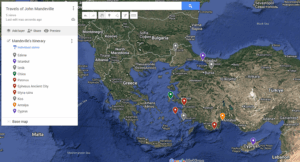
Modern Map of Mandeville’s Travels:
Link to Mandeville’s Travels on the Hereford Mappa Mundi:

Medieval Map Assignment


Link to Medieval Map!

Placing the itinerary of The Travels of Sir John Mandeville within the visual context of the Hereford Mappamundi helps to alleviate the confusing nature of both sources, independent of one another. While John Mandeville speaks to the importance of various places, the Mappamundi emphasizes the visual authority of a given person, group of people, or place. Nonetheless, both serve the same function of showing a Medieval Christian audience the far-reaching influence of Christianity in the known world.

Mandeville places his origin in St Albans, a city north of London and west of Hereford, where the Mappamundi has been on display for centuries. The origin of both the map and the text being in such close proximity to one another underscores their connection. With that being said, neither the Mappamundi nor Mandeville emphasizes England within the context of the known world. Mandeville seldom mentions his home country or its government, while the Mappamundi presents England as nondescript and sans marvels–a contrasting portrayal compared to other locations.

Constantinople is the first place Mandeville truly travels, receiving attention on account of its relevance to the author, who claims to be a Christian pilgrim. Mandeville predicates Constantinople’s importance on its Christian relics, in addition to the Church of Santa Sophia and its accompanying sculpture of the Emperor Justinian I. The Mappamundi includes Constantinople as well, labeling its location alongside a structure reminiscent of the Church of Santa Sophia. The continuity of the Church in both Mandeville and the Mappamundi highlights its status as a holy site within the Christian mind. 

The Hereford Mappamundi includes a myriad of Greek islands and cities, just as Mandeville enumerates in his travel account–Ephesus and Patera among them. Mandeville’s convention when describing Greek territories is to accentuate the difference between Greek Christians and his own concept of Christianity. Furthermore, he simultaneously recounts regional myths and Christian history, framing the intersection of pagan and Christian ideologies in the Medieval Mediterranean. There are several Classical references throughout the Mappamundi, complicating its function as a Christian storytelling device. These allusions, in tandem with Mandville’s own Classical education, reveal the literacy of both sources’ intended audience.

For Mandeville, Cyprus is an extension of his commentary on Greece as he highlights its strong Christian government, in addition to several holy sites on the island. He marks Cyprus as a crucial stop for travelers on their way to Jerusalem, and yet, the Mappamundi does not give Cyprus the same visual importance. Instead, it is largely unidentifiable, as the map seeks to spotlight marvels.

Another significant piece of continuity between The Travels of Sir John Mandeville and the Hereford Mappamundi is the placement of Jerusalem at the physical center of each source. Mandeville traces multiple routes to the Holy Land, while also addressing all of the Biblical and historical connections to the region. Similarly, the Mappamundi carves out space to showcase the crucifixion as well as a compass at Jerusalem. This strategic visual reminds the viewer what is most important: Christ.

The geography of Sicily in relation to Babylon is misconstrued by Mandeville and the Mappamundi. Both the text and the map mislabel Sicily’s location. Mandeville asserts that in order to get to Babylon, one must pass through Sicily, which is geographically counterproductive. On the other hand, the Mappamundi places Sicily west of Rome and south of Crete, neither of which are accurate. Its inclusion speaks to its importance within the Mediterranean world, but its misinterpretation–across both sources–demonstrates that neither Mandeville nor the craftsmen of the Mappamundi have acute geographical knowledge.

Egypt is a significant arena for marvels in the Mappamundi, which is aptly echoed in Mandeville’s account. The most fascinating parallel is the presence of a fauna on the map, and Mandeville’s anecdote about a half-goat, half-man being he allegedly encounters in Egypt. This is a blatant instance of Mandeville compiling content from other sources in his travel writings. That being said, Egypt is where Mandeville first describes people with dark skin. The Mappamundi does not focus on identifying ethnic or religious groups by skin color, but instead by physical characteristics, often represented through extremes and deformities.

India is an additional location where Mandeville and the Mappamundi overlap. Numerous times throughout his account, Mandeville describes the various people he meets with physical differences–one which being people with one large foot that encompasses their entire body. The Hereford Mappamundi has an illustration that perfectly coincides with Mandeville’s writing, in the same location: India. Similar to Egypt, Mandeville likely borrowed his description from the prior drawing on the Mappamundi.

Mandeville’s section on the Land of Gog and Magog is an extension of the anti-Semitic imagery depicted in the Hereford Mappamundi. In his writing, Mandeville asserts that the Land of Gog and Magog is where the Ten Tribes reside in the Caspian Mountains, labelling them as evil and inhumane. Additionally, he notes the numerous gryphons native to the region, which are also present within the map. The Mappamundi itself is full of various stereotypes of Jewish people, including Moses with horns and Jews worshipping a calf. These portrayals reflect the deep disdain certain Christian sects felt towards Judaism. The placement of Gog and Magog in the far East within both sources further ‘others’ the Jews they are intending to depict. Although Mandeville’s text and the Mappamundi are intended for a Christian audience, they are marred by their staunch anti-Semitism. 

The legend of Prester John is pervasive throughout various Medieval travel accounts and narratives. Mandeville himself falls into the trope, repeatedly alluding to Prester John, before finally describing him and his palace in Babylon. Prester John’s wealth and abundance is heavily emphasized by Mandeville. There are a few instances in which Mandeville references the Tower of Babel, but it is not a major talking point for him. On the other hand, the Mappamundi identifies Babylon by the Tower, emphasizing its function as a Biblical setting  rather than settling for the city’s connection to a fictional person.

Both The Travels of Sir John Mandeville and the Hereford Mappamundi have several shared narratives, images, and stereotypes. Each source reinforces the function of the other, helping the audience to understand what it means to be a Christian in 14th century Europe. The spatial awareness of those in this era was broadly limited, and yet, to know about a different place, in any capacity, distinguished oneself. That being said, the target audience members for both the text and the Mappamundi were Christian, English people equipped to read, write, and work. The prospect of journeying to such faraway places like Mandeville was impossible to most. Thus came the ability to pursue a mental pilgrimage alongside this book and this map.

The Book of Marvels and Travels by John Mandeville: One Way to Jerusalem

Whoever wrote this book, whether it be a monk or a knight or whomever, had the kind of faith that let Moses turn rivers to blood. Which is to say really galldarn intense. We can see this on page 9 as Tim (the name we’ll use as a stand in for the monk who wrote John Mandeville) starts us off with a phrase that should trigger our “crazy wild unsubstantiated claims are about to be made” alarms, “And you must know,” (9) prime bs indicator, “that our lord was nailed lying down,” (9) here we see that his audience is Christian as he does not say my lord but rather our lord, also in this first claim about stuff that we all know he sort of does hit the nail on the head, this probably would be common knowledge. Now that he has established both our faith in Christianity and our knowledge that he has both faith and knowledge of Christianity he’s immediately going to try to cash all of that in immediately. “Moreover Greek and foreign Christians say,” (9) ‘all of the Christians are saying this so of course it is true,’ “that the wood used for the Cross which we say was cypress waa actually from thhe tree of which Adam ate the apple,” (9) oh my goodness this is a wild conspiracy theory. John, is there any other way to know this is true? Of course with this wild theory you have some evidence? “This is backed up in their writings.” (9) Wonderful, they said it and they wrote it down? Well then it has to be true.

Like with all things in Mandeville this makes sense in the frame of a story. I feel like I’m beating a dead horse but this travel narrative makes about as much sense as a puma in a nightgown. Once you understand that it isn’t a puma (travel narrative) at all but instead a hairless little sphinx cat (piece of cristofascist propaganda) then the jammies (weird and incongruous bull shit that is littered on every single fucking page of this book!!!) you start to realize that everything makes a ton of sense. The rascism is the only thing that can be explained through the lens of a travel narrative because travel narratives also have a vested interest in being rascist. Maintaining the hierarchical structure which is supported by bigotry.

Gotten slightly off track so let me root myself back in the text. Constantinople. He never went. I do find his phrasing here to be intriguing. “It is my task to make you know” (11) he goes on in classic Mandeville style to say only things that one could glean from the most coursory of glances at an account of Constantinople but this offers a good deal of insight into the motivation of the author. His task therefore is to guide people to Jerusalem. But he gives no actual tangible details that would help you get there and even when he does the details are hardly sufficient to get you there. He must’ve been writting for a mental pillgram.

The Travels of Sir John Mandeville: India

John Mandeville begins his account of India by detailing the ‘natural’ tendencies of those living in the region. To frame his description, Mandeville mentions the Indus River that travels through the area, giving the country of India its name. Mandeville then notes the presence of thirty-foot eels in the Indus River, before describing the people of India as ugly with a yellow-green complexion. By listing the eels ahead of the civilians, Mandeville frames Indian people and their customs as inherently animalistic. He talks about conventions of nudity in India, explaining how the heat influences men to walk around nude, thus weakening their bodies. Mandeville asserts that the need to cool oneself from the heat dictates daily life. He draws a parallel to what he claims to have observed in Ethiopia, telling his reader that men and women often lie naked in the river, and that women are unashamed to do this around men. Once again, Mandeville marks this practice as ugly because he himself is made uncomfortable by it.

Mandeville tethers their daily practices to India’s climate, remarking they live beneath Saturn, which is inherently slow-moving. Mandeville believes that because of this, people are not inclined to leave India. He compares their leisure, or laziness, to the unquenchable desire for people from his country to travel. Mandeville attributes this to England being ruled by the moon, which moves quickly, thus breeding people to live productive, worldly lives. This construction of us vs. them, between himself and the people of India, indicates Mandeville’s racism. Since Mandeville’s account is fictional, his descriptions are rooted in his own bias about a place he has never been and people he has never met.

Mandeville spends a great deal of time talking about the distinction between simulacrums and idols, labelling one as natural and the other as unnatural. To Mandeville, worshipping simulacrums is equivalent to worshipping a hero. He references Hercules and Achilles as apt examples, noting they are beloved by God on account of their marvelous deeds. On the other hand, worshipping idols includes praying to animals that signal a good omen, such as an ox or a snake. Mandeville notes that people build small idols to worship in their homes as an extension of this practice.

As Mandeville, theoretically, journeys throughout the isles surrounding India, he refers to the cities of Baroch, Bandinanah, and Cranganur as fine and good cities on account of their strong Christian populations. He argues the land’s fertility is directly connected to the presence of Christians, mirroring prior accounts of his travels, where a strong government was tied to a Christian leader. Mandeville lists the various fruits, spices, and peppers native to this region, providing flowery descriptions of each category. This embellishment is an attempt to establish his own legitimacy before referencing his greatest marvel yet: the fountain of youth. Mandeville claims that he himself drank from the fountain three times on an empty stomach and was made forever healthy. Mandeville’s mention of the fountain of youth in India aligns with Medieval conventions that the East is closer to Paradise. Mandeville’s description of India signals that the region’s breadth of natural resources is on account of its proximity to Paradise, incentivizing his reader to travel east.

The Book of John Mandeville: Mt. Sinai

In The Book of Marvels and Travels, Sir John Mandeville describes Mt. Sinai and its surrounding area in detail. Eager to court an audience of would be pilgrims, he reports on the popular pilgrimage destination of St. Catherine’s monastery on the mountain. He gives a short description of the monastery itself and its inhabitants, and quickly moves on to relating fantastic stories about the place. For instance, Mandeville says that the monks’ supply of oil for their lamps and food comes from birds miraculously bringing olive branches to the remote monastery. This, he says, shows how holy the place is and that if birds make pilgrimage there in honor of St. Catherine, so too must humans. Mandeville also claims that each monk has a lamp which both foretells their own death as well as choosing the next abbot when one dies. The bones of St Catherine too are miraculous. Apparently they exude a substance similar to oil or balm, but blacker. Mandeville assures his readers that many more relics are on display. All these stories emphasize the holiness of St. Catherine’s monastery, showing how miracles abound in its vicinity because of the many relics stored there.  The point of this emphasis is to promote pilgrimage. Religious travelers were on the look out for any holy site to pay homage, and Mt. Sinai and its monastery seem to be prime locations. Mandeville, surely working from earlier descriptions of the place, reinforces the holy reputation of this location for his readers who were looking to fill their itineraries.

Another theme in Mandeville’s description of Mt. Sinai is its Biblical history, and connection to Moses in particular. Of primary importance is the location of the Burning Bush which the prophet saw and could still be seen in the monastery of St. Catherine, but there are many more. At its gate is the spring Moses made with his staff, and even the route Mandeville describes from Egypt is purportedly the same one which Moses and the Israelites  took. Walking in these footsteps surely deepened a pilgrim’s faith and increased the spiritual desires which prompted their travels. Interestingly, Mandeville says that in this region travelers must know Latin before the local language, showing that to him this is Christian territory not Muslim. Its famous monastery serves as an outpost of Christendom and Europe by extension (never mind the actual ethnic composition of the monks). Mt. Sinai itself has many sites relating to Moses. Moses’ Chapel stands where the prophet hid when he saw God, the rocks of which still bear his outline. Nearby is the place where Moses received the Ten Commandments, and where he fasted for forty days and forty nights. Mandeville wants his audience to think of Moses’ stories when reading about Sinai. Again this can be explained by his audience. For people traveling so far and risking so much, a trip to Mt. Sinai allowed them to see all these important sites from the Bible in a relatively concentrated area. Following in the footsteps of Moses, an important Biblical character, shows great piety, and being in the presence of such holy sites only deepened such piety.

The Book of Marvels and Travels by John Mandeville: Prester John

Unshockingly, the idea that a man named John, a very classic English name, who is Christian, a very classic English tradition, is the emperor of India, is inherently racist and carries with it the idea that India should be ruled by an Englishman. The idea also that his land is populated with Christians is one borne of the fear of the encroachment of Muslim forces into Christian lands, a fear at least in part motivated by racism. Mandeville describes the land as hard to reach and even talks about the merchants which is a common feature of the travel narrative but not one that is usual within the writing of John Mandeville, as he’s merely a fiction drawn up by the hand of a monk; this is unusual, but can be explained away by acknowledging that Mandeville barely writes about the merchants and only uses their absence to show the richness of his land. While his land is described as not rich, this most likely refers to trade rather than physical mineral deposits. We can see this supported on the end of page one hundred and eight and going onto page one hundred and nine, as Mandeville writes, “they also carry in front of him another vessel, full of gold and jewels, gems like rubies, diamonds, sapphires, emeralds, topaz, irachite, chrysolities, and various other gems, signifying his lordship and his power.” (108-109) The emphasis on the relation of material wealth to his lordship may seem to be a strange one for a Christian knight to espouse. At the time, the Christian beliefs were much more embroiled in the divine right of kings, the idea that if one is rich and noble, then they must have necessarily been ordained by God. His power both comes from God and is then used in his name. The banners of Prester John are crosses, which are representative both of his dedication to religion and of his God’s power. His defense of the standards is fierce and “he has innumerable men when he goes into battle against other rulers.” (108) As I struggle to find the ways that Mandeville is moving through or interacting with this land, I am hard pressed to find any examples. In only one paragraph of this chapter does Mandeville talk about how he is moving through the lands of Prester John, “I was once travelling on that sea and I saw something like a kind of long island with many trees and branches and tree-trunks growing from it. The sailors told me that it was all the big ships that the adamantine had caused to be left there, and all the things that spilt from these ships.” (107) Mandeville has just made up some mineral that is so magnetic and powerful that it would rip iron from the ships, which were at the time being fashioned with enough iron that if they were to pass through the sea of the lands of Prester John. This travel is entirely a rhetorical device to instill a religious fervor within the people of England in order that they may have the fire to sustain a war in the Middle East.

Sincerely,

Gev, the Scaled Scorch

The Travels of Sir John Mandeville: Egypt

John Mandeville begins his account of Egypt by taking a page from Caesar’s book. But rather than saying, “Gallia est omnes divisa in partes tres,” Mandeville asserts, “Egypt is divided into two parts.” By marking these distinct regions, Mandeville associates them with specific ethnographic details, leaving behind his previous custom of merely listing place after place.

Most of Mandeville’s geographical knowledge of Egypt is based on the Nile River. Mandeville describes that Egypt is home to both fertile and barren lands based on proximity to the river. He expresses his own concerns about the region’s climate, noting that though Egypt is a desert, the land is inundated by the river several times a year. By his description, it is apparent that such a contrast of desert and flooding, in the same country, is unfamiliar to Mandeville.

On the same note of the unfamiliar, Egypt is the first instance in which Mandeville explicitly recounts meeting people with dark skin: the Nubians. He details them as being black in color while also being Christian, and that they believe a darker complexion to signify beauty. Mandeville believes that the Nubians’ skin color is directly tethered to the heat of the region in which they live. Mandeville says that if the Nubians could, they would paint an angel in black and a devil in white. Additionally, Mandeville states that if people are not dark enough when they are born that they are essentially doctored to become darker. The choice to include a racial description of the Nubians within Mandeville’s fictionalized journey reflects the author’s intention to highlight ‘the other.’ Although there is no indication that the Nubians are practicing Christianity incorrectly, by describing their cultural values in opposition to Mandeville’s, their status as Christians is negated.

Similar to other places he travels, Mandeville incorporates local myth within his account of Egypt. He highlights the city of Heliopolis, ‘the city of the sun.’ He tells his reader that Heliopolis is home to a round temple–similar to the Temple at Jerusalem–with a sacred book harboring the details of the Phoenix. Mandeville details the role of the priest in the arrival of the Phoenix and the preparation of the temple’s altar with various spices and twigs. The intention of the ceremony is for the Phoenix to burn itself upon the altar, before recuperating and flying back to its home on the third day. Mandeville acknowledges the similarity between the Phoenix and Jesus Christ, being that there is only one of each, and both rise from the dead on the third day.

Although this myth is not categorically Christian, it is included to echo Christian ideology while drawing on pagan customs. Mandeville goes on to describe the Phoenix as bird-like, remarking that if a man sees it fly overhead that he will have good fortune. This idea draws upon earlier, Greek conventions of eagles flying over one’s shoulder to signify a good omen.

Mandeville’s account of Egypt reflects both the author’s bias and ability to connect unexpected locations to the text’s Christian purpose.

The Travels of Sir John Mandeville: Medieval Map

The fact of the matter is that it does not even make sense to put the travels of Mandeville on any map that even tangentially holds to reality. Any map that even pretends to depict Earth shows that he either loved traveling in the worst possible way to get anywhere or that he was simply not real. Spoiler alert, he was not real. This becomes the most obvious when you see how he ping pongs across the Mediterranean. When you read the travels, it makes sense that he goes from where St. Nicholas was born to where he was elected bishop. That makes perfect sense, right? Nope! Not even a little bit. The monk who was sitting alone in his tower, thinking about St. Nick, must have thought that St. Nick travelled a couple of miles outside of his hometown and got set up as a bishop. But he did not do that at all! He crossed half the bloody Mediterranean to get elected bishop.  So this monk, or whoever wrote the travels, we’re not quite sure who wrote them, but given the content, of the centrality of the trip to Jerusalem, the focus on religious figures as he moves through the world, his knowledge of the places where religious figures were and his lack of practical information regarding their physicality it is safe to say that he was a monk. Let us just call him Tim, for convenience. (We can dismiss entirely the idea that Sir John Mandeville was a real person. He rarely, if ever, talks about how he gets to places, or the people that he talks to there, and the people he does talk to seem more like rhetorical devices than actual people.) So Tim has his OC, John Mandeville, and wants to take him along the paths that important religious figures in the past took, without any regard to geography. Tim wants John to follow these people’s itineraries, where they were and where they were going. What map do we use for that? Even on the most weird and fucked up t-map, even on one that centers Jerusalem, which I agree would seem to be the best in a story that clearly so centrally deals with Jerusalem, the trip from Patras to Myra passing over Kos and Rhodes, which he then goes back to, does not make any sense. If I am going to Cedar Point, in Ohio, with my younger sibling Teddy (a real trip that I’m looking forward to), and we leave from Pittsburgh and decide that we want to stop in Youngstown and Akron, we’re not going to stop in Akron and then double back to Youngstown. That’s going to add an hour to the trip, not to mention the cost of gas, Dr. Pepper, and Doritos that this detour demands. If you told me that you were taking that route, I would assume that you had not taken this trip and put it on a map. I do not need to tell you that the medieval costs of travel were astronomically higher than some petrol and snacks. This trip would get you killed if you had not planned properly. If Mandeville were real, this kind of stupidity would have gotten him killed long before he would have had the chance to write any of this down. Mandeville is so bogus that it does not make sense to use any map other than an itinerary map. Tim was not thinking in terms of geography but in terms of connections and temporality. Need more proof? John goes from Chios, passes Ephesus, to Patmos, then doubles back to Ephesus! Why does he do this? Because it follows the temporality of the life of John the Baptist. John the Baptist wrote The Apocalypse in Patmos and was then buried in Ephesus. Tim just likes to have John move through the word along with the lives of the Saints. It makes for an interesting narrative technique. It also makes it so that there is no real way for us to properly map John’s travels, except for the itinerary map. We could discuss the virtues of the other kinds of maps until we’re blue in the face, but the only way that we can look at the travels of John Mandeville on a map without dismissing it immediately as the merest glint of moonshine is by looking at it through the lens of an itinerary map. I end this blog post feeling as if I have spent my entire post belaboring a single point, but I feel as if it is an important one, and indeed, the only one that I can make. He was not real; he’s a narrative device. Everything that he does is for the sake of the narrative.

The bad way to get to Cedar Point https://maps.app.goo.gl/vBeUT6u2J5Mxkg9G9

https://www.canva.com/design/DAG3tET4e64/_6Snk3xgHFOzYt46ZtGRMQ/edit?utm_content=DAG3tET4e64&utm_campaign=designshare&utm_medium=link2&utm_source=sharebutton

https://www.google.com/maps/d/edit?mid=1uJCNSU-tfz4Smqy_qcJnyzDgTNMH_Cw&usp=sharing

Medieval (Re)interpretation of the Holy Places: Virtual Pilgrimage, Matthew Paris’s Itinerary Map, and Meditative Tools – The Pilgrim’s Guide

The Travels of Sir John Mandeville: Cyprus

While John Mandeville often blurs myth and reality in his travel account, his description of Cyprus is anchored by fact, emphasizing the island’s historical relevance within the Medieval mind. 

Before detailing his account of Cyprus, Mandeville references the once-great city of Adalia, associating it with a regional myth. He explains that a young man once happened upon the tomb of a beautiful young woman, and laid down beside her before continuing his journey. In a dream, the man was told to revisit the grave or else he would experience great suffering. And yet, when the tomb was reopened, an ugly head escaped and terrorized the city, causing it to sink. Mandeville asserts that this story is the reason for dangerous waterways in the region. The inclusion of this myth serves two purposes: to explain a natural phenomenon and to provide a contrast ahead of Mandeville’s glowing account of Cyprus.

For Mandeville, Cyprus’ importance relies on its status as a Christian nation and its proximity to Jerusalem. Thus, he spends more time highlighting the ethnographic details of Cyprus than he did in previous locations. At the beginning of this chapter, Mandeville mentions Cyprus’ strong vines and noble wine, noting the wine is originally red, but that with each year it becomes whiter, and eventually runs clear. Mandeville associates the visual purification of the wine as a marker of strength. The wine serves as a metaphor for the power and longevity of Christian rule in Cyprus.

Furthermore. Mandeville’s account accentuates Cyprus’ organization. He introduces Cyprus as a large island home to four major cities, three bishops, and one archbishop. Mandeville is clearly impressed by Cyprus’ unity in faith, despite its size, before enumerating several Christian references. He tells his reader about the Mountain of the Holy Cross and the abbey of monks that resides there, in addition to the Castle of Amours, where the bodies of Saint Genovefe and Saint Hilarion lie. Mandeville contends that the Cross of Our Lord is not indeed in Cyprus, contrary to popular knowledge. This assertion reflects Mandeville’s commitment to fact in his description–an attempt to establish his credence as a writer. 

Notably, Cyprus coincides with Mandeville’s first description of hunting and eating practices. He remarks that men hunt with papions, leopard-like cats, that are well-equipped at capturing beasts. He distinguishes papions by their agility and size, in comparison to dogs and lions. Additionally, Mandeville underscores that all men in Cyprus eat their food on the ground because of the heat. And yet, in the presence of foreigners, they eat at tables. Mandeville suggests that although their dining customs are different, that they serve a function to those who practice them.

Mandeville’s account of Cyprus identifies the island as an important stop on the way to the Holy Land. Cyprus’ status as both a major trade hub and as a historically Christian-ruled region makes it significant to Mandeville’s journey. As Mandeville’s travels bring him closer to the Holy Land, he focuses on locations that support his mission as a Christian pilgrim.

The Book of Marvels and Travels by John Mandeville: Kingdom of Manzi

In the Kingdom of Manzi we find ourselves in a rather strange spot. Literarilly speaking. Sir John Mandeville, as we will continue to call him, has, so far in the adventures we’ve talked about together, confined himself almost entirely to his own Christian faith. This is due, of course, to his incorporeal nature. Meaning that he is not real. These are the writings of a monk, and now, we get to hear him talk about animals and feasts! He’s not even racist about it! I know! He even, believe it or not, has a conversation. I’m so excited.

He’s not even weird about poor people or other religions’ beliefs about the soul! We can see this in his interaction with a monk, whom I want to assume is Buddhist, given his belief in the reincarnation of the soul and how the life that you lived shapes your next life. He observes their feeding of the animals with the monastery scraps, and he listens and asks questions respectfully. This is delightful.

“The monk said that these animals are the souls of dead men, the gentle and attractive animals being the souls of aristocrats and gentlemen, and those that are ugly being the souls of commoners. I asked him if it would not be better to give these leftovers to poor men than to these animals. He replied that there are no poor men in that country, and, even if there were people who needed alms, it would be better to give it to these souls which suffer their penance there and may not go out and seek food, unlike people who have the knowledge to find food and the capacity to work.” (88)

This quote is interesting because it shows how Sir John Mandeville is able to recognize that poor men are more deserving than beasts, which is great. Leads to a big question: where are all of the disabled people? Does this monk define disabled people as people? He says that people have the knowledge and capacity to work, and yes, most do, but not everyone is able-bodied. My hope is that they’re being accommodated and given good jobs, but sadly, I’m faced with a more likely option. The monk who is writing this work considers a perfect city to be one without any disabled people. We can also observe the classism that the monk exhibits in the assigning of souls to animals, or animals to souls? It is not entirely clear. What is clear is that beauty is linked to morality as well as to class. This gives us the question: in this system of morality, are a person’s actions and character determined by their class, or is their class determined by their character? The more important question is: are we supposed to buy this correlation between class and character? On the surface, the answer is no. The person doing the talking is a monk of a non-Christian religion who is talking about reincarnation, which is not recognized by Catholic doctrine. Looking deeper, the fact that this didn’t actually happen leads me to believe that we are supposed to buy it. A Buddhist monk didn’t say this; a monk created a knight and another monk and put them into conversation. If Sir John Mandeville doesn’t respond, it isn’t due to his lack of a witty retort; the monk has all the time in the world to think of a fiery comeback, it is because the monk is choosing to have him leave this point entirely unchallenged. Also, considering we are very much in the days of kings and queens, it seems to me as if we should be buying it.


So long and thanks for all the fish,

Gev, the Scaled Scorch

« Older posts

© 2026 Mapping the Global Middle Ages


Academic Technology services: GIS | Media Center | Language Exchange

Theme by Anders NorenUp ↑