Category: Uncategorized (Page 1 of 3)

Benjamin Of Tudela- Alexandria

Benjamin’s account of Alexandria begins with the famed lighthouse, the Manar al-Iskandriyyah, which Alexander the Great had built on a pier extending into the sea. The lighthouse features a large tower with a glass mirror that could reportedly allow inhabitants to see ships from a distance of twenty days’ journey. Benjamin recounts a story in which a Greek captain named Theodoros breaks the mirror, after which Christians gain greater access to the surrounding seas, eventually capturing Crete and Cyprus. This anecdote emphasizes the strategic importance of Alexandria’s location for maritime control, as well as the city’s role in the interaction between Christian, Greek, and Egyptian spheres of power. For Benjamin, the lighthouse symbolizes both technological sophistication and the vulnerabilities inherent in controlling trade and naval passage.

Beyond its military significance, Alexandria functions as a commercial crossroads for merchants from across Europe, the Mediterranean, and as far as India and Africa. Benjamin enumerates a remarkable range of trading partners: Venetia, Lombardy, Tuscany, Apulia, Amalfi, Sicily, Calabria, Hungary, France, Aragon, Andalusia, Africa, Arabia, India, and Javan. Goods such as spices, silver, gold, silk, and linen flow through Alexandria, demonstrating its centrality in medieval trade networks. Each nation reportedly maintains its own inn, suggesting a cosmopolitan city accustomed to accommodating diverse travelers. Through this lens, Benjamin emphasizes the city as a point of contact between multiple religious, ethnic, and economic communities.

Religious and demographic observations are also central to Benjamin’s description. He notes around 3,000 Jews in Alexandria and provides detailed counts for Jewish populations in surrounding towns, such as Damietta, Simasim, Sunbat, and Tanis. His attention to these populations reflects both practical concerns for Jewish travelers and a broader interest in the status and distribution of Jewish communities in the Mediterranean. The presence of Christian and Mohammedan communities alongside Jews illustrates the plurality of religious life, while Benjamin’s careful record-keeping indicates the ways in which Jews navigated this diversity for commerce, pilgrimage, and communal support.

Benjamin also records the physical and logistical aspects of travel in and around Alexandria. He gives distances between towns, the relative fertility of lands, and economic activities such as flax cultivation, linen weaving, and local trade. Travelers where Jewish communities reside as well as which regions provide resources, sustenance, or trade opportunities. Alexandria, with its fertile surroundings, maritime access, and extensive markets, provides both material support and safe passage for long-distance travelers, particularly pilgrims heading toward Jerusalem.

Interpreting Benjamin’s account, it is clear that Alexandria embodies the intersection of wealth, religious diversity, and strategic importance. The city’s maritime prominence, extensive commercial connections, and abundant local resources make it a model of medieval urban significance. Benjamin’s attention to both Jewish communities and foreign merchants highlights the ways in which trade and religion were intertwined, and how Jewish travelers relied on knowledge of these networks for safety and sustenance. Furthermore, the story of the broken lighthouse mirror suggests a Jewish awareness of geopolitical shifts and the subtle relations of power among Christians, Greeks, and Egyptians.

Overall, Alexandria emerges as a city of remarkable complexity: a strategic maritime center, a hub of international trade, a locus for diverse religious communities, and a waypoint for pilgrims. Benjamin’s narrative blends practical travel information—distances, populations, products, and ports—with a reflection on cultural, political, and religious networks, demonstrating how medieval travelers understood and navigated the Mediterranean world. His account provides insight into both the material realities of travel and the broader cultural interactions that shaped the experiences of Jewish and non-Jewish communities in the medieval period.
Travels by Benjamin of Tudela: Palermo

Benjamin portrays Palermo as a prosperous and well-governed city on the island of Sicily, rich in natural resources and architectural marvels. He emphasizes the king’s domain, including a garden called Al Harbina, which contains every type of fruit tree, a large fountain, and an enclosed reservoir called Al Buheira with fish. The king owns ships overlaid with gold and silver, illustrating both wealth and leisure. Benjamin describes palaces with walls painted and overlaid with precious metals, and marble floors designed with intricate gold and silver patterns. For a medieval traveler, these details signal Palermo’s opulence and sophistication, setting it apart from other Mediterranean cities.

The city also functions as a hub for pilgrims traveling to Jerusalem, suggesting its significance within broader religious and commercial networks. Benjamin notes the Jewish population of around 1,500, alongside numerous Christians and Mohammedans, reflecting the city’s religious diversity. He highlights the fertility of the surrounding land, including abundant springs, gardens, wheat, and barley, which support both local sustenance and trade. Palermo is thus a city where commerce, agriculture, and political power converge, offering travelers both material resources and social insight.

From a practical perspective, Benjamin provides travel information: Palermo is roughly two days’ journey from Messina, and from there pilgrims cross to Jerusalem. Distances, populations, and local economic products are carefully noted, demonstrating the interconnectedness of Mediterranean trade and pilgrimage networks. Travelers would find Palermo not only a place of beauty and wealth but also a logistical waypoint for longer journeys.

Interpreting Benjamin’s description, one can see that his attention to material wealth, gardens, and palaces underscores medieval values regarding power and status. His continued interest in Jewish populations suggests a concern with both communal welfare and potential assistance for Jewish travelers. The combination of leisure, commerce, and strategic location would have made Palermo a model city in Benjamin’s eyes: a place where political authority, economic activity, and cultural diversity were all very evident.

Overall, Palermo emerges as a site of wealth, religious and cultural diversity, and strategic importance, offering insights into the networks that shaped medieval life. Benjamin’s account blends factual travel information with his own religious/cultural concerns, making it both a practical guide and a reflection of Jewish experience.

In addition, Benjamin provides information on Messina, which lies about two days’ journey from Palermo along the northeastern coast of Sicily. Messina serves as the initial port of arrival for travelers coming from the eastern Mediterranean and functions as a critical waypoint for pilgrims heading to Jerusalem. He notes the fertility of the area, with gardens and plantations that supply both the local population and visitors, highlighting the city’s role in provisioning travelers. Though smaller than Palermo, Messina’s position on the sea makes it an important logistical hub, connecting Sicily with broader Mediterranean trade and pilgrimage routes. By including Messina, Benjamin emphasizes the practical side of travel: while Palermo showcases wealth and cultural prominence, Messina ensures access, sustenance, and maritime connectivity for those on extended journeys.

Medieval Travel Map

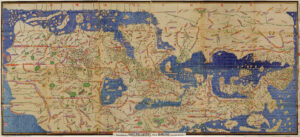
Plotting Benjamin of Tudela’s route onto the Tabula Rogeriana made the differences between medieval and modern maps feel much more obvious than they did in theory. Once the points were actually sitting on al-Idrīsī’s map, I could see how each map carries its own ideas about what matters in the world. The modern map treats distance and navigation as the main concern, while the medieval map treats relationships, routes, and cultural density as the things that make geography meaningful.

Working first with the modern map pushed me into a very standardized way of thinking. I had to turn Benjamin’s “a day’s journey,” “five parasangs,” or “the road is dangerous because of serpents and scorpions” into something a contemporary viewer could recognize. That meant looking for distances, estimating travel time, and describing terrain as if those details were meant to be objective. The modern map doesn’t care that Babylon has biblical ruins or that Hillah has four synagogues and 10,000 Jews. It only cares where those cities sit on a coordinate grid. It has no way of portraying anything more complex than that.

The Tabula Rogeriana, on the other hand, treats space as something lived, which is what makes it perfect for this narrative. The south-up orientation shifts gravity toward Africa and the Mediterranean instead of Europe. That orientation lines up seamlessly with Benjamin’s own priorities. He spends more time in the Levant, Mesopotamia, and Egypt than in Western Europe, and those regions sit at the top of al-Idrīsī’s map. The map reinforces the idea that this part of the world is central. It does not flatten it or minimize it in the way a modern map would.

The climate zones create another layer of meaning and intrigue. Al-Idrīsī divides the world into seven horizontal bands that each carry environmental and social implications. When I placed Benjamin’s journey points into those bands, his descriptions made more sense. His comments on prosperity, strong water systems, and thriving trade fall in the temperate zones. His mentions of instability or sparse settlement fall in harsher ones. The modern map ignores this logic. It gives terrain but doesn’t try to explain why different climate regions feel different to the traveler. The Tabula offers that context immediately, making Benjamin’s descriptions feel rooted rather than vague.

Medieval travelers also thought about distance differently than we do now, and plotting Benjamin’s route onto the Tabula brought that into focus. His sense of movement is tied to people, customs, and the reputations of regions rather than to mileage. A “day’s journey” only makes sense inside a world where travel time depends on terrain, safety, hospitality, and political stability. The Tabula supports that mindset because it organizes space around lived experience. Its climate bands, regional clusters, and emphasis on navigable water routes give a traveler information that a modern map treats as irrelevant.

The density of coastal cities and river routes on the Tabula Rogeriana stood out as soon as I began placing points. The map shows the Mediterranean as a complex, connected system rather than just a boundary. Once I plotted Benjamin’s stops, that network lined up naturally. His itinerary mirrors the patterns the map highlights: ports, commercial cities, political centers, and river crossings. A modern map hides this structure because it treats every coordinate as equal. Without additional notes, it makes Hillah, Babylon, and Kufa look isolated instead of part of a dense, interdependent region. The Tabula makes the social logic of his route visible.

Part of what enables this clarity is the way the map makes its priorities explicit. Medieval maps were not trying to depict the world “accurately” in the modern sense. They were arguing for the importance of certain regions and routes. The south-up orientation, the expanded Mediterranean basin, and the dense labeling of port cities all show where al-Idrīsī believed the world’s energy was concentrated. A modern map distributes space evenly, which washes out these differences. The Tabula shows that some regions mattered more than others, and that acknowledgment helps Benjamin’s journey fall into place rather than float between isolated points.

Scale shifts are part of this worldview. Modern maps stretch space evenly, so long stretches look empty. The Tabula compresses and expands regions depending on cultural significance. When I placed Benjamin’s points, the areas he focuses on felt larger or more central because the map expects those places to matter. It isn’t a distortion; it’s a perspective. Seeing the two visualizations side by side made it clear that Benjamin’s itinerary fits more naturally inside al-Idrīsī’s system than inside a modern one.

Actually plotting the points exposed how much interpretation the assignment required. Some sites, like Babylon or Kufa, aligned easily with the river systems the Tabula emphasizes. Others—especially smaller villages or religious landmarks—had to be placed by reading the logic of the surrounding map rather than looking for a one-to-one match. That felt truer to how medieval maps functioned: as guides blending geography, memory, and narrative. My choices—where to put Kotsonath, how far to place Hillah from Babylon, how to position Ain Siptha—mirrored the judgment a traveler like Benjamin would have relied on. Working this way made the medieval world feel less abstract and showed how geography, storytelling, and lived experience were linked.

While the modern map argues for objectivity and measurement, the medieval one argues for networks, climates, and centers of life. Putting Benjamin’s journey onto both made the assumptions behind each style visible in a way they weren’t before. It changed how I see his travels and how I think about the act of mapping in a broader sense.

Acre- Benjamin of Tudela

In Acre, Benjamin sees a major port city full of merchants from across the Mediterranean. He notes its strong walls, its thriving markets, and the mix of cultures living there under Crusader control. He estimates about 200 Jews living in the city and names several leaders of the community. He also mentions the ease of travel from Acre to surrounding regions thanks to its centrality in trade and pilgrimage. Acre feels like a crossroads in Benjamin’s account—a place where cultures intersect not only in trade but in governance. Christians rule the city, but Arabs, Jews, and many others circulate through it daily. Benjamin’s emphasis on the port’s international character shows how he imagines the Mediterranean world: porous, mobile, and full of economic possibility. His attention to Jewish leadership here shows that even in a Crusader city—where tensions could easily overshadow everyday life—Jewish communal structures persisted. Acre becomes a kind of reminder that empire and conflict don’t erase local coexistence.

Ibn Fadlan Medival Map

The journey of Ibn Fadlan, as mapped out on the Tabula Rogeriana, gives insight into how Ibn Fadlan visualized his journey. It also aids in realizing how complicated his travels actually were. The Tabula Rogeriana was created in the 12th century. Ibn Fadlan traveled in the 10th century. So, this map was not available for Fadlan to follow to navigate his journey to Bulghar. Even if he did have it, it would have still been difficult to follow. The Tabula Rogeriana maps the known world in the 12th century. When Fadlan was traveling, there were places that were still unknown that were featured on the Tabula Rogeriana. My limited knowledge of labels and places on the mapping was frustrating. Fadlan would have been traveling essentially blind; this must have been frustrating. These potential frustrations can be examined by comparing Fadlan’s journey on a modern map versus the Tabula Rogeriana.

         The biggest difference between the modern map and the Tabula Rogeriana is the orientation. The Tabula Rogeriana is oriented south upwards. When he was traveling to the North, he was envisioning himself walking down towards the pole. This wouldn’t have affected his own view of his travel, as his worldview was south-oriented upward. This was a principle of the Islamic view of the world. However, what could’ve been difficult was if he got directions or insight from other travelers on how to find any of the locations he needed to go to. We know he interacted with people of different religions. The logic about where things are oriented may have been different from his, making travel difficult. Fadlan wasn’t just wandering through the Middle East and up into Europe. He had set locations where he was going. Therefore, he needed directions. Some of the places he stopped didn’t seem calculated; they weren’t a part of a “trip itinerary.” However, some of the locations were pre-planned. He stops in Bukhara to receive money for the mosque in Bulghar. He needed to know how to get here. Without having a map, this must have been very difficult.

         Another difficulty in his travels comes from the differences in geographical features. On the modern map, the Caspian Sea is (obviously) the correct shape. On the modern map, the Caspian Sea is a lot longer (it kind of looks like New Jersey); it is just generally bigger. However, on the Tabula Rogeriana, the Caspian Sea is significantly smaller. It is a lot more circular. The whole tale of it is missing. Obviously, the medieval map isn’t going to have the right shapes of every feature and country; everything is an estimation based on people’s accounts of their travels. Fadlan would have had a less accurate idea of the shape of the Caspian Sea. You can tell this by looking at the direction of his travels on both maps. On the modern map, Fadlan swings very widely to the left of the Caspian Sea. He goes out of his way to seemingly make sure he doesn’t intercept the sea. His stop in Bukhara was pre-planned; this was one of the locations he knew how to reach. This seems like a way to avoid geographical issues as well as completing tasks for the Calif.

         The last large difference between the two maps is the distance between the top and bottom (north and south). On the modern map, Bulghar is significantly farther from Baghdad than on the Tabula Rogeriana. The scale of the maps is completely different. The Tabula Rogeriana under-accounts the distance between the two places. I thought that the Tabula Rogeriana was out of scale; however, the scales of Egypt and Saudi Arabia are pretty consistently sized with the modern map. These scale differences wouldn’t have necessarily affected Fadlan’s travels. However, it does change the perspective of how people would have viewed Fadlan’s journey.

         In conclusion, Fadlan’s journey wasn’t much affected or changed by the differences in the two maps. The biggest difference between the two maps is the orientation and views of the world. This, to a modern traveler, seems foreign; however, to Fadlan, this would have been the norm. The only confusion could have been sparked by discussing directions with non-Islamic travelers. The second difference would be the ideas of the shape and location of geographical markers that could have affected the exact navigation of his journey. Since they didn’t know precisely where these geographical obstacles would have been, they could’ve over- or undercompensated for avoiding them. Overall, his actual journey was simply perceived differently by modern viewers and non-Muslim audien

Medieval Map Assignment – Felix Fabri and the Psalter World Map

My Medieval Map: https://uploads.knightlab.com/storymapjs/3d3e14d6ff5bf791e8df42414c25f59c/medieval-map-assignment-gillie-schmidt-quee/index.html

The Psalter Map illuminates a similar conceptualization as Felix Fabri’s pilgrimage to the Holy Land in the late Fifteenth Century. The Psalter Map was published sometime after 1262, over a century before Fabri’s journey in 1483 (Wacha 2020). However, when read alongside one another, they present a dominantly Christian religious conception of the world that places Jerusalem in the center. By comparing Felix Fabri’s route on the Psalter Map to a modern one, it becomes evident that society has de-centralized Jerusalem and no longer presents objectivity through religious understanding. Instead, modern maps are focused on scale, geographic features, nation-borders and distinctions, and population density. While the shape of Fabri’s journey stays the same, the presentation of his route and the concepts around each location have shifted away from religious bias and towards a more objective representation of geography and distance. 

The most apparent difference between a modern map and the Psalter World Map is its orientation. Like many maps of the time, the Psalter World Map is oriented so that East faces upwards, unlike the modern representation of North at the top. Another significant visual difference is the shape of the map. The Psalter World map is circular, and represents the world as it was known with only three continents: Europe, Asia, and Africa. Prominent cities and geographic features shape the map. Places like Rome, Macedonia, and Cyprus are illuminated, and the Mediterranean Sea, the Alps, and the Sahara Desert are clearly marked physical features. The Psalter map distorts the rest of the world around Jerusalem so it appears superior and uses geographic boundaries to reinforce their physical impact on travelers’ journeys. The Psalter Map is surrounded by religious iconography and references which present the world through a starkly Christian lens. While modern maps still represent man-made and geographic elements, the presentation is much less subjective. Technology such as Google Maps use satellite photography to present an objective view of the world. The implementation of photography shifts away from religious iconography as a means of representation and instead mirrors what one sees. Maps still employ symbols to show significant landmarks and borders, however these icons are no longer shaped by religious storytelling and instead work to mimic reality. 

We learn early on in Fabri’s narrative that travel is esteemed and is not accessible to everyone. However, Fabri embarks on his second wandering because he “was by no means satisfied” with his previous “short and hurried” journey (Fabri 3). While he is hesitant to ask to return to the Holy Land, he does it anyway and vows to himself that this time he will record the journey – hence The Book of Wanderings. Fabri perceives Germany as a superior and dominant nation, a perception that is not shared with the Psalter World Map’s presentation of the world. The Alps are a significant landmark for the map, however Germany itself is not labeled and does not give the same importance as Fabri’s account of his nation. His world view is created by both a religious and nationalistic understanding to reinforce the accuracy and reality of his narrative. Fabri’s representation of German superiority builds on Christian hegemony and narrates a shift towards nationalism after the creation of the Psalter Map. 

The Psalter World Map and Felix Fabri’s Wanderings visualize distance and location through a dominant, Western, Christian perspective. In the second half of his narrative, Fabri emphasizes his desire to visit Mount Sinai and the convent of Saint Catherine, another important location for religious pilgrimage. However, he resists this desire because of the extreme distance. He wants to “go as far as Mount Sinai” and appeals to church leaders, however it is understood that Mount Sinai is just too far (Fabri 50). The Psalter Map represents this distance, from Jerusalem to Egypt looks just as long if not longer than the Alps to Jerusalem. The map places Egypt in a far corner close to the unfamiliar and threatening drawings of “monstrous races” (Wacha 2020). This distance and Mount Sinai’s closeness to the monstrous races ostracizes the location and presents it as completely foreign – thus informing Fabri’s conception that it is of a different land. The inherent racism of Christian society’s understanding of the world is written into Felix Fabri’s narrative and his understanding of location. He blames “Saracens” for the corruption of Saint Catherine’s convent, and goes further to describe them as having “heads like dogs, with long ears hanging down” (Fabri 54). His representation is mirrored by the Psalter map’s illustrations and together it becomes evident that these hegemonic ideas were not only prominent in religion but also influenced political and social understanding. 

The narrative and the map work together to project Southern lands as both dangerous and unhuman, which continues to fuel the discourse and Fabri’s understanding that Mount Sinai is an unattainable destination regardless of his desire. Modern maps help disprove the racist projection of the Middle Ages, and make it apparent that this conceptualization is skewed. In actuality, Mount Sinai is only 330 miles from Jerusalem, while Ulm (Fabri’s starting point) is 2,425 miles from Jerusalem. Additionally, one could travel from Jerusalem to Mount Sinai on land whereas it took Fabri many weeks of sailing on the Mediterranean to arrive in Jerusalem. It would have taken Fabri a fraction of the time to continue to Mount Sinai, especially after going on pilgrimage not once, but twice. Modern tools illuminate that the journey to Mount Sinai would have been attainable for Fabri, information that was not available to him because of Christian framework. It is helpful to compare the two visualizations to understand the rigidity of the world view Fabri was traveling with. Modern tools present accurate distances which shows the falseness of Fabri’s understanding and the impact of the Christian world view in shaping ideas of space, distance, and familiarity. 


Works Cited 

Fabri, Felix. “The Book of the Wanderings of Felix Fabri (Circa 1480-1483 A.D.)” trans. Aubrey 

Stewart. 2 vols. London: Palestine Pilgrims’ Text Society, 1896. 

Wacha, Heather. “Psalter World Map (British Library Add. MS 28681, f. 9r).” n Virtual Mappa, 

eds. Martin Foys, Heather Wacha et al. Schoenberg Institute of Manuscript Studies, 2020: https://sims2.digitalmappa.org/36

Medieval Map Project: The Travels of Ibn Battutah


Mapping Ibn Battutah: Ibn Battutah Medieval Map — Dailey (Editing)

Ibn Battutah spends the second section of his account traversing Syria, venturing from modern day Cairo, Egypt to Hama, Syria, and beyond. Nearly all of his travels have been confirmed by scholars of the Middle Ages, which allows for modern scholars to map his journey with great accuracy. However, to gain more insight into how Battutah himself would have conceptualized the world of his travels, it is helpful to view his journey on a Middle Age source. The Tabula Rogeriana, created by Muhammed al-Idrisi in 1154, continued to be the most accurate and detailed world map through Battutah’s time (he departed in 1325). The Tabula Rogeriana would have likely been a well-circulated and widely utilized resource for Battutah and his contemporary travelers. Mapping his journey, particularly the first ten stops he makes after his departure from Cairo, onto a map of his time provides a greater understanding for where he would have situated himself in the world, his belief systems, and his travel hardships. 

In viewing the two mappings of his journeys, the middle age and modern, alongside each other, we can make a distinction concerning religious authority in the two different time periods based on characteristics of the maps themselves. The most obvious is in the maps’ orientations. The Tabula Rogeriana is rotated upside down to how we now understand the world to be oriented, with the South pointing to the top. But, of course, in Battutah’s time, this made an equal amount of sense as our contemporary orientation. While our modern map is more scientifically based and pulls its orientation from things like knowledge about the earth’s rotation, magnetic poles, etcetera, Muslim maps in the 12th-14th centuries were ruled by religious belief. This is primarily due to the holiness of the city of Mecca. Muslims often lived north of the city, and so going south towards Mecca was seen to be the most correct orientation, associating the upward direction with righteousness toward Heaven. Similarly, the imagined Hell as being cold rather than modern interpretations of Hell as hot. This would orient North downward, as the further North you went, the closer, in theory, you would travel to the underworld. Modern maps are absent of religious influence and rely entirely on geography (though, it could also be argued that current divisions of land are intertwined with religion and politics, but as far as land mass and coordination itself, these things are absent). 

The division of climes present in the Tabula Rogeriana is another dividing factor between it and the modern map. The Tabula Rogeriana divides the world into seven climatic regions. Ideas about race, religion, and geography through the lens of Abrahamic religion often regarded those climes closer to the center as more agreeable, both in land and climate as well as in inhabitants. It is interesting that nearly all of the points mapped on this section of Battutah’s journey are pinpointed in the 3rd clime, with the first being the southmost. Though he journeys far and wide, he doesn’t leave the “comfort” of these climes. When he begins to travel out of these agreeable bounds, his discomfort around people different than him grows. Many of these locations are also holy – consider his decision to travel inland to visit areas from Hebron to Jerusalem. For the medieval traveler, this would mean that clearly based on geography alone, this area was indeed the holiest and best, and this would have reinforced their belief of Islam as the dominant, most correct religion. This also raises interesting questions about what Battutah would have thought his own biological makeup (though the same ideas about biology did not exist). Tangier similarly lies in the third clime. It is possible that based on these geographic details that oriented both the most holy places in Islam and his own country he would have found himself to be the same level of agreeable and well bred as those near the holy cities. 

The two maps side-by-side also highlight interesting differences between what locations are mapped versus what are not. The modern map seems to more accurately reflect some of Battutah’s fascinations with certain cities, notably Cairo. It is interesting that Battutah seems to assign so much reverence and excitement surrounding Cairo that one would assume would be reflected by a contemporary map as a notable city, especially concerning it lies somewhat near the coast and would have been easier to access. Yet, there is no mention or direction to Cairo on the Tabula Rogeriana. We know by its inclusion on the modern map that its influence has long survived and that it has been the sort of breathtaking, powerful city since Battutah’s time. Yet, we only visually see its representation when we view the modern map. I wonder if Cairo flourished greatly between the creation of the Tabula Rogeriana in the 12th century and Battutah’s 14th century travels. 

The modern map also more clearly highlights why Battutah would have stayed so close to the coast through its immense detail of mountain ranges, which visually hold less of a significance and do not seem as much of a hindrance on the Tabula Rogeriana. From a medieval standpoint, coastal travel would have been preferable because inland would have constituted the unknown. We visually see this on the Tabula Rogeriana with the sparsity of mapped locations inland. While the mountain ranges are highlighted well, their scale is a bit different to the modern. The detail and accuracy of the modern map shows just how aggressive these locations could be. On the Tabula Rogeriana, they seem frustrating at most based on visuals alone. The mountains are much closer to the coast on the modern map of well, which more accurately showcases the necessity of not venturing inland. Viewing this sector of Battutah’s travels on two different maps allows one to fully grasp the travel choices that Battutah made and how they were shaped by the world around him, as well as allowing us to examine the exponential ways that travel and cartography have developed and become methodic in recent centuries.


The Itinerary of Benjamin of Tudela: The Cotton Map

The early part of Benjamin of Tudela’s journey on the modern map follows precisely along the northern coastline of the Mediterranean Sea. On the Cotton map from the eleventh century, the route jumps around quite erratically. The text is the most precise about distance and place names of any we have read for this class which makes the struggle to place the locations on a map stand out in even greater relief. The Cotton map seems at first glance to present a close approximation of the Mediterranean coastline, but when one tries to place specific locations, they realize that the proportions are entirely nonsensical and the locations of cities such as Constantinople do not relate accurately to other features even using the logic of the map. The Cotton map has enough labels that I was not guessing for where to mark the locations which made the resulting route even stranger than the coastline alone would imply.

The modern map prioritizes geographic accuracy. The proportions and coastlines are all designed to be as close to real life as possible. Every city and town is included regardless of their importance or size. This precision allowed me to map Benjamin of Tudela’s route exactly town by town with the distances and time between locations matching those listed in the text. Modern maps claim to represent objective factual depictions of the world. They strive to depict the world as it is not through symbols. My map of Benjamin’s route is still symbolic, however, because I cannot accurately match every stop he took to a modern city. The walking paths shown are in no way parallels to the medieval roads, and there is no way to know which he may have taken if they were because he offers no details as to the specifics of his journey.

The Cotton map, like other pre-modern maps, makes no attempt at accuracy. The map itself is oriented by religious principles with east at the top because of its proximity to paradise. Unlike similar Christian maps, Jerusalem is not in the middle as the perceived center of the world. The middle of the map is instead dominated by jarringly rectangular divisions of the land between the twelve tribes of Isreal. Christian theology still dominates the map. The exact locations and shapes of landmasses and cities are secondary to their theological importance. Some of the most detailed cites are Rome, Jerusalem, Alexandria, and Babylon because they are all places of importance within biblical sources. Banjamin of Tudela’s route looks bizarre when transposed onto the Cotton map because the relative location of these cities was seen as unimportant. The map was not intended to guide travel so much as it was mean to provide a snapshot of the Christian world.

The medieval travel writer’s journey was viewed in similarly symbolic terms. While the practicalities of travel were a matter of great concern, they are never the focus of the narrative. They focus on the sites and people they encountered. None of the travel narratives we have read for class were intended to be guides that people followed to recreate their journeys. The books are representations of the places that are passed through the lens of the author’s perspective. The stress of traveling only rarely appears and even then, it is glossed over on the way to the next place of note. Medieval travel writers recorded their stories to show the people they returned to an image of the world, but, like the medieval maps, they only discussed the parts they considered important, not the complete picture. Travel was something monumental that deserved acknowledgment, but it was justified by the value of the things the traveler saw rather than the act itself. Travel for its own sake was a frivolous waste of time and money, so the traveler, and especially the travel writer, had to make sure they emphasized the glory of their journey and hid they unglamorous realities that made it possible.

Neither medieval maps nor medieval travel narratives are concerned with realistic portrayals of geography. The meaning places were imbued with was far more important than their relative locations. These depictions were never intended for practical use. They were meant instead for reflection and consideration by an audience that had very little regard for the exact location of the Mediterranean islands or how much water one should carry across the Sahara Desert. Medieval travelers did not expect others to emulate them because few people actually traveled; there was simply no need for precision when the audience would never find out.

Chapter 11: Permission to Travel to Jerusalem

Up to this point, Kempe’s travels have been described in detail as a religious pilgrimage, during which she struggled greatly with others’ perceptions of her devoutness. Her companions were not the only obstacle during her travels, though. In Chapter 11 of her book, Margery describes the struggles and arguments she and her husband had before Kempe was permitted to begin her journey. Kempe and her husband start the chapter by discussing undertaking a vow of chastity. Kempe’s husband is hesitant to do so, as they are married and should not have to be chaste in matrimony. Kempe, on the other hand, insists that, for religious reasons, she yearns to be chaste once again; Kempe even states that she would rather see her husband killed than have intercourse again.

When they reach an impasse, Kempe goes to pray and converse with God. Throughout her travels and in this chapter, it is evident that Kempe uses prayer as a type of clarifying, meditative process to come up with solutions and the courage to face challenges. Here, God encourages Kempe to compromise with her husband on this matter, as he wants multiple things from Kempe. They eventually compromise, and Kempe is allowed to travel to the Holy Land and undergo the vow of chastity, as long as she eats meat on Fridays with her husband and pays off his debts on her journey to Jerusalem.

Chapter 11 ends with Kempe and her husband rejoicing at their compromise, and the two pray and celebrate together. They discuss how they ended up traveling together to many places, including Bridlington, and recount the many people they met along the way: “God’s servants, both anchorites and recluses, and many others of Our Lord’s lovers, with many worthy clerks, doctors of divinity and bachelors also, in divers places (Kempe 50).” The final line of the chapter states that throughout her journeys, Kempe acted as she always had: passionate in her devoutness, often weeping or making strict decisions because of her religious beliefs.

This chapter is important to better understand what we already know of Kempe’s travels. Up to this point, Kempe had mostly struggled with her companions’ thoughts of her. These companions were generally strangers to Kempe, and yet she saw similar issues with her husband who knew her very well. Her devout religiousness even caused a rift between her and her husband, who is also evidently religious based on their ability to pray and rejoice together.

It follows, then, that she would be set in her religious actions if she has had to deal with them for much of her adult life, even with people who know her and love her well. She is strong and courageous because of the discrimination and negativity she has faced, and through these past struggles, her ability to be so strong-willed with her companions along her pilgrimage becomes more understandable. Kempe’s ability to turn to God for courage and to lean on the very thing that causes her such strife as a source of positivity and strength is Kempe’s greatest quality.

The Travels of Margery Kempe – Chapter 27

In Chapter 27, Margery Kempe continues her travels in Constance. As with her descriptions of most places, Kempe doesn’t discuss much about the landscape or journey there. The specifics of her travel and what she did to get to each place are far less important to her than the religious and oppressive actions of her companions.

In Constance, Kempe describes further harassment for her religiously influenced lifestyle decisions. Her companions are described as constantly attempting to get Kempe to alter her diet, insisting that she eat meat even though she refuses in the name of the Christian God. Kempe also describes meeting a well-respected member of the clergy. The legate became a trusted outsider to Kempe, who asked him to watch how her companions treated her to see who was truly in the wrong.

When Kempe’s companions complain about her annoying religious habits, the legate takes Kempe’s side, only furthering the divide between Kempe and her companions. This squabble results in Kempe’s companions discarding her, telling the legate to take over in caring for her.

Then, Kempe found a man named William Wever to guide her on her travels. When describing her travels from Constance to Bologna, the most information Kempe writes is, “Then they went on day by day and met many excellent people. And they didn’t say a bad word to this creature, but gave her and her man food and drink, and the good wives at the lodgings where they put up laid her in their own beds for God’s love in many places where they went. And our lord visited her with great grace of spiritual comfort as she went on her way (Kempe 101).” Through her writing, it is evident that Kempe cares not about the minutiae of traveling, but only describes how she gets the necessities. The things she describes in detail are mostly about the moral and ethical code of the people she meets along the way, and she rarely gets specific unless she is deeply personally slighted.

Kempe’s relationship with God is one of the major recurring themes throughout her travel narrative, and, especially in times of great need and uncertainty, Kempe writes about having an unusually personal relationship with God. In her conversations with Him, He is often reassuring her that everything will work out and gives her insight into future events, including predicting William Wever’s entrance into Kempe’s journey.

By the end of the Chapter, Kempe sees her old companions once again in Bologna. When she notes that they have not changed their stance on how they believe Kempe should behave, she refused to eat with them for over a month. Kempe’s relationship with God supersedes any earthly relationship she builds, especially if those relationships deny Kempe’s religious fervor as sane. She cares less about what others think of her, and maintains a one-track mind to reaching the Holy Land. It is for God that she began this journey, and it is through God that Kempe overcomes struggle and hardship and keeps her courage to continue and eventually complete her journey.

« Older posts

© 2026 Mapping the Global Middle Ages


Academic Technology services: GIS | Media Center | Language Exchange

Theme by Anders NorenUp ↑