The Travels of Marco Polo – Tibet

Marco Polo arrives in Tibet after leaving Ch’êng-tu-fu and traveling through the plain and valley for five days. He describes the province as “terribly devastated” after battle. Other towns and cities surrounding Tibet were also damaged (171). Polo describes how merchants and travelers in Tibet used large canes that produced a loud, obnoxious noise to scare away the dangerous beasts of prey abundant in the area. Polo says that the area is so desolate that it extends for a twenty day journey that is basically entirely spent without access to shelter or food. The area is deemed dangerous. 

He also describes some of the customs he notices, and disapproves of, in Tibet. Mainly the marriage customs, one in particular says that “…a woman is worthless unless she has had knowledge of many men” (172). The women were seen as not suited for marriage if they were  virgins. They would receive tokens to display on themselves from the prior men they had relationships with, and if she had many she was seen as “…most favorable by the gods” (173). He highlights religion again, saying that all of the natives are idolaters. He specifically describes them as “out-and-out bad,” and the “greatest rogues and the greatest robbers in the world,” clearly casting judgement on them because of the way and what they worship (173). He also describes them as “rascally,” again casting judgment towards them (173). He also judges them because of their currency and the fact that they use salt instead of paper money. When describing the trade in Tibet, he notes that they have gold and cinnamon in high quantities. 

Clearly, Polo believes he is morally superior to the people of Tibet because of their low quality environment, beasts, social customs, and religion. His judgement towards them because of their religion, reflects the same judgments he has carried throughout his narrative towards idolaters, especially due to his own religion. He does focus on and acknowledge the trade in Tibet, but spends more time judging the province because of its prior destruction. Tibet is a larger region, so it makes sense that Polo spent time reporting about the area and the things he saw, but his particular language in this section is interesting since he clearly casts more judgment towards this region than some of the others. His use of “out-and-out bad” in particular proves how judgemental he is towards idolaters, to the point where it can impact his entire perspective of a place.

Benjamin Of Tudela- Alexandria

Benjamin’s account of Alexandria begins with the famed lighthouse, the Manar al-Iskandriyyah, which Alexander the Great had built on a pier extending into the sea. The lighthouse features a large tower with a glass mirror that could reportedly allow inhabitants to see ships from a distance of twenty days’ journey. Benjamin recounts a story in which a Greek captain named Theodoros breaks the mirror, after which Christians gain greater access to the surrounding seas, eventually capturing Crete and Cyprus. This anecdote emphasizes the strategic importance of Alexandria’s location for maritime control, as well as the city’s role in the interaction between Christian, Greek, and Egyptian spheres of power. For Benjamin, the lighthouse symbolizes both technological sophistication and the vulnerabilities inherent in controlling trade and naval passage.

Beyond its military significance, Alexandria functions as a commercial crossroads for merchants from across Europe, the Mediterranean, and as far as India and Africa. Benjamin enumerates a remarkable range of trading partners: Venetia, Lombardy, Tuscany, Apulia, Amalfi, Sicily, Calabria, Hungary, France, Aragon, Andalusia, Africa, Arabia, India, and Javan. Goods such as spices, silver, gold, silk, and linen flow through Alexandria, demonstrating its centrality in medieval trade networks. Each nation reportedly maintains its own inn, suggesting a cosmopolitan city accustomed to accommodating diverse travelers. Through this lens, Benjamin emphasizes the city as a point of contact between multiple religious, ethnic, and economic communities.

Religious and demographic observations are also central to Benjamin’s description. He notes around 3,000 Jews in Alexandria and provides detailed counts for Jewish populations in surrounding towns, such as Damietta, Simasim, Sunbat, and Tanis. His attention to these populations reflects both practical concerns for Jewish travelers and a broader interest in the status and distribution of Jewish communities in the Mediterranean. The presence of Christian and Mohammedan communities alongside Jews illustrates the plurality of religious life, while Benjamin’s careful record-keeping indicates the ways in which Jews navigated this diversity for commerce, pilgrimage, and communal support.

Benjamin also records the physical and logistical aspects of travel in and around Alexandria. He gives distances between towns, the relative fertility of lands, and economic activities such as flax cultivation, linen weaving, and local trade. Travelers where Jewish communities reside as well as which regions provide resources, sustenance, or trade opportunities. Alexandria, with its fertile surroundings, maritime access, and extensive markets, provides both material support and safe passage for long-distance travelers, particularly pilgrims heading toward Jerusalem.

Interpreting Benjamin’s account, it is clear that Alexandria embodies the intersection of wealth, religious diversity, and strategic importance. The city’s maritime prominence, extensive commercial connections, and abundant local resources make it a model of medieval urban significance. Benjamin’s attention to both Jewish communities and foreign merchants highlights the ways in which trade and religion were intertwined, and how Jewish travelers relied on knowledge of these networks for safety and sustenance. Furthermore, the story of the broken lighthouse mirror suggests a Jewish awareness of geopolitical shifts and the subtle relations of power among Christians, Greeks, and Egyptians.

Overall, Alexandria emerges as a city of remarkable complexity: a strategic maritime center, a hub of international trade, a locus for diverse religious communities, and a waypoint for pilgrims. Benjamin’s narrative blends practical travel information—distances, populations, products, and ports—with a reflection on cultural, political, and religious networks, demonstrating how medieval travelers understood and navigated the Mediterranean world. His account provides insight into both the material realities of travel and the broader cultural interactions that shaped the experiences of Jewish and non-Jewish communities in the medieval period.

Travels by Benjamin of Tudela: Palermo

Benjamin portrays Palermo as a prosperous and well-governed city on the island of Sicily, rich in natural resources and architectural marvels. He emphasizes the king’s domain, including a garden called Al Harbina, which contains every type of fruit tree, a large fountain, and an enclosed reservoir called Al Buheira with fish. The king owns ships overlaid with gold and silver, illustrating both wealth and leisure. Benjamin describes palaces with walls painted and overlaid with precious metals, and marble floors designed with intricate gold and silver patterns. For a medieval traveler, these details signal Palermo’s opulence and sophistication, setting it apart from other Mediterranean cities.

The city also functions as a hub for pilgrims traveling to Jerusalem, suggesting its significance within broader religious and commercial networks. Benjamin notes the Jewish population of around 1,500, alongside numerous Christians and Mohammedans, reflecting the city’s religious diversity. He highlights the fertility of the surrounding land, including abundant springs, gardens, wheat, and barley, which support both local sustenance and trade. Palermo is thus a city where commerce, agriculture, and political power converge, offering travelers both material resources and social insight.

From a practical perspective, Benjamin provides travel information: Palermo is roughly two days’ journey from Messina, and from there pilgrims cross to Jerusalem. Distances, populations, and local economic products are carefully noted, demonstrating the interconnectedness of Mediterranean trade and pilgrimage networks. Travelers would find Palermo not only a place of beauty and wealth but also a logistical waypoint for longer journeys.

Interpreting Benjamin’s description, one can see that his attention to material wealth, gardens, and palaces underscores medieval values regarding power and status. His continued interest in Jewish populations suggests a concern with both communal welfare and potential assistance for Jewish travelers. The combination of leisure, commerce, and strategic location would have made Palermo a model city in Benjamin’s eyes: a place where political authority, economic activity, and cultural diversity were all very evident.

Overall, Palermo emerges as a site of wealth, religious and cultural diversity, and strategic importance, offering insights into the networks that shaped medieval life. Benjamin’s account blends factual travel information with his own religious/cultural concerns, making it both a practical guide and a reflection of Jewish experience.

In addition, Benjamin provides information on Messina, which lies about two days’ journey from Palermo along the northeastern coast of Sicily. Messina serves as the initial port of arrival for travelers coming from the eastern Mediterranean and functions as a critical waypoint for pilgrims heading to Jerusalem. He notes the fertility of the area, with gardens and plantations that supply both the local population and visitors, highlighting the city’s role in provisioning travelers. Though smaller than Palermo, Messina’s position on the sea makes it an important logistical hub, connecting Sicily with broader Mediterranean trade and pilgrimage routes. By including Messina, Benjamin emphasizes the practical side of travel: while Palermo showcases wealth and cultural prominence, Messina ensures access, sustenance, and maritime connectivity for those on extended journeys.

Medieval Travel Map

Plotting Benjamin of Tudela’s route onto the Tabula Rogeriana made the differences between medieval and modern maps feel much more obvious than they did in theory. Once the points were actually sitting on al-Idrīsī’s map, I could see how each map carries its own ideas about what matters in the world. The modern map treats distance and navigation as the main concern, while the medieval map treats relationships, routes, and cultural density as the things that make geography meaningful.

Working first with the modern map pushed me into a very standardized way of thinking. I had to turn Benjamin’s “a day’s journey,” “five parasangs,” or “the road is dangerous because of serpents and scorpions” into something a contemporary viewer could recognize. That meant looking for distances, estimating travel time, and describing terrain as if those details were meant to be objective. The modern map doesn’t care that Babylon has biblical ruins or that Hillah has four synagogues and 10,000 Jews. It only cares where those cities sit on a coordinate grid. It has no way of portraying anything more complex than that.

The Tabula Rogeriana, on the other hand, treats space as something lived, which is what makes it perfect for this narrative. The south-up orientation shifts gravity toward Africa and the Mediterranean instead of Europe. That orientation lines up seamlessly with Benjamin’s own priorities. He spends more time in the Levant, Mesopotamia, and Egypt than in Western Europe, and those regions sit at the top of al-Idrīsī’s map. The map reinforces the idea that this part of the world is central. It does not flatten it or minimize it in the way a modern map would.

The climate zones create another layer of meaning and intrigue. Al-Idrīsī divides the world into seven horizontal bands that each carry environmental and social implications. When I placed Benjamin’s journey points into those bands, his descriptions made more sense. His comments on prosperity, strong water systems, and thriving trade fall in the temperate zones. His mentions of instability or sparse settlement fall in harsher ones. The modern map ignores this logic. It gives terrain but doesn’t try to explain why different climate regions feel different to the traveler. The Tabula offers that context immediately, making Benjamin’s descriptions feel rooted rather than vague.

Medieval travelers also thought about distance differently than we do now, and plotting Benjamin’s route onto the Tabula brought that into focus. His sense of movement is tied to people, customs, and the reputations of regions rather than to mileage. A “day’s journey” only makes sense inside a world where travel time depends on terrain, safety, hospitality, and political stability. The Tabula supports that mindset because it organizes space around lived experience. Its climate bands, regional clusters, and emphasis on navigable water routes give a traveler information that a modern map treats as irrelevant.

The density of coastal cities and river routes on the Tabula Rogeriana stood out as soon as I began placing points. The map shows the Mediterranean as a complex, connected system rather than just a boundary. Once I plotted Benjamin’s stops, that network lined up naturally. His itinerary mirrors the patterns the map highlights: ports, commercial cities, political centers, and river crossings. A modern map hides this structure because it treats every coordinate as equal. Without additional notes, it makes Hillah, Babylon, and Kufa look isolated instead of part of a dense, interdependent region. The Tabula makes the social logic of his route visible.

Part of what enables this clarity is the way the map makes its priorities explicit. Medieval maps were not trying to depict the world “accurately” in the modern sense. They were arguing for the importance of certain regions and routes. The south-up orientation, the expanded Mediterranean basin, and the dense labeling of port cities all show where al-Idrīsī believed the world’s energy was concentrated. A modern map distributes space evenly, which washes out these differences. The Tabula shows that some regions mattered more than others, and that acknowledgment helps Benjamin’s journey fall into place rather than float between isolated points.

Scale shifts are part of this worldview. Modern maps stretch space evenly, so long stretches look empty. The Tabula compresses and expands regions depending on cultural significance. When I placed Benjamin’s points, the areas he focuses on felt larger or more central because the map expects those places to matter. It isn’t a distortion; it’s a perspective. Seeing the two visualizations side by side made it clear that Benjamin’s itinerary fits more naturally inside al-Idrīsī’s system than inside a modern one.

Actually plotting the points exposed how much interpretation the assignment required. Some sites, like Babylon or Kufa, aligned easily with the river systems the Tabula emphasizes. Others—especially smaller villages or religious landmarks—had to be placed by reading the logic of the surrounding map rather than looking for a one-to-one match. That felt truer to how medieval maps functioned: as guides blending geography, memory, and narrative. My choices—where to put Kotsonath, how far to place Hillah from Babylon, how to position Ain Siptha—mirrored the judgment a traveler like Benjamin would have relied on. Working this way made the medieval world feel less abstract and showed how geography, storytelling, and lived experience were linked.

While the modern map argues for objectivity and measurement, the medieval one argues for networks, climates, and centers of life. Putting Benjamin’s journey onto both made the assumptions behind each style visible in a way they weren’t before. It changed how I see his travels and how I think about the act of mapping in a broader sense.
Acre- Benjamin of Tudela

In Acre, Benjamin sees a major port city full of merchants from across the Mediterranean. He notes its strong walls, its thriving markets, and the mix of cultures living there under Crusader control. He estimates about 200 Jews living in the city and names several leaders of the community. He also mentions the ease of travel from Acre to surrounding regions thanks to its centrality in trade and pilgrimage. Acre feels like a crossroads in Benjamin’s account—a place where cultures intersect not only in trade but in governance. Christians rule the city, but Arabs, Jews, and many others circulate through it daily. Benjamin’s emphasis on the port’s international character shows how he imagines the Mediterranean world: porous, mobile, and full of economic possibility. His attention to Jewish leadership here shows that even in a Crusader city—where tensions could easily overshadow everyday life—Jewish communal structures persisted. Acre becomes a kind of reminder that empire and conflict don’t erase local coexistence.

Marco Polo – Medieval Travel Map

The Hereford Mappamundi was created after the time that Marco Polo was traveling, but Marco Polo would not have chosen to use it while he was traveling anyway. The Hereford Mappamundi was not created with geography and travel in mind. Its purpose was to be symbolic, and display art and religion in relation to the world as it was understood at the time through a Christian lens. The purpose of a modern map is to be geographically accurate and informed. The modern map would’ve better reflected the distances and landscapes of the places Polo was traveling to.

The Hereford Mappamundi is a T-O map that divides the world into only three continents, Europe, Asia, and Africa. I noticed while I was mapping Armenia and China that they were almost directly next to each other, which is inaccurate to how close they are in reality. The orientation and arrangement of the map distorts the actual distance between the locations. The map is also very obviously Christian oriented. It depicts Jersualem at the center of the map, and the world, and orientates the map with east at the top to represent paradise and heaven. This was one of the biggest differences in mapping on the modern map versus the Hereford Mappamundi. It made it extremely difficult to accurately map the places Polo traveled to on the medieval map. Polo begins his journey in Venice, and to accurately mark where that is, I had to physically take a picture of the modern map and rotate it to the east so I would get a better idea of where everything was located.

The Hereford Mappamundi also uses icons and drawings to represent locations. It has over 500 drawings that have spiritual meanings or depict a curiosity for parts of the world that were unknown. It includes biblical scenes, cities, animals, and depictions of strange people of the world. Some of the drawings were confusing, but others helped me locate the places I was mapping. For example, there is a drawing of an elephant that represents how Indian and Persian solders would use them as fighting platforms, and that story and image helped me find Persia on the map. On the modern map there is a complete arial view of every city in the world. You can see shops, monuments, parks, roads, and topography, which made it significantly easier to map the places Polo traveled to on the map because they were extremely accurate.

Marco Polo is very focused on Christianity throughout his travel narrative. He frequently talks about it, especially when comparing Christianity to other religions he saw. This is where I believe Polo’s travels and the Hereford Mappamundi are the most related. The Hereford Mappamundi is a visual representation of the Christian world as it was understood at the time. Polo would’ve agreed with the way the biblical history was explaining the origins of the world. The drawings that depict monstrous races and the unknown were also depicted by Polo in his travel narrative. He says “…all the men on this island have heads like dogs…” which perfectly matches the dog headed people or Cynocephali featured on the mappamundi (Polo 256). He interprets the people in Asia through a Christian medieval lens, just like the map. Though I do think he would’ve appreciated a map that was more geographically accurate because of his long travels and interest in trade as a merchant. He spends a lot of his travel narrative talking about the time and distance it took to travel to a new place, and a map like the Hereford Mappamundi, would’ve been unhelpful for the practical aspects of his voyages. A modern map would’ve given him a clearer view of the locations he was traveling to.

Marco Polo’s travel narrative gave his predominately Christian audience an interesting perspective of the world and how it related to their view of Christianity. The Hereford Mappamundi would’ve reflected this world view but been inaccurate in regard to the geographical locations and distances between the places Polo traveled to. Its purpose was to create a map that could be considered a work of art and reflect Christianity in regard to the world. A modern map would’ve been useful to Marco Polo’s travels but couldn’t reflect an accurate picture of how a Christian would view the world like he did at the time. The differences between the maps show how the ideas of the world influence the way the physical locations are shown, versus the spiritual meanings.


Map: https://storymap.knightlab.com/edit/?id=marco-polo-travel-map

Medieval Map: The Tabula Rogeriana and the Itinerary of Benjamin of Tudela

The Tabula Rogeriana, completed in 1154, was an atlas commissioned by the Norman king Roger III of Sicily by Al-Idrisi, a Muslim geographer. Though it was one of the most detailed and accurate world maps of its time, it is very different from our standard world maps in 2025, almost 900 years later. Having plotted parts of Benjamin of Tudela’s journeys on both the Tabula Rogeriana and a modern map, there are several significant comparisons to be made between the two experiences. It is of course much easier to plot many accurate points on a modern map using modern software; GPS systems do most of the work for us once we enter the name of a town or city. I was able to plot dozens of places that Benjamin of Tudela stopped fairly quickly in Google Maps, as long as the location still existed or I was able to estimate where it is now.

On the Tabula Rogeriana, the cities are marked and labeled, but since it is written in Arabic and the points are quite small, I was not able to mark the locations as precisely as on a modern map and instead had to estimate where to place the icons. In addition, the axis is switched, with South on top according to medieval Muslim theology. Many features of the map are misshapen and features are also missing, which made some places difficult to map. Rome, especially, was hard to figure out, because its shape in the Tabula Rogeriana is very different from our modern visualizations.

One of the reasons that the Tabula Rogeriana is laid out very differently is that it places Mecca at the center of the world, which, like the South-North layout was standard for medieval Muslim maps. All of the medieval maps that we have studied, across various religions and regions, are based on ideology as well as, or more so than, geographical accuracy. This shaped the way that medieval travelers would have perceived the world, as well, when religion was central to life and philosophy across Europe and the Middle East, where Benjamin traveled. Modern maps, in contrast, are utilitarian, based on standardized measurements of distance. Though there are various projections which change the size of the continents in relation to each other, they are not constructed to promote a certain worldview or belief system.

In the 12th century, travel was hard and dangerous, and most normal people did not spend very much time traveling through their lifetimes. Travel itself was an enormous undertaking. Now, travel is easy, fast, and widely accessible. In some ways this is reflected in the difference between the two maps. When broad travel was difficult and rare, limited to walking, riding, or ships, constructing a map that accurately reflected the world was nearly impossible. It took Al-Idrisi more than 15 years to complete the Tabula Rogeriana, and he relied mostly on older writings and accounts of contemporary travelers. Modern technology allows us to map the world perfectly and access information about any place in the world in an instant. I was able to be more comprehensive and precise while reconstructing Benjamin of Tudela’s route in Google Maps, but the Tabula Rogeriana is likely closer to his conception of the world and how he would have mapped his travels.


StoryMap page:


Mapping John Mandeville on the Hereford Mappa Mundi

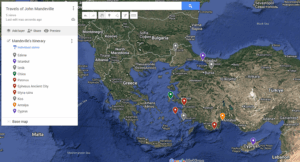
When trying to understand the confusing account of John Mandeville’s fantastic journey, it can be helpful to use a map from the period. The Mappa Mundi found in Hereford cathedral is useful for this purpose, being composed roughly contemporaneously with Mandeville’s The Book of Marvels and Travels. The writer of the Travels never actually visited the places he wrote about, and surely was working from sources similar to the Hereford Mappa Mundi. Putting both documents in conversation with each other, as well as a modern map, reveals several things about the mentality of people in the Middle Ages. The Hereford map distorts distance, heavily favoring the holy land and giving it prime place in the Christian worldview, as opposed to modern maps which aim for accuracy. The map also includes mythic and other classical knowledge, acting as a collection of information on what one can find in certain locations where modern maps tend to emphasize geography.

The Hereford Mappa Mundi, as well as Mandeville’s Travels, are thoroughly influenced by the Christian worldview of their respective makers. One can easily see this in how the Mappa Mundi presents geography and distance. The holy land takes up an absolutely massive amount of space, almost as big as Europe, which far outstrips its actual size in reality. Hereford’s Mappa Mundi does not pretend to give an accurate size, instead emphasizing the region’s importance within the Christian imagination. Supporting this is the Mappa Mundi’s subject matter. The world is covered in stories from the Bible, such as Noah’s Ark resting on Mount Ararat, the path Moses took the Israelites, and the centerpiece of Jesus’ Crucifixion on Mount Calvary. No wonder then that the Levant, the location of most of the Bible’s contents, takes up so much importance and space. Mandeville’s Travels does something similar. Throughout the book, its author is focused on the religious nature of the places he describes. From recounting miracles and informing readers about where to find relics, to when possible recalling the actual places certain biblical events took place, such as where to see the burning bush or where Jesus performed certain miracles. When in the holy land itself, this is the majority of Mandeville’s descriptions.

Also, both place Jerusalem in the center of the world, with the Hereford Mappa Mundi doing so in a quite literal sense. Mandeville agrees with this interpretation, describing in his section on India how that city is at the center of the world and travelers from everywhere else must climb up towards it. In his cosmology Jerusalem is both the center and at the highest point in the world to which all others ascend. Mandeville finds validation about this in a passage from Psalms where David says ‘God wrought salvation in the midst of the Earth,’ which he, and other Christians as evidenced by the Hereford map, took literally. This is a departure from modern maps. Jerusalem is not the center of the world, nor are our maps covered in Biblical allusions. Modern maps seek to emulate distance as accurately as possible to aid navigation, shrinking the holy land from its prominent place to a small bit of land on the Mediterranean. Despite this modern maps, as a necessity of projecting a sphere in 2D, must include some distortion. The popular Mercator projection has been criticized for making Europe seem far bigger than it is, and places like Africa smaller. Even though the overt Christian bias has been removed, mapping still requires a choice of what parts of the world to emphasize.

Along with Biblical stories, both the Hereford Mappa Mundi and Mandeville’s Travels include references to classical knowledge and myth. Mandeville’s travels on the map would take him past the ancient city of Troy, and the Labyrinth on Crete. In the book he similarly makes reference to ancient figures like Hermes Trismegistus and Hippocrates, as well as recounting fantastic stories about monstrous heads that destroy cities and maidens turned into dragons. Similarly, both include many of the monstrous races said to live in the terra incognita such as the Sciopodes and Blemmyes reported by ancient sources like Pliny the Elder. This allows both works to serve an encyclopedic purpose, acting as a collection of knowledge about the world for their audiences which, as evidenced by their similarities, were quite similar. Modern maps, on the other hand, eschew this. Most commonly they emphasize strictly geographical information, such as terrain features, distances, and the like as opposed to the catalogue of places, lore, and creatures that populate the world.

Mapping Mandeville’s journey on Modern and Medieval maps reveal different things based on different purposes. Medieval maps like the Hereford Mappa Mundi are repositories of various information including Biblical and ancient stories and the various peoples inhabiting far away places. Mandeville’s Travels serves a similar function for the prospective pilgrim to Jerusalem, meaning the two synergize well. Modern maps, on the other hand, emphasize geographical accuracy above all. Tracing Mandeville’s travels on a modern map allows one to see things like how far it would take to get from point a to point b or how difficult the terrain would be to traverse. Doing so on the Hereford Mappa Mundi allows one to see what Mandeville thought he would encounter on that journey, and just how central the pilgrimage was to the Christian mind.

Modern Map of Mandeville’s Travels:

Link to Mandeville’s Travels on the Hereford Mappa Mundi:

Ibn Fadlan Medival Map

The journey of Ibn Fadlan, as mapped out on the Tabula Rogeriana, gives insight into how Ibn Fadlan visualized his journey. It also aids in realizing how complicated his travels actually were. The Tabula Rogeriana was created in the 12th century. Ibn Fadlan traveled in the 10th century. So, this map was not available for Fadlan to follow to navigate his journey to Bulghar. Even if he did have it, it would have still been difficult to follow. The Tabula Rogeriana maps the known world in the 12th century. When Fadlan was traveling, there were places that were still unknown that were featured on the Tabula Rogeriana. My limited knowledge of labels and places on the mapping was frustrating. Fadlan would have been traveling essentially blind; this must have been frustrating. These potential frustrations can be examined by comparing Fadlan’s journey on a modern map versus the Tabula Rogeriana.

         The biggest difference between the modern map and the Tabula Rogeriana is the orientation. The Tabula Rogeriana is oriented south upwards. When he was traveling to the North, he was envisioning himself walking down towards the pole. This wouldn’t have affected his own view of his travel, as his worldview was south-oriented upward. This was a principle of the Islamic view of the world. However, what could’ve been difficult was if he got directions or insight from other travelers on how to find any of the locations he needed to go to. We know he interacted with people of different religions. The logic about where things are oriented may have been different from his, making travel difficult. Fadlan wasn’t just wandering through the Middle East and up into Europe. He had set locations where he was going. Therefore, he needed directions. Some of the places he stopped didn’t seem calculated; they weren’t a part of a “trip itinerary.” However, some of the locations were pre-planned. He stops in Bukhara to receive money for the mosque in Bulghar. He needed to know how to get here. Without having a map, this must have been very difficult.

         Another difficulty in his travels comes from the differences in geographical features. On the modern map, the Caspian Sea is (obviously) the correct shape. On the modern map, the Caspian Sea is a lot longer (it kind of looks like New Jersey); it is just generally bigger. However, on the Tabula Rogeriana, the Caspian Sea is significantly smaller. It is a lot more circular. The whole tale of it is missing. Obviously, the medieval map isn’t going to have the right shapes of every feature and country; everything is an estimation based on people’s accounts of their travels. Fadlan would have had a less accurate idea of the shape of the Caspian Sea. You can tell this by looking at the direction of his travels on both maps. On the modern map, Fadlan swings very widely to the left of the Caspian Sea. He goes out of his way to seemingly make sure he doesn’t intercept the sea. His stop in Bukhara was pre-planned; this was one of the locations he knew how to reach. This seems like a way to avoid geographical issues as well as completing tasks for the Calif.

         The last large difference between the two maps is the distance between the top and bottom (north and south). On the modern map, Bulghar is significantly farther from Baghdad than on the Tabula Rogeriana. The scale of the maps is completely different. The Tabula Rogeriana under-accounts the distance between the two places. I thought that the Tabula Rogeriana was out of scale; however, the scales of Egypt and Saudi Arabia are pretty consistently sized with the modern map. These scale differences wouldn’t have necessarily affected Fadlan’s travels. However, it does change the perspective of how people would have viewed Fadlan’s journey.

         In conclusion, Fadlan’s journey wasn’t much affected or changed by the differences in the two maps. The biggest difference between the two maps is the orientation and views of the world. This, to a modern traveler, seems foreign; however, to Fadlan, this would have been the norm. The only confusion could have been sparked by discussing directions with non-Islamic travelers. The second difference would be the ideas of the shape and location of geographical markers that could have affected the exact navigation of his journey. Since they didn’t know precisely where these geographical obstacles would have been, they could’ve over- or undercompensated for avoiding them. Overall, his actual journey was simply perceived differently by modern viewers and non-Muslim audien

Medieval Travel Map – Marco Polo/Tabula Rogeriana


While it was sometimes difficult to plot the points of Marco Polo’s journey onto a modern map due to ancient locations and names not lining up with those of the modern day, it seems even more confusing trying to map these modern points onto my ancient map simply because of the visual differences and artistic vision of the two separate maps. Looking through a strictly visual lens to start, it is clear that the Tabula Rogeriana as an ancient piece of cartography carries different perspectives on the world from what we know today, the space being represented in physically and culturally different ways.

                  At a first glance, the Tabula Rogeriana looks like a completely different world, and the landmasses look like something you would see in the front pages of a high fantasy fiction novel. But turning the map upside down and taking a careful look will show that it does indeed represent the majority of mainland Europe and Asia, as well as Northern Africa. The difference in appearance comes from how the map has been oriented upside down, at least according to our traditional Eurocentric views on what a map should look like. Instead, and this is due to the map’s creator being Muslim, the map takes on an Islamic view of the world where South is oriented towards the top of the map.

                  The Tabula Rogeriana also provides an outlook that is more interpretive and is put together through scholarship and beliefs about the world, as well as the desire to see pathways and obstacles in relation to trade. It is organized into a kind of grid, where one might be able to pick out a certain section of the map and do a cursory analysis of the region based on the important features drawn in. Individual settlements, forests, mountains, lakes, rivers, and roads can be seen clearly on the map, as they are drawn to stand out sharply as features of note for a traveler through the region. Being able to see all of these geographical features from such a wide lens on the map offers an important but also very vague interpretation of direction and landscape across the continents. This is opposed to the digital modern maps of today, where a zoomed out view will show general topography and borders, but zooming in allows for extremely precise location tracking, names of roads and buildings, directions, and more.

                  This contrast carries over on a grander scale as well when looking at the organization of the world and its continents on the Tabula Rogeriana. With the precise tools, mapping, and satellite views of today, we have been able to carefully and accurately map out landmasses with greater care for scale. It is clear when looking at the ancient map and trying to plot points, there was not a lot of knowledge or care for the true scale of things, but the real focus was giving a simple regional overview. Compared to other ancient maps, this one is surprisingly easy to interpret when trying to make out the picture it is painting of the globe. You can see the European peninsula and the extension of Italy clearly, and make out the Middle East, Eastern Asia, and Northern Africa as separate entities – albeit ones still blocky in form and completely off scale. This becomes more of a problem when looking at all of the various islands, which generally are not differentiated from one another much, and are really just grouped together tightly to show that they are all in the water over there somewhere, but the distances between the islands are not mapped at all.

                  Based on all of these things you can point out between the two maps, I would generally say that when we look at maps today and all of our navigational devices, we are using them strictly directionally and for the sake of knowing where we are and which direction to travel next. In ancient maps such as the Tabula Rogeriana, I would say there is more cultural weight behind the cartography, and while the geography was not as well known, the cartographers of the period aimed to implement more cultural knowledge and ideas about how the world was connected. Growing trade and travel necessitated clear pathways and markings of what settlements were in a region, as well as potential geographical roadblocks to be encountered. Using my previous points I plotted on the modern map in relation to Marco Polo’s journey, and trying to plot them on this ancient map, it is interesting to see how difficult travel must have been and how impressive it was for him to include multiple measurements of distance, especially seeing how vague distances were when looking at the Southeastern Asian islands. Today, we would look at our GPS and think about ourselves, where we are, what our next stop is – ancient technologies were less precise, but the growth in travel subsequently grew the desire for knowledge of the wider world.

« Older posts

© 2026 Mapping the Global Middle Ages


Academic Technology services: GIS | Media Center | Language Exchange

Theme by Anders NorenUp ↑