Page 10 of 14

Ibn Fadlan’s Journey on a Modern Map

Map Link:

Category key:

The different icons correspond to the category I selected for each location, which describes Ibn Fadlan’s experience with that location. 

The star icon – Mark Ibn Fadlan’s home and destination for this journey. 

The bed icon – Places where Ibn Fadlan and his group only visited because they needed to break up the trip, and did not do much more than sleep. 

The lightning bolt icon – The places where Ibn Fadlan faced difficulties.

The walking icon – Locations where Ibn Fadlan and his group passed through to get to the next location. 

Ibn Fadlan: From Merv to Atrak’s Camp

Mapping Link: https://www.google.com/maps/d/u/0/edit?mid=1KkXuoGbWTl7zwncmnP96q1LLvaqz4sc&usp=sharing

Key For Categories

Description of Icon Color Category
House Red Home of Traveler
Bed Teal Lodging
Shopping Cart Green Trading Post
Car Yellow Brief Stop (not much is described at this location)
Building with Columns Purple Political
Two Houses Dark Blue Shelter and Long-term Stay
Two People Walking Blue Culture

Ibn Fadlan: Where did he go?

Link to map 

Map color Key:

Red=Major locations that have been detailed in depth/own sections:

Baghdad: Where he begins,

Bakhara: Where he stops and gives a first look into another culture

Khwarazm(Kath): Where he gives his second account of Culture

Bulghar: His end location, where he spends a great amount of time discussing their culture and conversion.

Blue=Locations that are mentioned with some detail (about their journey, not these places’ cultures):

Rayy: We learn that they waited for Ahmad ibn (they were in the wrong location)

Jit: They got stuck due to the snow and had to stay for two days so their camels could walk through the snow

Yellow=Locations that are mentioned in passing with no additional information:

Nishapur: The only information is that they made it here with the concealed caravan, but no additional trip info is given (no time, no weather, etc.)

Sarakhs: Absolutely no information is given

Nahrawan: We only know they stayed one day

Simnan: Once again, no information is given

Felix Fabri: Modern Map

Here’s the link to my map on the Wanderings of Felix Fabri:

https://www.google.com/maps/d/edit?mid=18yLeabCtHe9qZXRYQ6KRjVoUrFovoIY&usp=sharing

Categories: I separated Felix Fabri’s Wanderings into categories based on terrain and physical description. Fabri focuses a lot on his natural surroundings for the beginning half of the pilgrimage. However, once he leaves Venice and travels toward the Holy Land, his physical descriptions diminish. This shift illuminates an interesting mindset regarding the authenticity of the Holy Land and his aim to preserve Jerusalem in its most honest state.

Key:

🏔️: mountainous region 

☀️: valley region 

🌊: Water/Ocean Region 

✝️: Holy Land – Jerusalem 


Margery Kempe Modern Map Assignment Norfolk-Jerusalem-Rome

Here is the link to my map:

https://www.google.com/maps/d/u/0/edit?mid=1H-JXjjcZgqbywpIZ1ZGmH0vX1edEvaI&usp=sharing

Blue Line: Her travels from Norfolk-Norwich-Yarmouth-Zierikzee-Konstanz-Bologna-Venice-Jerusalem

Red Line: Her travels from Bethany-Jerusalem-Back to Venice-Assisi-Rome

Blue icons: Places she went to in Europe

Red Icons: Places she went to in Asia

Each icon is given with a symbol which shows her mode of transportation at each region

a descripition is given in each text box of each location


Benjamin of Tudela Modern Map

Europe

Asia

Link to full map: https://www.google.com/maps/d/edit?mid=1KbMXk61iebYfY4LHM5QQkYRSbhjzPmw&usp=sharing


The main two categories are by region. I have mapped Benjamin of Tudela’s travels in Europe (red) and Asia (green). Important locations on which he spends the most time are marked in slightly darker colors with city icons.

The Travels of Marco Polo: Shang-Tu

Cameron DeVries

Blog Post #2

October 2, 2025

The Travels of Marco Polo: Shang-Tu

Marco Polo goes on and on for a long time about the Great Khan and all of his palaces, cities, and places he stays during various seasons, and I could write about any one of them. I was most interested in this city of the Khan’s, called Shang-tu (or Shangdu), because I did some research and saw that it was also known as Xanadu in the West.  I remembered from my film class when we watched Citizen Kane that Kane lived in this very opulent mansion on a hill that was called Xanadu, and it seems that the word has derived from the times of the Khan and is still used today to represent places of great beauty and wealth. For the majority of this section, this seems to be what Marco Polo is mainly focused on.

Again, Marco Polo does not seem overly concerned with the details on himself, such as the dates of his arrival or the places he stayed in. However, he does note that the Khan stayed in Shang-tu during the Summer months of June, July, and August, and based on the ways in which he tells certain stories and makes descriptions, it can be assumed that Polo was there during these months, although I am not certain. Something else to be noted about Marco Polo before getting into specifics is the fact that he came from a merchant family in Venice, Italy, so he would not be a stranger to wealth or that sort of lifestyle. It could be for this reason that he seems so attracted by and appreciative towards the decadent structures and signs of wealth that he is seeing around him, and the Khan’s lifestyle in general.

We can kind of say that Polo was focused on the buildings and the environment here, because the environment seems to consist mostly of the works of Kubilai Khan and the ways in which he has formed the city to his liking. He talks about the Khan’s great palace with all its columns, rooms, and adornments, as well as the Khan’s huge park that contains (besides another palace of its own) multitudes of species of wildlife, such as stags, leopards, and falcons. This is also the section in which Marco Polo seems to show his great interest in animals more, or maybe it is just because the Khan has so many animals to be spoken of. Marco is impressed by the tens of thousands of pure white horses, and notes how the Khan leaves this city at the end of every summer in conjunction with the ceremony of throwing his mares’ milk on the ground before he leaves, in order to appease the spirits and gain protection over his lands and subjects.

Something that seems to shock him a little more is the presence of the Bakhshi, or the “enchanters” that are called in to dispel the rainy weather when it appeared. It seems like magic and enchantments are something that Marco Polo is a little wary of, because he says he believes their spells to be the work of the Devil rather than holy work as they claim. However, he seems to get past this shock quickly and become interested in their practices; even when he is saying that they live in squalor and look ragged, he is still just saying this in his matter of fact manner, and does not seem judgmental. Similarly, for the Sien-seng people that he describes, he just states that they are “austere” after talking about how they eat only flax, own virtually nothing, and sleep on mats. Going back to the Bakhshi and how they would levitate cups up to the Khan seemingly through magic, it was funny when Marco said “What I have told you is the plain truth without a word of falsehood”, like he was trying to just convince himself, accept it, and move on. Marco Polo continues to write respectfully and in a straightforward way, and is interested in but not judgmental of those with different practices, and is pretty enchanted by the great wealth of Kubilai Khan.

The Book of John Mandeville: Ephesus and Lango, Among Others

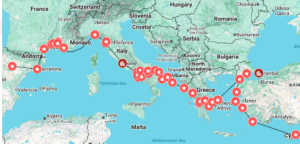
From Constantinople, the fictional John Mandeville outlines his travels to Greek islands–still on his way to the Holy Land. This section of The Travels of Sir John Mandeville builds upon the narrator’s identification of Greek Christians as different from the Western Christians within Mandeville’s audience. He asserts the necessity of this distinction, writing, “For many people take great pleasure and comfort to hear talk of unfamiliar things” (14). This statement reflects both Mandeville’s bias and his purpose for writing a travel account. Aside from the trees on the island of Chios, he does not provide ethnographic details about Greece. This choice focuses Mandeville’s account on the importance of religious sites rather than the people who inhabit them.

Thus, Mandeville spends more time writing about locations integral to Christian memory. To Mandeville, the importance of a place is dependent upon what event happened there. While less significant places are merely listed, many locations are denoted by an associated Christian figure or relic. Furthermore, Mandeville takes more time to address the most relevant places and their story, whether historical, mythical, or Biblical. Mandeville associates Patmos with being, “where Saint John the Evangelist wrote the Apocalypse” (14). Rather than talking about the island’s terrain or people, Mandeville instead tells his reader about Saint John–quickly shifting his location to Ephesus, where Saint John died.

Mandeville describes Ephesus more than the preceding Greek islands, signaling its value to his audience. He calls it, “a lovely city” (14), on account of the fact that it was once controlled by Christians. To Mandeville, the hallmark of Ephesus is the tomb of Saint John and the mysterious whereabouts of his body. Similar to the provenance of the relics he encountered in Constantinople, Mandeville highlights that the story of Saint John’s tomb is contentious. He notes that, “some men say that his body was translated to Paradise” (14), while others believe, “he did not die but that he is resting there until the Day of Judgement” (14). By addressing various conclusions to the question of Saint John’s tomb, Mandeville maintains the site’s relevance, making it contemporary to his reader rather than solely historical.

Beyond Ephesus, Mandeville briefly accounts for Patera, the birthplace of Saint Nicholas, and its wine, before writing about the island of Lango. In contrast to previous locations, Mandeville’s description of Lango is tethered to regional myth. He outlines the presumed origin of the island, noting it to be, “Hippocrates’ daughter in the form of a dragon” (15). Mandeville goes on to detail a story about a young maiden being transformed into a dragon, with only a bold, brave knight able to save her. Similar to his description of holy, Christian relics and sites, Mandeville constructs an ultimatum of fate. If the young maiden is kissed by the right knight, she will no longer be a dragon. Similarly, if Saint John is in his tomb, when the Day of Judgement arrives, he will reappear. The ‘if’ within Mandeville’s account adds a layer of intrigue, positioning him as a storyteller rather than a travel expert.

Although Mandeville is less receptive to the customs of Greek Christians, this section illustrates his appreciation for explanations different than his own. Since Mandeville’s account is not rooted in fact, the power of a place is dependent on its associated myth–whether secular, pagan, or Christian. Though this account tracks Mandeville’s journey to Jerusalem, he does not condemn the stories of other cultures, but embraces them. Mandeville bridges the gap between his travels and his reader by underscoring the continuous, cross-cultural practice of storytelling.
The Book of Marvels and Travels by John Mandeville: Cyprus

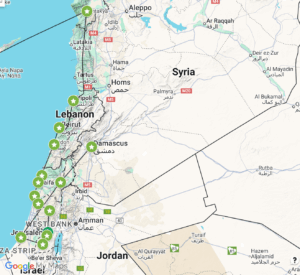
After leaving Constantinople, the next place John Mandeville describes in detail is the island of Cyprus. Mandeville, writing for the benefit of prospective pilgrims, for the most part maintains his religious focus when describing the island. He informs his readers that there is an archbishop at Nicosia, along with four others in the region. Along with this he says that in Cyprus there is the Hill of the Holy Cross of the good thief Dysmas, along with the burial sites of St Sozomenos, an ecclesiastical historian, and St Hilarion, and that St Bernard was born near the city of Famagusta on the island. Pilgrims using Mandeville’s book as a guide for their own journeys would surely find such information useful, as they were on the look out for places to display their piety. Mandeville even warns pilgrims that the locals advertise that they have half of the Holy Cross upon which Jesus was crucified, but it is a fraud and that they sin by saying so.

Mandeville does, however, include more practical and secular information about Cyprus as well. In fact, the first thing he says about the island is that a variety of grapes which start red and turn white after a year grow there, and that these grapes are “…utterly translucent and have the best scent.” Descriptions of local produce like this have not been mentioned before, so it is interesting that he would want to include it here. Mandeville also informs us that the city of Famagusta has an excellent harbor and that “…Christians, Saracens, and people of all nations live there.” It is interesting to note how matter of fact the zealous Mandeville talks about the island’s Muslim inhabitants. On top of this he describes how the Cypriots hunt with papiouns, a type of big cat similar to a leopard though modern scholars do not know what it could actually be. Mandeville also reports that Cypriots eat on the ground in massive ditches dug for that purpose up to the knees. He says this is because it keeps food more fresh in the hot climate of the island, though when foreigners come for great feasts they set up tables for them, but would prefer eating on the floor.

Because Mandeville is an invented character and did not actually go to Cyprus, it is difficult to tell if any of the information he relays is true. The strange eating custom could be something the author heard from someone else and believed it, but just as easily be something he decided would be fun to make people believe. The fact scholars have no idea what a papiouns is, and that Mandeville claims Cypriots use these animals which he says are larger than lions to hunt is too strange to believe. Which begs the question of what he gains from making this up? He seems to sincerely want people to be informed about the pilgrimage route and where to stop on the way by the fact he warns readers where frauds are, but his own fraudulent information seems to work against this stated goal. This disconnect continues down to smaller details: usually light on the practicalities of travel, he claims Cyprus is nearly 500 miles from Rhodes. No it isn’t, the distance is much closer to 300 miles. It may be an innocuous detail, but it seems strange to me that he feels the need to include such a detail when he never has before, and it is just plain wrong.

« Older posts Newer posts »

© 2026 Mapping the Global Middle Ages


Academic Technology services: GIS | Media Center | Language Exchange

Theme by Anders NorenUp ↑