Page 2 of 14

The Book of Margery Kempe: Medieval Map Assignment

Comparing Margery Kempe’s journey on a modern map and the Psalter World Map juxtaposes how a modern traveler and a medieval traveler visualize the world differently.

The modern map provides a modern traveler with a physical and geopolitical understanding of the world. This map defines countries with strict borders, establishing that different regions have separate cultural and political identities. Cities are labeled, with the more prominent and larger cities labelled in bigger fonts, reflecting their social significance and popularity. Generally, continents are scaled to reflect their comparative sizes. While this map is a world map, it also reflects the U.S. government’s (and some Americans’ perspective of the world). For example, this map uses the label “Gulf of America” rather than “Gulf of Mexico.”  In addition, the labels are in English, meaning that location names are anglified, and not necessarily  written how a native speaker would write them..

The Psalter World Map provides a medieval traveler with a different physical and geopolitical understanding of the world that is largely rooted in Catholicism. Jerusalem, the holiest city, is placed in the center of the world. The cardinal directions are rotated ninety degrees, with east as north, due to the belief that Paradise (the most Northern/upwards point) was in the same direction the sun rises.

While the modern map is divided into countries, the Psalter World Map has no country borders. The T-O structure of the map uses the Mediterranean Sea to generally separate the world into three land masses, though there are no defined countries with names. Instead, it depicts some prominent geographical features, such as bodies of water and mountains, and prominent cities (represented by gold triangles). This layout of the map suggests a worldview in which different geographical groups of people are viewed not by country, but through a religious lens. Each of the three land masses is representative of the descendants of one of the three sons of Noah, informing how the people in each of those areas may have been perceived. For example, the top left of the map is an illustration of Alexander’s Wall, behind which were meant to be the cannibalistic descendants of the evil sons of Cain, the Gog and Magog. By depicting this religious lore, the Psalter World Map identifies those living in the Northeast of the world as evil cannibals.

Like the modern map reflects a modern day American perspective, this map reflects an English perspective from (roughly) the thirteenth century, due to the location and time of its creation. This English perspective of the world is evident in the amount of locations labelled in each area. Outside of Jerusalem with its many labelled (religiously informed) locations, the bottom left quadrant, closest to Britain, contains the most labelled cities. Meanwhile, the right side of the map contains depictions of the “monstrous” races, or people/creatures with multiple or missing body parts. This portrayal of people in the southern part of the world reflects that those in Britain knew less about the world the further it was from them, allowing speculation and folklore to shape their understanding.

An additional element of the modern map that the Psalter World Map lacks is the inclusion of roads. This aspect of the modern map emphasizes that its priority is to give instruction for travel. The modern map suggests that the modern traveler views their place in the world as a specific geographical point, and the purpose of a map is to accurately assess this point in relation to the rest of the world. It offers physical guidance on how to reach a specific location, not only through its depictions of roads, but its depictions of mountainous terrain and bodies of water, which both accurately reflect the physical world and illustrate potential geographic barriers to a modern traveler. Country borders also provide this type of logistical information, as a border crossing can be an obstacle for travelers.

Instead of providing practical and logistical information for travel, the Psalter World Map’s visual priorities are in religious illustration. This purpose can be seen in the colorful and detailed artwork not only on the map but surrounding the map– angels surround the world, along with the upper body of Christ, who has a large halo of gold. In his hand, Christ holds a T-O sphere, expressing that he is ruler of the world. Margery begins her journey in Britain, located at the bottom of this map, and in moving physically upwards on this map to reach Jerusalem, the map shows Margery is moving closer to God on her journey. This idea suggests that in going on her pilgrimage to Jerusalem, a medieval traveler like Margery would have held the perspective that she was not only symbolically and spiritually growing closer to God, but also physically moving closer to him. Further, by physically (in her mind) moving up in the world, she could have felt that her religious status and quality of life was also moving upwards. By looking at the modern map, a modern traveller can see the impressive length and physically difficult journey Margery went on (traveling more than 3,000 miles southeast), which, though it does not support this religious narrative of moving upwards and closer to God, does reflect the strength of her religious devotion.

While the modern map is a physical representation of the earth, visualizing logistical and terrain-related information, it also reflects a modern day geopolitical understanding of the world. The Psalter World Map frames the world from a religious viewpoint, both physically and through the religious illustrations surrounding it. Rather than categorizing people by countries, it expresses a medieval idea in which areas are generally understood through religious scripture and speculation. In mapping Margery Kempe’s journey on both of these maps, a viewer is able to compare their modern day understanding of the world and travel to the Catholic perspective through which pilgrims like Margery Kempe saw the world and understood other people.
 

Medieval Travel Map Assignment – Ibn Fadlan

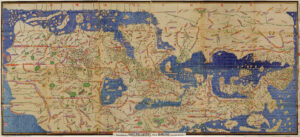
Travelling during the Middle Ages was not an easy task due to the lack of information people had on foreign areas, the limited options for travelling – either by foot or by animal – and the risk of coming into contact with dangerous persons or events. Even so, people, like ibn Fadlan, still journeyed into the unknown world. Fadlan’s journey took place from 921-922, and he travelled over 2,000 miles from Baghdad to Bulghar, or modern-day Republic of Tatarstan. Although the Middle Ages did not have an abundance of mapping technology, there were some advancements made, like the creation of the Tabula Rogeriana in 1154. The Tabula Rogeriana, created by Muhammad ibn Muhammad al-Idrisi and commissioned by King Roger II of Sicily, was a huge step forward for cartographical progress during this era (Sturtevant). I have produced ibn Fadlan’s trip on both a modern map and the Tabula Rogeriana, which creates a better understanding of what travel was like in the medieval era compared to how travel is in the modern age. Although both maps were created centuries after Fadlan took this journey, considering the medieval map, it goes to show the sheer difficulty of traveling during medieval times due to the lack of information and preparation travelers like Fadlan had access to. 

While mapping this journey on two different maps from different points in time, the disparities between the maps are very apparent. For the modern map, mapping ibn Fadlan’s stops was fairly easy. I only ran into some difficulties because some of the cities do not even exist anymore. Most of the cities Fadlan traveled to now have a different name in the modern world than when he visited, so I needed to research on the cities’ modern equivalents. The name changes can be because of some historical implications, like perhaps someone conquered the city and changed the name, or it can be the result of linguistic and cultural influences changing over the course of history. Other than that, it was pretty simple to transcribe his journey onto the modern map because I just typed in the name of the city, and the technology took care of the rest. The medieval map was certainly not as simple. To start, the Tabula Rogeriana is flipped from the modern perspective, meaning North is down and South is up. This is due to the Arab-Islamic cartography influences al-Idrisi learned,

where the scholars depicted North at the bottom of the map and South at the top because they believed up is good and down is bad (Pastuch), so I needed to reorient my thinking. Then, I needed to place the points I believe to be the locations of the cities Fadlan visited purely based on the modern map. The Tabula Rogeriana has cities depicted by the little black dots, but the labeling is all in Arabic, which I do not speak, so I had to estimate to the best of my ability. Also, the Tabula Rogeriana does not include borders on the map, so I needed to use other landmarks to help with my estimation of each point, such as the mountains and rivers. The inclusion of the different topographical elements denoting mountains and rivers show that although this map is from an entirely different era, they still had the ability to track and illustrate these features, which would be of great help to a medieval traveler. 

Both maps presented challenges when mapping out Fadlan’s journey, but the medieval map of the Tabula Rogeriana is definitely the more difficult one to use. Cartographers had limited information since the only information they had was either their own experience or their colleagues’ experience, so they ran the risk of spreading false information about these locations. The Tabula Rogeriana had the influence of people from all different religious, occupational, and cultural backgrounds, which is what made this map so important for its time (Pastuch). The collaboration of the Arab-Islamic influences al-Idrisi learned from the Balkhi School of Geography (Pastuch) and King Roger II’s Christian influences is why this is one of the earliest examples of multiculturalism, which is demonstrated by the lack of borders included in the map. The area is one united mass and not separated by religious differences or culture. On the modern map the borders separate countries by government control and territorial agreements. Information for the modern map does not come from word of mouth, but by modern technology. This technology gathers every piece of data about every location on Earth. Modern travelers do not face nearly as many of the same concerns as the medieval travelers, and it is all because of technology. There is no guesswork, the information is all at their fingertips. 

Ibn Fadlan’s journey included various stressful points, but his lowest point during his journey was his visit to Jurjaniya due to the intensely cold climate. He and his group needed to stay in Jurjaniya for three months due to the frigid weather and he describes it as, “the cold of hell” (Fadlan 7). Fadlan would have greatly benefitted from modern technology, especially weather applications that would have warned him about the climate of the area he traveled to; furthermore, the modern map could also give him an alternate route so he could avoid places that would cause him such hardship. It took Ibn Fadlan about a year to travel about 2,000 miles, and in the modern age, that trip could take a person five hours by plane. It is miraculous how far technology has come and what it has given people the ability to accomplish. Ibn Fadlan virtually traveled all that distance to meet the king of the Saqaliba in the land of the Turks (Fadlan 25), which in modern day could have been a day trip or a Zoom meeting. Ibn Fadlan was proud to serve the caliph and promote Islamic worship, but I assume he would have appreciated the modern inventions that decrease the risk and hardship of travel needed to accomplish tasks. 


Works Cited

Ibn Faḍlān, Aḥmad, et al. Ibn Fadlān and the Land of Darkness : Arab Travellers in the Far North. Penguin Books, 2012.

Pastuch, Carissa. “Al-Idrisi’s Masterpiece of Medieval Geography.” Library of Congress Blogs, Jan. 2022, blogs.loc.gov/maps/2022/01/al-idrisis-masterpiece-of-medieval-geography/.

Sturtevant, Paul B. “A Wonder of the Multicultural Medieval World: The Tabula Rogeriana.” The Public Medievalist, 9 Mar. 2017, publicmedievalist.com/greatest-medieval-map/. Accessed 9 Mar. 2017.

Marco Polo on the Ebstof mappamundi

Marco Polo is renowned for his travels across the Medieval world, but notable, he would never have used a navigational tool such as the Ebstorf mappamundi during his travels. A concept such as using a map for directional information was not standardized and most travelers would resort to hiring guides or consulting manuscripts akin to those of Marco Polo’s for navigation. Because of this, mapping Polo’s travel route on an incomplete, biased, and overall incomprehensive is a argues endeavor since the creator of the map was not focused on geography, place, location, or even realistic accuracy. Instead, the Ebstorf map is filled with European ideas of the eastern world based on classical literature and Biblical overtones. Additionally, parts of Asia are completely unknown and not mapped at all. It is not even just Asia that is at risk. Domestically, countries are shrunk down to unproportionale sizes or in the case of Italy, Marco Polo’s native land, represented as sole city.

In comparison to a modern map, the Ebstorf map falls phenomenally short at being a device a traveler can use to orient themselves. The most notable difference is the overall size. While I had initially only plotted out Polo’s journey through mainland China on a modern map, doing as such on the Ebstorf map was simply impossible. To begin, China is not labeled as a definitive place on the map. The general direction of Asia is north of the “T” aspect of the map, dividing the world into three segments, leaves very little room to definitively mark each city Polo noted in his travels. Instead, I traced Polo’s journey starting from his departure in Venice. As mentioned previously, Italy is not represented geographically, but rather as a large circle of churches with a lion nearby comprise the city of Rome. Rome is reprehensive of a larger theme of the map: religion and its influence on the physical landscape of the world. Italy is only represented as Rome because of its ties with the Vatican and the Holy Sea. In contrast, Polo’s trail on a modern map shows only factual information of where he traveled and says nothing to how medieval people such as Polo would view the rest of the world.

The Ebstorf map puts into conversation European ideas of religion with the locations of places, showing how God and His Kingdom are everywhere in the mortal world, functioning more as the “medieval European’s view of the world” opposed to what it realistically looks like. Marco Polo reflects this in his accounts of his journey. Every place he goes, Polo mentions Christianity or how the area he is currently traveling through differs from the traditional Christian values. For instance, the second area plotted on the map is Jerusalem, which is notably one of the largest icons on the map, but also in the center of the whole world. Jerusalem is the Holy City, one of the most significant cities in the Christian world, so it being in the center of the world further supports how medieval map makers were influenced by the religion at the time. Other locations like Ayas, Saba, and the Grave of Saint Thomas, while not explicitly shown on the map can be located through iconography of Christian elements. In particular, Saba, the city where one of the three magi who came and bore gifts to the baby Jesus, is reportedly buried there, with the other two buried in surrounding locations. Saba is not on the map, but a turret where a plume of fire is spitting out at the top resembles the castle Polo talks about where “fire is worshipped”. The symbolism of the castle standing in for any geographic location or even a name is representative of how the map was “made for Europeans by Europeans”.  Inversely, areas of the world such as Myanmar are not with any definitive characteristics. The boarders of the map consist of mythical and misshapen people which fit the medieval narrative of not knowing what is beyond the gates of their own world. Polo “visits” such a place when he travels to the city of Mein, in Myanmar. There, Polo encounters what the Ebstof map considers “the boarder of civilization and humanity” and makes his journey seem like he has traveled across planes into a land of chaos and magic.

Marco Polo’s tales of travel were some of the most popular in the medieval world and even in the present day. His travel accounts give insight into how travelers from Europe would view the world and then bring back their discoveries and share them with others. This in turn influences how medieval map makers would style their maps, creating the world in the image of how a European would view it since that was all the information they had to base their designs off.


MAP: https://uploads.knightlab.com/storymapjs/fbe66306001392d57a9e7aec871afb8a/ebstorf-map/index.html

Medieval Map Assignment – Map Comparison

After re-mapping Margery Kempe’s travels on the Bianco Map, it became evident that the major difference between Bianco’s Map and Google Maps is specificity. Bianco’s Map depicts many important locations and areas of the world, but it tends to ignore anything considered a ‘minor’ city (often cities of less religious importance, and therefore fewer visitors). Marking Kempe’s journeys on this vaguer map proved to be more difficult simply because I had to estimate the locations of places like Constance and Great Yarmouth in relation to larger bodies of water or other landmarks. Because of this lack of specificity on Bianco’s map, Kempe’s travels may be more difficult to follow, or the markers of certain locations may be entirely incorrect.

Further, Bianco’s map is an artistic rendition of the world that utilizes illustrations to mark specific cities. Borders are completely omitted, while they are something our maps today rely heavily on. One of Google Earth’s central capabilities is to show specific borders of countries, cities, and continents. The way we understand travel today is based on the idea of crossing borders – whether that means crossing borders to other states, or farther away to other countries. While Kempe was certainly aware of crossing into other countries, the awareness of a specific line or immediate transition may have been less apparent than it is to us today.

Bianco’s interest in the religious significance of major European cities is clearly evident on this map. As with most medieval maps at this time, Jerusalem is oriented in the center of the map, highlighting its significance and centrality in the world. For Bianco and Kempe, and other Christians on pilgrimage, Jerusalem’s orientation in the center of the world makes the most sense, as it is the location for Jesus’s adult life. Surrounding areas, including the Red Sea, depictions of Adam and Eve, and proverbial characters like the three wise men, show the significance of religious themes in understanding travel and location in Europe. Even beyond the landmarks and depictions of cities, Bianco’s religious expertise is evident in the outskirts of the map: the world is surrounded by the stars (heavens), and the farthest reaches of the ocean show fantastical creatures like two-tailed sirens and two-winged dragons.

In addition to this map representing common religious ideologies, it’s imagery also holds underlying racist themes. The existence of Gog and Magog as one gets closer to Africa is something that should not go unnoticed. Because of this map’s emphasis on imagery to show location, the images tend to represent common notions of what those locations hold (mostly religious importance), and having the people of Africa become more monstrous, fantastical, or dangerous shows the racist ideas European people held about African people. Bianco’s map is opinionated and based on religious and cultural beliefs, while today’s maps, especially Google Earth, lean more toward factual and scientific evidence of location and proportion. That is not to say that Bianco’s map holds no accuracy, though. In her book on the world map, Evelyn Edson says, “It is a struggle between the authority of the mighty classical past, the religious orthodoxy of the medieval mappaemundi, and the practical experience of sailors, ‘persons worthy of trust who have seen with their own eyes’ (Edson 7).” Bianco’s map was accurate, or at least as accurate as possible for the time period, but it certainly is not as accurate as modern maps.

On Bianco’s map, the distance of Kempe’s journey seems to be across over half of the length of the world. If Bianco’s map is, in fact, a map of the entire world, Kempe has seen a significant portion of it. In relation to our modern map, though, Kempe’s travels cover barely a fraction of Europe, let alone the whole world. The sheer size of the map on Google Earth is significantly larger than Bianco’s Map, even though, at their time of creation, both are believed to depict the entire (known) world. To Kempe and most of the European world at this time, her travels seemed quite extensive, and while they certainly were for the time, our understanding of travel in today’s world far surpasses what it once meant.

Overall, there are many differences between Bianco’s map, Google Earth, and what that means for those who utilize each atlas. One of the most difficult parts of mapping Kempe’s travels on Bianco’s map was the medieval map’s orientation with east at the top. To ensure my locations were marked correctly, I rotated Google Earth 90 degrees to the left to make the maps match as closely as they could. After comparing both maps, readers can see that Bianco’s map holds important cultural information on beliefs of travel, religion, and race, while today’s map values specificity, facts, and scientific proportions to ensure accuracy.


Edson, Evelyn. The World Map, 1300-1492 : The Persistence of Tradition and Transformation. Baltimore, Sante Fe, N.M., Johns Hopkins University Press ; Published in association with the Center for American Places, 2007.


Medieval Map Assignment


Link to Medieval Map!

Placing the itinerary of The Travels of Sir John Mandeville within the visual context of the Hereford Mappamundi helps to alleviate the confusing nature of both sources, independent of one another. While John Mandeville speaks to the importance of various places, the Mappamundi emphasizes the visual authority of a given person, group of people, or place. Nonetheless, both serve the same function of showing a Medieval Christian audience the far-reaching influence of Christianity in the known world.

Mandeville places his origin in St Albans, a city north of London and west of Hereford, where the Mappamundi has been on display for centuries. The origin of both the map and the text being in such close proximity to one another underscores their connection. With that being said, neither the Mappamundi nor Mandeville emphasizes England within the context of the known world. Mandeville seldom mentions his home country or its government, while the Mappamundi presents England as nondescript and sans marvels–a contrasting portrayal compared to other locations.

Constantinople is the first place Mandeville truly travels, receiving attention on account of its relevance to the author, who claims to be a Christian pilgrim. Mandeville predicates Constantinople’s importance on its Christian relics, in addition to the Church of Santa Sophia and its accompanying sculpture of the Emperor Justinian I. The Mappamundi includes Constantinople as well, labeling its location alongside a structure reminiscent of the Church of Santa Sophia. The continuity of the Church in both Mandeville and the Mappamundi highlights its status as a holy site within the Christian mind. 

The Hereford Mappamundi includes a myriad of Greek islands and cities, just as Mandeville enumerates in his travel account–Ephesus and Patera among them. Mandeville’s convention when describing Greek territories is to accentuate the difference between Greek Christians and his own concept of Christianity. Furthermore, he simultaneously recounts regional myths and Christian history, framing the intersection of pagan and Christian ideologies in the Medieval Mediterranean. There are several Classical references throughout the Mappamundi, complicating its function as a Christian storytelling device. These allusions, in tandem with Mandville’s own Classical education, reveal the literacy of both sources’ intended audience.

For Mandeville, Cyprus is an extension of his commentary on Greece as he highlights its strong Christian government, in addition to several holy sites on the island. He marks Cyprus as a crucial stop for travelers on their way to Jerusalem, and yet, the Mappamundi does not give Cyprus the same visual importance. Instead, it is largely unidentifiable, as the map seeks to spotlight marvels.

Another significant piece of continuity between The Travels of Sir John Mandeville and the Hereford Mappamundi is the placement of Jerusalem at the physical center of each source. Mandeville traces multiple routes to the Holy Land, while also addressing all of the Biblical and historical connections to the region. Similarly, the Mappamundi carves out space to showcase the crucifixion as well as a compass at Jerusalem. This strategic visual reminds the viewer what is most important: Christ.

The geography of Sicily in relation to Babylon is misconstrued by Mandeville and the Mappamundi. Both the text and the map mislabel Sicily’s location. Mandeville asserts that in order to get to Babylon, one must pass through Sicily, which is geographically counterproductive. On the other hand, the Mappamundi places Sicily west of Rome and south of Crete, neither of which are accurate. Its inclusion speaks to its importance within the Mediterranean world, but its misinterpretation–across both sources–demonstrates that neither Mandeville nor the craftsmen of the Mappamundi have acute geographical knowledge.

Egypt is a significant arena for marvels in the Mappamundi, which is aptly echoed in Mandeville’s account. The most fascinating parallel is the presence of a fauna on the map, and Mandeville’s anecdote about a half-goat, half-man being he allegedly encounters in Egypt. This is a blatant instance of Mandeville compiling content from other sources in his travel writings. That being said, Egypt is where Mandeville first describes people with dark skin. The Mappamundi does not focus on identifying ethnic or religious groups by skin color, but instead by physical characteristics, often represented through extremes and deformities.

India is an additional location where Mandeville and the Mappamundi overlap. Numerous times throughout his account, Mandeville describes the various people he meets with physical differences–one which being people with one large foot that encompasses their entire body. The Hereford Mappamundi has an illustration that perfectly coincides with Mandeville’s writing, in the same location: India. Similar to Egypt, Mandeville likely borrowed his description from the prior drawing on the Mappamundi.

Mandeville’s section on the Land of Gog and Magog is an extension of the anti-Semitic imagery depicted in the Hereford Mappamundi. In his writing, Mandeville asserts that the Land of Gog and Magog is where the Ten Tribes reside in the Caspian Mountains, labelling them as evil and inhumane. Additionally, he notes the numerous gryphons native to the region, which are also present within the map. The Mappamundi itself is full of various stereotypes of Jewish people, including Moses with horns and Jews worshipping a calf. These portrayals reflect the deep disdain certain Christian sects felt towards Judaism. The placement of Gog and Magog in the far East within both sources further ‘others’ the Jews they are intending to depict. Although Mandeville’s text and the Mappamundi are intended for a Christian audience, they are marred by their staunch anti-Semitism. 

The legend of Prester John is pervasive throughout various Medieval travel accounts and narratives. Mandeville himself falls into the trope, repeatedly alluding to Prester John, before finally describing him and his palace in Babylon. Prester John’s wealth and abundance is heavily emphasized by Mandeville. There are a few instances in which Mandeville references the Tower of Babel, but it is not a major talking point for him. On the other hand, the Mappamundi identifies Babylon by the Tower, emphasizing its function as a Biblical setting  rather than settling for the city’s connection to a fictional person.

Both The Travels of Sir John Mandeville and the Hereford Mappamundi have several shared narratives, images, and stereotypes. Each source reinforces the function of the other, helping the audience to understand what it means to be a Christian in 14th century Europe. The spatial awareness of those in this era was broadly limited, and yet, to know about a different place, in any capacity, distinguished oneself. That being said, the target audience members for both the text and the Mappamundi were Christian, English people equipped to read, write, and work. The prospect of journeying to such faraway places like Mandeville was impossible to most. Thus came the ability to pursue a mental pilgrimage alongside this book and this map.

Medieval Travel Map Assignment – Margery Kempe


Tristan Deliana Link to Story Map because it gets cut off on the blog post: https://uploads.knightlab.com/storymapjs/16945eb4b6d4bd1c035a3a3eb37beb86/margery-kempe/draft.html

     A modern day map and the Hereford Mappa Mundi have drastically different styles of mapping the world but both contain vital information pertaining to travel. Modern day maps do not contain a subjective world view, but rather keep a more objective and neutral lense. They display the world as it is, with minor unintended errors such as enlarging countries. For example in the Mercator projection, due to attempting to place a 3D spherical world on a flat plane. Modern day maps display countries that are partially or entirely recognized, indicating borders, cities, and terrain of the area. They are useful for accurate navigation and for understanding the geographical location of an area and its terrain. They do not usually contain mythological or religious elements to them and remove the sense of the unknown due to technological advances in mapping and seeing the world. Using a modern map, the physical extent of Margery Kempe’s travels is truly revealed, displaying visually the large distance she had to cover from England, across the European continent, and to Jerusalem. It gives a realistic idea of what route she may have had to take, the distance she would have had to travel, the time it would have taken, and the terrain she would have had to overcome. It gives a pragmatic view of her journey without any bias, and can allow the viewer to either mentally or physically replicate her journey. It is devoid of subjective perspectives or prejudices that can affect the perception of how locations are, or what they should be like. For example, on the Hereford Mappa Mundi, the labyrinth of Minos is present whilst in reality, if someone were to have followed the Hereford Mappa Mundi they would find no such labyrinth, at least in the area indicated. 

  The Hereford Mappa Mundi on the other hand itself focuses much less on precise geographical depictions like a modern map and more on presenting the religious worldview. In comparison to a modern map, Margery Kempe’s journey on the Hereford map appears much shorter. On the Hereford map, cities are placed much closer in proximity to each other, countries are distorted and shrunken to conform to the T-O style that places Jerusalem at the center of the world. Margery’s journey on the Hereford Mappa Mundi looks as though she had traveled much less than she actually did. It does not display detail of terrain other than very broad imagery used to display rivers and the Alps, making her journey look flatter and relatively simple. This is because the map is not intended for accurate navigation but for the average viewer to have a certain view of the world around them.The map was created with religious iconography and placed into a Catholic cathedral displayed to a Catholic parish. It was intended to display an English Catholic perspective of how the world is assumed to be.     

    The map depicts Christ at the top with angels holding inscriptions whilst other angels turn themselves to look at the world and to the saints around them. These drawings and inscriptions visibly present two core Catholic beliefs. Christ is God and the king of both Heaven and of Earth itself. The second being that the saints are alive in heaven and can engage in intercessionary prayer. The map also displays biblical events and locations and places Jerusalem as the center of the world since this is where Christ was crucified and resurrected giving salvation to all of humanity. This gives more emphasis to the religious aspect of Margery’s journey. She does not travel for politics nore economic motivations. She does not travel with the intent of finding new lands and exploring. Her sole intentions are religious in nature, motivated by the Spirit of God to visit holy sites for the benefit of her soul. The Hereford map displays the cross with Christ on it directly above Jerusalem, which is in the middle of the map, telling the viewer that at the center of it all is Christ and the salvation He brings to humanity. Margery herself is departing from England with the intention of arriving to Jerusalem for pilgrimage, she travels to not only the center of the world, but also the place that holds sites of the faith that is the center to her life. In this aspect, the Hereford Mappa Mundi is more faithful to Margery’s journey and account in comparison to a modern map. In her narrative, Margery never describes the exact route she takes, the terrain that she must travel through, and rarely describes someone’s ethnicity or culture. The focus of her narrative is based on religious nature, and if it talks about something else it is always tied back to her faith, religion, or Christ. Just as her narrative, the Hereford Mappa Mundi places emphasis on Christ, Catholic doctrine, religious sites, and mythological mysteries rather than practical matters like distance. 

     A modern map and the Hereford Mappa Mundi may appear stylistically very different but both serve an important role in understanding the world and travel, specifically that of Margery Kempe. A modern map will give genuine appreciation to the large scale that Margery had to travel and the terrain she had to overcome. It will give an objective view of the world she had to travel through, with the exception of modern day borders. The Hereford Mappa Mundi gives emphasis to the purpose of her travels, and allows the viewer to gain access to how Margery herself would have seen the world. It allows the viewer to see the importance of faith and how it affects a person’s motives, specifically pertaining to travel and pilgrimage and can give a better insight to Margery’s thought processes that she details in her book. 

Link to Story Maps: https://uploads.knightlab.com/storymapjs/16945eb4b6d4bd1c035a3a3eb37beb86/margery-kempe/draft.html   

Pictures used for storymaps: 

Rome: https://commons.wikimedia.org/wiki/File:St_peters_basilica_interior_drawing.jpg

Assisi:https://www.posterazzi.com/assisi-italy-in-the-late-19th-century-from-el-mundo-ilustrado-published-barcelona-circa-1880-posterprint-item-vardpi1958095/?srsltid=AfmBOoqewbND0DcoXcG5Yb_XIIWN7LZLZNK-_HEjUibWqMEzv9L-zkCp

Venice: https://www.britannica.com/biography/Gentile-Bellini

Jerusalem: https://www.saintjohnchurch.org/palm-sunday/

Bologna: https://en.wikipedia.org/wiki/Towers_of_Bologna

Konstanz:https://www.meisterdrucke.ie/fine-art-prints/Unknown-artist/915499/Exterior-view-of-the-Notre-Dame-Cathedral-in-Constance,-Germany.-Engraving-in-%27The-Universe-illustr%C3%A9%27.html

Zierikzee:https://www.alamy.com/ruin-of-the-sint-lievensmonsterkerk-in-zierikzee-after-the-fire-of-1832-the-st-lievens-monsterkerk-in-zierikzee-daily-after-the-brandview-of-the-building-of-the-sint-lievensmonsterkerk-in-zierikzee-after-the-fire-of-october-6-1832-on-the-left-the-tower-that-has-remained-intact-right-the-destroyed-church-building-image414430917.html

Yarmouth:https://commons.wikimedia.org/wiki/File:St._Nicholas_Great_Yarmouth_1864_Ecclesiologist22camb_0047.jpg

Norwich:https://www.periodpaper.com/products/1919-print-norwich-cathedral-norfolk-england-architecture-landscape-dayes-art-129953-xac9-036 

Norfolk:https://www.wellandantiquemaps.co.uk/product/st-margarets-church-west-front-lynn-norfolk-by-mackenzie-le-keux-c-1809-2/ 

Virgin Mary Fighting Devil:https://www.bl.uk/stories/blogs/posts/the-medieval-origins-of-mothering-sunday 

Saint George Drawing:https://monarchies.fandom.com/wiki/Saint_George%27s_Cross?file=St_George_BNF_Fr_241_101v.jpg

Ship drawing: https://modelshipworld.com/topic/25896-medieval-longship-by-bolin-finished-130-based-on-reconstruction-helga-holm/ 

Holy Roman Empire drawing: https://themiddleagesperiod4.weebly.com/the-holy-roman-empire.html

Christ Middle ages depiction: https://ica.themorgan.org/manuscript/page/30/77488

The Annunciation drawing: https://michaelfaletra.weebly.com/virgin-mary.html 

Crucifixion: https://ica.themorgan.org/manuscript/page/18/77488


Medieval Travel Map: The Travels of Ibn Battutah

The Tabula Rogeriana was not a one to one accurate map, but considering it is a Muslim map it was ideal for plotting Ibn Battutah’s journey. Mecca was at roughly the center of this map as the most important city to the religion of Islam and the original goal Ibn Battutah had when leaving his home of Morocco for the first time. Besides the geography of the time being somewhat inaccurate, this map gets the general shape of landmasses correct. This made mapping the locations easier than most medieval maps and also makes it easier to read coherently, as long as the reader knows which way it is oriented. Once again because of the Islamic craftsmanship, this map is oriented with south at the top and north on the bottom. East and west are also flipped accordingly, which can cause some difficulty with locating things. The scope is also perfect for tracking Ibn Battutah, as his entire journey never leaves the bounds of this map. Morocco is far on the right hand side and the farthest east he goes is Peking in China, all of which is present there. For its time, the Tabula Rogeriana was considered a world map since the Americas had not been discovered yet. Some known land was omitted from this map of the world, namely the southern two-thirds of Africa. The map was centered around not just Mecca it seems but the entire Islamic world, as at the time the majority of this land was under Muslim control. Seeing as the only parts of Africa that made it in were the northern countries that were primarily Muslim, the continent was likely cut out pertaining to relevance for those that might be reading the map, as well as the cartographer’s own desires.

Ibn Battutah probably did not use maps much at all during his time travelling, mainly due to ease of access. It was also fairly easy to hire guides or rely on slaves that could speak the language of the foreign country they were navigating. Muslims at this time also relied little on written documents and more on memory, with Ibn Battutah’s entire travels even being recorded by his later recounts of them. If he did have some form of map, it was likely lost or stolen as happened to many belongings he travelled with over the years. Aside from the likelihood of him carrying a map, Ibn Battutah would have agreed with the way the Tabula Rogeriana shows the world. Being a jurist of his faith, Ibn Battutah’s whole journey revolved completely around his religion and how it should be practiced. His constant policing of his religion throughout the lands he travels falls in line with the Muslim centric view of the world seen in the Tabula Rogeriana. Mecca’s centrality would also likely please him, as the pilgrimage was so important to Ibn Battutah that he did it more than once in his lifetime. With Islam being such a big part of his life and in some ways his purpose, having the world displayed as it is in the Tabula Rogeriana would be validating to say the least.

As a jurist, Ibn Battutah saw the world in relation to the laws of Islam and its practice. His pilgrimage was the original intention of his journey, but after reaching Mecca he traveled farther to spread his faith and act as an advisor to foreign rulers. In the modern day, it is generally frowned upon to travel somewhere and critique local customs or be judgmental of cultural and religious differences. While it may have been his job, Ibn Battutah judges cultural differences often, sometimes openly to whatever government official is in front of him. Not only would the more cautious and respectful mindset modern travelers have be lost on him, but Ibn Battutah would likely find it difficult wanting to travel anywhere as the Muslim world is significantly smaller than when he was alive. Given the larger reach of Islam, he also encountered many Muslims wherever he went and was met with primarily Muslim countries and cities. Traveling today, he would not be received with Muslim hospitality in every city and not be given such special treatment either, resulting in miserable conditions for travel in terms of what he thought of as standard.

So considering Ibn Battutah’s journey in relation to not only the Tabula Rogeriana but also modern day maps, it appears that the medieval map would be preferrable for him. Not only would it be better in line with his beliefs, but the differences in the modern world make it hard to imagine Ibn Battutah traveling in it or using modern maps.

Ibn Battutah – Medieval Map

Storymap

The most significant difference between al-Idrisi’s Tabula Rogeriana and our modern Google Earth map, is, of course, its orientation: the Tabula Rogeriana is oriented south-up, and we in modern times are most accustomed to thinking of north as upwards. This difference reflects a variation in religious and cultural beliefs. Muslims, such as Muhammad al-Idrisi, the map’s creator, and Ibn Battutah, a well-traveled medieval jurist, would think of south as being downwards and closer to hell, because in Islamic cosmology hell was cold. On the other hand, our modern satellite maps, made in a culture dominated by those of European descent, continue to place the European continent at the top of the world. And because this culture is also largely dominated by Christianity, we might tend to think of the hotter southern lands as being more hellwards. Ibn Battutah might have thought of his journey as being relatively safe (at least, as safe as travel could be in that era), because he remained mostly in warmer, more “heavenly” zones, and didn’t journey terribly far into the hellishly cold northern climates. The Tabula Rogeriana also places Mecca as the center of the world, which is something Ibn Battutah likely would have internalized as well. A modern satellite map, however, has no center, and one can scroll across the whole map in one seamless loop.


The Tabula Rogeriana contains only the world that was known at the time, and focuses mainly on Europe, West Asia, and North Africa. It is most detailed around the Mediterranean, and becomes less detailed the further east it goes. Eastern cities such as Delhi, which Ibn Battutah visited during his travels, are nowhere to be found on the map. So embarking on such a journey could feel dangerous, as one is quite literally stepping into the unknown. Travel during modern times, on the other hand, is far easier to navigate, since satellite maps are able to provide an accurate image of an area, down to specific buildings and landmarks. Traveling is far less stressful and pathways are less unknown, because if one is lost, one can simply open the satellite map and use their location to pinpoint exactly where they are in relation to everything around them. Modern maps also allow us to view the entire world, because we are able to literally send a camera up into space and take pictures of everything, and so we have knowledge of entire continents and landmasses that were completely unbeknownst to the people of Ibn Battutah’s time. 


The Tabula Rogeriana is surprisingly accurate for a map made long before the era of satellite photography. To draw the shapes of the landmasses so faithfully, especially over such a large area, is an impressive feat indeed. That being said, the map is the most accurate along the coastlines of the Mediterranean. It would, after all, be far easier to draw a city located on the coast than to draw one further inland, where there may not be as significant a geographical feature to locate it by. While mapping Ibn Battutah’s journey on the Tabula Rogeriana, I had a far easier time locating the coastal cities he visited. With the inland ones, though, I sort of had to take my best guess and zoom in, and then scan around a lot until I found a phonetically similar name (as I cannot read Arabic, I used a version of the map that had been helpfully transliterated into the Latin alphabet). For travelers such as Ibn Battutah, moving away from the coastline may have felt more like entering uncertain territory, since it’s easier to get lost and disoriented without an idea of what landmarks you can reference along your way. The Tabula Rogeriana also does not make any real distinction between cities based on size or landmarks, although there are a few exceptions. Alexandria is drawn with its iconic lighthouse, and there’s a grouping of four cities further east surrounded by a circular, almost spiky looking wall. Beyond that, though, there’s very little to differentiate one city from the next. Natural features such as mountains or rivers abound, but if one were to become completely lost and stumble upon some mountain or river, it would be very difficult to identify exactly which one you were looking at by using the map. Or, worse, you could follow a river or navigate around a mountain believing it to be the landmark needed to stay on your route, only to discover they were two completely different mountains and you’ve gone the wrong way entirely. Your best hope in order to ensure you take the right path and get to your destination would be to rely on locals familiar with the area. Much different than travel in this day and age, when any idiot can pull up Waze to tell them which route to take.

Medieval Map Assignment – Felix Fabri and the Psalter World Map

My Medieval Map: https://uploads.knightlab.com/storymapjs/3d3e14d6ff5bf791e8df42414c25f59c/medieval-map-assignment-gillie-schmidt-quee/index.html

The Psalter Map illuminates a similar conceptualization as Felix Fabri’s pilgrimage to the Holy Land in the late Fifteenth Century. The Psalter Map was published sometime after 1262, over a century before Fabri’s journey in 1483 (Wacha 2020). However, when read alongside one another, they present a dominantly Christian religious conception of the world that places Jerusalem in the center. By comparing Felix Fabri’s route on the Psalter Map to a modern one, it becomes evident that society has de-centralized Jerusalem and no longer presents objectivity through religious understanding. Instead, modern maps are focused on scale, geographic features, nation-borders and distinctions, and population density. While the shape of Fabri’s journey stays the same, the presentation of his route and the concepts around each location have shifted away from religious bias and towards a more objective representation of geography and distance. 

The most apparent difference between a modern map and the Psalter World Map is its orientation. Like many maps of the time, the Psalter World Map is oriented so that East faces upwards, unlike the modern representation of North at the top. Another significant visual difference is the shape of the map. The Psalter World map is circular, and represents the world as it was known with only three continents: Europe, Asia, and Africa. Prominent cities and geographic features shape the map. Places like Rome, Macedonia, and Cyprus are illuminated, and the Mediterranean Sea, the Alps, and the Sahara Desert are clearly marked physical features. The Psalter map distorts the rest of the world around Jerusalem so it appears superior and uses geographic boundaries to reinforce their physical impact on travelers’ journeys. The Psalter Map is surrounded by religious iconography and references which present the world through a starkly Christian lens. While modern maps still represent man-made and geographic elements, the presentation is much less subjective. Technology such as Google Maps use satellite photography to present an objective view of the world. The implementation of photography shifts away from religious iconography as a means of representation and instead mirrors what one sees. Maps still employ symbols to show significant landmarks and borders, however these icons are no longer shaped by religious storytelling and instead work to mimic reality. 

We learn early on in Fabri’s narrative that travel is esteemed and is not accessible to everyone. However, Fabri embarks on his second wandering because he “was by no means satisfied” with his previous “short and hurried” journey (Fabri 3). While he is hesitant to ask to return to the Holy Land, he does it anyway and vows to himself that this time he will record the journey – hence The Book of Wanderings. Fabri perceives Germany as a superior and dominant nation, a perception that is not shared with the Psalter World Map’s presentation of the world. The Alps are a significant landmark for the map, however Germany itself is not labeled and does not give the same importance as Fabri’s account of his nation. His world view is created by both a religious and nationalistic understanding to reinforce the accuracy and reality of his narrative. Fabri’s representation of German superiority builds on Christian hegemony and narrates a shift towards nationalism after the creation of the Psalter Map. 

The Psalter World Map and Felix Fabri’s Wanderings visualize distance and location through a dominant, Western, Christian perspective. In the second half of his narrative, Fabri emphasizes his desire to visit Mount Sinai and the convent of Saint Catherine, another important location for religious pilgrimage. However, he resists this desire because of the extreme distance. He wants to “go as far as Mount Sinai” and appeals to church leaders, however it is understood that Mount Sinai is just too far (Fabri 50). The Psalter Map represents this distance, from Jerusalem to Egypt looks just as long if not longer than the Alps to Jerusalem. The map places Egypt in a far corner close to the unfamiliar and threatening drawings of “monstrous races” (Wacha 2020). This distance and Mount Sinai’s closeness to the monstrous races ostracizes the location and presents it as completely foreign – thus informing Fabri’s conception that it is of a different land. The inherent racism of Christian society’s understanding of the world is written into Felix Fabri’s narrative and his understanding of location. He blames “Saracens” for the corruption of Saint Catherine’s convent, and goes further to describe them as having “heads like dogs, with long ears hanging down” (Fabri 54). His representation is mirrored by the Psalter map’s illustrations and together it becomes evident that these hegemonic ideas were not only prominent in religion but also influenced political and social understanding. 

The narrative and the map work together to project Southern lands as both dangerous and unhuman, which continues to fuel the discourse and Fabri’s understanding that Mount Sinai is an unattainable destination regardless of his desire. Modern maps help disprove the racist projection of the Middle Ages, and make it apparent that this conceptualization is skewed. In actuality, Mount Sinai is only 330 miles from Jerusalem, while Ulm (Fabri’s starting point) is 2,425 miles from Jerusalem. Additionally, one could travel from Jerusalem to Mount Sinai on land whereas it took Fabri many weeks of sailing on the Mediterranean to arrive in Jerusalem. It would have taken Fabri a fraction of the time to continue to Mount Sinai, especially after going on pilgrimage not once, but twice. Modern tools illuminate that the journey to Mount Sinai would have been attainable for Fabri, information that was not available to him because of Christian framework. It is helpful to compare the two visualizations to understand the rigidity of the world view Fabri was traveling with. Modern tools present accurate distances which shows the falseness of Fabri’s understanding and the impact of the Christian world view in shaping ideas of space, distance, and familiarity. 


Works Cited 

Fabri, Felix. “The Book of the Wanderings of Felix Fabri (Circa 1480-1483 A.D.)” trans. Aubrey 

Stewart. 2 vols. London: Palestine Pilgrims’ Text Society, 1896. 

Wacha, Heather. “Psalter World Map (British Library Add. MS 28681, f. 9r).” n Virtual Mappa, 

eds. Martin Foys, Heather Wacha et al. Schoenberg Institute of Manuscript Studies, 2020: https://sims2.digitalmappa.org/36

Medieval Map Project: The Travels of Ibn Battutah


Mapping Ibn Battutah: Ibn Battutah Medieval Map — Dailey (Editing)

Ibn Battutah spends the second section of his account traversing Syria, venturing from modern day Cairo, Egypt to Hama, Syria, and beyond. Nearly all of his travels have been confirmed by scholars of the Middle Ages, which allows for modern scholars to map his journey with great accuracy. However, to gain more insight into how Battutah himself would have conceptualized the world of his travels, it is helpful to view his journey on a Middle Age source. The Tabula Rogeriana, created by Muhammed al-Idrisi in 1154, continued to be the most accurate and detailed world map through Battutah’s time (he departed in 1325). The Tabula Rogeriana would have likely been a well-circulated and widely utilized resource for Battutah and his contemporary travelers. Mapping his journey, particularly the first ten stops he makes after his departure from Cairo, onto a map of his time provides a greater understanding for where he would have situated himself in the world, his belief systems, and his travel hardships. 

In viewing the two mappings of his journeys, the middle age and modern, alongside each other, we can make a distinction concerning religious authority in the two different time periods based on characteristics of the maps themselves. The most obvious is in the maps’ orientations. The Tabula Rogeriana is rotated upside down to how we now understand the world to be oriented, with the South pointing to the top. But, of course, in Battutah’s time, this made an equal amount of sense as our contemporary orientation. While our modern map is more scientifically based and pulls its orientation from things like knowledge about the earth’s rotation, magnetic poles, etcetera, Muslim maps in the 12th-14th centuries were ruled by religious belief. This is primarily due to the holiness of the city of Mecca. Muslims often lived north of the city, and so going south towards Mecca was seen to be the most correct orientation, associating the upward direction with righteousness toward Heaven. Similarly, the imagined Hell as being cold rather than modern interpretations of Hell as hot. This would orient North downward, as the further North you went, the closer, in theory, you would travel to the underworld. Modern maps are absent of religious influence and rely entirely on geography (though, it could also be argued that current divisions of land are intertwined with religion and politics, but as far as land mass and coordination itself, these things are absent). 

The division of climes present in the Tabula Rogeriana is another dividing factor between it and the modern map. The Tabula Rogeriana divides the world into seven climatic regions. Ideas about race, religion, and geography through the lens of Abrahamic religion often regarded those climes closer to the center as more agreeable, both in land and climate as well as in inhabitants. It is interesting that nearly all of the points mapped on this section of Battutah’s journey are pinpointed in the 3rd clime, with the first being the southmost. Though he journeys far and wide, he doesn’t leave the “comfort” of these climes. When he begins to travel out of these agreeable bounds, his discomfort around people different than him grows. Many of these locations are also holy – consider his decision to travel inland to visit areas from Hebron to Jerusalem. For the medieval traveler, this would mean that clearly based on geography alone, this area was indeed the holiest and best, and this would have reinforced their belief of Islam as the dominant, most correct religion. This also raises interesting questions about what Battutah would have thought his own biological makeup (though the same ideas about biology did not exist). Tangier similarly lies in the third clime. It is possible that based on these geographic details that oriented both the most holy places in Islam and his own country he would have found himself to be the same level of agreeable and well bred as those near the holy cities. 

The two maps side-by-side also highlight interesting differences between what locations are mapped versus what are not. The modern map seems to more accurately reflect some of Battutah’s fascinations with certain cities, notably Cairo. It is interesting that Battutah seems to assign so much reverence and excitement surrounding Cairo that one would assume would be reflected by a contemporary map as a notable city, especially concerning it lies somewhat near the coast and would have been easier to access. Yet, there is no mention or direction to Cairo on the Tabula Rogeriana. We know by its inclusion on the modern map that its influence has long survived and that it has been the sort of breathtaking, powerful city since Battutah’s time. Yet, we only visually see its representation when we view the modern map. I wonder if Cairo flourished greatly between the creation of the Tabula Rogeriana in the 12th century and Battutah’s 14th century travels. 

The modern map also more clearly highlights why Battutah would have stayed so close to the coast through its immense detail of mountain ranges, which visually hold less of a significance and do not seem as much of a hindrance on the Tabula Rogeriana. From a medieval standpoint, coastal travel would have been preferable because inland would have constituted the unknown. We visually see this on the Tabula Rogeriana with the sparsity of mapped locations inland. While the mountain ranges are highlighted well, their scale is a bit different to the modern. The detail and accuracy of the modern map shows just how aggressive these locations could be. On the Tabula Rogeriana, they seem frustrating at most based on visuals alone. The mountains are much closer to the coast on the modern map of well, which more accurately showcases the necessity of not venturing inland. Viewing this sector of Battutah’s travels on two different maps allows one to fully grasp the travel choices that Battutah made and how they were shaped by the world around him, as well as allowing us to examine the exponential ways that travel and cartography have developed and become methodic in recent centuries.


« Older posts Newer posts »

© 2026 Mapping the Global Middle Ages


Academic Technology services: GIS | Media Center | Language Exchange

Theme by Anders NorenUp ↑