
ALLARM received an interesting question from one of our partner monitoring groups: Does the Alconox-Liquinox soap used to wash sample analysis glassware affect the value of orthophosphate, since some products sold by Alconox contain phosphate chemicals (SDS)?
Alconox and Alconox-Liquinox are detergents used when washing lab equipment such as beakers, pipette tips, glass cuvettes, and more. While the brand Alconox makes both Alconox and Alconox-Liquinox soaps, the difference between the two products is that Alconox-Liquinox does not contain phosphate while Alconox does. ALLARM uses Alconox-Liquinox soap. The recommended way of washing equipment in the lab is to first, clean with 5% Alconox-Liquinox and rinse it with tap water. Second, put the equipment in a 10% Hydrochloric solution acid bath if equipment is plastic or do acid rinse by hand if there is no acid bath available or equipment is glassware. Third, rinse acid off with deionized water. Lastly, let the equipment air dry.
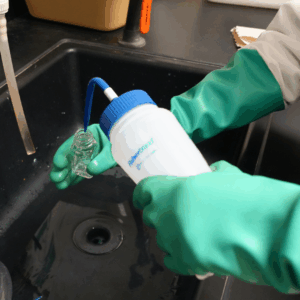
Cleaning a glass with 5% Alconox-Liquinox soap.
The question of the relationship between soap and phosphate arose when a volunteer saw one of their samples turn dark blue during the measurement of orthophosphate, indicating a high concentration of orthophosphate. Usually, sample water stays colorless or becomes slightly light blue due to low concentrations. They also observed some bubbles in the sampling cuvettes. Hypothetically, the Alconox-Liquinox soap, even if there is soap residue, should not react with the reagent and affect the orthophosphate value.
To investigate whether this soap may be affecting orthophosphate analysis, I did research on the Alconox-Liquinox soap and conducted an experiment. In the experiment, I followed the same protocol as volunteer monitors do for washing and analyzing orthophosphate concentrations. The washing protocol is the same as described above, and the method for orthophosphate analysis was developed by HACH.
To investigate whether the soap is affecting orthophosphate concentration, sampling cuvettes were exposed to five different treatments (Table 1).
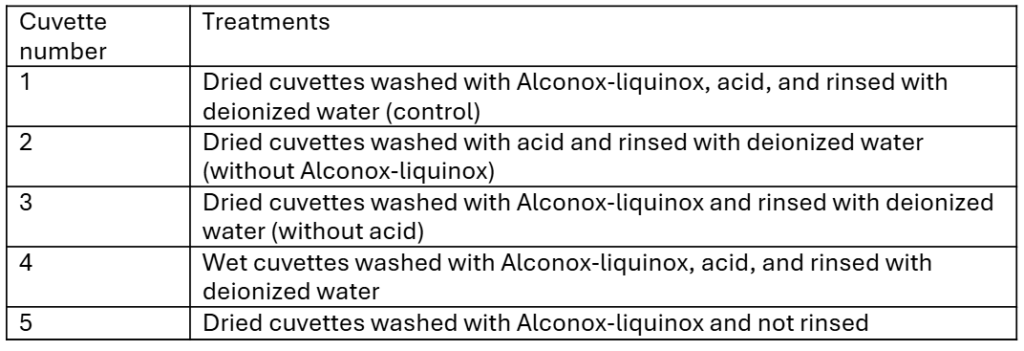
Table 1: Five kinds of treatment methods performed for each cuvette.
After performing the treatments, I followed the same protocol to measure orthophosphate using Hach powder pillow reagents and a spectrophotometer to read the orthophosphate values. Additionally, pure distilled water was used for all samples, so there is no orthophosphate to affect the results.
Table 2 shows the measurements of two replicates and their average orthophosphate concentration for each trial. The final results are calculated by subtracting the reagent blank value from the average. A reagent blank is measured and subtracted from the average to account for human influence during the protocol. If the final result is a negative value after subtraction, it is written as 0.
Here are the results:
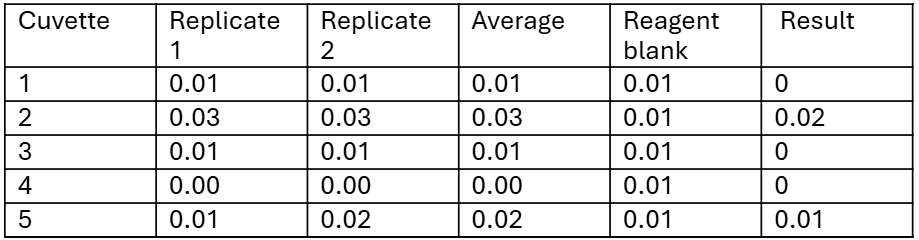
Table 2: Experimental Results | Reagent used: PhosVer3 for 10mL (LOT: A5066, exp. date: Aug-28)
During the experiment, I observed bubbles when pipetting the deionized water into the treatment cuvette #3. I did not see any visible change in color in any samples. The results showed that the cuvettes with high exposure (cuvettes # 3 and #5) to Alconox-Liquinox had no orthophosphate found while the cuvettes washing without Alconox-Liquinox had the highest value (Figure 1).
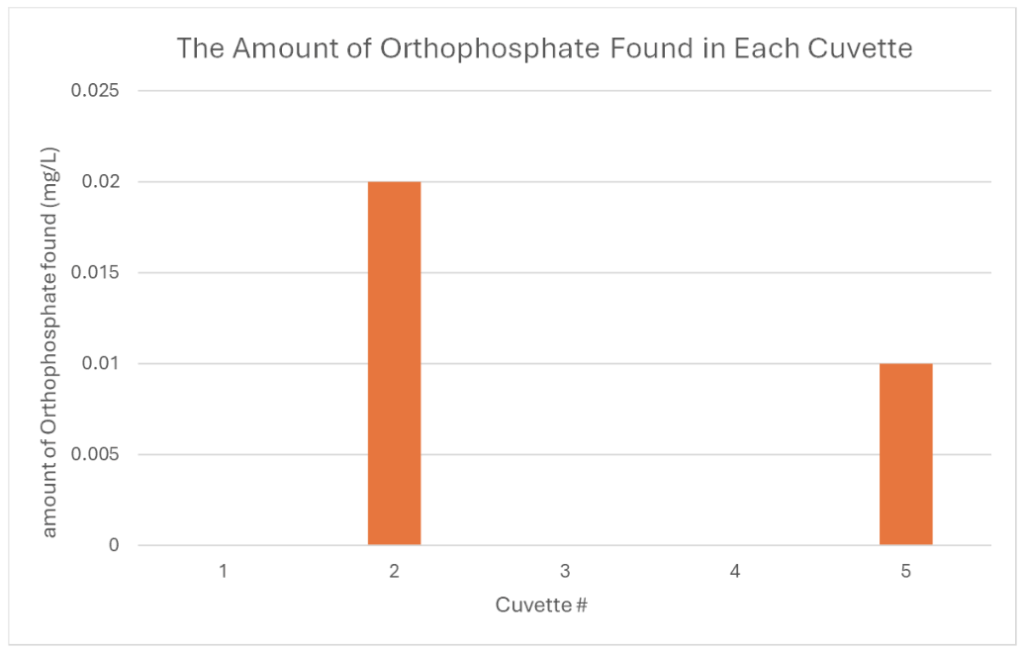
Figure 1: The bar graph of results for each treatment. The x-axis shows the cuvette number under the different treatments corresponding to Table 1 above, and the y-axis is the concentration of orthophosphate (mg/L).
Even though there should not be any orthophosphate in cuvette 2 and 5, all values were low and relatively close to zero.
In conclusion, our results did not find that Alconox-Liquinox soap is affecting the orthophosphate concentration in water samples. This experiment was practical because it also supports that the washing method ALLARM recommends to volunteers does not affect orthophosphate results.
References:
Safety Data Sheet. (n.d.). https://alconox.com/wp-content/uploads/2020/07/Alconox-SDS-english.pdf
Safety Data Sheet. (n.d.). Retrieved October 27, 2025, from https://alconox.com/wp-content/uploads/2020/07/Liquinox-SDS-english.pdf