INTRODUCTION

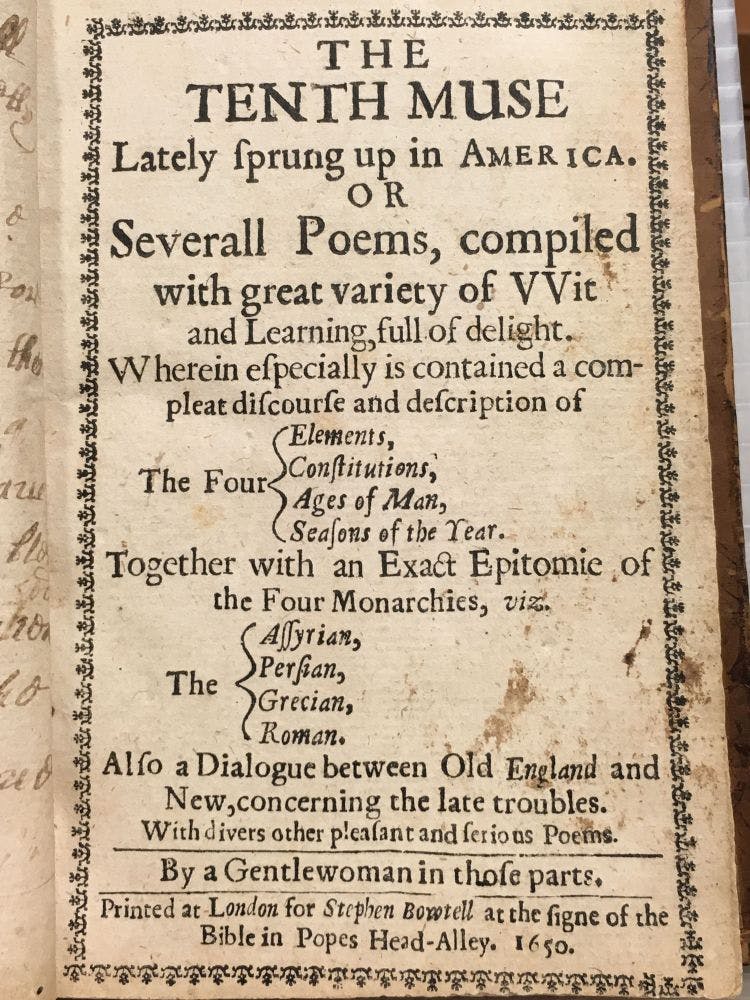
Anne Bradstreet (1612–1672) was born in England and came to the Massachusetts Bay Colony as an eighteen-year-old in 1630, with her new husband (Simon) and other Puritan refugees aboard the ship Arbella, as they were seeking to build on the efforts of earlier Pilgrims and establish a safe haven for their non-conforming Protestant sect. Following the difficult journey, the Bradstreets listened to a stirring sermon from Puritan minister John Winthrop vowing that if they could only “knit together, in this work, as one man” then their plantation (or colony) would become a fabled “city upon a hill” that would showcase their Christian virtue. Bradstreet was originally reluctant to leave England but she and her husband raised several children and seemed to thrive in Massachusetts and to build a loving home. It was a turbulent time for the Puritans, however, with debates over their own break-away sects and dissenters such as Anne Hutchinson (a close friend of Bradstreet’s) and with a civil war erupting in England during the 1640s. The Puritans, led by Oliver Cromwell, gained control of Great Britain for a period and even beheaded King Charles I. Bradstreet agreed to the publication of her first volume of poetry, The Tenth Muse –a reference to the nine daughters of Zeus or muses who inspired ancient Greek arts and sciences– in London in 1650 (a year after the royal execution). Bradstreet’s later poems included this tongue-in-cheek homage to her earlier publication which Edward Hirsch labels “a pivot point in her work” (Heart of American Poetry, 10). “The Author to Her Book” and other personal poems demonstrated advanced skill and a unique voice, earning Bradstreet modern acclaim as America’s first great poet.
The Author to Her Book
Thou ill-formed offspring of my feeble brain,
Who after birth didst by my side remain,
Till snatched from thence by friends, less wise than true,
Who thee abroad, exposed to public view,
Made thee in rags, halting to th’ press to trudge,
Where errors were not lessened (all may judge).
At thy return my blushing was not small,
My rambling brat (in print) should mother call,
I cast thee by as one unfit for light,
The visage was so irksome in my sight;
Yet being mine own, at length affection would
Thy blemishes amend, if so I could.
I washed thy face, but more defects I saw,
And rubbing off a spot still made a flaw.
I stretched thy joints to make thee even feet,
Yet still thou run’st more hobbling than is meet;
In better dress to trim thee was my mind,
But nought save homespun cloth i’ th’ house I find.
In this array ’mongst vulgars may’st thou roam.
In critic’s hands beware thou dost not come,
And take thy way where yet thou art not known;
If for thy father asked, say thou hadst none;
And for thy mother, she alas is poor,
Which caused her thus to send thee out of door.