The following are some areas of research in which I conduct projects, especially with students. For a full list of publications, see my Google Scholar Profile.

Memory as a Conversationally Embedded Process
We know from decades of research that memories can be influenced by conversations and we know that people talk about their memories with others very often. But beyond that, the details of how and when our memories are affected by others is really hard to pin down. One part of my research focuses on ways to study how conversations shape our memories and when or if some parts of memory are harder to influence than others.
Selected Publications:
- Grysman, A., Camia, C., & Pasupathi, M. (2024). Different routes to conversational influences on autobiographical memory. Journal of Applied Research in Memory and Cognition, 13(1), 40–56.
- Grysman, A., Baime, M., & Cantor, E. (2023). Listeners’ effects on autobiographical memory for recent events. Memory, 31(10), 1425-1436.
Memory and Artificial Intelligence
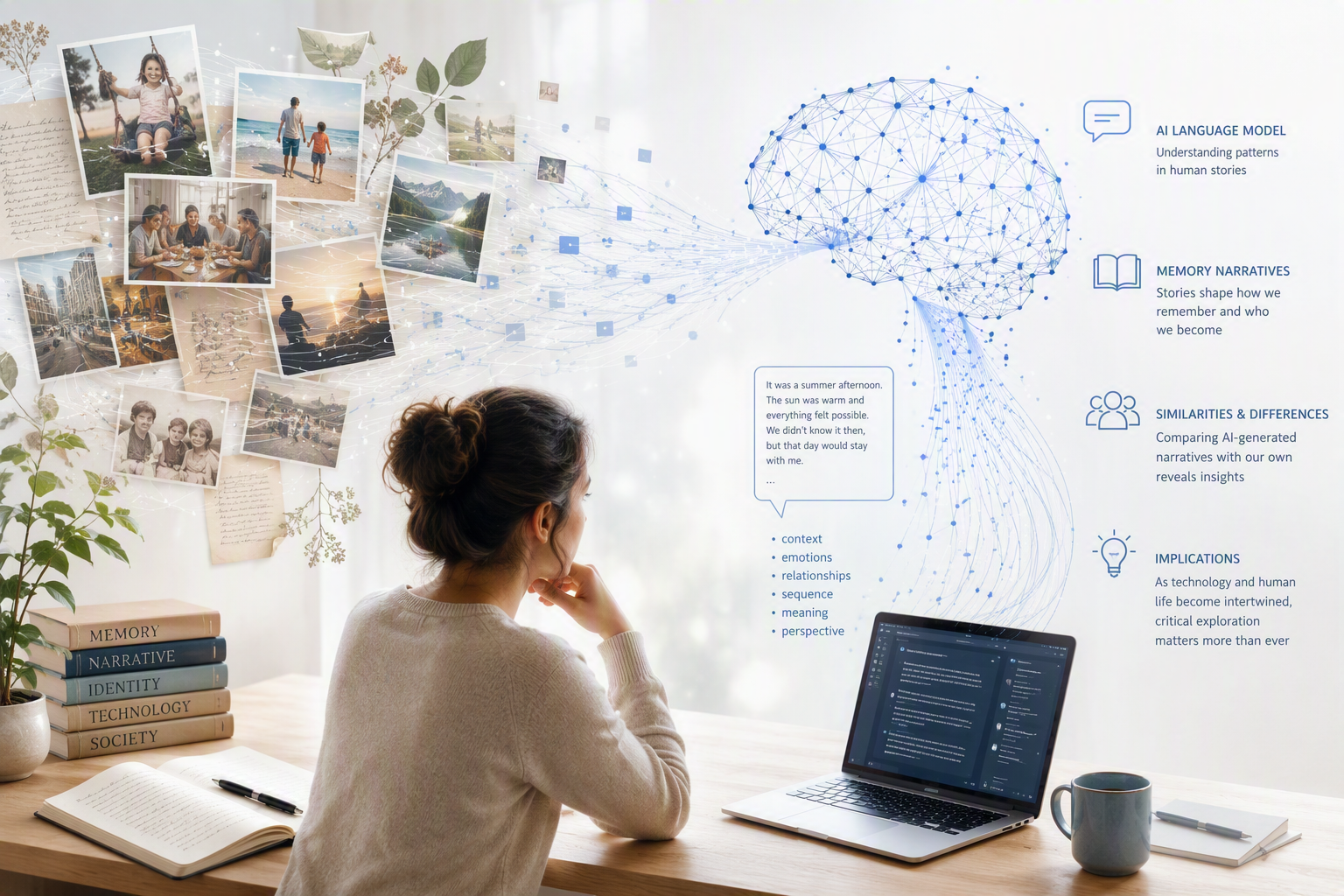
AI is already a powerful force in society and millions of people worldwide are struggling to understand what it means. As the technology behind large-language models gets better and better, it offers a tool to understand what we do when we tell stories about our memories by simulating memory narratives from AI and seeing how they are similar or different to our own. As human life gets more and more intertwined with technology, it is crucial to keep exploring the implications in every way we can.
Selected Publications
- Grysman, A., Mansfield, C. D., Singer, J. A., Camia, C., Booker, J. A., Bauer, J. J., & Fivush, R.(2024). Human or artificial intelligence: Can people tell the difference in first-person narratives? Journal of Applied Research in Memory and Cognition. 14(1), 108–118.
- Mansfield, C. D., Bauer, J. J., Booker, J. A., Singer, J. A., Grysman, A., & Fivush, R. (2026) What might we learn about autobiographical narrative processing from artificial intelligence? Submitted for publication in Humanities and Social Sciences Communications.
- Grysman, A. (2024).Does technology-mediated memory differ from human-mediated memory? Psychological Inquiry, 35(2), 113-116.

Narrative, Memory, and Meaning
In the most ‘zoomed-out’ area of my research, I think about memory as a process not only for holding on to information but for getting meaning out of that information. Narratives do that too – the way we put together stories helps us understand our life experiences. I elaborate on these ideas in my forthcoming book, and this area of my research focuses on memory and narrative as meaning system.
Selected Publications:
- Fivush, R., & Grysman, A. (2022). Narrative and gender as mutually constituted meaning-making systems. Memory, Mind & Media, 1, 1-14.
- Grysman, A., & Mansfield, C. D. (2017). What do we have when we have a narrative? Imagination, Cognition and Personality: Consciousness in Theory, Research, and Clinical Practice, 37, 105-126.
Gender and Autobiographical Memory
Many people have observed that sometimes women remember more than men about events in their lives, especially about the emotional aspects. But the truth is that understanding a pattern like this is more complex than meets the eye. It is not true of all men and women, or at all ages, and it raises questions about whether patterns of how much people talk is the same thing as how much they remember. In more than a dozen papers, I have explored different factors relating to gender and autobiographical memory, updating my understanding of the topic each time and exploring factors like gender norms, conversational expectations, and individual upbringing.

Selected Publications:
- Grysman, A. (2018).Gender and gender typicality in autobiographical memory: A replication and extension. Memory, 26 (2), 238-250.
- Grysman, A., & Hudson, J.A. (2013). Gender differences in autobiographical memory: Developmental and methodological considerations. Developmental Review, 33, 239-272.
- Grysman, A. (in press). Gender and Autobiographical Memory: An Updated Review. Applied Cognitive Psychology.