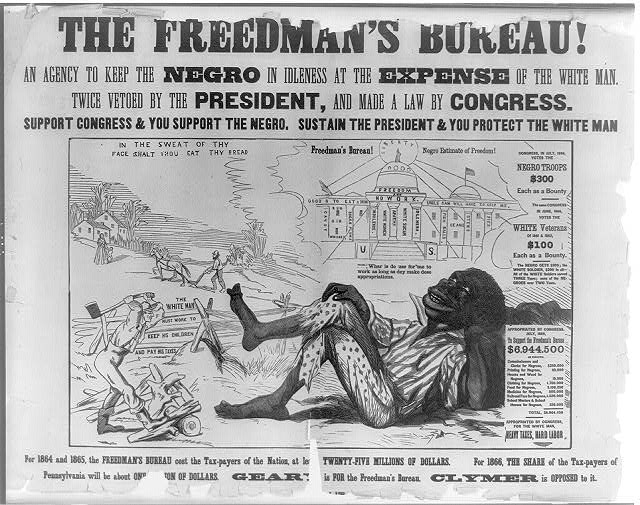
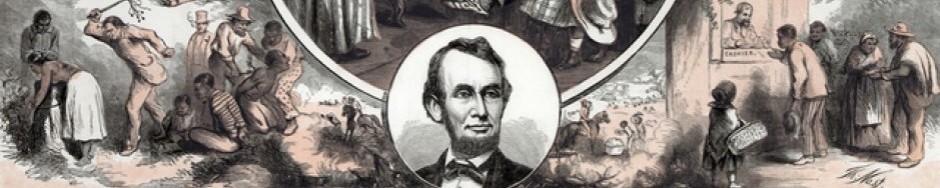
The end of the Civil War brought about the restoration of the Union and the end of slavery, but were these two objectives really one and the same? If so, does Abraham Lincoln deserve the lion’s share of the credit for melding them together? These are the types of questions that historians argue over. So did nineteenth-century Americans. One way to engage a fresh perspective on that debate is to examine what a commercial printer in Philadelphia did with a popular image following Abraham Lincoln’s assassination in 1865. Here is what the image looked like that year:

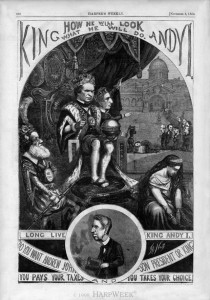
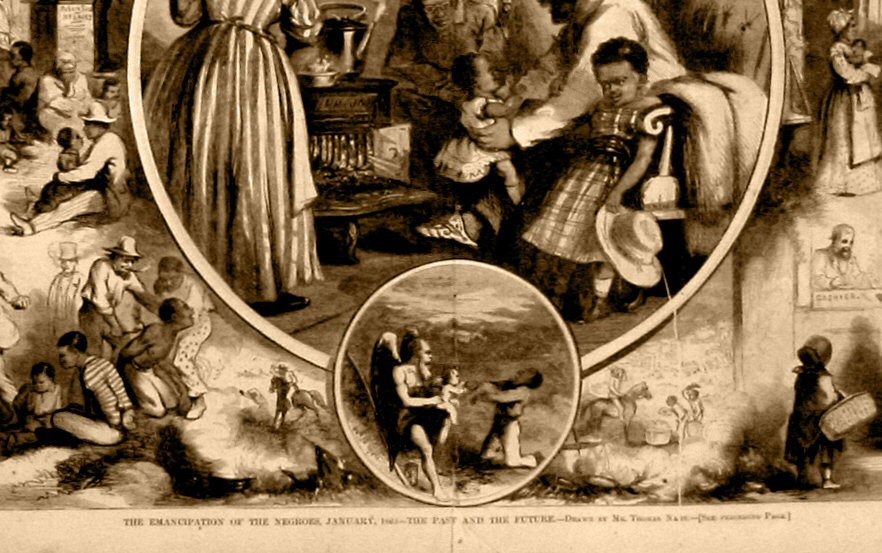
Yet here is what the original illustration looked like in January 1863 when Thomas Nast first drew it for Harpers Weekly:
 The difference is more than just color. Nast’s allegory for emancipation has now been subtly altered to give the martyred president a greater role.


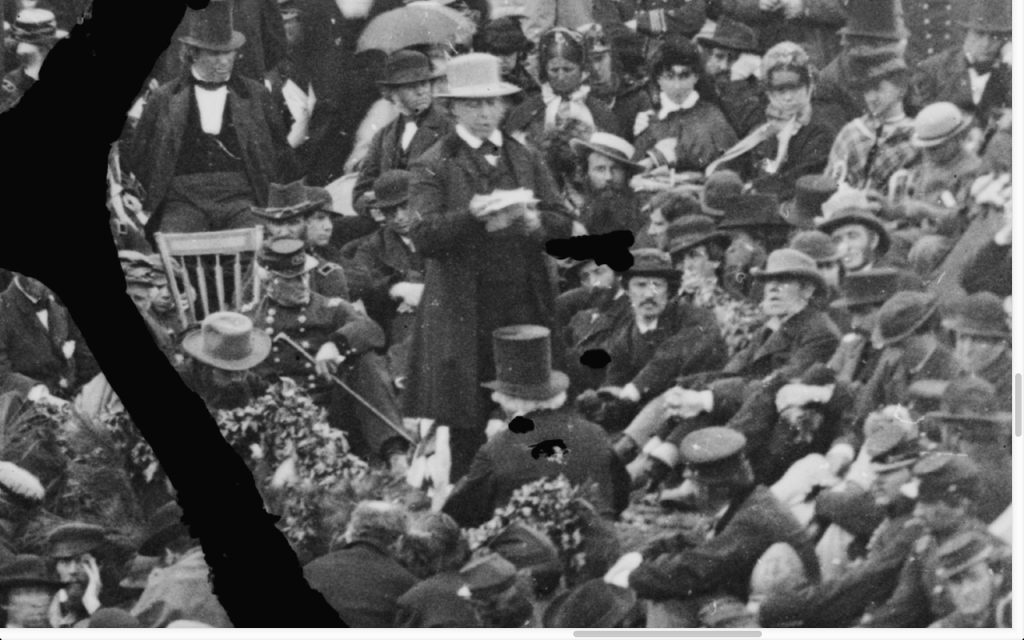
Below is a photograph taken at Fort Sumter on Friday, April 14, 1865. That was a special day for the Union coalition –a kind of “mission accomplished” moment as Col. Robert Anderson returned with a delegation of notables, including abolitionists like Rev. Henry Ward Beecher and William Lloyd Garrison, to raise the American flag once again over the fort in Charleston harbor where the Civil War had begun almost exactly four years earlier.
 Note the cracked glass plate from this seemingly ruined photograph now in the collection of the Library of Congress. But look what happens to this image when it is digitized at a high resolution and then magnified.

That’s Rev. Henry Ward Beecher speaking on the afternoon of Friday, April 14, 1865, from what he called “this pulpit of broken stone.” Originally, scholars, using magnifying glasses, thought that William Lloyd Garrison was perhaps seated on Beecher’s left.
 But now we are confident at the House Divided Project that Garrison was actually seated in a special section on Beecher’s right, with other leading abolitionists and Lincoln administration notables.


It was obviously a moving, reflective moment for Garrison, one captured in this detail image above from right after the ceremony and by the little known story of his visit the following morning to see the grave of secessionist icon John C. Calhoun. You can read more about this episode here and here. Sometimes people are surprised by the stories that slip out of public memory and don’t make it into standard textbooks. The Garrison visit to South Carolina in April 1865 is certainly one of them, but another such lost tale involves a Dickinsonian named John A.J. Creswell, who was deeply involved in the final passage of the Thirteenth Amendment to abolish slavery, which occurred in early January 1865. Here is the image that appeared in Frank Leslie’s Illustrated Newspaper to celebrate that moment.

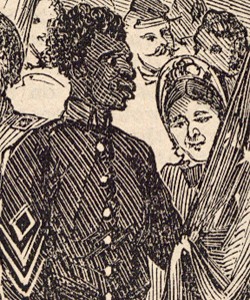
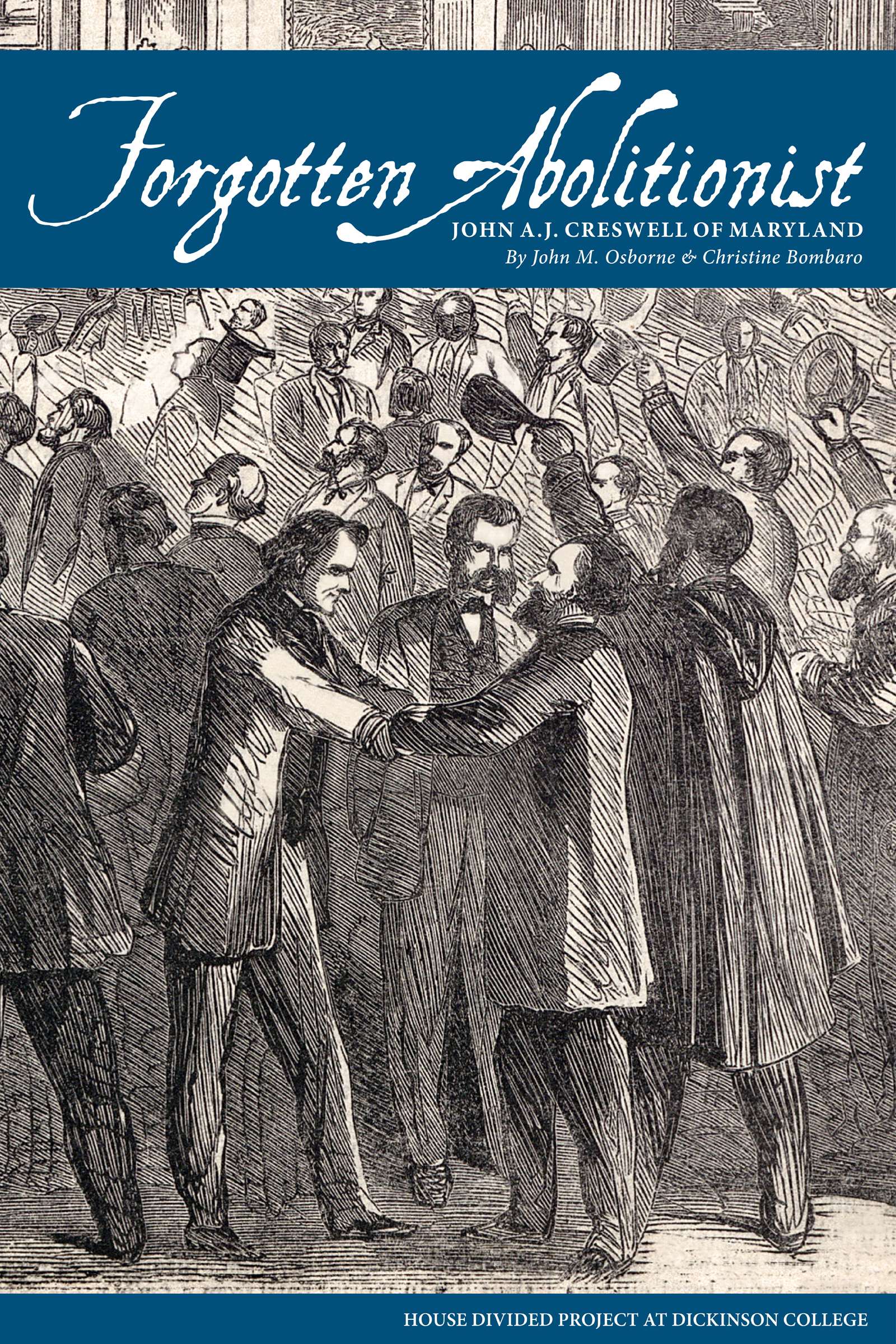
You will notice the trio of men in the lower right hand corner, obviously prominent figures according to the illustrator. We researched them here at the college and were thrilled to discover that one of them was a Dickinsonian. It turns out that these are three congressman from the Mid-Atlantic (from left to right) Thaddeus Stevens, William D. Kelley, and John A.J. Creswell. We used a detail from that image for the cover of our first House Divided e-book, which profiles Creswell, a Dickinson graduate and Maryland politician who became one of the nation’s most important wartime abolitionists. Yet, he’s almost completely forgotten, not even mentioned in Steven Spielberg’s movie “Lincoln” (2012), which concerned passage of the amendment. You can download a free copy of Creswell’s biography, written by Dickinson college emeritus history professor John Osborne and college librarian Christine Bombaro, here. Ultimately, that might be the best way to rediscover the drama at the end of the Civil War –by seeing old stories from new perspectives.