
By: Max Emery Baum
On September 10th, 2001, Colonel John V. Donovan was having lunch with a former military “buddy,” at the United States Pentagon. Unbeknownst to them, just 24 hours later, the place in which they were sitting would meet the nose of American Airlines Flight 77. This attack on U.S. soil marked a new chapter not only in American foreign policy but also in its domestic security infrastructure. Historian and author H.W. Brands writes that “[B]ush proclaimed a national emergency” which for that reason, he “later went before Congress to declare a ‘war on terror.’”[1] While Brands correctly highlights the sweeping foreign policy response, he overlooks a transformative domestic development: the creation of the TSA in November of 2001, and the urgent expansion of the Federal Air Marshal program and the controversial debates that reshaped the role of aviation security in the post-9/11 era.
On September 11, 2001, “19 terrorists from the Islamist extremist group al Qaeda hijacked four commercial aircrafts” and crashed them into the World Trade Center towers, the Pentagon, and a field near Shanksville, Pennsylvania.[2] The attacks claimed the

Federal Air Marshal Credentials – John Donovan (Personal)
lives of nearly 3,000 Americans, marking one of the deadliest acts of terrorism on American soil. Just five days after these devastating attacks shook the nation’s collective consciousness, Col. Donovan received a call from “a retired three-star general and close colleague” whom he had known from his days as an active duty member of the United States military.[3] His colleague, whose name will remain redacted, told him, “I need you right now,” and immediately began processing his security clearance.[4] Within hours, Donovan was informed he was now the 33rd Federal Air Marshal, tasked, under a direct presidential directive, with expanding the program from just 32 agents to several thousand within six months. But with thousands of daily flights, the scale of this commitment raised serious logistical questions. “It’s a very great goal, [but] it’s difficult to meet that,” Donovan admitted at the time in a Wall Street Journal article from 2001, reflecting the unprecedented scope and urgency of the mission.[5]

Federal Air Marshall Facility in Atlantic City, NJ (The Washington Post)
As outlined by the the Aviation Security Act (S. 1447), the urgent mission of the Federal air marshal program was to “provide for random deployment of Federal air marshals” on both domestic and international flights, conduct “appropriate background and fitness checks for candidates,” and ensure “appropriate training, supervision, and equipment” for all new marshals.[6] The morning after Donovan assumed his new position, he “flew alone on a Gulfstream provided by the Secretary of Transportation, from D.C. to Atlantic City,” then the program’s only operational hub.[7] As Donovan recalls, “it was the only plane moving at Reagan Airport, an eerie and unforgettable experience.”[8] Once in Atlantic City, he met with the existing leadership and divided responsibilities: “they would handle tactical operations and training” while he would lead plans and policies, acting as the bridge to “Congress, [and] to the White House.”[9]
From the perspective of Donovan, the TSA was unaware of the threat landscape at the time, and had “no clear sense of what could come next.”[10] To address this, he established a small intelligence cell, nicknamed the “chin scratchers,” tasked with thinking creatively from the perspective of “deviant minds,” and tactically about potential future threats. The mission of this group was to war-game possible attack scenarios, such as bombs being smuggled onto planes, aircraft being hijacked, or explosive devices planted on board. He also had to be strategic in deciding which flights received coverage, based on a specific algorithm, which focused on high-risk targets: long-haul, fully fueled, high-profile flights that were both domestic, and international.[11] Conversely, he had to deemphasize the need for Federal air marshal presence on short regional flights with limited potential for catastrophic impact.
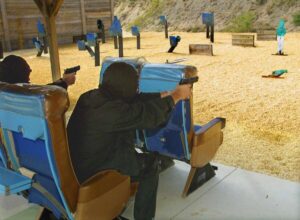
Federal Air Marshal Training (LA Times)
Additionally, scaling the Federal Air Marshal program posed a significant challenge, especially without compromising its elite standards. After conducting extensive research and consulting with experts, Donovan concluded that the original growth targets were unrealistic without sacrificing the high standards they maintained, something the program refused to do. Federal Air marshals were required to meet the highest firearms qualification standards in the U.S. government, exceeding even those of the Secret Service, because, as Donovan emphasizes, “the margin for error on an aircraft is zero. There is no second shot in a pressurized cabin.”[12] As it appeared then to Donovan, the need for such high standards could be argued as the difference between a beat cop in an alley, who might exchange multiple rounds in a chaotic shootout, and an air marshal, who had to neutralize a threat with a single shot in the confined, high-stakes environment of an aircraft cabin. This uncompromising approach to training and firearms proficiency also shaped Donovan’s firm opposition to a controversial policy proposal gaining traction in Congress at the time: arming commercial airline pilots.

Armed Pilots Posing for Picture in the Cockpit (Reddit)
One of the most contentious post-9/11 aviation security debates centered on whether commercial airline pilots should be armed. As Donovan recalls, “there was a push from at least one lawmaker to arm airline pilots, a well-intentioned, but deeply flawed idea.”[13] “Pilots are trained to fly planes, not engage in firefights,” he explains, “they need to stay focused on aviation proficiency, not firearms training.”[14] His stance directly contradicted the logic put forth in a House of Representatives report, which claimed that “giving pilots a means to defend themselves in an emergency will allow them to concentrate on flying and ensure the safety of the flight.”[15] Donovan was of the belief that the opposite was true: arming pilots would only distract them from their core responsibilities and introduce unnecessary risk into the cockpit. To support his view, he conducted live demonstrations in Atlantic City simulating how a pilot, depending on their dominant hand and cockpit position, would have to react to a sudden threat, noting, “you can’t expect someone to turn 180 degrees and fire a precise shot in a confined space when they’re startled and untrained for that kind of scenario.”[16]

Article with John Magaw’s Stance (London Times)
The House of Representatives report attempted to address some of these practical concerns by requiring the TSA to consider “the placement of the firearm… to ensure both its security and its ease of retrieval in an emergency,” as well as to define “the division of responsibility between pilots” if only one or both were armed.[17] These measures, while well-intentioned, failed to fully account for the unpredictable realities of a live flight deck. Donovan remained unconvinced that these procedural requirements could compensate for the operational and psychological risks that were brought forth from arming pilots. His concerns were echoed at the time by then TSA Administrator John Magaw, who, according to The Times (London), “opposed arming pilots, arguing that their responsibility was to control the aircraft.”[18] Donovan’s warnings were tragically validated a few years later when a Federal Flight Deck Officer discharged his weapon negligently while parked at the gate in Charlotte.[19] “No one was hurt,” he notes, “but it was a wake-up call, and it confirmed what I’d said all along: this was a dangerous idea from the beginning.”[20]
Donovan was keen to understand such miscalculations from the decades he spent in the military, and these experiences were the foundation for his role in the Federal Air Marshal Service. His leadership within the TSA reflected a fundamental belief that rigid hierarchy and “we’ve always done it this way” thinking were dangerous in a world where threats constantly evolved, shedding light on his rare perspective on institutional innovation. He rejected command-and-control leadership in favor of collaboration, respect, and clear standards. “You don’t motivate professionals by barking orders,” he reflects, “I focused on setting the right tone, fostering collaboration, and leading in a way that motivated people.”[21] Donovan’s philosophy of leadership wasn’t about relinquishing discipline, it was about aligning structure with mission. His attention to detail stemmed not from a desire to micromanage, but from a conviction that the systems he built needed to last beyond any one person. It was this forward-thinking mindset, paired with a commitment to operational excellence, that helped shape an air marshal culture built not just for immediate post-9/11 threats, but for the long term.
Looking back, Donovan expresses quiet confidence in TSA’s trajectory, discussing how the “TSA has done a remarkable job staying true to its mission.”[22] Though acknowledging that no system is perfect, he argues that Americans are fundamentally safer in the air today than they were before 9/11. For him, the true danger lay not in bureaucracy or inconvenience, but in complacency. “Complacency is your worst enemy,” he warns, “the moment you assume you’re safe is the moment you’re most vulnerable.”[23] Donovan’s legacy within the TSA and Federal air marshal program is not measured in medals or headlines but in the culture he helped shape. He never sought recognition, but rather holding fast to the ethos of the “quiet professional”: do the job, do it right, and move on. In a security landscape defined by unpredictability, his story serves as a reminder that the most powerful defense is not fear or force, but foresight and nimble-thinking. In the wake of terror, Donovan didn’t just help build a new agency, he helped build a mindset. One that asks not if we are safe, but rather “what haven’t we thought of yet?”
[1] H.W. Brands, American Dreams: The United States Since 1945 (New York: Penguin Books, 2010), 176.
[2] Naval History and Heritage Command, “Sept. 11 Attack,” Naval History and Heritage Command, [WEB].
[3] Video Interview with John V. Donovan, Carlisle, PA, and Chapel Hill, NC, April 14, 2025.
[4] Video Interview with John V. Donovan, Carlisle, PA, and Chapel Hill, NC, April 14, 2025.
[5] Stephen Power, “Push to Expand Air Marshals Force Will Send Law Officers Back to Camps,” Wall Street Journal, September 27, 2001, [WEB].
[6] U.S. Congress, Senate, Aviation Security Act, S. 1447, 107th Congress, 1st session, introduced in Senate September 21, 2001, placed on calendar September 24, 2001, [WEB].
[7] Video Interview with John V. Donovan, Carlisle, PA, and Chapel Hill, NC, April 14, 2025.
[8] Video Interview with John V. Donovan, Carlisle, PA, and Chapel Hill, NC, April 14, 2025.
[9] Video Interview with John V. Donovan, Carlisle, PA, and Chapel Hill, NC, April 14, 2025.
[10] Video Interview with John V. Donovan, Carlisle, PA, and Chapel Hill, NC, April 14, 2025.
[11] U.S. Congress, Senate, Aviation Security Act, S. 1447, 107th Congress, 1st session.
[12] Video Interview with John V. Donovan, Carlisle, PA, and Chapel Hill, NC, April 14, 2025.
[13] Video Interview with John V. Donovan, Carlisle, PA, and Chapel Hill, NC, April 14, 2025.
[14] Video Interview with John V. Donovan, Carlisle, PA, and Chapel Hill, NC, April 14, 2025.
[15] U.S. Congress, House, Committee on Transportation and Infrastructure, Arming Pilots Against Terrorism Act, H.R. Rep. No. 107-555, pt. 1 (2002), [WEB].
[16] Video Interview with John V. Donovan, Carlisle, PA, and Chapel Hill, NC, April 14, 2025.
[17] U.S. Congress, House, Committee on Transportation and Infrastructure, Arming Pilots Against Terrorism Act.
[18] Roland Watson, “Bush backs plans to give guns to pilots,” The Times Digital Archive, September 6, 2002, [WEB].
[19] ABC News, “Trigger-Happy Pilot? Gun Discharged Midflight,” ABC News, March 24, 2008, [WEB].
[20] Video Interview with John V. Donovan, Carlisle, PA, and Chapel Hill, NC, April 14, 2025.
[21] Video Interview with John V. Donovan, Carlisle, PA, and Chapel Hill, NC, April 14, 2025.
[22] Video Interview with John V. Donovan, Carlisle, PA, and Chapel Hill, NC, April 14, 2025.
[23] Video Interview with John V. Donovan, Carlisle, PA, and Chapel Hill, NC, April 14, 2025.
Appendix
“Bush proclaimed a national emergency, in light of what he described as ‘the continuing and immediate threat of further attacks on the United States.’ He went before Congress to declare a ‘war on terror.'” (H.W. Brands, American Dreams, p. 176)
Interview Subject
I will be interviewing Col. John V. Donovan, a U.S. veteran who began his lengthy military history and service to the United States of America during the Vietnam war. Following the 9/11 attacks, Col. Donovan was appointed head of the Federal Air Marshal Service and later served on the committee responsible for establishing the Transportation Security Administration (TSA).
Interviews
– Audio recording, Carlisle, PA, April 14, 2025
Selected Transcript
Q: In the immediate aftermath of 9/11, how were you brought into the leadership of the Federal Air Marshal Service, and what were your initial responsibilities?
A: “Just five days after the attacks, I received a call from a retired three-star general and close colleague from my active duty days. He was then Chief of Security at the FAA and had just come from a White House Situation Room meeting with the President. He told me, ‘I need you right now,’ and immediately began processing my security clearance. He informed me I was now the 33rd Federal Air Marshal—with the President’s directive to grow the program from 32 to thousands within six months.”
Q: What was your understanding of the threat landscape at that time, and how did it shape your approach to air travel security?
A: “In the immediate aftermath of 9/11, we had no clear sense of what could come next. The threat environment was entirely uncertain, so we had to prepare for worst-case scenarios. I stood up a small intelligence cell—nicknamed the ‘chin scratchers’—who were tasked with thinking creatively and tactically about future threats. Their role was to war-game potential attack vectors, such as bombs being brought onto planes, aircraft being hijacked for non-piloting purposes, or explosive devices planted on board. We also had to be strategic in deciding which flights received coverage. Our focus was on high-risk targets—long-haul, fully fueled, high-profile flights—not short regional ones with limited potential for catastrophic impact.”
Q: H.W. Brands mentions the ‘war on terror’ and emergency declarations, but leaves out the formation of the TSA. In your view, how significant was the creation of the TSA in the broader U.S. response to 9/11?
A: “One of the most impactful aspects of TSA’s creation was how it brought together subject matter experts from across corporate America—18 different companies contributed top talent to help design a new aviation security system from scratch. These experts, many from sectors like logistics and crowd management, worked grueling hours in D.C. for over a year. For example, the layout of the TSA checkpoint queuing system was designed by a Senior Vice President from Disney, leveraging their expertise in managing high-volume crowds efficiently. Baltimore-Washington International Airport served as the testing ground for many of the concepts these experts developed—what eventually became the standardized screening process we know today.”
Q: As someone on the committee that created the TSA, what were the biggest challenges in the creation of a brand new federal agency essentially from scratch?
A: “A major hurdle came from Congress. There was a push from at least one lawmaker to arm airline pilots—a well-intentioned but deeply flawed idea. I was one of the first to oppose this publicly. My position was clear: pilots are trained to fly planes, not engage in firefights. They need to stay focused on aviation proficiency, not firearms training. To prove this, I conducted demonstrations in Atlantic City simulating how a pilot—depending on whether they were right or left-handed and seated in the left or right cockpit seat—would have to react to a threat at the cockpit door. The physical mechanics made it nearly impossible to respond quickly and accurately under stress. You can’t expect someone to turn 180 degrees and fire a precise shot in a confined space when they’re startled and untrained for that kind of scenario. My warnings were unfortunately validated a few years later when a Federal Flight Deck Officer (FFDO) discharged a weapon negligently while parked at the gate in Charlotte. No one was injured, but it was a wake-up call that confirmed why arming pilots was a bad idea from the beginning.”
Q: Looking back now, do you feel the TSA has stayed true to its founding mission?
A: “Yes, I do. In fact, just yesterday I sat next to a commercial airline captain, and he expressed how much more comfortable and confident he feels flying today compared to before 9/11—thanks to the multiple layers of security now in place. The immediate deployment of Federal Air Marshals, the creation of the TSA, and the overall overhaul of aviation security have all played a part in that. Sure, there are inconveniences. You might have to stand in line, take off your shoes, or follow new protocols that seem frustrating. But these measures exist for a reason. We take our shoes off because one individual tried to ignite explosives in his sneakers. And it all started with just 19 people—not a country, not an army, just 19—who were able to carry out an attack that changed the world. That’s the scale of what we’re dealing with. Given that, I think the TSA has done a remarkable job staying true to its mission: keeping the flying public safe. Do I think it’s perfect? No system is. But I feel safer flying today, and I think most people do—even if they don’t always say it out loud.”
– Audio recording, Carlisle, PA, April 14, 2025
Leave a Reply