By Eddie Liszka
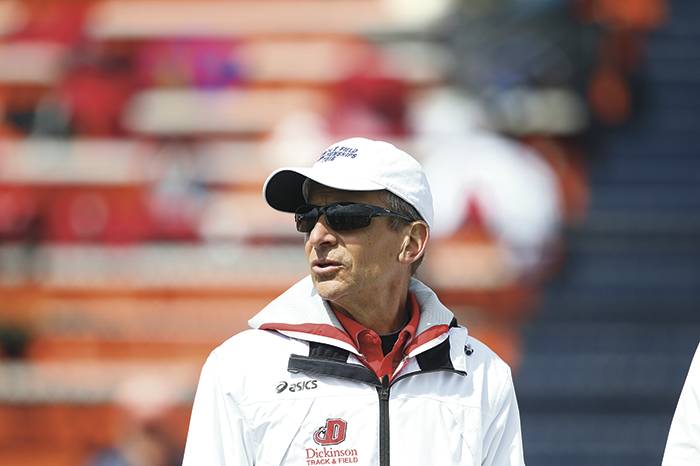
Dickinson College Cross Country Coach Don Nichter (Chris Knight)
On the morning of September 11, 2001, Dickinson College Cross Country Coach Don Nichter was attending a routine department meeting led by Bob Massa, the college’s vice president at the time.[1] Abruptly, the meeting was interrupted when Massa’s administrative assistant ran into the building and whispered news of the first crash to him, causing Massa to leave with no further explanation than “There’s been an emergency. I have to go.” Confused, Nichter and other coaches gathered around a television and watched as the tragedy of September 11 unfolded. He remembers the disbelief they all felt knowing that “nothing like this had ever happened in the U.S.” In the book American Dreams, H. W. Brands describes this intense shock that characterized the American reaction to September 11 and credits prominent leaders for helping the country overcome it.[2] While figures such as George W. Bush and Rudy Giuliani were instrumental in the country’s recovery efforts, Brands’ portrayal fails to acknowledge the bravery and resilience of the American people who returned to their lives fearing the possibilities of further attacks. This unwillingness to be compromised by fear is what truly defeats terrorism, and in 2001 it was displayed by Nichter’s athletes as well as the broader Dickinson community.

Dickinson College students attend a candlelight vigil outside of the Holland Union Building (Pierce Bounds)
In the immediate aftermath of September 11, it is undeniable that grief dominated national sentiment. Brands writes that “The shock of the day evolved into mourning for the thousands killed in the attacks.”[3] This was especially evident on college campuses, where students came together to support each other as they processed the events of the day.[4] Although classes at Dickinson were canceled, Nichter and other coaches held practices that afternoon to check in on their athletes.[5] “We didn’t run that day, but we got everybody together,” he remembers. “And there were people in tears . . . . There was a lot of sadness.” That evening, the campus convened in a community gathering at Anita Tuvin Schlecter Auditorium.[6] Adding to the emotion of the event was the fact that many students were personally affected by the attacks. According to Nichter, two students lost parents, and many others had family and friends that worked and lived in New York City.[7] Arika Peck, a junior at the time, was also stricken by loss. At the gathering, she lamented, “I lost eight friends today. That is a big number of friends that I don’t have anymore.”[8] Later, a candlelight vigil would be held in honor of the victims.[9]

Dickinson students decorated their dorms to display patriotism after September 11 (Courtney Shackelford).
Although events such as those held at Dickinson were born out of feelings of sorrow, they created a sense of solidarity that helped communities recover. Nationwide, many sought to display their patriotism by playing a role in the country’s effort to rebuild, whether through joining volunteer organizations or the military.[10] Staff members at Dickinson established a crisis center to help students navigate the tumultuous period.[11] In a sense, the reemergence of the United States post-September 11 was not a story of any politician’s heroic individual efforts, but of Americans looking out for each other.
As the surprise wore off, life began to resemble what it had been like before the attacks, apart from a new sense of vulnerability. “We just kind of went on with a new reality that terrorism can happen in the U.S.,” Nichter says.[12] On campus, classes, events, and athletics resumed. Nichter’s teams were at the forefront of the return, competing in and winning both the men’s and women’s races at the Vassar College Invitational on September 15.[13] He remembers the meet as particularly emotional, noting that “people were crying during the national anthem, and they gave a moment of silence.”[14] For the team, competing alongside their friends offered the comfort and familiarity that the preceding days seemed to lack. It is likely the same could be said about the many Americans who returned to jobs and other responsibilities in the wake of September 11.
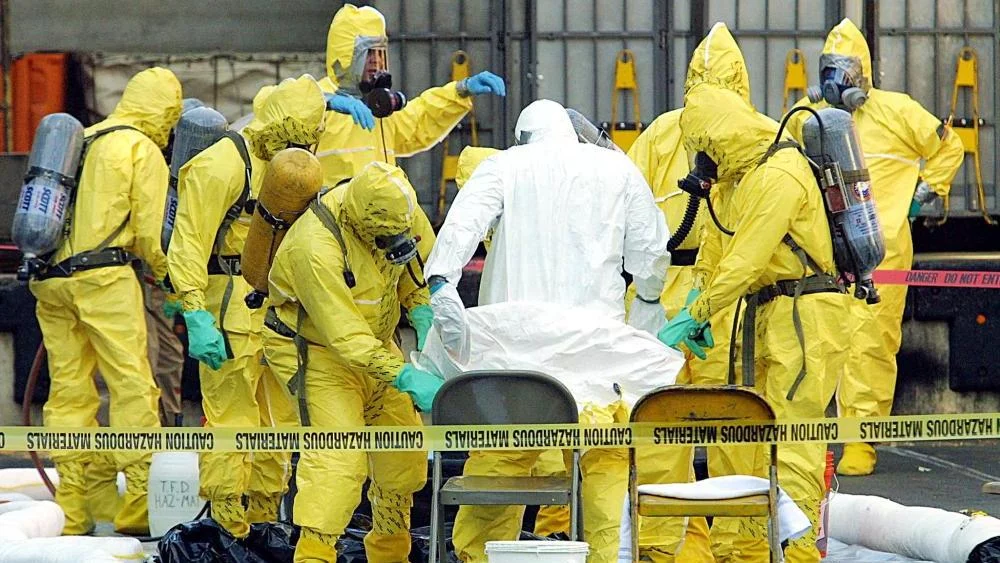
After two anthrax-laced letters were linked to a post office in West Trenton, N.J, a hazardous materials response team was deployed to the location (Tom Mihalek/AFP/Getty Images).
Even as some semblance of normalcy reappeared, a heightened vigilance of terrorism remained at the forefront of the national consciousness. On some occasions, it was justified. Beginning only a week after September 11, anthrax-laced mail was sent to members of Congress and the media, eventually killing five and infecting 17 others.[15] But for every legitimate concern of anthrax infection, there were many more hoaxes designed to take advantage of the hysteria surrounding the matter.[16] On October 30, this issue arrived on Dickinson’s campus after workers in the student mailroom found two envelopes containing white powder and the message “You now have anthrax; prepare to die.”[17] In response, the Carlisle Police closed the Holland Union Building until November 3, when the powder was confirmed harmless. During that time, students dined inside the Kline Center, which is typically reserved for athletics. This incident and the many others like it exemplify how Americans had to accommodate for the growing anxiety over terrorism. By neglecting to describe such stress, Brands misses an opportunity to illustrate the lasting effects of September 11 on the country. Furthermore, he discounts the courage it took for many to continue the push towards normalcy, adjusting to new threats instead of submitting to them.
Nichter’s runners demonstrated this principle as they maintained focus throughout the uncertainty of the semester, finishing the season successfully. The women’s team won the conference championship and qualified for the national meet.[18] The men were conference runners-up and sent two individuals to nationals.[19] Reflecting on the season, Nichter believes “coming together and having practice and performing on the weekends was, for those student athletes, probably a really positive [experience] for most of them—a way to sort of, not forget . . . . but at the same time, try to move on, too.”[20]
Brands’ portrayal of the United States recovery from September 11 focuses mainly on the leadership of elected officials like George W. Bush and Rudy Giuliani.[21] This choice is understandable, as the guidance of these men was inspiring and highly visible. However, their efforts alone did not lift the country out of the despair caused by the attacks. Just as, if not more, important, was the response of the American people. Despite the ever-present concern over further terrorist action, communities came together in grief, emerged united, and carried on with the determination to make the world feel safe again. Such resilience is integral in any reaction to terrorism, which, by definition, aims to spread fear, chaos, and intimidation to further the attacker’s interest. Nichter’s teams, along with the broader Dickinson community, serve as examples of the countless instances in which Americans carefully but resolutely returned to their normal lives after September 11. Taken together, these many instances were the backbone of the nation’s ability to move forward stronger. “[It’s] complicated when you say we’ll never forget,” Nichter observes, “but, but, we also knew we got to move on.”[22]
[1] Interview with Don Nichter, Carlisle, PA, April 14, 2025
[2] H. W. Brands, American Dreams: The United States Since 1945 (New York: Penguin, 2010), 351.
[3] Brands, American Dreams, 351.
[4] Michele DiPietro, “The Day After: Faculty Behavior in Post 9/11 Classes,” 1.
[5] Interview with Don Nichter, April 14, 2025.
[6] Kate Sweeney, “Community Meeting Gave Voices to the Grieving,” Dickinsonian, September 21, 2001.
[7] Interview with Don Nichter, April 14, 2025.
[8] Sweeney, “Community Meeting.”
[9] Jerilyn Covert, “New York Crisis Unites Campus in Candlelight Vigil,” Dickinsonian, September 21, 2001.
[10] “Solidarity After 9/11,” 9/11 Memorial & Museum
[11] Allyson Ayers, “A Quick Response to Crisis,” Dickinsonian, September 21, 2001.
[12] Interview with Don Nichter, April 14, 2025.
[13] Matt McFarland, “Men Strive to Recieve [sic] Bid for National Championship,” Dickinsonian, September 21, 2001; Alicia Fitzpatrick, “Dickinson Women are Leaders of the Pack,” Dickinsonian, September 21, 2001.
[14] Interview with Don Nichter, April 14, 2025.
[15] “Timeline: How the Anthrax Terror Unfolded,” NPR, February 15, 2011.
[16] Jason Snow, “Anthrax Scare Large Problem,” Dickinsonian, November 8, 2001.
[17] Susan White and Bill Hudock, “Just the Facts: A Look into Exactly What Happened,” Dickinsonian, November 8, 2001.
[18] Bill Hudock, “Women’s Cross Country Ends Impressive Season,” Dickinsonian, November 30, 2001.
[19] Matt McFarland, “Midwest Bound,” Dickinsonian, November 16, 2001.
[20] Interview with Don Nichter, April 14, 2025.
[21] Brands, American Dreams, 351.
[22] Interview with Don Nichter, April 14, 2025.
Brands Quote:
“The utterly unexpected events of 9/11 unfolded in real time on television in the homes and offices of the entire country. The shock of the day evolved into mourning for the thousands killed in the attacks” (351).
Interview Subject:
Don Nichter, 68 years old, has coached cross country and track and field at Dickinson College since 1983.
Transcript:
Q: Could you provide some context for where the team was heading into the season and what your expectations for the team were?
A: Obviously, at that point in the year, two weeks into the competitive season, middle of September, we had only had two meets—two smaller meets—and I would think that the team was just kind of starting to sort of gel as a team after competing together and racing with each other and supporting each other. You know, part of the evolution of a cross-country season is, I don’t need the training component, but getting a chance to race together as a team and be on a line together. So I think we were just at the very early stages of that, kind of developing that sort of culture, a racing culture.
Q: Could you tell me a little about how that day started, before the tragedy happened, for you?
A: So, it was just like a normal day. We had a meeting with our division. Vice President Bob Massa was the vice president then, so our department was there with him, and it was just a standard morning meeting that you have once every two or three weeks. Just like a regular, up-to-date meeting, talk about recruiting, whatever. So we got up and did that, and we were sitting in the meeting.
Q: What was it like when you when you heard the news in that meeting?
A: Well, we just knew that something was happening because, the administrative assistant for Bob, she came running into the building when he was literally standing before us and just whispered something to him. And he immediately just, his face just kind of turned blank, and he said, “There’s been an emergency. I have to go.” And so he literally left. We’d all just came in … all of our coaches were in this building, and somebody had a TV. And we just kind of all were gathered around the television, just in disbelief that this was actually happening. It was just sort of one of those moments where you go like—nothing like this had ever happened is the US, you know what I mean? Like we were not used to anything like that in terms of terrorism. Terrorism didn’t exist in the US. It existed everywhere else. So, I just remember just being in an office, just going like, “I can’t believe this is happening,” kind of thing.
Q: And what was the mood like on campus after that tragedy?
A: I think I just remember contacting the team. And [we] came in for practice. Obviously they canceled classes that day, but we talked about it. I can’t remember the circumstances for deciding what we were gonna do as a department, but I think I remember something along lines of, “We’re gonna have practice and then process it as a team.” We didn’t run that day, but we got everybody together because we were kind of encouraged to do that. And there were people in tears. There were people just, you know, their facial expression was just blank. There was a lot of sadness. We kind of just met and talked a little bit about it, but it was brief. It was kind of more just to make sure people were as okay as you can be under those circumstances, that there wasn’t anybody really having a really horrible meltdown. So then the next day is when we actually kind of started to talk through it a little bit. And it was more or less just like an open forum. I mean, we did go out and run that day because I talked to the captains and decided then that it was a good idea to just kind of get out and move a little bit and get away from it, so we did actually do a little baby run together.
Q: So do you think running, in a way, was able to help the team kind of return to a sense of normalcy?
A: Yeah, I do. I mean, that’s a good way to put it. These things, there’s never an easy—you know, everybody always says when there’s a death in your family, there’s never like a perfect way to handle it, right? So you just kind of go through and you try to—but there’s not like a script for “This is what you should do,” especially in this case. Like, should you practice, should you not? Should everybody just go to their room? But I think at that point, it was more, “Okay, let’s try to get back to some level of normalcy in terms of who we are as a team and use running partly as an outlet for getting back into a routine that they’re familiar with.”
Q: And once you returned to running, what was the general attitude toward continuing the season? Was that even a concern?
A: No, I don’t remember talking about shutting down the season. We had a delay for a week where we didn’t compete—a meet that was canceled—and then the following week, we went to a meet. People kind of took it more as something that, you know, we have to move on [from], and we can’t dwell on this. The first meet back was emotional because they had a national anthem beforehand. We were at Vassar, and I just remember people crying during the national anthem, and they gave a moment of silence. So I think that was the extent of it. But by two or three weeks after it, I think we were—I won’t say everything was normal. There was still some, you know—the news was being bombarded every day with information about trying to find survivors and all of that. But, I guess at some point, we just kind of went on with a new reality that terrorism can happen in the U.S. I think that was the recognition—that, we’re not safe and the world is a very complicated place.
Q: How did it feel being able to line up to race afterwards?
A: I think it was a positive experience for me and for the team to sort of be back, trying to find your place in a normal pattern of racing on the weekend and being together as a team, traveling together. I think that was really important. I think teams, personally, that that was a good thing and can be really positive thing, to be on the team. I think coming together and having practice and performing on the weekend was, for those student athletes, probably a really positive [experience] for most of them—a way to sort of, not forget. You’re never gonna forget, right? Always said that, but at the same time, try to move on, too. [It’s] complicated when you say we’ll never forget, but, but, we also knew we got to move on.
Q: Lastly, do you have anything else that you’d like to share about this topic?
A: I can’t remember a lot about what other coaches did. I don’t remember, like I said, anybody shutting down. The school didn’t send everybody home or anything. I think, you know, you got up the next day and it was on everybody’s mind. Campus-wide, there were a couple of kids that lost parents—I think there were two. So that was like a big thing, obviously, huge thing. [There] wasn’t anybody on my team, cross country, that had a close relative or anything like that. But Dickinson has a lot of students from New Jersey and Connecticut, and parents that work in New York City. There certainly were some people that had like really strong connections for whatever reason, so that was a different situation. There was like—the two students that—there was a ceremony on campus, not too long after it happened when they identified who passed away.
Leave a Reply