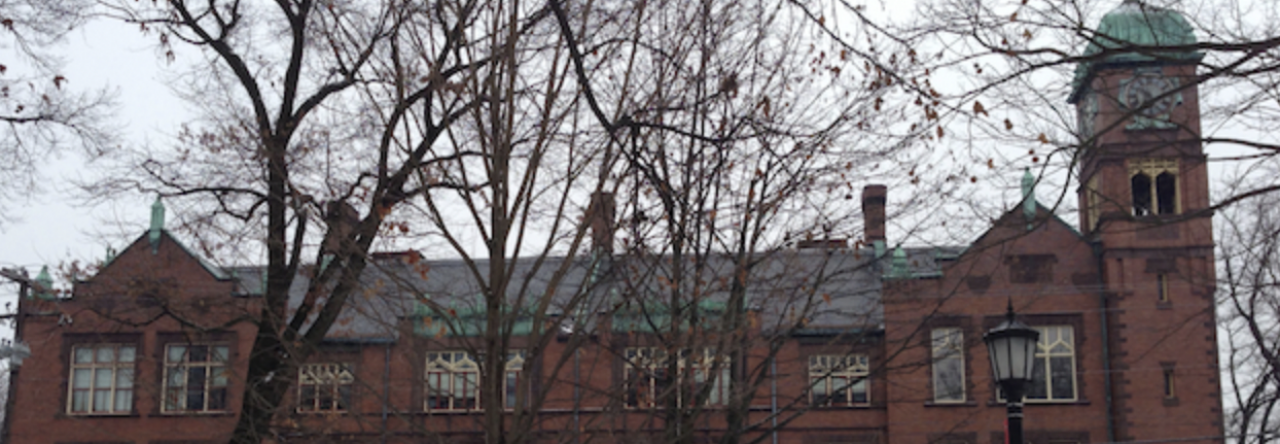
Was Senator Joseph McCarthy a lying, demagogue bent on destroying American civil liberties? Or was McCarthy instead a determined foe of dangerous Communist spies during the early 1950s? H.W. Brands calls McCarthy a “virtuoso of the political attack” who “tapped into anxieties current in the American psyche,” but also acknowledges that some of those “anxieties were perfectly rational” (52-53). Students in History 118 need to review the evidence themselves and offer their tentative conclusions. What were the principal causes of the intensifying “Red Scare” of the late 1940s and early 1950s? How should Americans describe this era and what lessons, if any, seem most relevant? The issue has special relevance for Dickinson College since the school was censured in 1956 by the American Association of University Professors (AAUP) for firing an economics professor (Laurent LaVallee) for invoking the Fifth Amendment when he was called to testify before the House Un-American Activities (HUAC) committee. See this article from the Chicago Tribune and also this background from the Lionel Lewis’ book, Cold War on Campus (available through Google Books). Brands also explains the impact of the Korean War on the Cold War and how containment doctrine began to evolve in dangerous new ways under President Eisenhower. Students in History 118 should be able to describe and explain the significance of covert operations in the mid-1950s, for example, and special items like the Doolittle report of 1954.
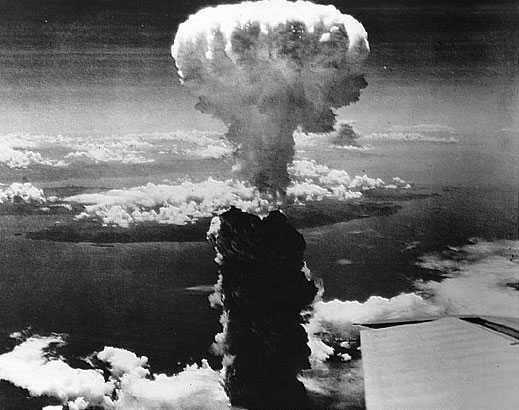
Col. Paul Tibbets was the pilot in command of the Enola Gay (a B-29 bomber named for his mother) that dropped the atomic bomb on Hiroshima, Japan on August 6, 1945. The city had a population of about 350,000 at that time. The explosion immediately killed about 70,000 of those residents, destroying most of the city’s buildings. Tens of thousands more died in the weeks afterward. Tibbets was interviewed on camera, not long after he returned (August 19th).
Russell Baker was a young 19-year-old naval pilot originally from Virginia who was training to go overseas in the summer of 1945. He later became a Pulitzer Prize-winning columnist for the New York Times who recalled his coming of age during the Great Depression and World War II in a famous memoir, Growing Up (1982).
“On August 9 the second atomic bomb was dropped at Nagasaki. Next night I wrote to my mother. “Well, today, to all intents and purposes, the war ended. The feeling of extreme elation which I had expected, existed for a bare moment, then life subsided back into its groove and it was just another day….” I didn’t confess that I hated the war’s ending. I knew she had been praying to God to save my skin; I could hardly tell her I was sorry her prayers had been answered… Still there was no hint in either my mother’s correspondence or mine that the arrival of the nuclear age interested us much. My mother, also excited about premature news that the war was over, had less cosmic things on her mind. The night after the Nagasaki bombing she wrote: “I’m still hoping that you’ll go to college when the war is over and study journalism; that is, if you’re still interested in that kind of work. Don’t lose hope and get married at this stage of the game.” (Russell Baker, Growing Up, p. 230)
Churchill, Truman and Stalin at Potsdam, July 1945
John Lewis Gaddis of Yale University is one of the nation’s leading historians of the Cold War era. In this excerpt, he challenges the widely-held view that President Harry S Truman never hesitated and never questioned his decision to authorize the dropping of two atomic bombs on the Japanese in 1945.
“It took leadership to make this [containment of atomic war] happen, and the most important first steps came from the only individual so far ever to have ordered that nuclear weapons be used to kill people. Harry S Truman claimed, for the rest of his life, to have lost no sleep over his decision, but his behavior suggests otherwise. On the day the bomb was first tested in the New Mexico desert he wrote a note to himself speculating that ‘machines are ahead of morals by some centuries, and when morals catch up perhaps there’ll be no reason for any of it.’ A year later he placed his concerns in a broader context: ‘[T]he human animal and his emotions change not much from age to age. He must change now or he faces absolute and complete destruction and maybe the insect age or an atmosphereless planet will succeed him.’ ‘It is a terrible thing,’ he told a group of advisors in 1948, ‘to order the use of something that …is so terribly destructive, destructive beyond anything we have ever had …. So we have got to treat this differently from rifles and cannon and ordinary things like that.’” (John Lewis Gaddis, The Cold War, p. 53)
In his fascinating article on Theodore Roosevelt’s complicated nationalism, Gary Gerstle offers students in History 118 a series of challenging ideas. First, Gerstle explains how Roosevelt saw world history in terms of race conflict and believed earnestly in a hierarchy of racial categories –an idea embraced by most people in the nineteenth century. Gerstle then offers compelling details about Roosevelt’s famous experiences with the Rough Riders in the Spanish-America War. Yet instead of focusing on the standard romantic myths about the diverse and rowdy regiment, Gerstle demonstrates how Roosevelt celebrated his fellow Rough Riders at the expense of equally heroic black troops during that brief conflict in Cuba. Students who read this article should be able to identify Presley Holliday, a remarkable man who challenged Roosevelt’s version of the war’s history. Despite Roosevelt’s reluctance to acknowledge black equality, he did reach out to selected African Americans, such as Booker T. Washington. Gerstle goes even further, arguing that what he labels Roosevelt’s “civic nationalism” was a precursor to the spirit of Martin Luther King’s “I have a dream” speech and the modern civil rights ideal. He claims that Roosevelt was full of contradictions and that despite his belief in racial hierarchy, and his distaste for blacks and Chinese in particular, he was also a deep believer in the equality of American citizenship and the principle of the “Melting Pot.” Gerstle suggests that in this contradiction, Roosevelt embodied a Progressive Age in America that contained competing ideas of what it meant to be American. Students who need extra background on the diverse topics covered in this article should consult with the online textbook at Digital History, noting especially the chapters on Along the Color Line, Closing the Western Frontier, Huddled Masses, United States Becomes a World Power, and the Progressive Era.