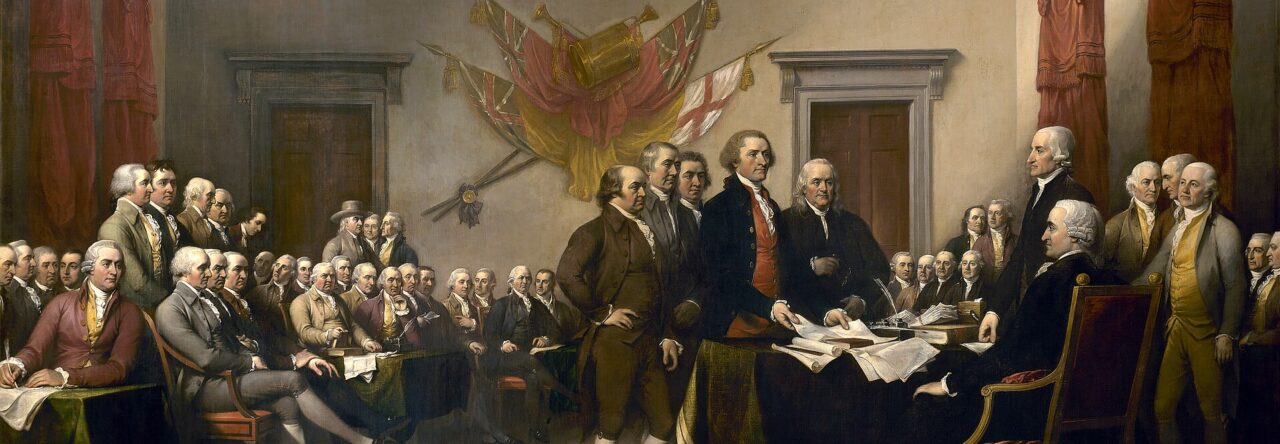
TEXT: Jefferson, Declaration (1776)
- Thomas Jefferson chaired the committee that produced the Declaration in early summer 1776; he was the principal author of the document that contained three sections: preamble, grievances against the King or “train of abuses,” and the resolution for independence
- The Second Continental Congress voted for Independence on July 2 and approved the Declaration (as amended) on July 4; the final document was not “engrossed” (or written formally in parchment) and ready for signatures until early August 1776
CONTEXT: American Revolution
“The majority of the [Declaration] outlined a list of specific grievances that the colonists had with British attempts to reform imperial administration during the 1760s and 1770s. An early draft blamed the British for the transatlantic slave trade and even for discouraging attempts by the colonists to promote abolition. Delegates from South Carolina and Georgia as well as those from northern states who profited from the trade all opposed this language, and it was removed.” —American Yawp, Chap. 5: IV
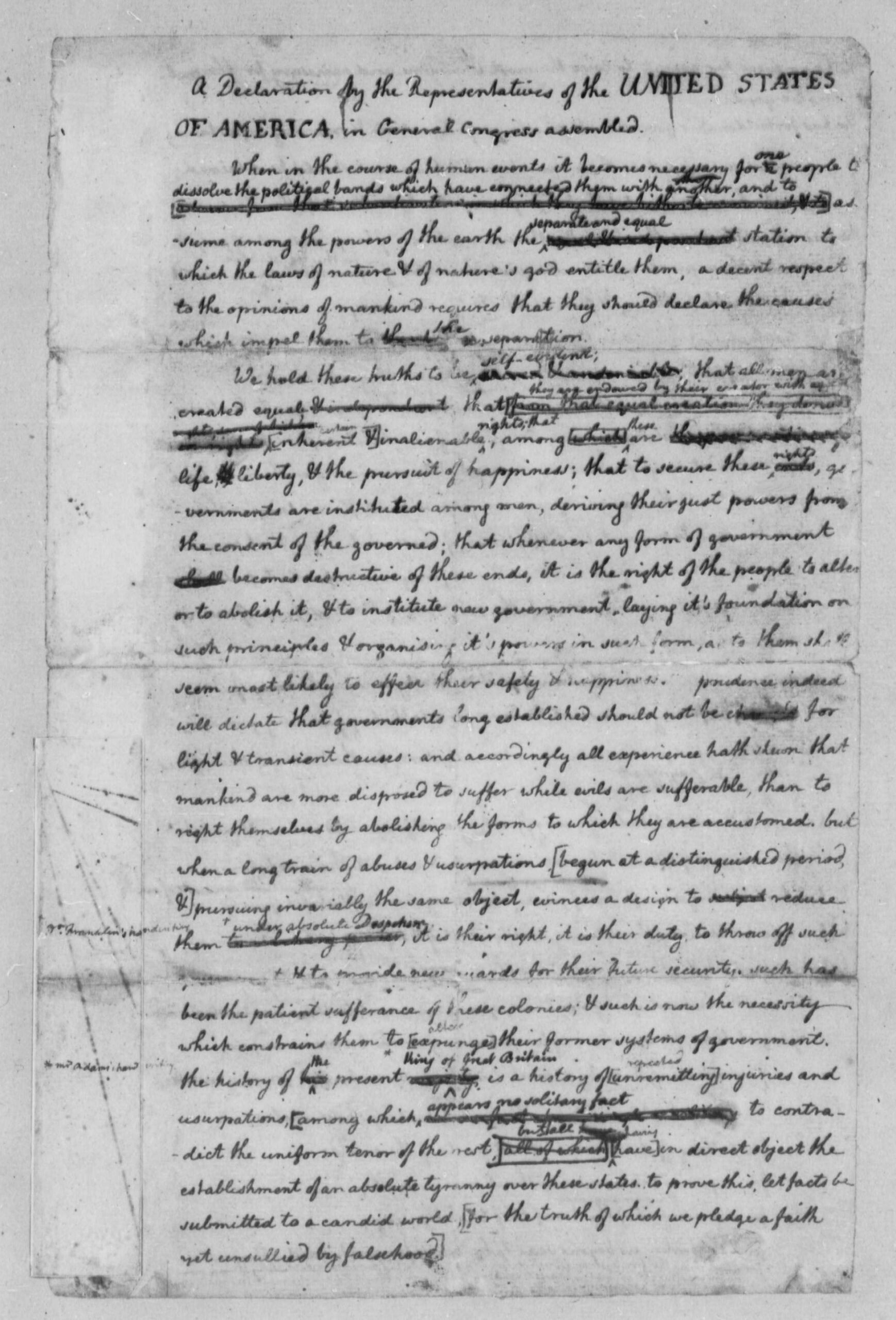
- Jefferson’s draft clause on African slave trade (Battlefield Trust)
- Jefferson’s preamble provoked little debate, though Benjamin Franklin convinced him to make an important editorial change –revising the original phrase, “sacred and undeniable rights” to “self-evident rights.”
-
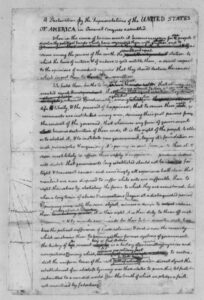
Jefferson’s original draft (Library of Congress) Jefferson’s revised preamble was truly an Enlightenment era statement that celebrated natural rights (Lockean liberalism), but modern students need to remember that Enlightenment era thinkers often separated natural rights from civil and political rights in ways that no longer seem fair or just.
- The second section of the Declaration, its “train of abuses,” invoked a different Enlightenment era philosophy: republicanism or the ideology of representative government.
SUBTEXT: Promises or Hypocrisy
- Tracy K. Smith (1972- ) served as the nation’s poet laureate, appointed by the Librarian of Congress, during the period from 2017-19. Her poem, “Declaration,” is an example of erasure, which creates poetry by removing words from an existing text. The poem first appeared in the New Yorker magazine in 2017 without italics and then in a published volume in 2018 with italics (as reproduced here). In this case of “found poetry,” Smith, as poet laureate, tackles the process of revisiting Thomas Jefferson’s prose in the Declaration of Independence. In particular, Smith focuses on the second section of the Declaration, not the famous preamble with its celebration of natural rights, but rather the “train of abuses” committed by the King (and Parliament) against the American colonists. Smith clearly finds resonance not only to the African American experience but also to modern-day abuses in the American system and uses erasure to help focus the reader on the evident hypocrisy that she sees then and now. Or by holding onto at least some of the keystone words, does Smith’s poem sustain as well as erase, and thereby make the Declaration her own promise to keep?
Declaration
He has
sent hither swarms of Officers to harass our people
He has plundered our—
ravaged our—
destroyed the lives of our—
taking away our—
abolishing our most valuable—
and altering fundamentally the Forms of our—
In every stage of these Oppressions We have Petitioned for
Redress in the most humble terms:
Our repeated
Petitions have been answered only by repeated injury.
We have reminded them of the circumstances of our emigration
and settlement here.
—taken Captive
on the high Seas
to bear—