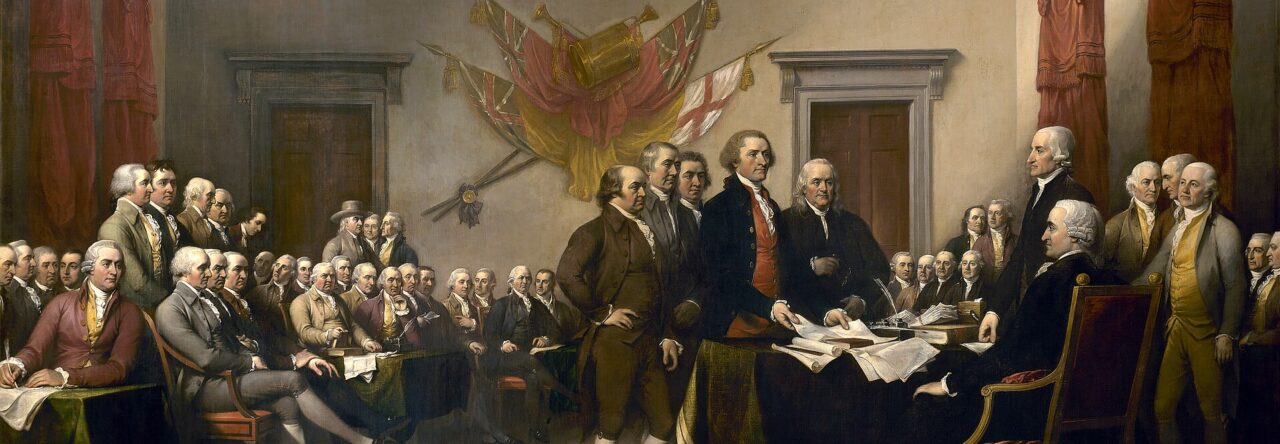
We hold these truths to be
sacred and undeniableself-evident,
—Declaration of Independence (1776)
Required Texts (B&N or library reserves)
- Joseph Plumb Martin, Ordinary Courage edited by James Kirby Martin, 4th Edition (Wiley-Blackwell, 2013)
- Ted Widmer, The Living Declaration (Library of America, 2026)
Additional Readings
- Abigail and John Adams, Letters (excerpts) (March-April 1776) [WEB]
- Fergus M. Bordewich, “What Can We Learn from America’s Centennial,” TIME, April 30, 2026 [WEB]
- Jelani Cobb, “Two Hundred and Fifty Years of Complicated Commemorations,” New Yorker, May 4, 2026 [PDF]
- Marc Egnall, “Witness to a Revolution,” HNN, May 21, 2026 [WEB]
- Joseph J. Ellis, “Friends at Twilight,” American Heritage (May-June 1993) [WEB]
- Thomas Jefferson, Declaration of Independence (July 1776) [WEB]
- Jane Kamensky, “The Many Founders of the United States,” New York Times Magazine, June 22, 2026 [WEB]
- Emanuel Leutze, Washington Crossing the Delaware (1851) [WEB]
- Abraham Lincoln, “Lincoln on Declaration,” Knowledge for Freedom Seminar [WEB]
- Sarah Lyall, “The Founding Father Who Sought a Last-Minute Deal to Avert the Revolution,” New York Times, June 30, 2026 [PDF]
- Thomas Paine, Common Sense (January 1776) [WEB]
- Pennsylvania Constitution (1776) [WEB]
- President’s Advisory 1776 Commission, The 1776 Report (January 2021) [WEB]
- Marc Stein, “The Bicentennial Made American History Look Ridiculous,” HNN, June 5, 2026 [WEB]
- Phillis Wheatley, POEMS: “On Being Brought From Africa” (1773) and “His Excellency General Washington (1776) [WEB]
First Essay – Close Reading
By Monday, October 5, students will submit a 4- to 6-page essay (typed, double-spaced) that offers a close reading analysis of one of the six primary source sets from the syllabus readings (Adams’s letters, Jefferson’s Declaration, Leutze’s painting, Paine’s pamphlet, Pennsylvania’s constitution, or Wheatley’s poems. Students must analyze text, context, and subtext within the framework of an interpretive essay that includes at least 2-3 academic secondary sources, properly cited with Chicago-style footnotes. Additional information and guidelines will be available at the course site. Essays will be graded on depth of analysis, use of evidence, and quality of prose. Late essays will be penalized up to 5 points each day.
Second Essay – Teaching Private Martin
By Monday, October 26, students will submit a 4- to 6-page essay (typed, double spaced) that answers this question: What are the most important insights about the Revolutionary War that teachers and students can find in Pvt. Joseph Martin’s memoir of his Continental Army service? Students must explain their arguments for classroom significance within the framework of an interpretive essay that includes at least 2-3 academic secondary sources, properly cited with Chicago-style footnotes. Additional information and guidelines will be available at the course site. Essays will be graded on depth of analysis, use of evidence, and quality of prose. Late essays will be penalized up to 5 points each day.
Research Journal
By Monday, November 30, students will submit an online research journal entry of 2- to 4-pages long (about 500 to 1,000 words), posted PRIVATE at the course website that details their initial research efforts for their final papers. Students should narrate their efforts to identify at least three (3) relevant primary sources and at least three (3) relevant academic secondary sources for their final paper topics. Journal entries do not require footnotes, but they should include Chicago-style bibliographies and 2 to 3 images, properly captioned and credited. Additional information and guidelines will be available at the course site. Entries will be graded on research effort, depth of analysis and quality of prose. Late entries will be penalized up to 5 points each day.
Final Paper
By Wednesday, December 16, students will submit a 10- to 12-page interpretive paper that analyzes one of the documents included in Ted Widmer’s book, The Living Declaration (2026), explaining why it is significant for understanding how the public memory of the Declaration of Independence has evolved over the years. Students should build their papers on a strong foundation of primary and secondary sources, including those outlined in their research journal posts. All papers should be typed and double-spaced as Word or PDF documents with title page and Chicago-style footnotes (no bibliography required). Additional information and guidelines will be available at the course site. Papers will be graded on research effort, depth of analysis, and quality of prose. Late papers will typically not be accepted after December 16.
Grade Distribution
Class Participation 25 percent
Close reading essay 20 percent
Teaching Private Martin essay 20 percent
Research journal 10 percent
Final paper 25 percent
| Day | Date | Discussion Topic | Reading Assignment |
| Tuesday | 9/1 | Methods & Expectations | — |
| Thursday | 9/3 | SUMMER 1775: Olive Branches | Lyall article |
| Tuesday | 9/8 | JAN 1776: Launching a Revolution | Paine, Common Sense |
| Thursday | 9/10 | NO CLASS | |
| Monday | 9/14 | Constitution Day: Jane Calvert
[READING] |
Weiss Center , 7pm [REQUIRED –no livestream] |
| Tuesday | 9/15 | FEB 1776: All Men? | Wheatley poems |
| Thursday | 9/17 | NO CLASS | |
| Tuesday | 9/22 | MARCH 1776: Remember the Ladies | Adams letters |
| Thursday | 9/24 | JULY 1776: Self-Evident | Declaration of Independence |
| Tuesday | 9/29 | SEP 1776: Framing constitutions | PA Constitution |
| Thursday | 10/1 | DEC 1776: Crossing the Delaware | Leutze painting |
| Monday | 10/5 | Close reading essays due | By 5pm via email |
| Tuesday | 10/6 | Joining the struggle (1776) | Martin, Introduction, chaps 1-2 |
| Thursday | 10/8 | Toward Valley Forge (1777) | Martin, chaps 3 |
| Tuesday | 10/13 | From Valley Forge (1778) | Martin, chap 4 |
| Thursday | 10/15 | Achieving victory (1781) | Martin, chap 7 |
| Tuesday | 10/20 | NO CLASS (Fall Break) | |
| Thursday | 10/22 | Farewell at Newburgh (1783) | Martin, chap 9 |
| Monday | 10/26 | Pvt. Martin essays due | By 5pm via email |
| Tuesday | 10/27 | Writing about the Revolution | Egnal article |
| Thursday | 10/29 | Declaration of Independence | Widmer, Introduction |
| Tuesday | 11/3 | First Fifty Years | Widmer, Part 2 |
| Thursday | 11/5 | Jefferson, Adams, and the Jubilee | Ellis article |
| Tuesday | 11/10 | Created Equal | Widmer, Part 3 |
| Thursday | 11/12 | Twelve Score and Ten | Lincoln on Declaration |
| Tuesday | 11/17 | American Empire | Widmer, Part 4 |
| Thursday | 11/19 | Centennial | Bordewich article |
| Tuesday | 11/24 | Civil Rights Era | Widmer, Part 5 |
| Thursday | 11/26 | NO CLASS –Thanksgiving | |
| Monday | 11/30 | Research journals due | By 5pm at course site |
| Tuesday | 12/1 | Bicentennial | Stein article |
| Thursday | 12/3 | Historians and 1776 | Kamensky article |
| Tuesday | 12/8 | Defining “patriotic” history | 1776 Commission report |
| Thursday | 12/10 | Lessons & Legacies | Cobb article |
| Wednesday | 12/16 | Final paper due | By 5pm |