Virginia Hall, the legendary spy who operated during WWII under the auspices of the Office of Strategic Services, caught my attention as a biographical research topic. Hall’s brief, one-line mention in George Herring’s From Colony to Superpower: U.S. Foreign Relations Since 1776 led me to compile a more complete background on Hall through my secondary-source research. Now shifting to primary sources, I began to look for materials that detail Hall’s successful covert activities and demonstrate why they were so effective. I decided that, in order to focus my research, I would orient it toward Hall’s time during WWII under the OSS instead of focusing on her work in the Cold War under the CIA.
While my initial search for sources in the American National Archives left me with no results, I tried again—this time searching for the term “Virginia Hall” enclosed in quotation marks to ensure that the database returned relevant results. It returned 12 results, one of which was a record group titled “Personnel Files of the Office of Strategic Services, 1942–ca. 1962,” containing 23,735 files. Opening the collection, I utilized the same search method for “Virginia Hall” and found three files, two of which were available digitally. I found a photograph from Virginia Hall’s Distinguished Service Cross award ceremony and the accompanying citation from President Harry Truman, which detailed her accomplishments under the OSS in France.
Searching through another record group titled “Record Group 226: Records of the Office of Strategic Services Series: Central Files,” with 276 subgroups, I input the same search term and uncovered other documents relating to Virginia Hall. I found a recommendation letter written by William J. Donovan, the director of the OSS, recommending Hall for the Distinguished Service Cross, in which he details more specifically the successes of her espionage. I learned that Hall went by Diane Heckler, utilizing the code name “Heckler.” I also found an activity report written by Virginia Hall detailing firsthand her activities from her landing in France on March 21, 1944, to her noted “Left Field” on September 26, 1944. Section V of the activity report explicitly details Hall’s sabotage activities against the Germans, highlighting specific railways destroyed and other sabotage acts committed with the French Forces of the Interior (FFI).
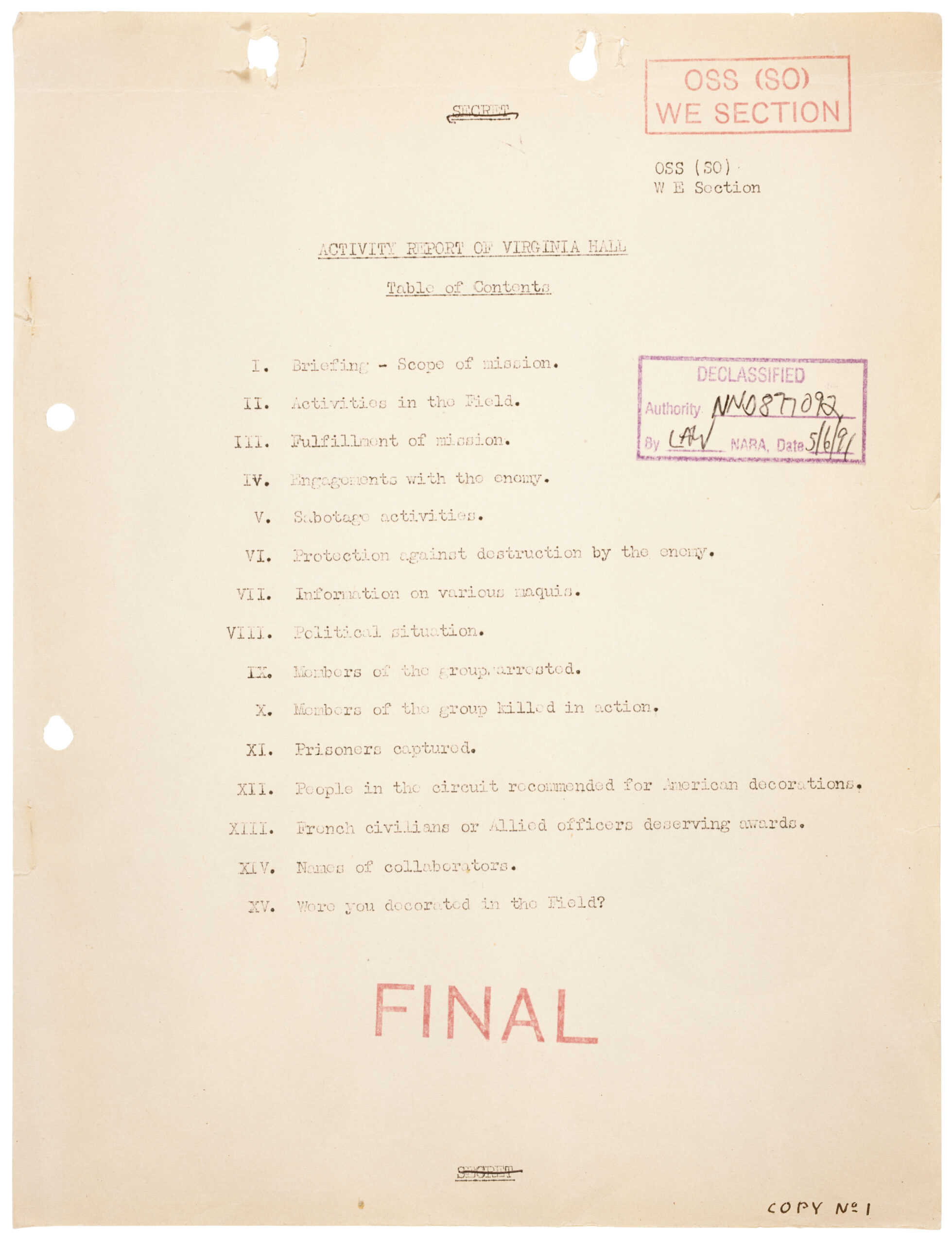
Activity Report of Virginia Hall | U.S. National Archives
Additionally, Hall’s activity report refers to a person by the name of “Aramis,” who accompanied her when she returned to France. Aramis is also the name of the illustrator of a 1944 sketch drawing of “Heckler,” or Virginia Hall, within the file group. Intrigued to learn more about her fellow agent and to encounter another activity report detailing their time together, I searched for “Aramis” in both aforementioned file groups but found no further information on this person. Nevertheless, the information I uncovered from Hall’s OSS files and firsthand report will greatly aid me in detailing Hall’s work throughout her time operating under the OSS. Hall’s OSS files, especially her activity report, will be integral to my biographical profile.
To situate Hall’s WWII work within the context of the time period from March 21, 1944, to September 26, 1944, I looked for sources to better highlight why Hall’s work was so integral to the war effort.
In the run-up to Operation Overlord in 1944, the strain between the Big Three had reached a boiling point. Herring mentions how the three allies were deeply divided on grand strategy, with the Soviet Union pleading for the opening of a second front to alleviate pressure on the Red Army, as well as differences in “British versus U.S. military doctrines” when it came to the execution of a cross-strait invasion (551). Interested in seeing how the conflict between the Big Three was represented in the media, I looked through the databases section of jumpstart on the library website. There I found a database titled “New York Times – Historical Newspapers” which led me to ProQuest. I searched the database for news articles using the search term “Operation Overlord.” I found a series of articles written by Winston Churchill detailing firsthand his decision-making. In the article titled Installment 22: Preparations for Operation Overlord, Churchill makes clear the divisions and differences of opinion regarding the execution of Operation Overlord. This series of installments from Churchill himself will allow me to explore the British point of view and emphasize why the execution and success of Operation Overlord was integral to keeping the alliance together—a feat greatly aided by Virginia Hall.
Looking through the Office of the Historian’s historical documents section, I found, under the Foreign Relations of the United States collection in the Diplomatic Papers, a collection covering the conferences at Cairo and Tehran. In this section, I searched for the terms “Operation Overlord” and “second front.”
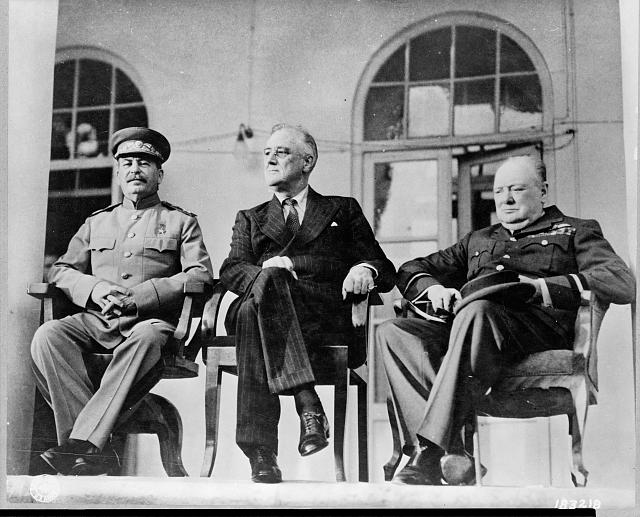
Roosevelt, Stalin, and Churchill on portico of Russian Embassy in Teheran, during conference – Nov. 28 – Dec. 1, 1943
Looking up “second front,” I found a message sent from Stalin to Roosevelt in June 1943 expressing his anger over the postponement of the second front, highlighting the sacrifices of the Red Army and beginning to question the support of the British-American armies. Another document, titled Bohlen Minutes, records the meeting between Roosevelt and Stalin in November 1943, in which Stalin expresses that the Soviet front was not faring well. The Combined Joint Chiefs of Staff Minutes, dated November 29, 1943, detail the discussion between American, British, and Soviet military leaders in planning Operation Overlord. Several other documents, such as minutes from the Tripartite Dinner and additional Bohlen Minutes, all record the high tensions in the lead-up to the Tehran Conference, where the three powers finalized Operation Overlord in the final Military Agreement issued on December 1, 1943. Throughout the documents, leaders from all sides emphasized the risks and how much depended on the successful execution of this operation. The Combined Chiefs of Staff Minutes, detailing a meeting between Roosevelt, Churchill, and Stalin, make most clear the urgency placed on the opening of a second front, as well as the key issues surrounding how the powers would invade France considering the German forces in the country.
These primary sources greatly detail the atmosphere in which Hall’s WWII operations took place: a splintering alliance focused on the execution and success of a second front. The documents I found on the Office of the Historian detail military planning and relationships between leaders, while Hall’s files outline her role in on-the-ground sabotage efforts against German forces. Her location in south-central France and attacks against transit infrastructure as well as arming of the FFI helped undermine German ability to successfully counter Operation Overlord.
This research process was challenging but highly rewarding. Initially delving into her time at the CIA, I learned to refocus my research efforts on a different time period, allowing for a more complete account of Hall’s work. My research on that front, however, will help me create a stronger general biography of Hall, while my focused research will allow me to demonstrate Hall’s integral role in the lead-up to Operation Overlord. Alongside the primary sources from the Office of the Historian and the OSS I am better able to trace Hall’s accomplishments and demonstrate, in context, why Virginia Hall was a key figure in the diplomatic history of the United States.
Bibliography
Library of Congress. “Image Record 96522736.” Prints and Photographs Online Catalog. Accessed April 26, 2026. https://www.loc.gov/pictures/item/96522736/.
National Archives Catalog. “Record 595660.” Accessed April 26, 2026. https://catalog.archives.gov/id/595660.
National Archives Catalog. “Record 595661.” Accessed April 26, 2026. https://catalog.archives.gov/id/595661.
National Archives Catalog. “Record 595672.” Accessed April 26, 2026. https://catalog.archives.gov/id/595672.
National Archives Catalog. “Record 595152.” Accessed April 26, 2026. https://catalog.archives.gov/id/595152.
“The New York Times. ‘By Winston Churchill: The Second World War: Installment 22—Preparations for “Overlord”.’” New York Times, October 30, 1951. Accessed via ProQuest. https://www.proquest.com/docview/112133435/9393EF7A86EB47F0PQ/4?accountid=10506&sourcetype=Newspapers.
U.S. Department of State, Office of the Historian. “Foreign Relations of the United States: The Conferences at Cairo and Tehran, 1943, Document 358.” Accessed April 26, 2026. https://history.state.gov/historicaldocuments/frus1943CairoTehran/d358.
U.S. Department of State, Office of the Historian. “Foreign Relations of the United States: The Conferences at Cairo and Tehran, 1943, Document 361.” Accessed April 26, 2026. https://history.state.gov/historicaldocuments/frus1943CairoTehran/d361.
U.S. Department of State, Office of the Historian. “Foreign Relations of the United States: The Conferences at Cairo and Tehran, 1943, Document 364.” Accessed April 26, 2026. https://history.state.gov/historicaldocuments/frus1943CairoTehran/d364.
U.S. Department of State, Office of the Historian. “Foreign Relations of the United States: The Conferences at Cairo and Tehran, 1943, Document 7.” Accessed April 26, 2026. https://history.state.gov/historicaldocuments/frus1943CairoTehran/d7.
U.S. Department of State, Office of the Historian. “Foreign Relations of the United States: The Conferences at Cairo and Tehran, 1943, Document 424.” Accessed April 26, 2026. https://history.state.gov/historicaldocuments/frus1943CairoTehran/d424.
Leave a Reply