William Casey died in May 1987 with most of his secrets intact. He suffered his first seizure on December 15, 1986, the day before he was scheduled to testify before the Senate Intelligence Committee about Iran-Contra. He never gave that testimony. Lawrence Walsh, the independent counsel who spent seven years investigating the scandal, devoted an entire chapter of his Final Report to Casey alone, and most of that chapter is about what could not be proved. Reading it was the moment I understood what this stage of the research was going to feel like. There is more material on Casey than I expected. There is also a permanent gap where his own testimony should have been.
This is my second journal on William Casey, who served as CIA director under Ronald Reagan from 1981 until his death in 1987. My final paper will argue that Casey used the directorship to make foreign policy rather than just carry it out. That unusual freedom of action is what made the Afghan covert program reach a scale large enough to force the Soviet retreat, while also creating the conditions for the Taliban’s rise a decade later. The first journal handled biographies and scholarly literature. This one covers what Casey wrote himself, what investigators wrote about him and what reporters were saying as he died.
I assumed Casey had written almost nothing publicly. I was wrong. A search for his name and the word “speeches” turned up Scouting the Future, a 1989 collection of his speeches as CIA director, edited by his former assistant Herbert Meyer. Casey rarely sat for interviews, so the speeches are one of the few places he chose his own words about Afghanistan, Soviet strategy and terrorism. They will matter for my paper because they show how Casey wanted his work to be understood, which is something the biographies and the investigations cannot fully recover.
Casey also wrote a book. The Secret War Against Hitler is his memoir of running spies for the Office of Strategic Services in Europe during World War II. He died before finishing it, and his widow Sophia oversaw publication in 1988. The book is technically about events from forty years before Afghanistan, but reading it changed how I understood his approach to the 1980s. Casey describes the OSS as proof that small, well-supported irregular forces could change the outcome of a major war. In the preface, he writes that clandestine intelligence and covert action “may be more important than missiles and satellites in meeting crises yet to come.” That sentence was published in 1988, but he had been acting on it since 1981. The mujahideen program was the same theory applied to a different empire.

Casey’s posthumously published memoir of his Office of Strategic Services service in World War II, completed by his widow Sophia Casey. (Goodreads, fair use)
After Casey’s own writing, the richest material came from the official investigations of Iran-Contra. I had originally planned to focus only on documents about Casey himself, but I realized after my first journal that I was thinking too narrowly. The investigations of the Reagan administration’s foreign policy as a whole are filled with evidence about Casey, even when his name does not appear in the title. The Tower Commission Report, released in February 1987, walks through the arms sales to Iran step by step in its Appendix B and names Casey at every point where he was driving the operation. The Walsh Final Report, which took seven years to produce, devotes a full chapter to him. Walsh found that Casey had directly encouraged senior CIA officers to merge their work with Oliver North’s contra-resupply network, in violation of the Boland Amendment that Congress had passed to prevent exactly that kind of aid. Walsh had subpoena power. Tower had sixty days and witnesses who could refuse to appear. Reading the two reports in sequence shows how the official record on Casey hardened between 1987 and 1993, even though he had been dead the whole time. The third investigation is the joint congressional committee report from November 1987, which contains the testimony of Oliver North and others who worked under Casey.

The Report of the President’s Special Review Board (i.e., Tower Commission Report – 1987), was the first official investigation of the Iran-Contra affair.
For sources from people who worked alongside Casey, the most useful was The Reagan Diaries, edited by Douglas Brinkley. Reagan calls him “Bill” in dozens of entries. The two most revealing fall on consecutive days in September 1987. On September 28, Reagan wrote that Bob Woodward had appeared on 60 Minutes claiming to have interviewed Casey on his deathbed, and Reagan called Woodward “a liar.” The next day’s entry is more striking. Reagan recorded that Ed Meese and Don Regan, who had actually visited Casey in the hospital, confirmed that by the end he “was incapable of understanding or communicating.” That second entry is the cleanest piece of evidence I have found for the central problem of researching Casey. The president of the United States, writing for himself in his own diary, shows that the witness everyone wanted to question could no longer answer. I also read the New York Times obituary that Eric Pace wrote the day after Casey died. Pace had covered him for years, and the obituary lingers on the Iran-Contra hearings he never attended in a way most obituaries would not.
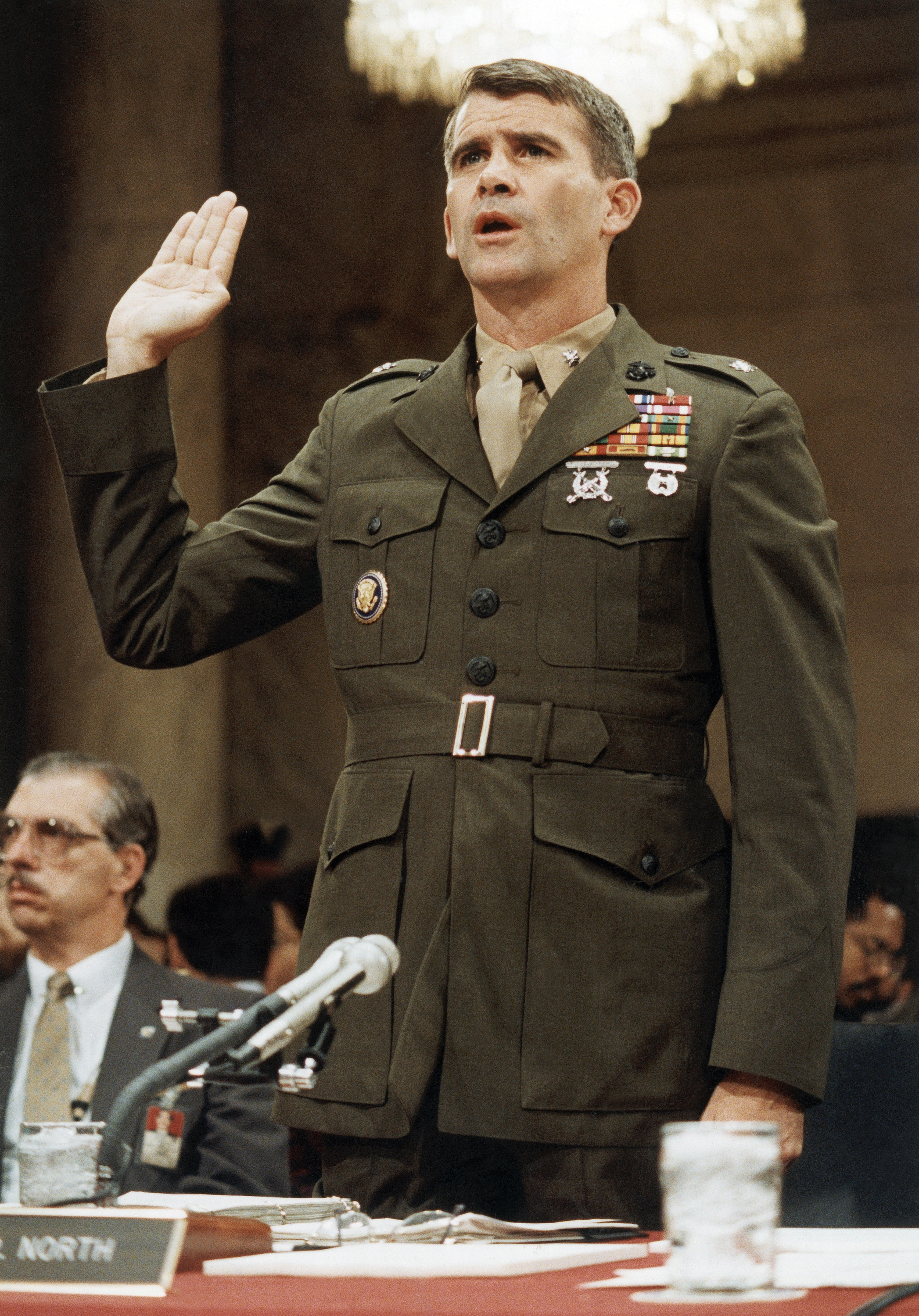
Oliver North testifying before the joint congressional Iran-Contra committees, July 1987. Casey, who had died two months earlier, was named throughout as the architect of the operations under investigation. (Wikimedia Commons, public domain)
The hardest call was what to do with Bob Woodward’s Veil. I used it as a secondary source in the first journal because it is published as a book of reporting. But Woodward’s text contains long passages of direct quotation from Casey that exist nowhere else, including the disputed deathbed scene Reagan called a lie. Those quotations are primary source material even when they sit inside a secondary source. For my paper, I will cite them only where another source confirms them, and flag them as Woodward’s account when none does.
What this stage taught me is the difference between volume and certainty. I expected the primary record on a CIA director to be thin. It is not. Casey’s speeches, his memoir, three official investigations, contemporary press, and Reagan’s own diaries add up to thousands of pages of usable material. What is harder to come by is direct testimony from Casey himself. Tower could not subpoena him because he was sick. Walsh could not question him because he was dead. Reporters could only print what others were willing to say on the record. My final paper will have to work around that absence rather than pretend it can be filled, but the surrounding record is rich enough to build a real argument from.
Bibliography
Casey, William J. Scouting the Future: The Public Speeches of William J. Casey. Edited by Herbert E. Meyer. Washington, DC: Regnery Gateway, 1989. [GOOGLE BOOKS]
Casey, William J. The Secret War Against Hitler. Washington, DC: Regnery Gateway, 1988. [GOOGLE BOOKS]
Pace, Eric. “William Casey, Ex-C.I.A. Head, Is Dead at 74.” New York Times, May 7, 1987. [PROQUEST]
Reagan, Ronald. The Reagan Diaries. Edited by Douglas Brinkley. New York: HarperCollins, 2007. [GOOGLE BOOKS]
Tower, John, Edmund Muskie, and Brent Scowcroft. The Tower Commission Report: The Full Text of the President’s Special Review Board. New York: Bantam Books and Times Books, 1987. [INTERNET ARCHIVE]
U.S. Congress. Report of the Congressional Committees Investigating the Iran-Contra Affair. Washington, DC: U.S. Government Printing Office, 1987. [WEB]
Walsh, Lawrence E. Final Report of the Independent Counsel for Iran/Contra Matters. Washington, DC: U.S. Court of Appeals for the District of Columbia Circuit, 1993. [WEB]
Woodward, Bob. Veil: The Secret Wars of the CIA, 1981–1987. New York: Simon and Schuster, 1987. [GOOGLE BOOKS]
Leave a Reply