“The turn from Madison’s sensitivity for the delicate balance between power and liberty to NSC 68’s assumption that foreign policy ends justify the means occurred not in the early days of the Cold War but between 1890 and 1920. Supreme Court Justice George S. Sutherland uttered the most famous blessing on that turn in 1936 when he wrote the majority opinion in United States v. Curtiss-Wright Export Corporation. But Sutherland’s decision had been shaped two decades before, and, resembling most such blessings, it only affirmed behavior that had long been practiced. Imperial presidencies, weak congresses, and cautious courts, which have been endemic to modern United States foreign policy formulation, appeared at the turn of the century. At the same time, the nation’s foreign relations became global rather than continental; they were driven more by corporate than by agrarian interests, and they were tracked by telegraphs and airplanes instead of by couriers and stage coaches. Those changes radically challenged the constitutional forms that had governed the continental foreign policy for a century. Presidents and the courts met the challenge simply and directly: they largely severed foreign policy from traditional constitutional restraints by declaring that international and domestic relations could be dealt with separately. Actions in the world arena were not unduly to affect liberties at home.” –Walter LaFeber, “The Constitution and United States Foreign Policy,” JAH (1987)
Discussion Questions
- The paragraph above contains the thesis statement behind LaFeber’s argument about constitutional diplomacy and how it evolved in practice over the course of American history. He pinpoints the period between 1890 and 1920 as critical. Why? What were his most persuasive examples suggesting a clear departure in foreign policy practice from the intentions of the Founders?
- The article discusses a now-obscure (at least to the general public) 1936 Supreme Court decision in great detail. Summarize the key facts from the case. Why does LaFeber find Justice Sutherland’s majority opinion to be so revealing and important?
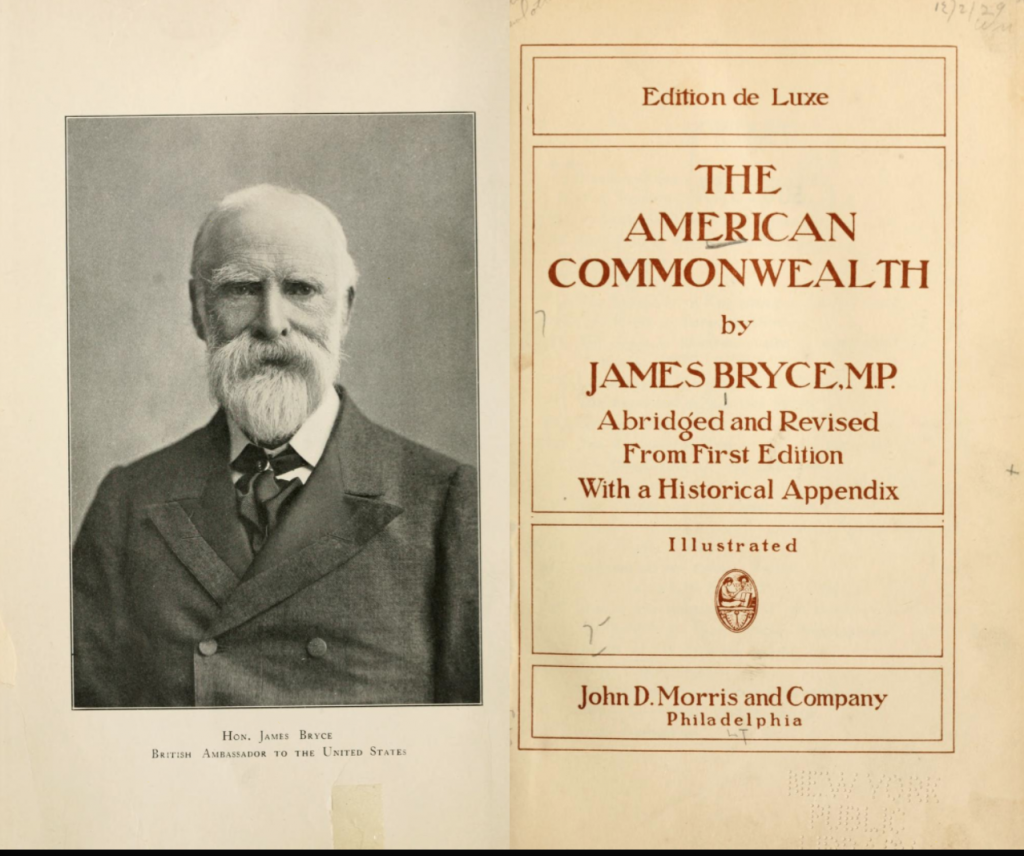
Both Mead and LaFeber quote from James Bryce’s American Commonwealth. But have you ever heard of it before?
- There was relatively little debate over war powers issues at the 1787 convention.
- August 17: Delegates discuss war powers. Highlights include:
- Oliver Ellsworth (CT) stating, “It should be more easy to get out of war than into it.”
- George Mason (VA) claiming he “was against giving the power of war to the Executive, because not safely to be trusted with it.”
- August 17: Delegates discuss war powers. Highlights include:
- The Constitution addresses the concept of war powers mainly in three brief clauses.
- Article 1, Section 8, Clause 11 (“The Congress shall have Power … To declare War”)
- Article 1, Section 10, Clause 3 (“No State shall … engage in war, unless…”)
- Article II, Section 2, Clause 1 (“The President shall be Commander in Chief…”)
- Presidents act
- Congress reacts
- Courts review
- People decide
US Supreme Court, War Powers and Foreign Policy
“every word [of the US Constitution] … decides a question between power and liberty.”
—James Madison, “Charters,” January 18, 1792
“Perhaps it is a universal truth that the loss of liberty at home is to be charged to provisions against danger real or pretended from abroad.”
—James Madison to Thomas Jefferson, May 13, 1798
“Safety from external danger is the most powerful director of national conduct. Even the ardent love of liberty will, after a time, give way to its dictates. The violent destruction of life and property incident to war, the continual effort and alarm attendant on a state of continual danger, will compel nations the most attached to liberty to resort for repose and security to institutions which have a tendency to destroy their civil and political rights. To be more safe, they at length become willing to run the risk of being less free.”
–Alexander Hamilton, Federalist No. 8 (1788)
1863 The Prize Cases (5-4)
“The President was bound to meet [the rebellion] in the shape it presented itself, without waiting for Congress to baptize it with a name.” (Justice Robert Cooper Grier, Class of 1812)
1890 In re Neagle (6-2)
“the rights, duties, and obligations growing out of the Constitution itself, our international relations, and all the protection implied by the nature of the government under the Constitution.” (Justice Samuel Miller)
1901 The Insular Cases (5-4)
[Commenting] “Yes, as near as I can make it out the Constitution follows the flag –but doesn’t quite catch up with it.” (Secretary of War Elihu Root)
1936 US v. Curtiss-Wright Export Corp (7-1)
“In this vast external realm, with its important, complicated, delicate and manifold problems, the President alone has the power to speak or listen as a representative of the nation. He makes treaties with the advice and consent of the Senate; but he alone negotiates.” (Justice George Sutherland)
1952 Youngstown Sheet & Tube Co. v. Sawyer (6-3)
“The Founders of this Nation entrusted the lawmaking power to the Congress alone in both good and bad times. It would do no good to recall the historical events, the fears of power and the hopes for freedom that lay behind their choice. Such a review would but confirm our holding that this seizure order cannot stand.” (Justice Hugo Black)