Class Blog

How do WE Relationship – and the many other manga I considered

During our class cultural artifact activity, I couldn’t decide what manga to bring, but I knew I wanted to bring a manga. (Manga read right to left)

I considered bringing The Whole of Humanity has Gone Yuri Except for me, (yuri is the japanese term for girls love) a book I picked up at barnes and noble because of it’s insane title. It turned out to be a somewhat camp, utterly insane, supernatural tale of a girl waking up and realizing that every single person in the world had been transformed into a lesbian woman.

I considered Bloom Into You, written by Nio Nakatani. I own every copy of this manga, and it’s super dear to my heart. This story features Yuu and Touko. Touko is outspokenly in love with – and wants to kiss – Yuu, and is fine if Yuu doesn’t reciprocate. Yuu is overwhelmed by this pressure, and feels like their relationship will lead nowhere, not because she isn’t attracted to girls, but because she’s not really sexually attracted to anyone, and never has been. She’s felt isolated from her peers her whole life, in this regard, atleast, and the story is about both of them coming to really love eachother and grow mutually as people.

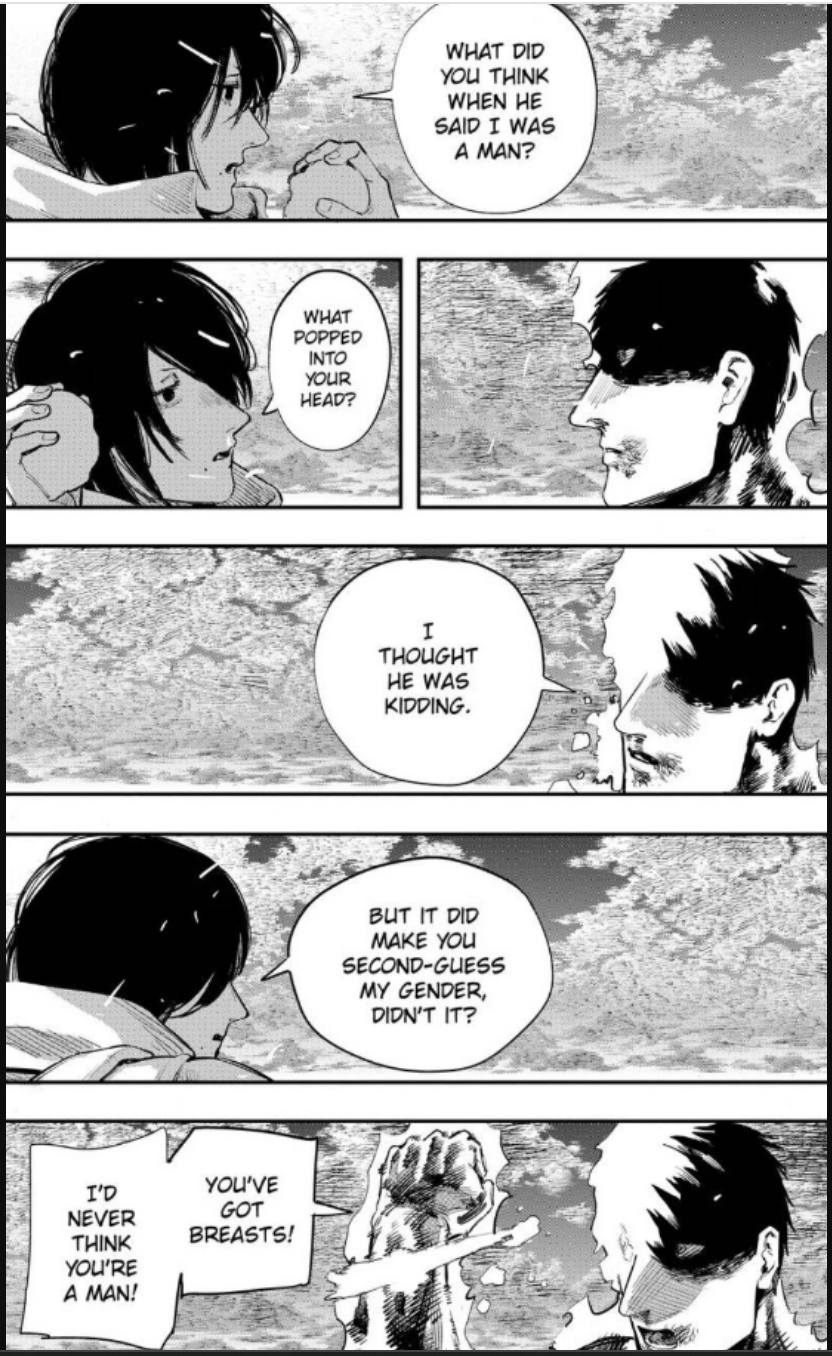
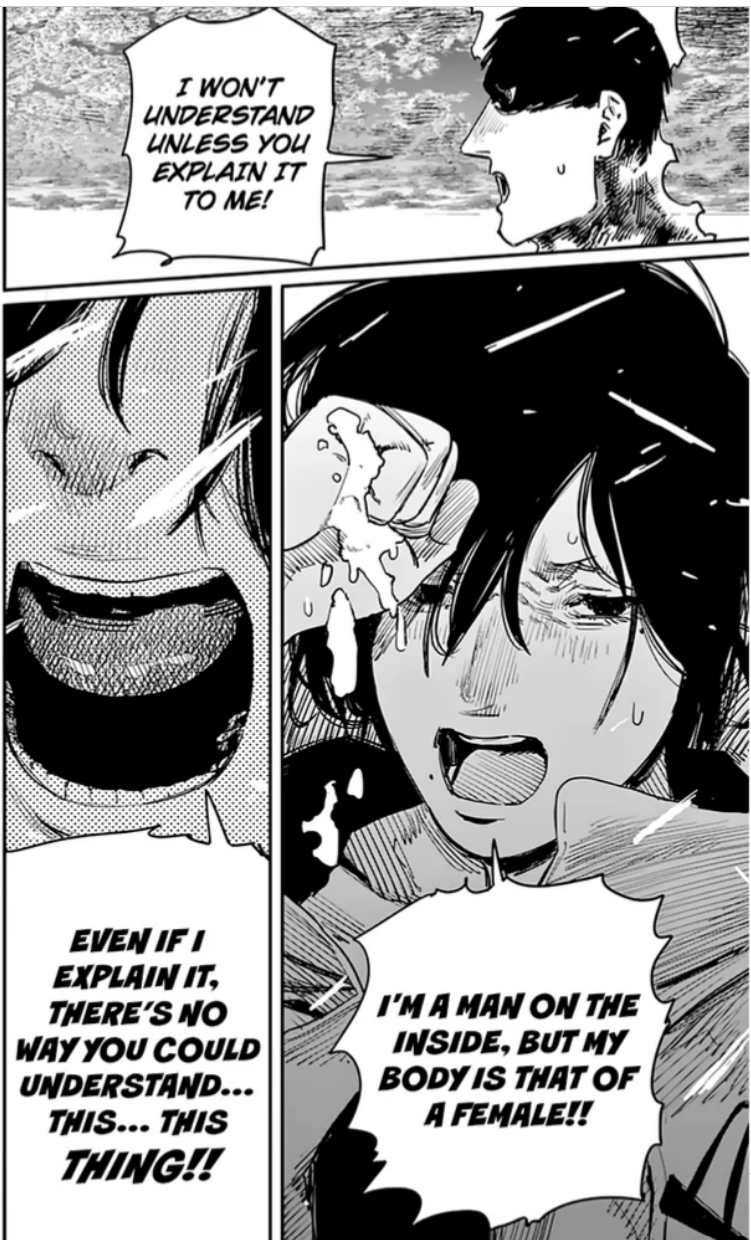
I even considered Fire Punch, written by Tatsuki Fujimoto. This work is very graphic and surreal in terms of themes and violence. The main character grows up in a dystopian wasteland, where few are cursed with and exploited for their supernatural regenerative properties. He is set on fire, early on, with flames that never go out, and since he cannot die, he walks the land a perpetual human torch. I almost chose Fire Punch, not for him, but for one of his companions that joins him on his journey. Togata is the deutragonist, who is rare in manga because he makes explicitly clear his gender dysphoria. Togata has a woman’s body, but confesses to Agni (the human torch) that he is a “man” on the inside. What makes Togata so tragic, is that he is also cursed with regeneration. Every time he dies (a constant device throughout the story) he must return to a body that he considers himself trapped in. A feminine body. Also related to our class is Togata’s role in the story. Togata is a self proclaimed director, and he orchestrates several events (and films them) throughout the story. It makes me think of diving into the wreck, returning to that dystopian land with a camera. But this time, Agni is the flashlight that Togata is using to explore the wreckage. (the following panels are not exactly page x and page y, there may be one sequence in between.)
 

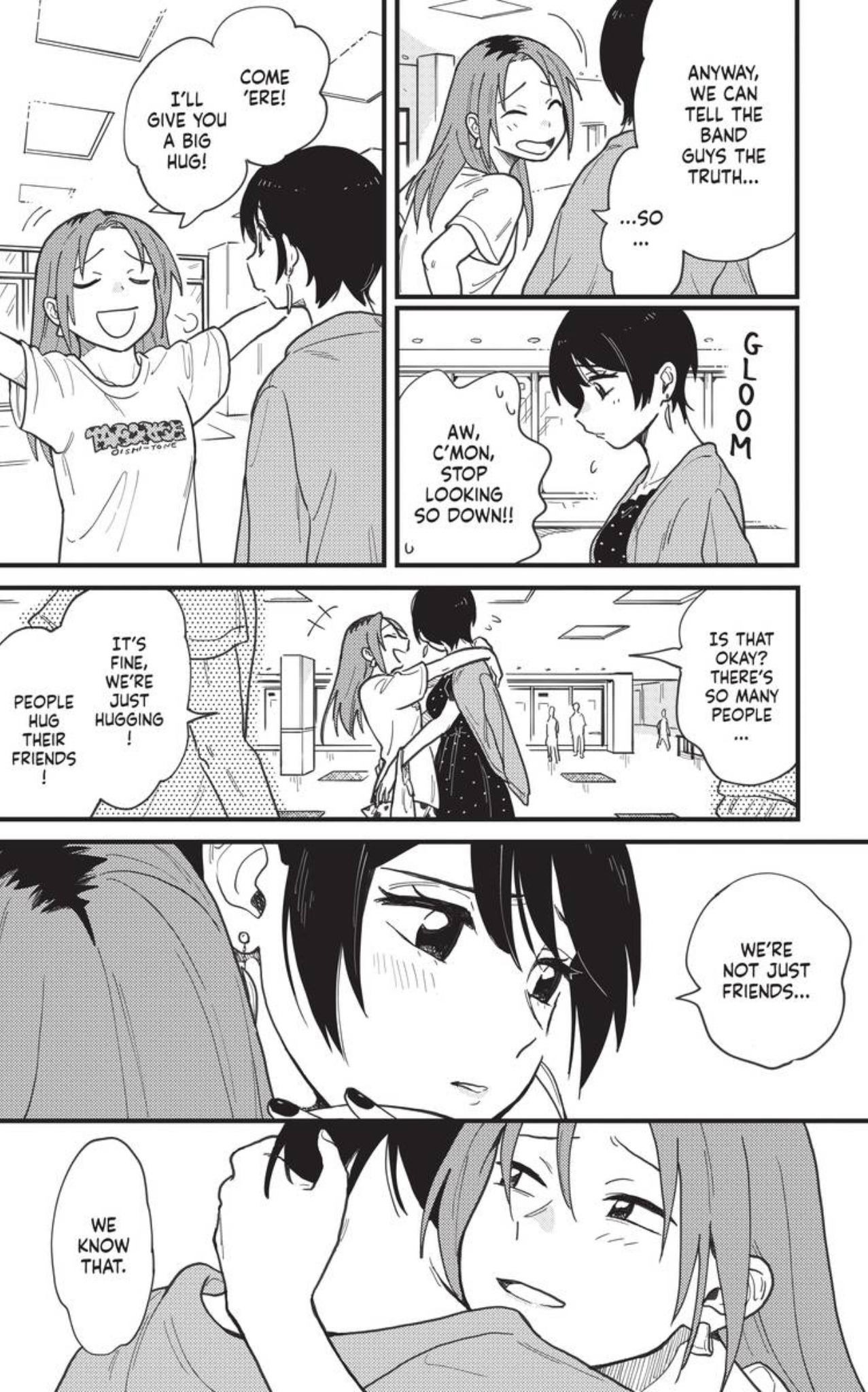
The manga I actually chose is How do we Relationship? By Tamifull. Like Bloom Into You, this is a super well known yuri manga in the community. How do we Relationship? is unique because the story starts when the two characters start dating. Most stories have the whole “will they/won’t they” through line, and while that does come into play because they break up once (or twice) having them meet and get together in the first chapter really sells the vibe that no, this is going to be a realistic portrayal of two people that love eachother, struggling to treat themselves right, struggling to treat eachother right, and struggling with the dynamics of a relationship. The character development is treated so well in this story, and I love how modern and well handled it feels. The characters, Miwa and Saeko, are openly lesbian, Saeko has a heterosexual friend that literally calls her on the phone while she’s having sex with a dude. They live actual lives, they have actual pasts, and the way Tamifull handles things like “visibility” is really nice. This manga feels super genuine to me, and I loved seeing Miwa and Saeko care for eachother. Misunderstandings feel believable and in character, not phoned in, you root for their growth and good communication, and you’re eventually rewarded. I think something powerful that How do we Relationship? touches on, is interconnectedness. While Miwa and Saeko are lesbian, and that’s a big part of their story, it’s not “how do lesbians relationship” it’s “how do we” and while that’s cheesy, I truly think anyone can learn and appreciate this story.


There isn’t a great “so what” here, I just wanted to talk about manga.

Banned Books

My cultural artifact was the US Banned Book Collection and it was chosen because of its informational and harmful qualities. This list was written by conservative members of the United States everywhere, who believe that books will lead to the breakdown of family and society as we know it instead of violent racial or religious supremacists, mass shootings, or hate speech. This list is an uncontrolled tumor on our society and it needs to be cut out. This list shows how far members of our country will go to undue change by the people before us who have put died and cried for us to have the rights that we do today.

The items contained within this list are about queer history or romance, Native Americans, or books that go against the views of the church — even though we are supposed to have a separation of church and state. These texts and the act of banning information is integral to this course, because they incredibly relate to the core part of this class which is learning. It is important to learn what people want so dearly to ban, because who will fight for this except for the people who have the information.

`The purpose of this class is to educate, and this banned book collection goes against that purpose. We need to be aware of what others seek to destroy

“The Summer Hikaru Died”: Body Horror and Boys in Love

During our class cultural artifact activity, I brought two volumes of The Summer Hikaru Died by Mokumokuren. It’s a series starring a teenager named Yoshiki and his relationship with his childhood best friend. His best friend, Hikaru, dies in the woods and is replaced by a supernatural entity. The story (both the manga and the anime) has horror-esque abstract art with the anime taking a mixed media approach with the series (blending real-life backgrounds and objects with animated characters). The series itself means a lot to me due to how it caters to my interests (supernatural horror with romance and unique art). It mainly connects to the class due to how Yoshiki had a crush on Hikaru when he was alive, and how he refuses to leave Hikaru’s side even though he was replaced by a dangerous entity. It also takes place in a rural location where same sex relationships aren’t as common (the term “LGBTQ+” itself is referred to as “that L gee bee t thing” by a child Hikaru in the anime).  

Another interesting concept explored in the series is sexual exploration shown through “mixing.” “Mixing” refers to the entity inserting himself into Yoshiki (or vice versa), with the entity eventually becoming a part of him. A unique part of this approach is how the characters react to each other, with Hikaru initially prompting Yoshiki to reach into his abdomen and then pinning Yoshiki down (with the parts of the entity going into Yoshiki’s body giving him pleasure and feeling “nice” to him). The text that primarily reminds me of the series is Prelude to Bruise by Saeed Jones, as they both center around the sexual coming-of-age experience of a boy in a rural village, and how that boy is seen as an outsider (specifically someone that is “hard to understand”). I find it interesting how The Summer Hikaru Died has a similar setting yet contrasts the piece with the dynamic between the two main characters. The entity inhabiting Hikaru’s body isn’t socially adjusted/in tune with societal norms, which in a way prompts Yoshiki’s attachment to him (as he wouldn’t resist his affection or feelings for him like the real Hikaru). Even though being with the entity is dangerous and leads to body-altering consequences, Yoshiki prefers it to being alone in a place where nobody truly understands him (preferring to be oneself than to live a lie). 

American Dreaming

Angels in America by Tony Kushner explores the idea that marginalized communities (specifically those in the LGBTQ+ community) struggle with feeling accepted in a country that boasts freedom and opportunity (the US). America is often seen as an ideal place to live since it provides the “key” to a better life (specifically being able to find job stability or security). Despite how America is portrayed, the reality is that not all people are viewed as equal in the country’s eyes. If a person doesn’t fit into a box that matches pre-established social norms, they are othered. If the people in power don’t respect those who are othered or considered a minority, they will do nothing to support them or treat them like outsiders in a country they call their home. Kushner’s play critiques the notion of the “American dream” by creating multi-dimensional characters from backgrounds and identities specifically targeted by United States legislation. 

The people in marginalized groups can have an us vs them or us vs the world mindset that influences their perception of society (seeing themselves as targets of harmful legislation or the government, specifically the Reagan administration in the play). In the text Louis states “Children of the new morning, criminal minds. Selfish and greedy and loveless and blind. Reagan’s children. You’re scared. So am I. Everybody is in the land of the free” (77). Louis’s sentiment is characterized by a sense of cynical realism and dissatisfaction. He knows he is an outcast in society because he is a gay man, and that the current president has done little to improve the lives of LGBTQ+ individuals (such as by actively ignoring the AIDS crisis for a long period of time). He sees both the president and the people present in society as ignorant for pushing their harmful beliefs onto individuals who only want to be themselves.  

An interesting point of contrast in the play comes from Joe, who brings up a more optimistic perspective of America. In the text, he states, “It’s still a great country. Best place on earth. Best place to be” (201). This perspective can come from ignorance, as Joe hasn’t experienced being othered by society due to agreeing with those in power (the same people who actively try to take away the freedom of sexuality Joe tries to experience). If a person is not directly harmed or at risk due to their social standing, they may feign ignorance and be slow to realize the consequences of their own actions (mainly how the free country they value isn’t truly free for everyone. As Angels in America shows, those who conform to the harmful ideals of a society (Joe) struggle to see eye to eye with those actively struggling because they are expressing their true selves (Louis). 

A Crime Against Humanity

How strange that some texts without an alias would never be considered important texts or get the recognition or fame they would have today. In The Legend of Auntie Po by Shing Yin Khor, Mei is speaking with Bee about there future in which Bee responds with, “Well, you’ll move in with me and you’ll write stories, and poems under a man’s name and sell them to the paper. I’ll illustrate them for you.” The story subtly  hint to the prejudices surrounding the main Characters. This book takes place in the 1840’s roughly and during that time the literary world was dominated by men. Women writers were often dismissed or judged unfairly. Using male pseudonyms helped their work be taken seriously. Mei would do just as the Brontë sisters and Mary Ann Evans did by using a male name to portray credibility.

The power and influence of just changing one’s name directly illustrates the power of conformity. I’m not only taking about changing names but cloths, appearance, and speech. This is dangerous because it allows one group to dominate and build expectations that only one type of person is credible. It is mind boggling that one must dress a certain way to be taken seriously and it will be others downfall for not accepting those who are not an identical copy of themselves. There is nothing new to learn if everyone is the same, there is nothing new to think about if everyone is thinking the same things. Life becomes grey and mundane. It is a crime against humanity, a crime against the beauty and art that is life to conform. It steals the beauty from life and the joy of something new and different to see, learn, understand everyday. Conformity steals color from the world and makes life practically not worth living. The human race is meant to learn and evolve and explore and depriving that is a crime.

Mei should put her shit on paper so the people that will grow and add color to this world will find it. So people like her can gain more credibility, so women do not have to hide behind a mans name, so people that love like her can be taken seriously. Mei should share her color and so should everyone else so that conformity can no longer be acceptable or a norm. It might not seem like there is a lot of conformity today but there is, My Friend Zhong Haoan goes by Austin because he didn’t want to bother trying to teach his friends to say his name in fear of being bullied. He is our valedictorian and my best friend and adds color to the world even if he doesn’t realize it, I wish he could of added more color to the kids lives that I grew up with… I think they could of really used it.

Keeping Memory Alive

I wear a necklace every day that holds some of my grandmother’s ashes. It is small and simple, but it means more to me than anything else I own. Whenever I touch it, I feel closer to her, like she is always watching over me. The only time I can’t wear the necklace is when I’m playing sports, so I wrap it around my water bottle and face it toward the court, like she’s still there watching me. When I was freewriting about this necklace, I realized it’s not just jewelry. It’s a reminder of where I come from and the people who helped shape who I am. 

Thinking about that made me connect it to The Legend of Auntie Po, which is also about how people hold onto memory and heritage. In the story, Mei uses stories to stay connected to her culture. Even though she lives in a place where she’s treated differently for being Chinese, those stories give her comfort, confidence, and a link to her family’s past. I think that’s important; everyone needs something to help them hold onto their identity. For me, it’s my necklace. For Mei, it’s her stories. 

LGBTQ+ communities, stories, and symbols are a way to stay visible and remembered in a world that sometimes tries to ignore them. These texts matter because they highlight the ways people stay connected and strong by holding onto the memories that shape them.  

Making this connection between my necklace and Auntie Po made me realize that remembering someone takes effort. Mei keeps her culture alive by sharing her stories, and I keep my grandmother close by wearing her ashes. And by reading books like The Legend of Auntie Po, we help make sure important stories and histories don’t disappear. 

auntie po taught me about mulan and mythmaking

Reading The Legend of Auntie Po made me think a lot about the stories we grow up with and how we change them to fit who we are. Mei reshapes the Paul Bunyan myth into something that actually reflects her life. She thinks of a powerful Chinese woman who protects her community instead of the giant lumberjack everyone else talks about. What I love is that Mei doesn’t wait for  permission to change the story, she just does it because she needs a version that makes sense to her.

I related The Legend of Auntie Po to Mulan. Mulan is a movie I watched when I was little and loved mostly because she was brave and independent (and I was obsessed with the idea of cutting my hair and becoming a warrior). But after reading Khor’s novel, I started noticing how much Mulan is also a kind of reimagining but just on a much bigger scale and shaped by a company instead of by one kid in a logging camp.

Both Mei and Mulan deal with people telling them who they’re supposed to be. Mei is expected to stay quiet, help her father and accept the racism around her without pushing back. Mulan is expected to become the perfect daughter and fit into her society’s rules. Neither of them can really be themselves inside those expectations, so they turn to stories to add themselves in.

What stands out most, seeing these two together, is how powerful it feels to take a story that doesn’t quite fit you and change it. Mei isn’t trying to make the correct version of the Auntie Po myth but she’s trying to make one that helps her survive. And I think a lot of us watch movies like Mulan for the same reason. It’s not because they’re perfectly accurate but because they give us a way to imagine ourselves as stronger or freer than we actually feel.

The Legend of Auntie Po reminds me that stories are alive and they grow and change with us. They shift based on who’s telling them, what they need and what they want. And maybe the whole point is that we get to shape the stories that shape us.               

Gay is in, gay is hot, I want some gay, gay It’s gonna be

One of my favorite TV shows is What We Do in the Shadows, a mockumentary-style show about a film crew that monitors the daily (or rather nightly) activities of a group of vampires. I highly recommend it due to its hilarious writing and the cast that make the delivery of every joke perfect.

This show relates to what we’ve been talking about in class because it is super campy, not in the way that is over the top in theatrics but in the sense that these vampires take themselves very seriously, which makes it difficult not to laugh at the ridiculous situations they put themselves in. This show makes me think of Susan Sontag’s ‘Notes on Camp’, in which she says “Camp is art that proposes itself seriously, but cannot be taken altogether seriously because it is ‘too much'” (Sontag 7). Watching a vampire go to a funeral in a church and trying to keep their composure and not disrupt the funeral while literally burning and being able to interact with the audience is a great example of deliberate camp, and a very funny one at that.

Not only is the show camp, but it is also very queer in general. They casually bring up that they have had both male and female lovers in the past and one of the show’s characters, a human familiar named Guillermo, even comes out as gay in the later seasons. Most importantly, the show really emphasizes the idea of a chosen family, and that all of these people who are outcasts from the rest of the ‘human’ world can live together and love one another.

Auntie Po is more than just the feminist version of Paul Bunyan

Myths are something usually seen as folklore or silly stories we make to explain certain phenomena in this world. However, Auntie Po proves that she is not just a phenomenon but rather needed representation. A voice for those who don’t feel seen. A person in space where traditionally she would be excluded from.

Mei is the only Chinese girl in the entire book other than Auntie Po who is supposedly imaginary. Mei makes her up not just to give the other children at the camp a story to listen to but for her to see representation of Chinese women that she doesn’t have in real life. Mei doesn’t dress stereotypically feminine compared to the other girls as well as that there are lingering undertones of possible romantic attraction between Mei and her best friend, Bee. It can be insinuated because Auntie Po doesn’t wear overtly feminine clothing that she is also queer representation for Mei. Though Mei is young, she still feels love for others and for her, Auntie Po is similar an older female member of her family to help her through her intersectional identity.

One of the main issues Mei faces is that she is not allowed to attend higher education because she is Chinese compared to Bee who is white. Mei is consistently told she is not like Bee and her family who advantage from white privilege and can attend university.  However, towards the end of the book Mei is given the opportunity to move to an area, San Francisco, that will permit her to eventually attend college. Towards the end of the book her father asks “Do you still see your Auntie Po?” where she replies “Does it matter? I don’t need to. I know who I am. I am a good cook. I have good friends. I have the best pa in the world.” (272, Khor). Auntie Po was a way for her to feel community, representation she hasn’t seen, people she doesn’t know. But people who are out there and exist. Through Auntie Po she was able to find her sense of self, learn to resilient during difficult times, and to rely on the people around here who are there to support her.

Unlike Paul Bunyan, Auntie Po is symbol for not just Chinese people for all people of color, queer people, or other minorities, to create stories that cater to them. Through storytelling, fiction, myths, marginalized people to become the representation that is needed in this world and tell their experiences in authentic and accurate ways.

It was queer, in the subtext, with the camp.

One of my favorite, albeit dated, movies of all time is Johnathan Lynn’s 1985 masterpiece Clue. It’s also a movie that thrives when thought about within the context of Angels In America. Angels is an undeniably campy play, with angels who give you orgasms, ghostly confrontations, witty comedy juxtaposed against incredibly serious subject matter, and more. But it is camp with a purpose. Camp in Angels is used as a form of societal critique, all the seemingly bizarre happenings happen for the purpose of telling a gripping story and scathing critique of the AIDS crisis, mixing in political and religious critiques as well. Once one understands this, one can understand Clue in a different light as well. One would think that Clue is a traditional family comedy movie. It is a film adaptation of the classic board game. But, set during the height of McCarthyism, Clue pokes fun at Cold War terror, with its entire cast being blackmail victims forced to solve an increasing number of murders. When we look past the ridiculous antics which early reviewers criticized as leading the film nowhere, we see meaning.

But Clue is not just about McCarthyism or comedy or how boring the board game is, it’s about deconstructing media as a whole. It famously released in theaters with three separate endings, seemingly jokingly. However this encourages one to not only re-watch the film but to analyze its insane premise, pick it apart, and put it back together. Over time, you begin to see things which may or may not even be there. It’s a movie which is both wholly unserious and obsessed with itself. Ultimately, Clue is whatever you want it to be.

Much like Angels, critically analyzing its camp instead of simply laughing at it builds the film up, the absurd board game format of the movie exists to mirror the absurdity of McCarthyism much like Angels uses actual angels as a way of critiquing religion and politics during the aid crisis. Why does this matter? Because Clue and Angels are a deconstruction of how artists smuggle queerness into media, of how we pick up on queerness: through innuendo, clever tricks, and camp. Much of the, primarily older, media that we understand as queer today is understood as such because we bothered to pick them apart. Clue and Angels in America encourage and remind us to ask to interpret, to ask why.


(it has been a while since I’ve seen Clue and though I always knew it had a lot to say these two sources were very helpful in getting me up to speed,)

Herring, Kyle. 9/17/2013. “Not Just a Red Herring – The Political Subtext of Clue”. theretroset.com

Vaughn, Joy. 8/29/2025. “Communism Is, Was, and Will Always Be A Red Herring” https://vaughnjoy.substack.com/p/communism-is-was-and-will-always