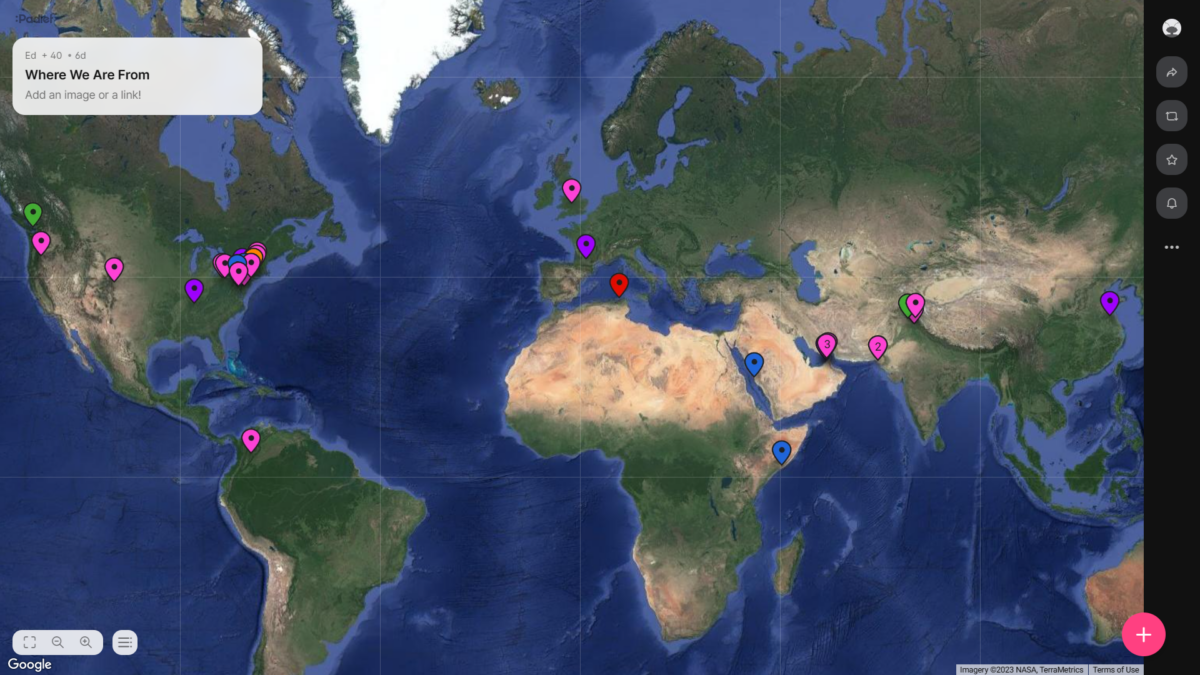
While in the second breakout room session during the first Zoom meeting with the students from the American University of Sharjah, the initial responses to the prompt we had been given impressed upon me with a pleasant surprise, although surprise might be too strong of a word to describe my overall reactions. There were six of us in the breakout room, four of us from Dickinson and two from the AUS. It was interesting that the four of us from Dickinson had had comparable experiences and views relating to the places we knew as home and fairly equal sentiments regarding Carlisle. All of us were originally from the North-Eastern region of the United States, within a reasonable distance from a larger metropolis which translated to viewing Carlisle as something of an island. The pleasant surprise came when one of the students from the American University of Sharjah told a story which was more or less similar to mine. This student was from Abu Dhabi, and although this is a far more populous place than that from which I originate, I learned that we both have a travelling time of about 2 hours to our respective schools. The main differences told by this student were about architecture as well regional culture.
While hearing from everyone in the group was interesting in one way or another, it was upon hearing from the other student from the American University of Sharjah, however, when my attention was truly captured. This student was from Kashmir. Although I recognized the name, I really had no knowledge of Kashmir until after they were done speaking and after I did my own research. One of the first things that this student told us was that Kashmir is a conflict zone between Pakistan and India. This was one of the main differences this student told us about; the greatly increased safety they experienced at school as opposed to when they were at home. They spoke about the cultural differences they had noticed between their home and the new country they were in, as well as the contrast in climate. This student told us how the climate in Kashmir was much more moderate than that of Sharjah, which could become unbearable to them at times, and how they would sometimes experience snow at home in Kashmir.

Image Courtesy of Reuters/Danish Ismail
Unfortunately, I was unable to ask this student any more questions about Kashmir and their experiences, though I hope to be able to reconnect with them in order to gain more information about the place they call home. In the meantime, I chose to do some research of my own in order to gain a better understanding of Kashmir, as well as to share some of what I learned with people like myself who might have otherwise had no knowledge of this complex geopolitical region.

Image Courtesy of the BBC
Kashmir is a region located along the Himalayas, primarily bordered by Pakistan to the West, India to the South, and China to the East. Since India and Pakistan gained independence from British rule in 1947, there have been fierce debates as well as armed conflicts over which of these countries should have claim to Kashmir. Ultimately, the region was divided so that each country should have claim to part of the area. Currently, Pakistan controls about 1/3 of Kashmir while India holds claim to the other 2/3, however, part of the area claimed by India is actually administered by China, adding to the complexities of the situation. Apart from the ebb and flow of unrest that has been evident for decades, two political actions from the past four years portend changes unknown.
The first of these actions was in 2019, when the Indian Government repealed Article 370 from the Indian Constitution. This Article granted the area of Jammu & Kashmir statehood as well as autonomy concerning internal affairs. At the same time, the Indian government divided the area in two, effectively creating two reduced status “union territories” called Jammu & Kashmir and Ladakh. This action was widely controversial, however the official US policy regarding the matter remained that all issues regarding Kashmir should be decided among India and Pakistan and within their respective governments. While this change in the Indian Constitution was advertised as an effort to bolster the regional economy, some sources say that this was an attempt to further disenfranchise native and Muslim Kashmiris.
The second action, which is related directly to the first, was introduced in 2020, when the Indian government began requiring residents of Jammu & Kashmir to apply for “domicile certificates” in order to vote as well as participate in other areas of commercial importance. The objective of this reform has been said to be to gain greater support for current Prime Minister Narendra Modi, while also increasing Hindu political control over the region. Like the constitutional amendment in 2019, this has been a criticized move in the political arena of the surrounding nations.
I hope this was able to provide some knowledge and clarity about the complex geopolitical landscape of Kashmir. I look forward to watching this situation unfold within the coming year, and hope to be able to answer any questions in the comments.
Reference & Image Links:
How India’s ruling party is tightening its grip on Kashmir | Reuters
Jammu and Kashmir | History, Capital, Map, Population, & Government | Britannica
Kashmir: Background, Recent Developments, and U.S. Policy (congress.gov)
Kashmir | History, People, Conflict, Map, & Facts | Britannica
Kashmir is bleeding. So is its economy | Business and Economy | Al Jazeera