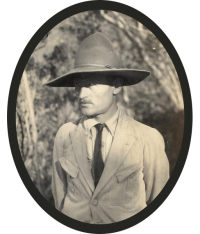
Ночь я по обыкновению провел в окопах, переходя от одной группы гусар к другой. Около 3 часов ночи перестрелка затихла, тучи разошлись, и день обещал быть жарким. Все мечтали подсушиться. Я пошел в землянку, напился чая, и в 4 часа утра лег поспать, так как это была вторая ночь, что я не смыкал глаз. Сапоги снять я не мог, и ноги были совершенно мокрые. В 5 часов утра будит меня ротмистр Доможиров и говорит, чтобы я скорее шел в окопы, так как по телефону передают, что немцы наступают. Я быстро пошел в окопы. В это время началась беспрерывная артиллерийская стрельба из легких и тяжелых орудий, но все левее или правее нашего участка. Я сделал все распоряжения для отбития атаки и ждал появления противника. В начале 7 –ого получаю приказ отходить. Надо было всех собрать, а это большие расстояния. Я взял направление на переправу через реку Дубиссу, где нас должны были ждать коноводы. Шел оврагами, сам тащил 300 патронов, чтобы не бросить немцам. Когда мы выходили из окопов, немцы уже занимали окопы левее меня, где наши уже отошли. Справа и слева был адский артиллерийский огонь, но он меня не трогал, так как я вел людей скрытно.
Когда мы прошли пару верст, я решил, что нам необходимо подзадержаться и я занял тыловую, очень удобную позицию. Только разделил людей, как на соседнем холме появились цепи немцев. Они шли как на параде. Я дал залп и стал их бить с постоянного прицела, до них было 500-600 шагов. Вот из-за горы выходят новые густые цепи немцев. Я обстрелял их, а потом повел людей бегом. Мы как шары скатывались в овраг, и немецкий пулеметчик не успевал пристреляться. Пробежали минут 5 и уже запыхались, так как несли с собой всякую мелочь из окопов, перешли на шаг и вдруг увидели коноводов. Молодчина старший унтер-офицер Солдатов подвел их очень хорошо. Он ждал нас. Я перешел Дубиссу и занял окопы на восточном высоком берегу. Другой берег был виден как на ладони. Густые и редкие цепи немцев двигались как на картинке. У нас было только 2 орудия, а цели было на 10 батарей. Нас была горсточка, их в 12-15 раз больше. Я снова открыл огонь и послал искать 1-ый полуэскадрон. Это был один из самых тяжелых дней за всю кампанию.
As usual, I spent the night in the trenches, walking from one group of hussars to another. Around 3 am, the skirmish subsided, the clouds parted, and the day promised to be hot. Everyone dreamed of drying out. I went to the dugout, drank tea, and at 4 am I went to sleep, as it was the second night that I did not close my eyes. I could not take off my boots, and my legs were completely wet. At 5 am, Captain Domozhirov wakes me up and says that I should go to the trenches right away, since they called and said that the Germans are advancing. I went to the trenches quickly. At this time, the continuous firing of light and heavy artillery began, but all to the left or to the right of our area. I made all the orders for countering the attack and waited for the enemy to appear. At the beginning of the 7th hour, I receive an order to move back. I had to gather everyone, and across a wide area. I took the direction of crossing the Dubysa River, where we were to wait for the horse handlers. I walked by way of gullies, myself hauling 300 cartridges in order to not leave them for the Germans. When we left the trenches, the Germans had already occupied the trenches to the left of me, which our men had already left. To the right and left was hellish artillery fire, but it did not touch me since I led my people in secret.
When we had walked a couple of versts, I decided that we needed to pause for a moment and I took a very comfortable position in the rear. I had just divided the people, when a chain of Germans appeared on a nearby hill. They walked as if in a parade. I fired a round and began to hit them with a constant aim; they were 500-600 steps away. Because of the mountains, a new dense chain of Germans appeared. I shot at them, and then directed my people to run. We rolled down into a gully like balls, and the German machine-gunner did not have time to aim. We ran for about 5 minutes and were already out of breath, as we were carrying every little thing from the trenches. We slowed down to a march and suddenly saw the horse handlers. The talented senior non-commissioned officer Soldatov lead them very well. He was waiting for us. I crossed over the Dubysa and occupied the trenches on the eastern high bank. The other shore was in full view. Dense and sparse chains of Germans moved as if in a painting. We only had 2 guns, and the target was 10 batteries. We were a handful of people, and they were 12-15 times our size. I opened fire again and sent the 1st half-squadron to do reconnaissance. It was one of the hardest days of the entire campaign.
Идет сильный дождь. В окопах много воды, я промок выше коленок, и вымазался в грязи. Наша офицерская землянка очень приличная для сухой погоды, протекает так сильно , что внутри льют ручьи. Сапоги мокрые, чай согреть нельзя. Печальная обстановка. Этот листок в книжке будет историческим. Во время обстрела невозможно выйти из землянки – пули жужжат как шмели.
It is raining hard. There is a lot of water in the trenches; I am wet past my knees and covered in mud. Our officers’ dugout is very decent for dry weather, but the water is leaking in so much that there are little rivers flowing inside. Boots are wet, tea cannot be warmed. The situation is sad. This page in the book will be a historical one. During the shelling, it is impossible to leave the dugout: bullets buzz like bumblebees.
Только сели обедать, как в 150 шагах раздался взрыв тяжелого снаряда, потом разрывы стали удаляться, чуть не зацепив наших коноводов.
I had just sat down to eat lunch when, 150 steps away, a heavy shell exploded. Then the explosions began to grow more distant and almost caught our horse handlers.
Вчера мы поменяли позицию. Спать я лег только в 12 часов дня. Около 3 часов дня Доможиров и я были разбужены разрывами шрапнели, которая рвалась около нашей халупы. Стрельбы с перерывами велась часов до 5. Днем летали аэропланы, а вечером пришли мужики скашивать поля. По этим признакам можно предполагать, что получены вести о готовящемся немцами наступлении.
Наш участок 3400 шагов занят 80 гусарами и 24 пехотинцами. Итак, на 34 шага – 1 человек. Пехотв в одном месте стоит на 700 шагов 12 человек, а гусары по 4 человека через 150 шагов. Я был в окопах с 10 часов вечера до 4 часов утра, и чувствовал себя довольно глупо. Как я могу управлять стрельбой на участке в 2 версты? Ходил от одной группы гусаров к другой. Если бы немцы захотели, то они бы в любой точке сделали бы прорыв, имея одну хорошую роту.
Окопы наши бывшие немецкие. Эти окопы удобные для немцев, были очень плохи для нас. Там, где немцы имели в тылу лес, у нас он оказался в 15 шагах перед нами. Теперь приходится изредка стрелять, чтобы попугать немцев. Козырьки и блиндажи сделаны плохо.
Yesterday we changed our position. I was only able to go to bed at 12 noon. At around 3 pm, Domozhirov and I were awakened by explosions of shrapnel, which detonated near our huts. The shooting lasted on and off for up to 5 hours. During the day, airplanes were flying, and in the evening men came to mow the fields. According to these indicators, we can assume that we’ve received news that the Germans are preparing an offensive.
Our area of 3,400 steps is occupied by 80 hussars and 24 infantrymen. This means there are 34 steps for every 1 person. The infantry stands on 700 steps for 12 people, and the hussars are 4 people to 150 steps. I was in the trenches from 10 pm to 4 am, and I felt pretty stupid. How can I manage shooting on an area of 2 versts? I walked from one group of hussars to another. If the Germans wanted, they could have made a breakthrough at any point, with only one good company.
Our trenches are former German trenches. These trenches, though comfortable for the Germans, were very bad for us. There, where the Germans had a forest in the rear, we now have it 15 steps ahead of us. Now we have to shoot every now and then to scare the Germans. The peaks and dugouts are made poorly.
Вчера с вечера эскадрон был поседлан. А ночью на участке литовских улан появился неприятельский патруль, и уланы отошли почти без боя, потеряв 1 раненного и 2 пропавших без вести. К рассвету они вернулись в свои окопы обратно, но противника там не оказалось. Штаб дивизии был напуган и послал им на помощь 3 эскадрона драгун. На нашем участке тоже была перестрелка.
К нашим пулеметчикам прибежали 2 перебежчика, оба поляки. Трое пулеметчиков сидели в землянке, вдруг дверь открывается, и входят 2 немца с винтовками. Ребята перепугались и уже хотели сдаваться, как немцы положили свои винтовки на землю и сами сдались. Старший из них был телефонистом и рассказал, где у немцев батареи, кто сидит напротив нас, что немцы стягивают сюда свои войска и что они знают, что у нас в окопах сидит кавалерия.
У нас недостаток снарядов, и наша 6-орудийная батарея имеет право выпустить только 4 снаряда в день.
Yesterday evening the squadron was saddled up. But last night, an enemy patrol appeared in the Lithuanian Uhlan’s territory, and the Uhlans withdrew almost without a fight, suffering 1 wounded and 2 missing soldiers. By dawn they returned to their trenches, but the enemy was no longer there. The division headquarters was scared and sent 3 squadrons of dragoons to their aid. There was also a shootout on our site.
Two defectors, both Poles, ran to our machine-gunners. Three machine-gunners were sitting in the dugout when suddenly the door opens, and 2 Germans with rifles enter. The guys were scared and already wanted to surrender when the Germans put their rifles on the ground and surrendered themselves. The eldest of them was a telephone operator and revealed where the Germans had batteries, who was positioned opposite of us, that the Germans are gathering their forces in this direction, and that they know we have cavalry in our trenches.
We have a shortage of shells and our 6-gun battery only has the right to release only 4 shells per day.
Деревня Можейкишки.
Говорят, что командир пехотного полка, на участок которого мы стали, не знал, плакать или смеяться, когда мы ему сказали, что вместо 12 рот и 42 орудий у нас всего 2 эскадрона и 1 пулемет. Жаль будет, если немцы прорвут нас, та как полк фактически не может держаться.
The Village of Mozheikishki.
It is said that the commander of the infantry regiment did not know whether to cry or laugh when he learned that instead of 12 companies and 42 guns, we only have 2 squadrons and 1 machine gun. It will be a pity if the Germans break through us, since the regiment will not actually be able to hold ground.
Вчера, после бессонной ночи в 4 часа утра мы выступили сперва на сборный пункт дивизии, а потом на Шавляны. Погода хорошая, но пыли все портит. Хотя я одел очки, но глаза все-таки заболели. Как это у нас всегда случается – сидим, сидим, и вдруг повскакали. Никто ничего не понимал и не знал. За весь день удалось 2 раза попить чая и больше ничего. Наш эскадрон попал в резерв.
At 4 am yesterday, after a restless night, we went to the division assembly point, and then to Shavliany. The weather is nice, but the dust spoils everything. Despite wearing my glasses, my eyes still hurt. This is how it always goes: we sit, sit some more, and suddenly we jump into action. Nobody understood or knew anything. Throughout the whole day I was only able to drink tea twice and nothing else. Our squadron was in reserve.
Газета «Новое Время» убеждает публику, что нам необходимо отойти, так что мы отступаем по обдуманному плану.
The newspaper New Time has convinced the public that we need to move back, and so that we will retreat according to a deliberate plan.
Сегодня прочел в газете, что наши в Галиции еще 16-го июня отошли к границе. Если это согласно плану, то ничего, но если это вынужденное отступление, может быть, из-за недостатка снарядов, и это очень печально.
Сегодня большое и радостное для меня событие: я снова во 2-ом эскадроне. Посажной болен, Топорков наконец-то принимает эскадрон Ее Величества, а во 2-ом эскадроне: ротмистр Доможиров, поручик Иваненко, прапорщик Янов и я.
Today I read in a newspaper that our troops in Galicia had already moved back to the border on June 16th. If this is according to plan, then it is not a big deal, but if this is a forced retreat, maybe due to a lack of shells, then this is very sad.
Today marks an important and joyful occasion for me: I am again with the 2nd Squadron. Posazhnoi is ill; Toporkov will finally take on Her Majesty’s Squadron. But in the 2nd Squadron there is Captain Domozhirov, Lieutenant Ivanenko, Warrant Officer Ianov, and myself.
Вчера весь полк пошел в лес на смену пехоте. Теперь все в одинаковых условиях. Все в окопах. Погода хорошая и скрашивает тяготу лесной жизни.
Yesterday the entire regiment went to the forest to replace the infantry. Now everyone is in the same conditions. Everyone is in the trenches. The weather is good and it brightens the hardship of forest life.