James D’Annibale, Director of Academic Technology
*Academic Technology would like to thank the following Dickinsonians for their contributions to this page whether through direct edits or constructive conversations: Dr. Renee Cramer, Dr. Amy Steinbugler, Dr. Michel Kozimor, Dr. Kirk Anderson, Dr. Howard Rosen, and many more colleagues*
This document offers guidance on how to clearly identify and implement policies concerning Generative Artificial Intelligence (GAI) in your courses. These guidelines do not prescribe a specific stance regarding student use of GAI– the College recognizes a plurality of perspectives. Instead, these guidelines illustrate a set of steps through which you may clearly communicate this preference to your students.
Complementing this document, three Dickinson-specific documents that will be helpful for you as you take the next steps:
- Sample AI Related Syllabus Statements
- Transparent Assignment Design in the Age of AI
- Provost Cramer’s “Academic Affairs and AI”
Introduction:
Generative Artificial Intelligence (GAI) models (that generate text, music, code, and images) pose challenges in the classroom. They also present new opportunities for teachers and learners. Because faculty have different opinions about the utility of GAIs, there is no single policy that works for every instructor of every course. However, as you finalize your syllabi, and plan assignments for your courses, there are a few things to keep in mind regarding your GAI decisions and how you communicate them.
Dickinson Resources available to you:
- The staff at the Center for Teaching, Learning, and Scholarship and the Multilingual Writing Center are available to assist faculty with implementing best practices for the writing process and other instructional strategies aimed at combatting prohibited use of GAI.
- The Academic Technology Department is prepared to assist faculty who are interested in integrating AI into their assignments or courses. Examples may include AI for simulations, feedback, brainstorming, or explanations of text and code. Please contact your Academic Technology department liaison or James D’Annibale directly if you’d like help. As with any assignment, we’ll work with you to discuss learning goals, student training, and provide support to you and the students throughout the process.
- Academic Technology staff are also prepared to assist your students with productive uses of GAI that you might not be aware of and are not directly related to course assignments or projects. Please let us know if you’d like us to teach these uses to your class or you could refer individuals to us. Examples include, but are not limited to:
- Plan a group project
- Make a daily calendar to assist with time management (allotting time to study, eat, socialize, etc.)
- Create custom learning scenarios like case studies or role-plays to help with concepts they’re struggling with or would like to engage with more deeply.
Crafting your Syllabus Statement
Essential Parts:
- Allowed & prohibited uses
- Transparent and understandable rationale for your decision(s)
- If allowing any GAI use, explain responsible use, acknowledgements, etc.
- Insert a statement that explains how other courses may have different rules, such as “Different courses at Dickinson College may have varying policies regarding AI use. This syllabus outlines the expectations for this course specifically.”
- Again, please see the Syllabus Statement Examples for inspiration and/or clarity as to what the above pieces consist of.
Things that are good to think through when deciding on GAI use, writing syllabus statements and communication with your students:
- First, decide if GAI should be part of the course, limited to individual assignments, or not at all.
- Here are some questions (Bruff, 2023) you may wish to ask yourself when making this decision for individual assignments:
- Why does this assignment make sense for this course?
- What are specific learning objectives for this assignment?
- How might students use AI tools while working on this assignment?
- How might AI undercut the goals of this assignment? How could you mitigate this?
- How might AI enhance the assignment? Where would students need help figuring that out?
- Focus on the process. How could you make the assignment more meaningful for students or support them more in the work?
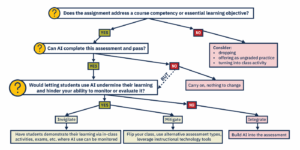
- The University of Michigan has an excellent page dedicated to helping Faculty think through course and assignment (re)design within the context of GAI availability. The decision tree is included below but the full page is definitely helpful.
- Whether or to what extent courses require new assignment design is up to individual instructors—but this Michigan site leads faculty through an interesting thought-exercise that is helpful regardless of if you are using or not using GAI.
- Please contact Academic Technology, CTLS, or the Multilingual Writing Center if you’d like to sit down and talk through this decision or to learn about GAI capabilities.
- Here are some questions (Bruff, 2023) you may wish to ask yourself when making this decision for individual assignments:
- If you are going to allow or even encourage GAI use, determine what type of GAI use makes the most sense.
- Important note: We believe students will do better with GAI use if the prompts are provided by the professor and demonstrated ahead of time either by the professor or by a member of Academic Technology. This ensures good prompting strategies of using the Role, Context, Information, Output structure. The CC licensed prompt library from Dr. Mollick can be very helpful.
- The U of M page linked in the section above is also helpful for integrating GAI into assignments, should you choose to do so.
- The scale at the bottom of this document created by Leon Furze presents different levels of use of GAI within a course and can be useful for considering different scenarios and providing explanations of what ought and ought not to occur at each level. You can read about the scale here: The AI Assessment Scale: Version 2.
- There are other scales you can find online that may also help you think through this process, such as the Gen AI Intent and Orientation Model. Use whatever works for you. The scale is meant as a guide for consideration. You should not feel limited to choosing a level listed.
- Important note: We believe students will do better with GAI use if the prompts are provided by the professor and demonstrated ahead of time either by the professor or by a member of Academic Technology. This ensures good prompting strategies of using the Role, Context, Information, Output structure. The CC licensed prompt library from Dr. Mollick can be very helpful.
- Communicate your GAI policy clearly to your students.
- It is strongly recommended that you have an open discussion with your students about the choices you’ve made regarding GAI. This discussion ought to include the educational benefits and ethical considerations of your choices regarding GAI in your assignments.
- If using a scale like Furze’s below when making your decisions, you can also share the scale with your students, much as you would a grading rubric, to help them understand expectations for uses and limitations of GAI within their assignment.
- Mention the caveat that different professors at Dickinson College will have different policies.
Something to keep in mind:
Some students may use GAI as a learning aid and in ways that are not dishonest or in violation of the academic integrity policy. For example, they might use GAI as a subject tutor or as an assistant for planning their day-to-day schedule. Many students with disabilities may find GAI is very useful to help them overcome the barriers to their living and learning. Without clear communication of expectations regarding learning objectives, etc., students may unintentionally veer into areas of GAI use that are indeed academic integrity violations. Please contact Academic Technology if you’d like to have a staff member demonstrate proper uses of GAI to ensure students do not make these mistakes while making productive and well-intentioned use of GAI.
Unfortunately, there are no AI Checkers that are reliable. In fact, “AI Checkers” are notoriously unreliable. The company that created ChatGPT took their checker down because they realized it was not able to perform adequately. This why it’s so very important that you clearly communicate expectations to your students. Please use Transparent Assignment Design in the Age of AI as a starting point for thinking through this communication. If you’re interested in instructional design strategies to help cut down on the likelihood of GAI use by your students, it’s recommended that you discuss your course and assignments with Academic Technology, the Writing Center, and/or the CTLS.
Custom GPT Built to Help With Your Syllabus Statement
You may use (optionally of course) this “GPT” to create your syllabus statement. We created it using the guidance below. It will literally walk you through step by step asking you questions about your decisions related to AI in your course and will give you a syllabus statement you could copy into your syllabus or at least give you a starting point. You need to log into ChatGPT before you can use this. Our apologies if you don’t want to make an account. Unfortunately ChatGPT requires an account to use the GPT we made: https://chatgpt.com/g/g-6789618b65c881919601df3303ba7edd-ai-syllabus-statement-builder
Assignment Design/Redesign Decision Tree
This decision tree—adapted from materials developed at the University of Michigan—was designed in the context of a campus-wide emphasis on intentionally incorporating AI into teaching and learning. While the tree leans toward integrating AI into assessments, we recognize that such a direction may not reflect every course’s needs or every faculty member’s perspective.
That said, the core questions in the decision tree remain valuable within the Dickinson context. They offer a thoughtful way to evaluate whether and how AI might impact student learning, course integrity, and assessment design. We encourage you to use this tool not as a directive, but as a prompt for reflection and conversation.
AI Use scale:
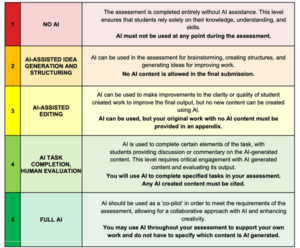
(Creative Commons license for Leon Furze’s image. To see original, and full peer-reviewed article, go to https://open-publishing.org/journals/index.php/jutlp/article/view/810)
Resources
AI is still relatively new and evolving. If you haven’t tried it yet, now is a great time to do it. Below are some resources from Academic Technology that you might find useful. Please also be sure to read the Academic Technology blog which has several posts related to GAI.
Other Resources: ·
- Assignment Makeovers in the AI age – The Derek Bruff article cited previously.
- Learn with AI – a Resource developed by the University of Maine.
- AI Pedagogy Project – a resource from metaLAB at Harvard.
- One Useful Thing – Dr. Ethan Mollick’s blog about generative AI.
- More Useful Things – Companion site to One Useful Thing.
- University of Michigan’s “Designing Teaching Activities in the Generative AI Era”