Seeing with the Soul

Cicero did not equate disability with incapability, argues Samantha Ritschel (’26).

I have lived life as a disabled person for over a decade. I was not born disabled. My disease, Friedreich’s Ataxia, began affecting me when I was eleven. So many doors that were previously open for me, suddenly shut, and I needed to find a new path forward. For me, that path led me to the world of the Classics. Classical Studies renewed something in me; it gave me a purpose, and with purpose comes the drive to succeed.

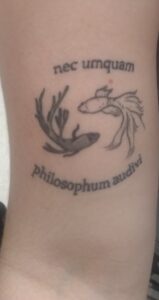
A tattoo on my right arm: one black beta fish and one white beta fish circling each other to form a yin yang symbol with the quote nec umquam philosophum audivi (“I never listened to a philosopher,” Petronius, Satyrica 71.12).

Throughout my academic career, ancient philosophers have occupied a great deal of the subject matter of my studies. I hate philosophy. I have never listened to a philosopher, and quite frankly, I don’t think I ever will. My experiences and the way I must live my life due to my disability cannot be mapped on to the philosophies that I am taught. Call me a pessimist if you must, but I prefer the term realist. To know oneself is the best thing that someone can do for themself, and for me that means accepting limitations and carving a path for myself, even though it will never be easy. And sometimes, to know yourself, you have to make a statement.

There is debate among the disabled community about disability first language and its use to refer to someone. I respect the opinions of others, but let me make mine clear. To use the language “person with a disability” erases who you are at your core. I am a disabled person. There is no taking the disability out of me. I am aware of the fact that when people meet me for the first time, the first thing they see is my wheelchair; they see the wheelchair rather than the person on the initial meeting. I am not saying that disability is what makes you who you are, I am saying that disability is part of you, whether you like it or not. There is no sense in chaining yourself with self-doubt and concern about how others may perceive you. I’m not saying that you are not allowed to be anxious, worried, or angry at the fact that you are not considered a typical person. But it is important to not let that consume you. Life is about the experiences that you have and the path that you forge for yourself. As a disabled person, I needed to forge a realistic path. I am aware how inconsistent I sound. Is this not philosophy? Is my thought process not the same type of doctrine that I despise? And you would be right, I am many things, and self-aware is one of them. This type of philosophy, one in which disability does not equate to incapability, is one that I hold close to my heart.

As I said earlier, I have learned to love the Classics, especially the Latin language. It is from this love of the Classics that I found an idea for my research project: the treatment of the disabled in ancient Rome. My original thought was to research physical disability in Rome, but I realized that it was too broad. I decided to research the treatment of the blind in Rome. I did this partly because of my father and partly because of my love of the Latin poet, Catullus. My dad runs a company that researches gene therapy for blindness caused by rare genetic diseases, Atsena. This, in combination with a few poems written by Catullus that state a variation of “I love you more than my own eyes,” led to this project. I would like to take a moment to acknowledge and appreciate Jason Morris (Dickinson ’00), who helped me throughout this project. If not for him, I would have never thought to look at the treatment of blind individuals in Rome from a philosophical perspective. I hate philosophy because it cannot be mapped on exactly to my life as a disabled person, therefore it never occurred to me, that perhaps a philosopher in antiquity tackled the issue of disability. Cicero’s Tusculan Disputations tackles philosophy from a Stoic point of view, which is interesting, but the most interesting content can be found in Book 5. Book 5 provides examples and analysis of how disability not only does not equate to incapability but also does not affect one’s ability to live a happy and virtuous life.

Book 5 teaches that virtue itself is sufficient for living happily (as Cicero himself summarizes it in De divinatione 2.2, docet enim ad beate vivendum virtutem se ipsa esse contentam). Cicero is firm during his defense of virtue as the key to happiness (Barney, 16). Virtue in Rome has multiple facets; it does not have a singular definition meaning that virtue is subjective to an individual’s experience. This is evident in the Latin language. The word for virtue is virtus which has a myriad of definitions. The main definitions of virtus are manliness and courage. Typically, virtue is defined in terms of one’s strength, specifically their physical strength. Most of the time virtus is used to describe manliness or warrior-like courage. However, virtue cannot be defined as just physical characteristics. If virtus refers to manliness, then does that make a person virtuous? The third definition for virtus is more ethical. Virtue can be based on the character of an individual. A virtuous person, someone who embodies virtus is courageous in both spirit and fortitude. A virtuous man can be judged on his manliness and battle, but it is the goodness of his spirit, and his relentless drive to improve himself that makes him worthy of the word. In terms of the disabled population in Rome, virtus could not be achieved via manliness or battle-based courage. For them, virtus was based on the goodness of their character, and the courage it took them to advocate for themselves and become a functioning member of society. The blind in Rome demonstrated courage daily by existing in an inaccessible world and attempting to lead the life of a happy man. The Disputations, specifically book five, teach that an individual has nothing to fear as long as they pursue a virtuous life by facing the challenges of life courageously (Barney, 13).

Cicero had a unique perspective regarding the blind. He argues it is the soul which receives the objects we see (animus accipit quae videmus, 5.111). His point is that a blind man sees through his soul, not his eyes, which implies that the lack of vision does not determine an individual’s capability to enrich his soul, which would metaphorically enrich his vision. He clarified this further by stating “Now the soul may have delight in many different ways, even without the use of sight; for I am speaking of an educated and instructed man with whom life is thought; and the thought of the wise man scarcely ever calls in the support of the eyes to aid his researches” (ibid.).

The use of animus is as interesting as his argument. The definition of animus can be interpreted as soul, mind, or spirit. It can be translated any of these three ways, meaning that Cicero made a choice to use such an ambiguous term to speak about blindness. The use of such an ambiguous term implies that Cicero wanted his readers to decide which definition fits best. He speaks of the education and pursuit of knowledge that blind man is capable of. In this context, the translation of animus as “mind” rather than “spirit” or “soul” is more relevant. However, the impact of translating animus as soul or spirit makes for a stronger statement. If a blind man is still able to enrich his soul and manipulate his spirit through the ways of philosophy and education, then perhaps they are not meant to be ridiculed in society as they were typically. Furthermore, an individual who was blind is still able to be virtuous utilizing their animus to fortify their virtus. A blind man’s soul can be enriched with courage from their mental fortitude and spiritual strength rather than a body capable of typical Roman virtus (manliness). This argument is uniquely Cicero’s, as most of Roman society typically found no use for disabled individuals.

The Stoic Diodotus, who was blind, lived for many years at my house. Now whilst—a thing scarcely credible—he occupied himself with philosophical study even far more untiringly than he did previously, and played upon the harp in the fashion of the Pythagoreans, and had books read aloud to him by night and day, in the study of which he had no need of eyes, he also did what seems scarcely possible without eyesight, he went on teaching geometry, giving his pupils verbal directions from and to what point to draw each line. (Cicero, Tusculan Disputations 5.113)

The language used in this section of Book 5 is extremely positive; there are no obvious negative connotations. The tone of the passage is not only admiring Diodotus but makes sure not to diminish his value simply because he is blind. Cicero emphasized his learnedness by claiming that he kept himself occupied with the study of philosophy and the study of music, both of which are seen as signs of a learned Roman. He also included a mention of his ability to teach geometry to students. That is pertinent, as it signifies that Diodotus not only had a strong education, but also that his patrons consisted of elite Romans. This is clear because, primarily, the elite and wealthy Romans were able to afford classes on theoretical mathematics such as geometry (Asper, 108).

Although his emphasis on learning clarifies the type of man Cicero admired, what is more interesting is how he discusses disability. The approach to blindness is clear: with reasonable accommodation, a blind man has no need for his eyes. Cicero wrote explicitly that Diodotus did not require vision as long as someone read to him during his personal time for study. He also stated that as a teacher, Diodotus was able to give instructions verbally to his students. Therefore, he was still capable of teaching without needing to have his eyesight. Using Diodotus as an example, Cicero argued that educated  blind men are capable of not only participating in Roman society but also thriving.

The typical attitude toward blindness and any disability in Rome is reminiscent of how today disability is treated. There were extreme restrictions on career opportunities for blind Roman citizens. Furthermore, there were many jokes made at their expense. Luckily, the Romans were not Christian at this time otherwise, like me, a random lady would pull out a rosary at a grocery store and start praying at them in pity. The prevalence of pity and uncomfortableness with disability has not changed from antiquity to now. However, Cicero was a breath of fresh air that I hadn’t ever considered before. I have read many of his works, but his philosophical work related to disability gave me some hope for philosophy in general. He believed that blind individuals were just as capable as those who could see. Cicero did not ridicule nor demean disabled individuals. In fact, he admired them for having the strength and resolve to do something with their lives. Cicero uses Diodotus, the blind Stoic, as an example of how disability did not equate to incapability; if accommodations were provided, a disabled the individual was just as capable as any other Roman.

References

Asper, M. 2009. “The two cultures of mathematics in ancient Greece.” In E. Robson, and J. Stedall (eds.), The Oxford Handbook of the History of Mathematics. Oxford: Oxford University Press.

Barney, R. 2025. “The Aims and Argument of the Tusculan Disputations,” in Brittain, Charles, James Warren, eds., Cicero’s Tusculan Disputations. Cambridge: Cambridge University Press.

Rings: Loyalty or Lies

Jilliyn Iannace (’26) shows how Ovid’s poem about the ring he has given to his beloved (Amores 2.15, Latin text at PHI; English translations by H.T. Riley 1885, and A.S. Kline 2001) begins by drawing on the ring a symbol of loyalty, but quicky veers off into a playful and risqué fantasy.

When you see a ring, what do you think of? The first thing that comes to many people’s minds is engagement. Rings have been a symbol of loyalty between two people for thousands of years, yet engagement rings did not become the symbol that we consider them until the rise of Christianity. Roman poets of the early first century discuss their love and desire for their girlfriends, but hesitate to give them gifts. Only Ovid dares to write a poem giving a ring to his girlfriend to show his loyalty to her. This is a part of his collection of love poetry called the Amores. The Amores are part of a larger genre called elegiac poetry which is defined by the distinctive elegiac meter of the poem and the content; typically discussing personal topics like love (Hinds & Kenney, 2015). While Ovid expresses all good intentions, his (and his girlfriend’s) infidelity undermines the meaning of loyalty of the poetic persona and leads the audience to question the devotion of other elegiac poets. The use of loyalty is ironic in the context of elegiac poetry.

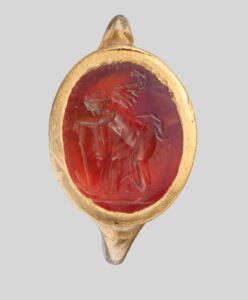
Gold ring with carnelian intaglio: Eros with flaming torch. 1st century BCE- 1st century CE.Ring. The Metropolitan Museum of Art, New York.
Gold ring with carnelian intaglio: Eros with flaming torch. 1st century BCE- 1st century CE. The Metropolitan Museum of Art, New York. 74.51.4233. The ring which Ovid gave his girlfriend would have looked something like this. Ovid does not specify the engraving featured on the gem but considering the sexual content of the poem an engraving of Eros would be very fitting. 

Ovid claims that the ring is made from materials  “in which nothing ought to be assessed except the love of the giver” (censendum nil nisi dantis amor, 2.15.2) to assert that the worth of the gift is dependent on the giver. Ovid intends the real gift to be the poem (James, 226) and his loyalty. The poem goes with the ring to outline the reasons that Ovid has sent it. In addition to this, he stresses the connection between his girlfriend and the ring, calling it “lucky” (felix, 2.15.7) because it will touch her. The ring’s function is to win over the beloved with flatteries and convince Ovid’s girlfriend to accept his loyalty. On the surface, Ovid does not appreciate the distance between him and his girlfriend, but it really allows him to express his desire and loyalty for her through the poem and fantasy. Ovid will undergo a metamorphosis, becoming the ring, which allows him to express his loyalty and the physical relationship that will come after her promise.

The first thing that Ovid does when he turns into a ring is come and fall into her breast (inque sinum mira laxus ab arte cadam, 2.15.14). Now Ovid is able to use the ring as more than a symbol of his loyalty. He can exert his agency and touch the beloved for his pleasure. With the metamorphosis, Ovid shows his true estimation of his loyalty. A poem previously serious becomes playful through the ring metamorphosis fantasy, and erotic through Ovid’s physical connection with his girlfriend as a ring. These ideas change the mood of the poem to one that is intended to thrill the audience.

Next, Ovid switches back into his promises of loyalty, revealing that the ring is a signet ring. Signet rings were used to seal documents and identify individuals with different engravings (Weingarten, 2021). Ovid, as the ring claims, that he will seal “secret tablets” (arcanas tabellas 2.15.15), meaning love letters sent by his girlfriend (McKeown, 323). However, Ovid makes it clear that he will  “not sign a message painful to [him]” (ne signem scripta dolenda mihi, 2.15.18), meaning love letters sent to other men. At this point in the poem, Ovid has shown that he wants to be loyal to his girlfriend, although he has not explicitly stated that this is the purpose of the gift. Now he begins to ask loyalty from her in return. Ovid’s refusal to seal a message would require his girlfriend to be faithful by not allowing her correspondence with other men. Ovid also claims that, “if [he] will be given to put in the box, [he] will refuse to go” (si dabor ut condar loculis, exire negabo, 2.15.19). If Ovid is put in a jewelry box, he cannot see what the beloved is up to. Ovid wants to be with his lover always because he is loyal. But furthermore, he also wants to test his lover’s loyalty by seeing her interactions with other men when he is worn throughout the day. If she keeps and wears the ring, she will be faithful to him, but if she puts him in her jewelry box, she is seeing other men.

Martial, a poet who writes short poems used as gift tags, writes from the perspective of a jewelry box, , “often a heavy ring slips from greasy fingers, but your ring will find safety in my trust” (saepe gravis digitis elabitur anulus unctis / tuta mea fiet sed tua gemma fide,  Epigrammata 14.123). The giver wishes that the recipient will use their gift and that the bond between the two individuals will benefit from the gift. This is the role of any gift: to express appreciation for a relationship between two individuals, whether platonic or romantic. Ovid uses the modest cost of the ring to argue for its continuous presence on the beloved’s finger (McKeown, 325). He claims that  “[his girlfriend’s] tender finger would not refuse to bear [his] weight” (tener digitus ferre recuset onus, 2.15.22). Ovid says this mainly to keep himself out of the jewelry box, but also to claim that his love will not be oppressive. He also claims that “[he] would not be repulsive to you, [his] life” (non ego dedecori tibi sum, mea vita, futurus, 2.15.21). The ring, although as discussed above, did not cost much, would have been well-made and beautiful for the beloved to wear. In Rome, a guild of craftsmen created different rings for jewelers to sell (Kiernan & Henz, 998), but throughout the empire, even local ring makers selling cheaper jewelry made from copper alloys created fashionable rings. Ovid transitions back into a sexual content, suggesting that his girlfriend wear him as the ring “when [she] bathe[s] [her] body in warm showers” (cum calidis perfundes imbribus artus, 2.15.23). With the removal of her clothes, the sexual fantasy takes over the poem. Next, Ovid states that “[he] think[s], [his] limbs would rise with lust at [her] nakedness/ and [he], as that ring, will fulfill the man’s role” (puto, te nuda mea membra libidine surgentet peragam partes anulus ille viri, 2.15.25). This is a very vivid image, even for the Amores. This description is the climax of the poem and stresses Ovid’s wish for this poem to be received lightly before he changes back into a man and returns to the address of the ring.

After returning to his human form, Ovid tells the ring to  “go, small gift” (parvum proficiscere munus, 2.15.27). He has one last request for the ring, which is to make sure his girlfriend knows the meaning of the poem and gift. In the last line, he summarizes the purpose: “let her feel that my loyalty is given with you” (illa datam tecum sentiat esse fidem 2.15.28). Ovid’s loyalty to his girlfriend is the reason for the gift.

While Ovid makes a claim for loyalty in this poem, he is certainly not throughout the corpus of the Amores. Two of his poems are dedicated to Cypassis, a maid of Ovid’s girlfriend. When she discovers their secret, Ovid asks  “Yet surely I did not blush? Surely, I did not slip in any word to surrender a guilty mark of our secret sex?” (num tamen erubui? num, verbo lapsus in ullo/furtivae Veneris conscia signa dedi? 2.8.7). While Ovid asks his beloved for loyalty and promises his own in this poem, his loyalty might be circumstantial. Ovid’s girlfriend is also found to be unfaithful when Ovid tells her  “I do not object, that you do not transgress, since you are beautiful/ but that it should not be necessary for miserable me to know it/ I am not a censor who orders you to become chaste/ but nevertheless I ask, that you try to conceal it” (non ego, ne pecces, cum sis formosa, recuso/ sed ne sit misero scire necesse mihi/ nec te nostra iubet fieri censura pudicam/ sed tamen, ut temptes dissimulare, rogat, 3.14.1). While Ovid asks for his girlfriend’s loyalty, he is aware that she cannot fully give it. In the same way, his loyalty cannot be fully given because he himself is unfaithful. Even so, he tells his beloved that the ring is a symbol of his love, and by promising loyalty, even conditionally, he demonstrates his playful take on elegiac poetry.

Ovid takes loyalty the most trivially out of all the elegiac poets. Propertius, an elegiac poet and predecessor of Ovid, rebukes a woman who tries to flirt with him, telling her that she cannot break the loyalty he has for his girlfriend,  “and the more by which you fight to weaken our love/ the more it fails with this loyalty having been undertaken by both of us” (quo magis et nostros contendis solvere amores/ hoc magis accepta fallit uterque fide, Propertius 1.4.15). Propertius makes the same claim as Ovid, that both he and his girlfriend are loyal to each other. However, when presented with the opportunity to have sex with another woman, Propertius turns it down. In contrast, and as discussed before, Ovid is willing to sleep around, even with his girlfriend’s maid. Instead of focusing the whole poem on loyalty, Ovid focuses on a sexual fantasy in order to thrill his girlfriend as well as readers of the poem.

This poem was written to incite readers with its erotic content. Ovid stakes his claim on literary criticism and allows himself to trivialize the ring and the loyalty that goes with it. Catullus, a predecessor and model for Ovid and Propertius’ poetry, states that well-written  “[poems] are able to incite longing” (et quod pruriat incitare possunt, Catullus, Carmina, 16.9). The distance between Ovid and his girlfriend creates a desire that is explored through Ovid’s fantasy as a ring. The sexual aspects of the poem are surely meant to incite desire and intrigue the audience. The ring is a symbol of loyalty, but one that is not taken too seriously through the sexual scenes in the poem. Ovid, as a lover and a poet, understands the nuances of his relationship with his girlfriend. Playfulness allows Ovid to come and go to the beloved as he pleases, and the ring will always be a reminder of loyalty but never a burdensome one.

Bibliography

James, Sharon L. “The Economics of Roman Elegy: Voluntary Poverty, the Recusatio, and the Greedy Girl.” The American Journal of Philology 122, no. 2 (2001): 223–53.

Kenney, Edward John, and Stephen Hinds. “Elegaic poetry, latin.” Oxford Classical Dictionary. 22 Dec. 2015; Accessed 18 Dec. 2025. Kenney, https://oxfordre.com/classics/view/10.1093/acrefore/9780199381135.001.0001/acrefore-9 780199381135-e-2376.

Kiernan, Philip, and Klaus-Peter Henz. “Rings from the Forbidden Forest: The Function and Meaning of Roman Trinket Rings.” Journal of Roman Archaeology 36, no. 1 (2023): 73–95. https://doi.org/10.1017/S1047759423000211.

McKeown, J. C. and Ovid. Ovid, Amores : Text, Prolegomena, and Commentary. ARCA, Classical and Medieval Texts, Papers, and Monographs 20. F. Cairns, 1987.

Weingarten, Judith. “seals, sealstones, and signet rings.” Oxford Classical Dictionary. 7 Mar. 2016; Accessed 17 Dec. 2025. https://oxfordre.com/classics/view/10.1093/acrefore/9780199381135.001.0001/acrefore-9 780199381135-e-5776.

Three Lessons from Plutarch

Maia Lindsay (Dickinson ’28) reads Plutarch’s Lives of Caesar and Cicero and finds that, for all the flaws in the “great man” view of history, stories like those told by Plutarch do have some merit. They show what a single person is capable of, for good or for ill, and remind us that we’ll never be remembered for all the things we don’t do.

In Homer’s Iliad, the warriors and women of the tale inhabit a world practically unrecognizable to us today, one where rivers talk, wealth is measured in tripods, and claiming descent from a god is the equivalent of having the last name Smith. These people are not even physically like us, we are told – they are greater and stronger than we will ever be. In a typical passage, the warrior Ajax easily hurls a stone “so enormous that a man could scarcely lift it, even with both hands, even a very sturdy, strong young man – of modern times.” (Iliad 12.468–71).

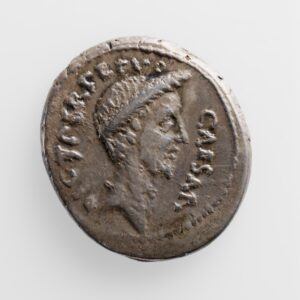
Denarius, 44 B.C. Obverse: Head of Caesar. Inscribed: CAESAR DICT PERPETVO.
Denarius, 44 B.C. Obverse: Head of Caesar. Inscribed: CAESAR DICT PERPETVO. Getty Museum.

It might be tempting to think of the men of Plutarch’s Lives in the same way as Homer’s warriors: remote, mythologized, and larger than life. The names of Caesar and Cicero have remained so familiar to us over the years that their names have practically outlasted their humanity. Unlike some of Homer’s heroes, however, these men were not half-god. And quotes about history repeating itself aside, human nature has not changed all that much in 2,000 years. Plutarch wrote his Lives – biographies of the greats of the ancient world – to record history, but also to pass down the lessons that could be learned from others’ successes, and perhaps just as importantly, failures. Two men who were overtaken by ambition and died by murder may not be the role models we seek in the modern age, but we can still find questions (and answers) in Plutarch’s text that resonate with us today.

Can being too trusting of others be a weakness?

Any discussion of misplaced trust in ancient Rome should probably begin with one of the most famous betrayals in history, immortalized for us today by the words, Et tu, Brute? (Shakespeare, Jul. Caes. 3.1 85). While Plutarch’s Caesar does not speak, the betrayal is hardly less dramatic: “Some say that Caesar fought back against all the rest, darting this way and that to avoid the blows and crying out for help, but when he saw that Brutus had drawn his dagger, he covered his head with his toga and sank down to the ground.” (Plut. Caes. 66). We cannot know whether Caesar actually exclaimed something or played dead like a possum, but in each variation of this story, one thing is the same: of all the betrayals Caesar faced on that day, the knife of Brutus was the one he couldn’t endure.

“Fate, however, seems to be not so much unexpected as unavoidable,” Plutarch remarks as he begins his account of Caesar’s assassination on the Ides of March (Caes. 63). One does not have to believe in the ancient understanding of fate to understand the message: someone with eyes could have seen what was to come. Brutus had not begun as a great ally of Caesar, and his rise to be “a person in whom Caesar had particular trust” (62) was fast and unlikely.

Four years before Caesar’s assassination, Brutus had been among the army facing down Caesar at the Battle of Pharsalus. After a victory that would prove to decide the civil war, Caesar walked into the enemy camp with the lives of many prominent Romans in his hands. As throughout the war, however, he chose not to be a vengeful victor. He freely gave out pardons that day, including to the man who would one day end his life. Reportedly, he even sought him out especially: “It is said that Caesar was very distressed when Brutus was not to be found, and that he was particularly delighted when, in the end, he was brought to him alive and well.” (46)

Forward several years, to the end of the war in 45 BCE, and Caesar’s mercy proved to extend beyond sparing lives. In the aftermath of the U.S. civil war, it’s hard to imagine Ulysses S. Grant appointing former Confederate generals to his Cabinet, but that was what Caesar chose to do. Brutus and another former adversary Cassius were made praetors that year, and Brutus was on track to be consul in three years, the highest office in the old Roman hierarchy (62).

Caesar apparently desperately wanted Brutus to be on his side and allowed that want to deceive him as to the reality. Indeed, Brutus did resist efforts to pull him into a plot at first, torn by all he owed to Caesar – his life, most of all – but in the end, he had the quality the Romans were most looking for: “[h]e was thought to be, on his father’s side, a descendant of the Brutus who had abolished the monarchy.” (62) They needed a king-killer, and here was their man. By the time Caesar walked into the senate on the Ides of March, those who were inciting Brutus against him had won, and he was none the wiser.

Cicero, too, experienced his share of betrayals. The politician and demagogue Clodius appears as a dark smudge across a number of Plutarch’s Lives, notably causing Caesar’s divorce from his second wife, Pompeia (Caes. 10). Clodius was, in fact, a friend of Cicero’s, but when Clodius went on trial for “perjury, fraud, bribing the people and seductions of women,” Cicero abandoned him and testified against him (Cic. 29). Clodius won acquittal anyway (likely through bribery), but he did not forgive the betrayal. Once he won election to a tribunate, he had a position from which to act and began his mission to bring Cicero down. Cicero, seeing that the winds were against him, sought a way to get out of Rome until Clodius’ term finished. Before he could skip town, however, Clodius intervened. He wanted a reconciliation, or so he claimed: “[he] made the most friendly remarks about him, giving the impression that he[…] had nothing against him except a few minor complaints which one friend might make of another.” (30) Cicero fell for the bait, and he declined his post on Caesar’s campaign to Gaul. Too late, he realized the trap laid for him. Clodius made Cicero’s life miserable in Rome before driving him into exile for real, with an “edict that he should be refused fire and water and that no man should give him shelter within 500 miles of Italy.” (32) Cicero managed to return to Italy after 16 months, but one would expect that a lesson had been learned.

Instead, one might say that Cicero laid the second trap for himself. In the aftermath of Caesar’s assassination, the dictator’s right-hand man Antony was on the ascendant, who was wary of Cicero and alarmed by his continued influence in Rome. Reassured by the election of the sympathetic consuls Hirtius and Pansa, however, Cicero chose once again not to leave Rome when it would have been wiser for him to do so (43). Then when Caesar’s heir and Antony’s natural competitor Octavian arrived in Rome, Cicero saw his chance. He could oppose Antony and wield this young man’s power to his own advantage with a simple bargain: “Cicero was to use his powers of oratory and political influence on Caesar’s behalf in the senate and before the people, and Caesar with his wealth and armed forces was to guarantee Cicero’s security.” (44) The deal worked – for a time. Once Cicero had helped Octavian win the consulship, however, he soon became disposable. He had “allowed himself to be carried away by the words of youth,” and now he realized, too late, “that he had ruined himself and betrayed the liberty of his country.” (46)

Octavian now ran into the arms of his former enemy Antony, as well as Lepidus, and the three together “divided the government[…] as though it were a piece of property.” (46) In their three-day conference near Bononia, they drafted the infamous proscriptions, with “more than 200 men who were to be put to death.” (46) Antony’s very first demand, unsurprisingly, was for the death of Cicero. Like Brutus before him, Octavian initially resisted, but when he weakened on the third day Cicero’s fate was sealed. “[A]ll considerations of humanity,” Plutarch says, “were swept aside by their rage and fury.” (46) Even when Cicero got wind of the proscriptions, however, he seemed reluctant to believe it of the young man who had reportedly called him “father.” (45) Describing his hesitation to flee and fateful delays, Plutarch wonders if “he had not yet entirely lost his faith in Caesar.” (47) Whatever faith he had, it proved fatal.

I would like to be able to disagree with the lesson imparted here. No one wants to be cynical, and unwilling to trust their fellow humans. However, as I myself have made the error of giving back my trust to a friend who had not earned it back, I can very well understand the risks. I have since learned caution, and I think that is a good thing.

On the other hand, trust is necessary to any sort of compromise, without which no government or society can properly function. Both Caesar and Cicero achieved much of what they did by acting with moderation and being open to cooperation with their political adversaries. A middle course, then, must be necessary: trust others, but be wary of those who have not actually done anything to earn the trust placed in them. The histories of Brutus, Clodius, and Octavian all should have been cause for reasonable doubt – however, as I can attest, this is easier said from a distance. Sometimes, the only way to learn is through mistakes – even fatal ones.

When is it right to give up freedom for stability?

Fans of Jean-Jacques Rousseau or other Enlightenment-era thinkers may be familiar with the concept of the social contract, the founding principle of governments, whereby individuals give up some part of their freedom in exchange for the protection of laws.

More than a millennium separated Rousseau from Plutarch, but the recurrence of this question goes to show just how fundamental it has been for human history. Plutarch was not concerned with the origin of government, however, but with the nature of government. Rome, unlike almost every other civilization before or after up to the last 200 years, was not a monarchy. Ask any Roman, and they’d tell you they very much wanted to keep it that way. Rome was not free from the institution of absolute power, however, as within their constitution they had a system in place for times of crisis, where a “dictator” would be appointed for a short period (usually six months) and bring the stability of one-man rule until things settled down.

The general Roman answer, then, was that freedom sometimes had to be ceded in the short term in the interest of stability, but with the expectation that constitutional norms would be restored in time. The problem, as Rome crept ever closer to civil war, was that adherence to constitutional norms was growing increasingly rare. Even elections, the very foundation of the system, were failing, as “candidates for office quite shamelessly bribed the electorate, actually counting out the money in public, and the people who had received the bribes went down to the forum not so much to vote for their benefactors as to fight for them with bows and arrows and swords and slings.” (Caes. 28)

The current governmental system was clearly nearing collapse, and so the question at that point was whether the ruling class would be willing to sacrifice its own power to save it. It was not clear that anyone appointed dictator at that point would give back power once it was handed to him – Rome’s powerful men had grown too powerful to trust in their goodwill. But “intelligent people,” as Plutarch reports, “could only be thankful if, after such a mad and stormy period, things ended in nothing worse than a monarchy.” (28) Many eyes were on the great general Pompey, who, Plutarch claims, “put on a show of declining the honor, but in fact did more than anyone else to get himself made dictator.” (28) Cato, one of the most ferocious republicans in the senate, sought a slightly more palatable solution and successfully had Pompey appointed sole consul instead, hoping that would be enough to hold Rome together without the senate having to abandon its power (28).

It was not. One powerful man might be a recipe for peace, but two is not, and Caesar was still on the loose. Civil war arrived when the senate was unable to produce an agreement for mutual disarmament between Pompey and Caesar (30). Idealism was rapidly abandoned as everyone was driven into the arms of one would-be dictator or another: Cicero, who reluctantly took the side of Pompey, “said he would rather follow in Caesar’s triumphal procession, if only matters could be settled satisfactorily.” (Cic. 37) And when the war ended with Caesar’s victory, the war-weary Romans largely “accepted the bit” (Caes. 57) – if this was what was necessary to have peace, they would take it. The man might be different, but their logic was the same as it had been with Pompey: “The rule of one man would give them, they thought, a respite from the miseries of the civil wars, and so they appointed him dictator for life.” (57)

As it happened, the civil wars ended not with Caesar but with his heir, Octavian, who was first to claim the imperial throne, and thus brought about the final demise of the republic. Rome was secure again, if not quite as free as they had been.

The imperial experiment worked out extremely well for Rome – the nation that had been on the verge of collapse went on to survive for another 500 years. (If you count the Byzantine Empire as the successor to Rome, you could even argue it lasted another 1500 years.) Rome has not been the only nation to make this bargain, either. England had an 11-year republican experiment after its own civil war, but as soon as the government fell into disarray, the people invited their monarch back. Nevertheless, the abandonment of a free government for absolute rule by an individual is a sacrifice that many people today (including myself) would not applaud. Can there be a lesson here, then? Perhaps. In Plutarch’s world, those who were willing to accept this compromise succeeded. We can decide whether they succeed in ours.

Can justifiable fear be worthwhile?

For this question, the two figures of Caesar and Cicero offer perfect counterpoints to each other, as they are each shown to have very different relationships to fear.

According to Plutarch, Cicero’s “reputation for courage among the people of Rome was not in any case a very high one.” (Cic. 19) Plutarch describes a particular incident where Cicero was serving as the defense for a man named Milo, who was being prosecuted for a prominent murder (35). Under directions from the senate to ensure no disturbances happened at the trial, the general Pompey had his soldiers posted around the forum the night before the trial. Milo knew that Cicero “lacked courage at the sight of armed men,” (35) and so he convinced him to be carried in on a litter so he would not see them and lose his confidence to speak. He spotted them anyway as he emerged from the litter, and, as Plutarch reports, “his body shook, his voice faltered and he could scarcely begin his speech.” (35)

On another occasion, when elections were being held during Cicero’s term in office, he showed up to preside wearing a breastplate under his clothes out of the fear of electoral violence (14). Plutarch even reports, shockingly for one with such a great reputation as an orator, that Cicero was “always timid at the beginning of a speech and in many trials scarcely stopped quivering and trembling even when he had really got going and was at the height of his eloquence.” (35)

Finally, there are the events leading up to Cicero’s death. After the news of the proscriptions reached him, Cicero wasted days in indecision, moving to flee, then retreating, and then turning to flee again. Plutarch suggests that some of this, or perhaps all of it, may have been motivated by fear. The night before what was to be his final move, to his estate at Caieta, Plutarch tells us that “he passed a night with his mind full of terrible thoughts and desperate plans. He actually decided to go secretly to Caesar’s home and kill himself there on the hearthstone, so as to bring a curse from Heaven upon him; but fear, the fear of torture, turned him from this course also.” (47) The next morning, he left for good, but it would be too late.

For most of his life, Caesar was the complete reverse of Cicero. He seemed to hold very little fear for his life, or at least was able to control it well. The Life of Caesar is full of examples of his daring on the battlefield, where “he showed that there was no danger which he was not willing to face.” (Caes. 17) He did not hesitate to fight at the frontline of battle alongside his men, on foot, putting himself in as much peril as any of them. The most dramatic example of this is from a battle against the Nervii tribe in Gaul, where “[i]n all probability the Romans would have been destroyed to the last man if Caesar himself had not snatched up a shield, forced his way through to the front of the fighting, and hurled himself on the natives; and if the tenth legion, seeing his danger, had not charged down from the high ground and cut their way through the enemy’s ranks.” (20) In civilian life and government he behaved no differently, and indeed “when Caesar’s friends advised him to have a bodyguard, many of them volunteering to serve in it themselves, Caesar refused to have anything to do with it.” (57)

The contrast between the two men could not be greater, then. However, the Life of Cicero shows Cicero acting courageously exactly once, and that was when the game was up and his death was all but certain. When his designated assassins caught up to him, Plutarch tells us that “[h]e himself, in that characteristic posture of his, with his chin resting on his left hand, looked steadfastly at his murderers.” (Cic. 48) Contrast this with Caesar, who Plutarch describes as spending his lasts moments like a cornered wild animal, “darting this way and that to avoid the blows and crying out for help.” (Caes. 66) Whatever “cowardice” Cicero may have shown in the rest of his life, he made up for it in the dignity of his death.

Still, we end where we began: in the end, both men were murdered. And that, I believe, is precisely the point. Cicero achieved no net gain for being more cautious with his life than Caesar. Caesar’s lack of a guard did not save his life, but neither did Cicero’s hidden breastplate save his. For every outcome that we can prepare for, there are ten more that we can’t.

I don’t believe this should be taken as an argument for anyone to stop wearing their seatbelts or bike helmets, but it’s certainly a reminder that sometimes living in fear only takes away from our enjoyment of the years that we do have. It’s certainly a lesson that I myself would do well to learn. As a younger person, I would have quoted a fictional character here: “My philosophy is that worrying means you suffer twice.” (Fantastic Beasts) However, I think Caesar, through Plutarch, expresses it just as well: “It was better, he said, to die once than to always live in the fear of death.” (Plut. Caes. 57)

That quote, I believe, sums up the argument I would make for every one of the questions I have discussed here. Trusting others might turn around to hurt us, and we should show some caution in who we offer our trust to, but we all have to trust someone, sometime, for society to function. The rule of a single person with absolute power may offer temporary stability, but it requires compromising a hundred other things for the sake of perceived security. Fear can be a useful mechanism for keeping ourselves safe, but no amount of worry will save us in the end.

What then? We focus on the actions that matter, not the consequences that we risk. If death is inevitable, we shouldn’t waste our lives trying fruitlessly to stop it. Caesar and Cicero did not make it into the pages of Plutarch’s Lives for doing otherwise. They didn’t always make the right choices, but they made them. They didn’t always do the right things, but they did them. A Caesar who did not cross the Rubicon would not be a Caesar. A Cicero who didn’t jeopardize his life working against Antony would not be a Cicero.

For all the flaws in the “great men” view of history, stories like those told by Plutarch do have some merit. They remind us what a single person is capable of, for good or for ill. They remind us that we’ll never be remembered for all the things we don’t do.

So, get out there and do something.

Penelope’s Odyssey

Rachel Pistol (Dickinson ’25) looks at two modern re-tellings of the Odyssey from Penelope’s point of view, Milica Paranosic’s opera Penelope and the Geese (2019) and Margaret Atwood’s Penelopiad (2005) and finds that, despite their differences, both acknowledge the complexities of womanhood more effectively than Homer’s original.

In the Odyssey, Penelope is depicted as having several positive qualities, chief among them being her fidelity to her husband, her wit, and her intelligence. However, we as readers see just a glimpse of what she endured during the twenty years that Odysseus was away, and even this is mostly focused on the few years that she was being courted by the suitors. All three of these qualities are shown in the myth through her constant despair over Odysseus’ absence and how she never explicitly accepts any of the suitors’ courtships, trying to delay this through weaving and unweaving Laertes’ burial shroud. However, whether she remained entirely chaste during this time later became a topic of ambiguity (Su 2010). Another significant point in Penelope’s story is her dream in which twenty geese whom she loves are killed by an eagle before the eagle reveals that this dream is a vision, with the geese being the suitors and the eagle being Odysseus (Homer Odyssey 19.540–554). This throws into question why Penelope was distraught over the death of the suitors in her dream, and whether that meant that the geese were not really the suitors but a representation of something else (Levaniouk 2011). Both plot points are integral in Penelope and the Geese and The Penelopiad, two modern works that take their inspiration from Penelope’s story and are both told primarily from Penelope’s point of view. This shift in perspective gives new meaning to these central events, although they are taken in different directions.

John William Waterhouse, “Penelope and the Suitors” (1912). Aberdeen Art Gallery and Museums, Scotland.

Penelope and the Geese is an opera by Cheri Magid told almost entirely from Penelope’s point of view as she reminisces on her time away from Odysseus right before seeing him again. In these twenty years, she has taken many lovers, both male and female, and has taken a lock of hair from each lover to weave into a blanket. Throughout the piece, Penelope debates where to put a lock of hair from Odysseus, leading her to recall several of her lovers and what she learned or how she benefitted from her encounters. At the end of the opera, Penelope is anguished over whether Odysseus will accept that her infidelity does not diminish her love for her husband, nor how much she has missed him over the years. The story ends with Penelope saying “Odysseus, I have something to tell you” (Paranosic 2019 1:09:36) leaving the audience to wonder whether she ultimately decides to tell Odysseus the truth or if she is going to tell him the same stories that the original Penelope in The Odyssey did.

This tale of Penelope’s encounters with the suitors serves to place Penelope and Odysseus on equal pedestals. In The Odyssey, Odysseus has relations with Calypso and Circe, yet it is well established that his goal is to return home to his beloved wife (Homer Odyssey 5.204–224). Rather than frame Penelope as a strictly loyal wife awaiting Odysseus’ return, she also has lovers and, just like her husband, this does not minimize how much she has missed him or her love for him over the period he has been gone. With Penelope being well known in both the ancient myth and modern times for her fidelity, this retelling of the story raises the question of whether this Penelope should still be considered a faithful wife. While Odysseus is not popularly described as a faithful husband, readers of The Odyssey cannot deny his loyalty to Penelope, and I believe the same can be said for Penelope in Penelope and the Geese, especially as Penelope voices very similar thoughts to Odysseus that yearn for a reunification of the couple. The opera manages to take Penelope’s drastically different experiences and, in allowing the audience to hear Penelope’s side of the story, still draws parallels between her and her husband, reaffirming their commitment to each other, even if it is unconventional.

The Penelopiad by Margaret Atwood also tells the events of The Odyssey from Penelope’s perspective, although the similarities between the novella and the opera do not extend far beyond that. Throughout the story, Penelope compares herself repeatedly to Helen, first jealously and later haughtily. Helen serves as Penelope’s foil. Where Helen is beautiful, Penelope is plain; where Helen had many men fighting to marry her specifically, Penelope saw the men fighting to marry her as more concerned with the dowry; where Helen is proud of how many people died because of her and her beauty, Penelope wants to live a quiet life with her husband. While Penelope is compared to Clytemnestra in The Odyssey to highlight her fidelity to her husband, Atwood’s version of Penelope compares herself to Helen to highlight how she might be plain in looks but is great in spirit and mind. This focus of who Penelope is as a person rather than who she is as a wife only becomes clear once Penelope is in control of telling her own story, and depicts the strength that Penelope had throughout the trials she had to endure in the events of The Odyssey.

Like Helen, Penelope does admit that she enjoyed the attention from the suitors, mostly because she found it amusing. She also tells the readers that she occasionally daydreamed about which one she would want to bring to bed, even though she never slept with nor wanted to marry any of the suitors because she did not like them. Beyond simply ignoring or rejecting the suitors, however, Penelope encourages them to continue trying to win her over simply to keep them appeased lest they try to win Penelope by force. This perspective, untold by the original myth, sheds light on how Penelope had to carefully tread the line between encouragement and avoidance with the suitors, and how dangerous she felt the situation was. This is a feeling that many women both in antiquity and today would likely resonate with, and one that is likely only portrayed because Atwood is able to utilize her own experiences and better portray womanhood than the male-centered narrative of The Odyssey.

Another point in which Penelope and the Geese and The Penelopiad diverge concerns Penelope’s dream and its meaning in the larger narrative. In the opera, Penelope dreams of the geese just as she does in the original myth, but her distress is better explained in the context of her various relations with the suitors. Since the opera dedicates much of its time establishing the care that Penelope has for each of the suitors, it makes more sense in this perspective why she is upset at their deaths. In the opera, Penelope sings that she is glad to be engulfed by the geese’s feathers because it means that she is no longer lonely (Paranosic 2019 58:30), further emphasizing her connection to the geese and the suitors they represent. She also draws parallels between the geese’s hearts and her heart, eventually using the phrase “our heart” (ibid 1:00:25), making them seem as one, just as she has done in weaving the suitors’ hair together in her blanket. By allowing Penelope to tell her own story, including her encounters with the suitors, to the audience, we can better empathize with her distress as we know that Odysseus killing the suitors would also be destroying the people who helped Penelope to grow and be happy over the course of her husband’s absence.

As The Penelopiad removes the ambiguity that Penelope has slept with or even cared for the suitors, it makes her dream even more confounding for the audience, until we get to hear of it from this Penelope’s perspective. Since Penelope knew that Odysseus was himself, even in disguise, she actively chose to tell him about her dream as a test (Atwood 2005). Odysseus interpreted the dream in the same way he did in the original myth, but Penelope tells the audience that he was wrong. She narrates that the geese were not the suitors but rather her twelve maids, which is why she was so distraught over their deaths. Throughout the time that Odysseus was away, Penelope developed a strong bond with her twelve youngest maids as they helped her unravel Laertes’ burial shroud every night. They develop inside jokes with each other and grow even closer when many of the maids are raped by the suitors in an effort to get closer with them to gain information. Even when some of the maids ended up falling in love with the suitors, they still relayed information back to Penelope, so she knew what to expect from them, showing their loyalty to her. This makes their death in the novella even more heartbreaking, especially as Penelope blames herself since she kept the maids’ involvement in her schemes a secret to protect them. In allowing Penelope to tell her own story, including the role of the maids and their real motivations behind their actions, it makes their death, already a glossed over event in the original myth, mean more both to Penelope and the wider theme in The Penelopiad of double standards of justice between the genders.

Both Penelope and the Geese and The Penelopiad expand on the events in The Odyssey by utilizing Penelope as a narrator. Through this, both pieces clear up ambiguity in the narrative, although they each take this in different directions. However, both pieces do depict Penelope as a more complicated character, who is put on an equal pedestal with Odysseus in both love and cleverness. This creates a more well-rounded narrative that also acknowledges the complexities of womanhood, especially in the time of the original Odyssey.

Bibliography

Atwood, Margaret. The Penelopiad. New York: Grove Press, 2005.

Levaniouk, Olga. Eve of the Festival: Making Myth in Odyssey 19. Hellenic Studies Series 46. Washington, DC: Center for Hellenic Studies, 2011.

Paranosic, Milica. Penelope and the Geese. Saugerties, 2019.

Paranosic, Milica. “Penelope and the Geese by Milica Paranosic and Cheri Magid.” August 14, 2019. Performance, 1:38:27.

Su, M. “Penelope.” In The Classical Tradition, edited by Anthony Grafton, Glenn W. Most, and Salvatore Settis, 1st ed. Harvard University Press, 2010.

Wilson, E., trans., Homer: The Odyssey. New York: W. W. Norton & Company, Inc., 2018.

Why Did Aeneas Kill Turnus?

Allie Hershey (’25) argues that Vergil subverts our expectations of heroism by not painting Aeneas as a perfectly good Roman. Rather, he portrays him as a realistic role model to Roman citizens. Turnus, on the other hand, while he has many good qualities, represents “force without wisdom.”

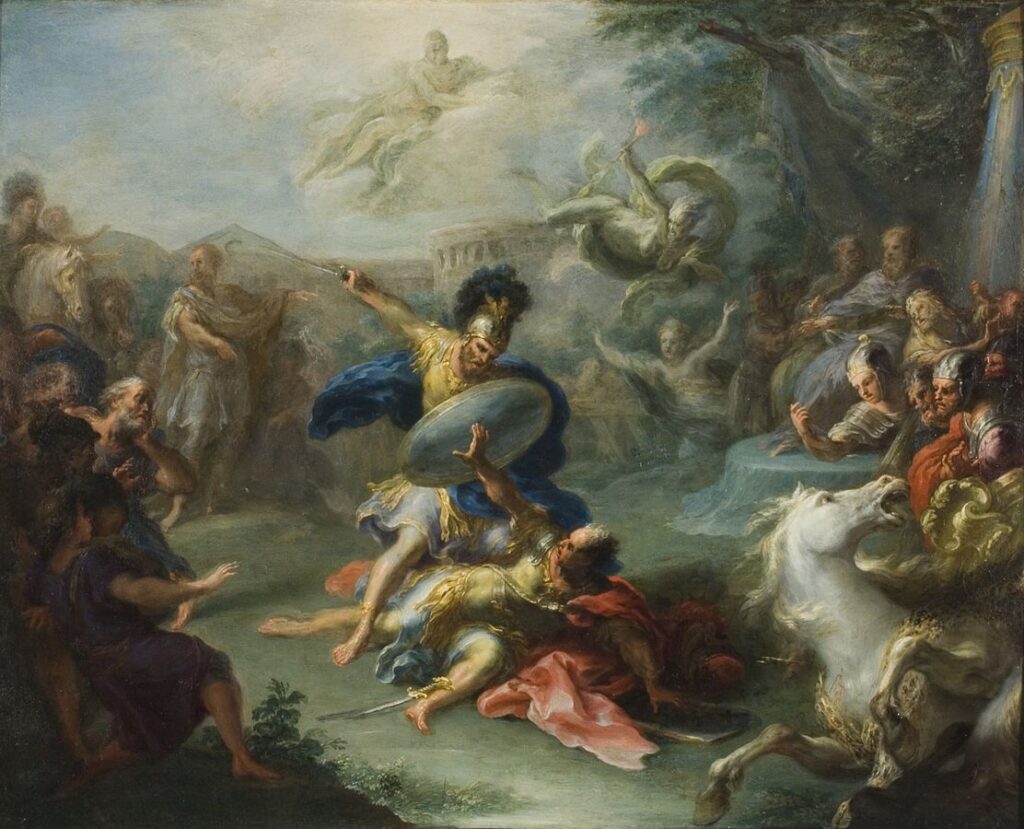
Victorious warrior looms over defeated warrior, surrounded by observers.
Giacomo del Po, “The Fight between Aeneas and King Turnus, from Virgil’s Aeneid” (ca. 1700) Los Angeles County Museum of Art

Vergil, Aeneid 10.491-10.497, 10.500-10.505, translated by Allie Hershey:

“Arcadians,” he says, “remember this and take back my words to Evander,
I return Pallas to him in the way that Evander deserves.
Whatever honor there is in a tomb, whatever comfort is in a burial,
I give freely. His hospitality to Aeneas will come at no small price.
And saying that, he pressed on the corpse with his left foot,
seizing the huge weight of Pallas’ belt.”

Oh, how the human mind is unaware of fate and future fortune and how to show restraint when exalted by success! There will be a time for Turnus, when he wishes to purchase Pallas untouched at a great price, and will hate those spoils and the day.


The Tragic and Powerful Myth of Queen Dido

Lindsay Werner (’25) explores the powerful and passionate language used by Dido as she confronts her faithless lover Aeneas in Book 4 of Vergil’s Aeneid.

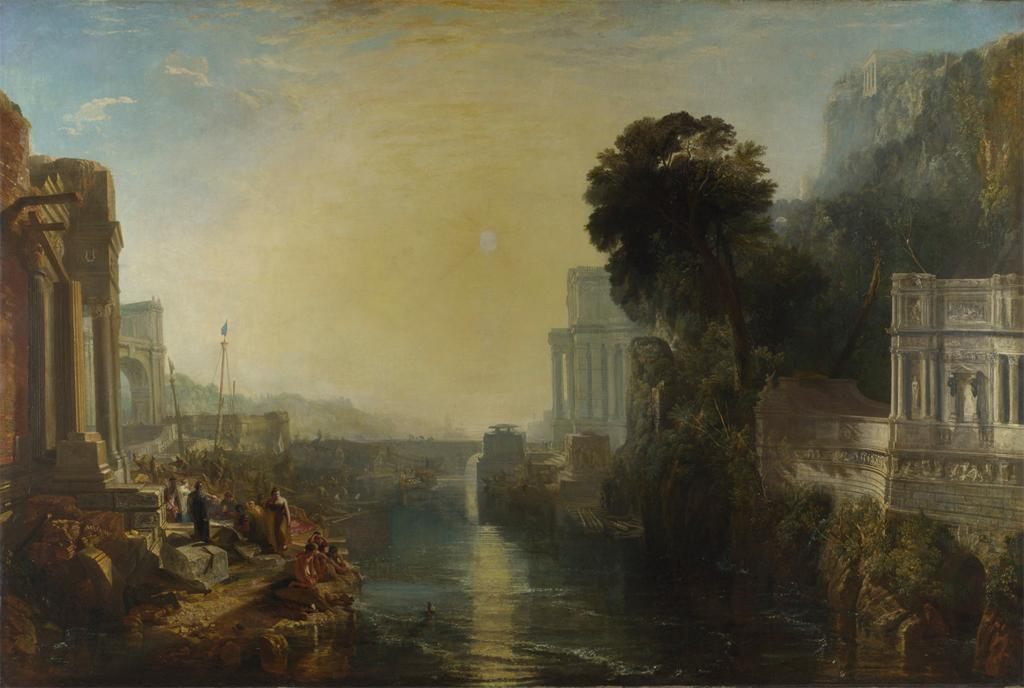
Classical city under construction along the banks of a river.
“Dido building Carthage, or The Rise of the Carthaginian Empire,” Joseph Mallord William Turner (1815). National Gallery, London.

Vergil, Aeneid 4.365–370, 373-376, 382-387, translated by Lindsay Werner:

You do not have a goddess as your parent, nor is Dardanus the founder of your line, treacherous man; but the Caucasus teeming with hard crags produced you and the Hyrcanean tigresses moved their breasts towards you. For why do I pretend, or what greater things do I hold myself back for? He has not groaned with (respect for) my weeping, has he? He has not turned his eyes, has he? He hasn’t cried tears having been won over, or pitied his lover, has he?

Trust is safe nowhere. Having been expelled onto the shore, I received the needy man, and I placed him in a part of my kingdom insanely; I brought back (his) lost fleet, I brought back the comrades from death. Oh inflamed I am being carried by frenzy!

Indeed I hope that, if the pious gods have any power, he will drain the cup of punishments in the middle of the rocks, and that he will often call out Dido by name. Being away I will follow with black fires, and, when cold death has severed my limbs from my soul, my ghost will be present in all places. You will pay the price, wicked man. I will hear and this rumor will come to me under the deepest shades (the underworld).

Unraveling Turnus—The Tragic Hero of Vergil’s Aeneid (7.435-463)

Sarah Tessler (’25) examines the scene in the seventh Book of the Aeneid in which the fury Allecto infects Turnus with war frenzy. Through Turnus’ character arc, she argues, Vergil emphasizes the devastating consequences of conflict, including a loss of individual identity, and the inevitable cycle of violence and suffering.

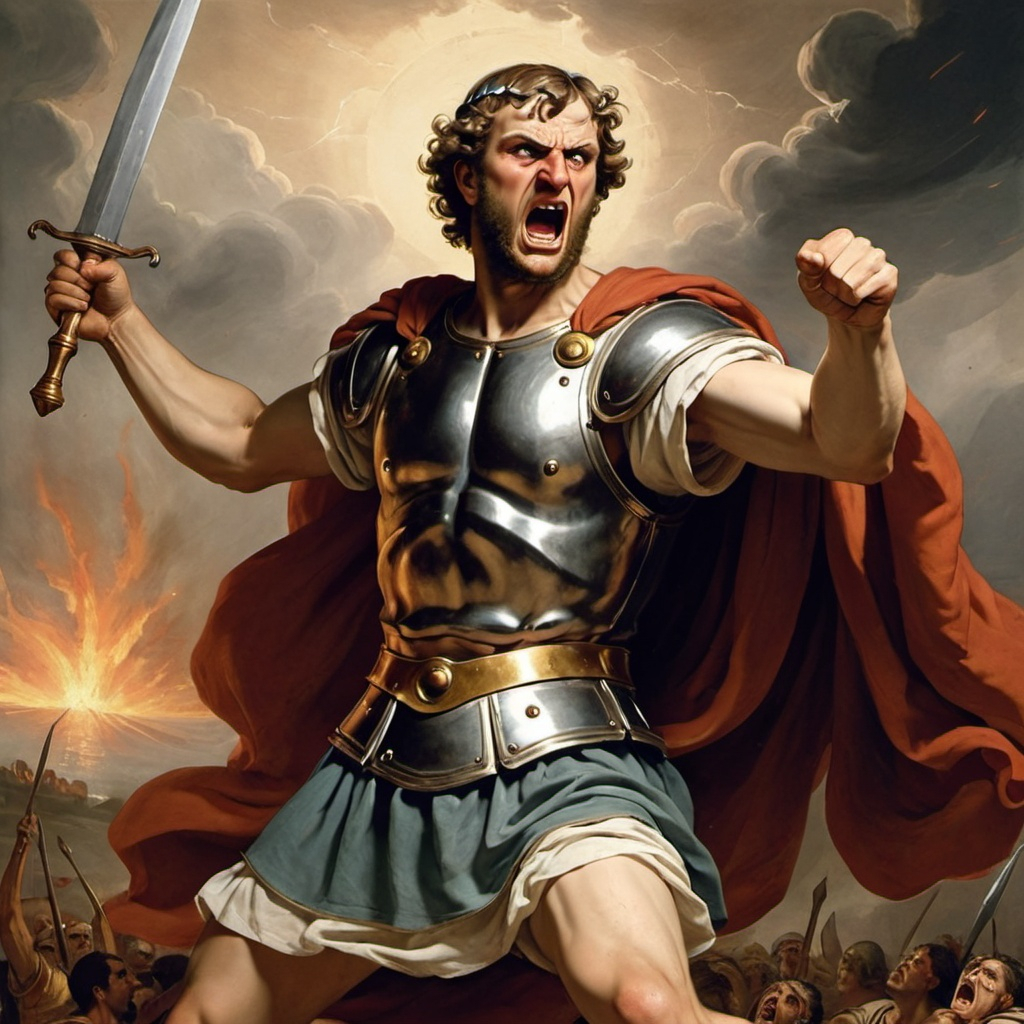
Warrior in Roman armor brandishing sword and shouting
Image generated using AI by Sarah Tessler

Hic iuvenis vatem inridens sic orsa vicissim                    435
ore refert: ‘classis invectas Thybridis undam
non, ut rere, meas effugit nuntius auris;
ne tantos mihi finge metus. nec regia Iuno
immemor est nostri.
sed te victa situ verique effeta senectus,                           440
o mater, curis nequiquam exercet, et arma
regum inter falsa vatem formidine ludit.
cura tibi divum effigies et templa tueri;
bella viri pacemque gerent quis bella gerenda.’

olli somnum ingens rumpit pavor, ossaque et artus
perfundit toto proruptus corpore sudor.
arma amens fremit, arma toro tectisque requirit;           460
saevit amor ferri et scelerata insania belli,
ira super:

At this, the young man, mocking the priestess,
replied in turn: “The news of the fleet having arrived into the Tiber’s waters
has not escaped my ears, as you suppose.
Do not imagine so many fears for me; nor
is Queen Juno forgetful of us.
But old age worries you, worn out by decrepitude and truth
O Mother, it pointlessly occupies [you] with cares
It deceives the priestess with false fears amidst the arms of kings
Men wage wars and peace, by whom wars must be waged.

A huge fright broke his sleep, and sweat
perfused from every limb.
Frenzied, he howled for arms; and looked for the hidden arms in couches;
the love of arms and the wicked madness of war raged,
anger above all. [trans. Sarah Tessler]


The Sacrifice of Palinurus (Aeneid 5.851-871)

Lucian Kapushoc (’25) discusses the meaning of the Palinurus episode at the end of the the fifth Book of the Aeneid, assesses two recent translations, those of Robert Fagles (2006 and Sarah Ruden (2021), and provides his own translation.

sketch of a crumbling grave monument overlooking the shore of the Mediterranean
Engraving by Wilhelm Gmelin (1760 – 1820) Cénotaphe de Palinurus

talia dicta dabat, clauumque adfixus et haerens
nusquam amittebat oculosque sub astra tenebat.
ecce deus ramum Lethaeo rore madentem
uique soporatum Stygia super utraque quassat 855
tempora, cunctantique natantia lumina soluit.
uix primos inopina quies laxauerat artus,
et super incumbens cum puppis parte reuulsa
cumque gubernaclo liquidas proiecit in undas
praecipitem ac socios nequiquam saepe uocantem; 860
ipse uolans tenuis se sustulit ales ad auras.
currit iter tutum non setius aequore classis
promissisque patris Neptuni interrita fertur.
iamque adeo scopulos Sirenum aduecta subibat,
difficilis quondam multorumque ossibus albos 865
(tum rauca adsiduo longe sale saxa sonabant),
cum pater amisso fluitantem errare magistro
sensit, et ipse ratem nocturnis rexit in undis
multa gemens casuque animum concussus amici:
‘o nimium caelo et pelago confise sereno, 870
nudus in ignota, Palinure, iacebis harena.’

At the end of the fifth Book of the Aeneid Palinurus, after being assigned by Aeneas to the vital job as helmsman for the lead ship in the fleet, falls victim to sleep and goes overboard. Clutching a fragment of the ship he shouts back in vain as he drifts off. After belatedly realizing that Palinurus has been lost, Aeneas takes the helm himself as he mourns the loss of his pilot. The last description of Palinurus is of his dead body lying unburied on an unknown shore (Virgil 5.852-872). The death concludes the seafaring portion of Aeneas’s journey but Palinurus’s presence in the story is not limited to his finale. His loss at sea fulfills a hidden promise made by Neptune that the fleet would reach Italy safely with only one crew member lost (Virgil 5.814–815). His earthly form did end up making it to shore but he was then knifed by bandits and left for dead (Virgil 6.359–361). His final fate was revealed by the Sibyl in the underworld when Aeneas is trying to cross the River Acheron, and Palinurus shows up on shore among the crowd of unburied souls (Virgil 6.337). He laments his fate and asks for passage across the river, but the Sibyl scolds him and assures him that someone would come and bury him. Palinurus delights when he finds out he will enter the underworld and that the beach he died on will be named after him.

Palinurus’ death occupies a significant place at the midpoint of the story, between land and sea, at an important turning point in Aeneas’s journey (Quint 50). With his sacrifice Virgil both emulates and contradicts Homer (Quint 1993: 91). On the one hand, Palinurus drifts through the open sea just as Odysseus did.On the other hand, Odysseus was the sole survivor of his crew, while Aeneas loses only one crewmember. While Odysseus had to give up his entire crew to get home, Aeneas had to give up Palinurus, and took his place as leader at the helm (Quint 1993: 89). If Palinurus is accepted as a stand-in for Aeneas, it also fulfills a divine plea from Dido that Aeneas be plagued by hardship and die prematurely, “unburied on some desolate beach” (Virgil 4.609–620). Palinurus, Creusa, Anchises, and Dido are some of the losses Aeneas and the Trojans sustain during the transition from Troy to Italy.

We are not meant to blame Palinurus for forsaking his duty but rather asked to see him as a victim of a cosmic fate over which he had no control. His devotion to his post and to Aeneas is shown by the broken fragment of the ship he still clings to in the water. Sacrifices such as this were meant to reaffirm the relationship between gods and humans. They paradoxically serve as reassurance that the gods are still on Aeneas’s side and his journey is still fated (O’Hara 2014: 112).  It’s not all bad for Palinurus, either. He is promised a burial and entrance into the underworld and he delights when The Sybil tells him that the beach he died on will forever be named after him. The place in Italy is still called Capo Palinuro.

Two good contemporary translations are those of Robert Fagles (2006) and Sarah Ruden (2021), who have both published impressive editions of The Aeneid unique in style and tone. In his translation Fagles balances the hopeful fate of the Trojans with sympathy for the native Italians who suffer their invasion. His tone bears strong narrative emphasis, encapsulating the themes of epic poetry and manifesting them in a world where epic poetry is no longer as common and esteemed as it used to be. The most notable aspect of Sarah Ruden’s version of The Aeneid is how she has formatted it to keep each line roughly a complete thought. This forces compression in words and ideas due to the differences between Latin and English (Ruden 2021: xxviii). The shortness helps maintain the elevated tone of The Aeneid that is absent in many other versions. The translation is as versatile as is required for such a story and retains many of the literary themes that Virgil made rich use of such as enjambment and speed. A translator’s style is present throughout the entire work and sets each version apart from the others. The coverage of a segment such as Palinurus will be equally unique.

Fagles’ style puts the reader right next to Palinurus using ecce as the imperative watch (Virgil 5.854). This creates a more personal tone that invests the reader into the fate of Palinurus with a natural buildup of suspense. The natural phenomenon of sleep is personified as a god and Palinurus’s fall happens as fast and as suddenly as one would pass out from exhaustion. The tragic undertones of the episode are realized with the direct translation of nudus as naked to complete the indecent and pitiful picture of Palinurus’ fate (Virgil  5. 872). Fagles does a good job of creating sympathy for Palinurus and then compensating equally with his eventual happy ending. Ruden provides a similar bystander perspective of the event in line for line verse which results in a more broken up sequence as to keep each line similar to its counterpart in The Aeneid and to stay within the meter. Her sentences start and stop as abruptly as one’s thoughts when battling fatigue. She discards ecce for a more impersonal tone fitting an independent reader (Virgil  5.854). Nudus turns into unburied to further lament Palinurus’s state, deprived of the proper rites and treatments of a valued member of Aeneas’s crew (Virgil 5.872). Changes in tone between versions likewise change the atmosphere and feeling in episodes like Palinurus without changing the core subject matter. Translations can make the experience more personal like Fagles or emphasize or more stoic and mythic like Ruden.

I translate as follows:

Thus he spoke to himself and Palinurus kept his hands stuck to the helm and his feet planted to the deck, rooted in place with his gaze fixed on the stars.

Hark, Sleep descends upon from on high wielding a sleepy branch, dripping with Lethaean dew and twilight power, which he waves over the temples of our oblivious helmsman; who struggled in vain as his swimming eyes began to ease.

Unanticipated weariness had already relaxed his body when Sleep, leaning over him, loosened his arms from the helm and pushed him headfirst over the rail into the rolling sea. Clutching hard onto the part of the stern he ripped off with him, Palinurus shouts in vain to his comrades back on the ship as Sleep flies off into the thin breeze.

The unaffected fleet runs its unchanged course over the sea just as Neptune had promised.

Here, the Sirens’ Rocks, once dangerous and stained white with the bones of countless sailors, now ring far and wide with the unending surf; And Father Aeneas, feeling his ship to float freely with no pilot, grabs the wheel, and guides the fleet across the midnight sea. He groans, shaken by the death of his comrade.

‘Oh Palinurus, you trusted too much in the sea and stars, and now your body will lie bare and unburied on an unnamed shore.’

My version aims to retain the personal and narrative tone that I like in Fagles with increased alliteration. The maritime nature of the episode is likewise emphasized with the use of Hark for ecce (Virgil 5.854) and sailors supplied with multorum (Virgil 5.65). Sleep is personified to a further extent and the elements of the sea and the Sirens’ rocks are played up to complete the tone.

Works Cited

Quint, David. Epic and Empire. Princeton 1993.

O’Hara, J. “Palinurus,” in Richard Thomas and Jan M. Ziolkowski, eds., The Virgil Encyclopedia, 3 vols. (Malden, MA: Wiley-Blackwell, 2014).

Virgil, Aeneid, Translated by Robert Fagles. Penguin Books, 2006.

Virgil, Aeneid, Translated by Sarah Ruden, Introduction by Susanna Braund. Yale University Press 2021.


Translating Rumor (Vergil, Aeneid 4.173-197)

Virginia Hargraves (’27) discusses the Rumor passage in Book 4 of the Aeneid, examining the recent translations of Shadi Bartsch and Sarah Ruden, then offers an adaptation of her own, based on “Rumor Has It” by Adele.

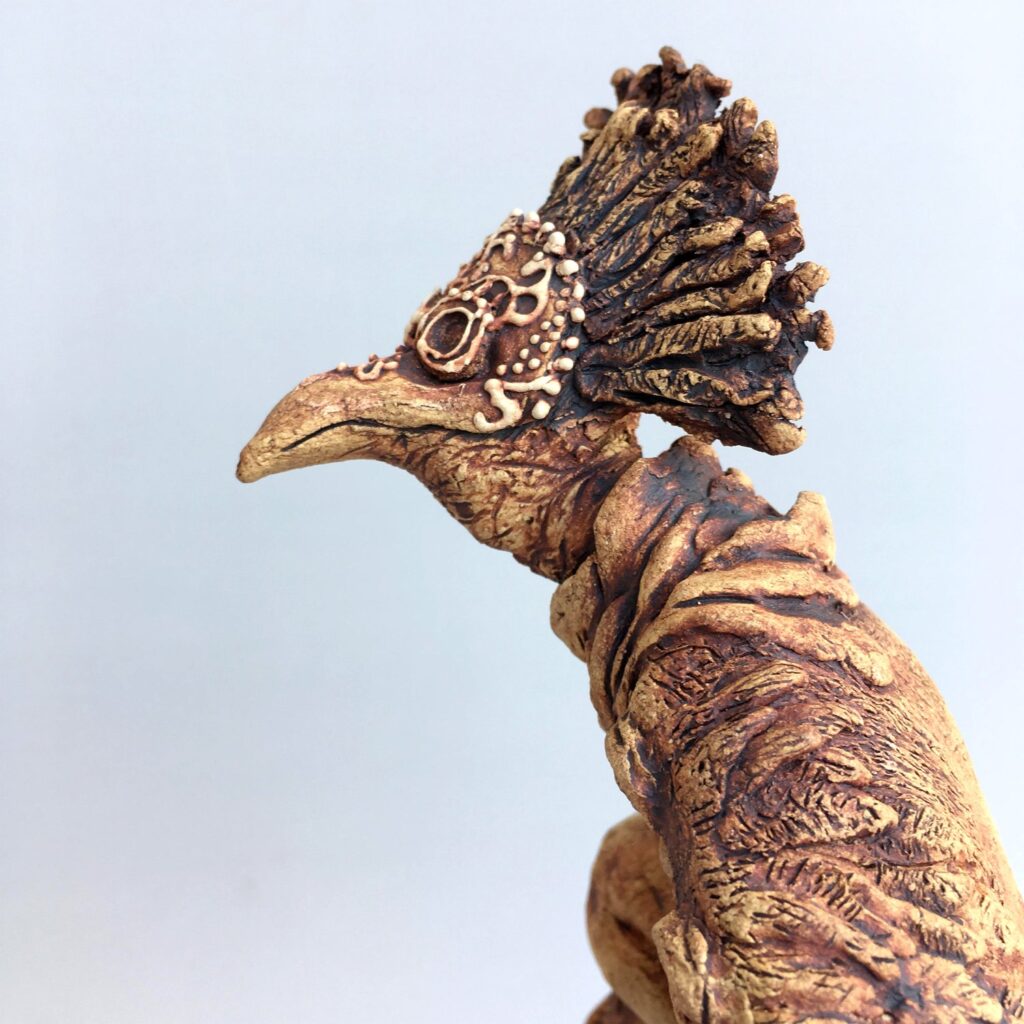
Sculpture of bird like figure wearing a Venetian style mask
Lindsey M Dillon, “Venetian Rumor”

Extemplo Libyae magnas it Fama per urbes,
Fama, malum qua non aliud uelocius ullum:
mobilitate uiget uirisque adquirit eundo,                                       175
parua metu primo, mox sese attollit in auras
ingrediturque solo et caput inter nubila condit.
illam Terra parens ira inritata deorum
extremam, ut perhibent, Coeo Enceladoque sororem
progenuit pedibus celerem et pernicibus alis,                              180
monstrum horrendum, ingens, cui quot sunt corpore plumae,
tot uigiles oculi subter (mirabile dictu),
tot linguae, totidem ora sonant, tot subrigit auris.
nocte uolat caeli medio terraeque per umbram
stridens, nec dulci declinat lumina somno;                                  185
luce sedet custos aut summi culmine tecti
turribus aut altis, et magnas territat urbes,
tam ficti prauique tenax quam nuntia ueri.
haec tum multiplici populos sermone replebat
gaudens, et pariter facta atque infecta canebat:                        190
uenisse Aenean Troiano sanguine cretum,
cui se pulchra uiro dignetur iungere Dido;
nunc hiemem inter se luxu, quam longa, fouere
regnorum immemores turpique cupidine captos.
haec passim dea foeda uirum diffundit in ora.                         195
protinus ad regem cursus detorquet Iarban
incenditque animum dictis atque aggerat iras.

“Immediately Rumor goes through the great cities of Libya, Rumor, an evil than which no other is swifter: she thrives with speed and gains strength by going, small with fear at first, soon she lifts herself into the air and walks on the ground and hides her head among the clouds. The Earth, provoked by anger against the gods, so they say, gave birth to her last as the sister of Coeus and Enceladus, quick on her feet and with nimble wings, a horrible monster, huge, who has as many feathers on her body, as there are  watchful eyes beneath (amazing to say), as many tongues, as many mouths are speaking, as many pricked up ears. She flies at night in the middle of the sky and the earth shrieking though the dark, her eyes do not close with sweet sleep; by day she sits as a guard either on the top of the highest roofs or on high towers, and alarms the great cities, holding on as much to false and evil things as to being a messenger of the truth. Now rejoicing she keeps filling the nations with various rumors, and she keeps singing true and untrue things equally: that Aeneas born from Trojan blood has come, beautiful Dido deigns to join herself to that man; now they are keeping the long winter warm together in luxury, forgetful of their kingdoms and captive to their shameful desire. The foul goddess spreads this on the mouths of men everywhere. At once she turns her course to King Iarbas and sets fire to his spirit with her words and increases his anger.”

In the fourth book of the Aeneid, following the metaphorical marriage between the Carthaginian queen and the Trojan hero, Vergil includes an extended depiction of Rumor personified as the goddess Fama. Rumor, described more specifically as a “foul goddess,” dea foeda, gleefully spreads the news of Dido and Aeneas’s private relationship through the city streets, inciting anger and unrest among their own people (4.195). As a result of Rumor’s wild and erratic behavior, Aeneas eventually comes to see Dido as a distraction and is reminded by the gods of his fate in Italy. Departing in secret from Carthage, Aeneas leaves behind Dido, who is so distraught from heartbreak that she abandons her role as queen and commits suicide while the Trojan fleet sails away from the Carthaginian shores.

Vergil opens this symbolic passage straightaway with a sense of urgency, using the Latin word extemplo, “immediately,” setting a frantic tone for the passage to follow (173). This is further emphasized in the next line with the comparative adjective velocius, “swifter.” Nothing one can match Rumor’s speed (174). Here, Vergil is already beginning to paint the image of Rumor as an uncontrollable creature who cannot be tamed. This portrayal of the goddess might also foreshadow the unfortunate future of Queen Dido, as both are compared to a female follower of Bacchus later in the epic. After Dido learns of Aeneas’s plan to leave Carthage in secret, she “runs wildly,” bacchatur through the city before confronting Aeneas (4.301). When Dido finally succumbs to her miserable state, Rumor is said to have similarly “run wildly,” bacchatur through the city, spreading the mournful news, acting as a dramatic echo of the dead queen’s actions (4.666).

Vergil also stresses the power of Fama as a deity, specifically noting her apparent omnipresence in the “skies,” auras and on the “ground” solo and among the “clouds” nubila (176-177). The polysyndeton in this line is what draws the reader’s attention to Rumor’s ability to seemingly be in a multitude of places at once because of her impressive speed and agility. Vergil uses various poetic devices throughout his entire epic, but this passage in particular is full of repetitions, most notably alliteration and anaphora, in addition to this example of polysyndeton. Not only does the phrase ira inritata almost exactly repeat in translation, meaning either “provoked by anger” or “angered by anger,” but it is also alliterated, producing a repetitive rhythm and tonal effect when spoken aloud (178). The repetition of tot, “so many,” or totidem, “as many,” in the list of Rumor’s descriptive traits, tot vigiles oculi…tot linguae, totidem ora…tot subrigit auris, is an example of anaphora in epic verse (182-183). These literary techniques and poetic devices, which are all repetitive in nature, stress the rhythmic pattern and verse of the epic while drawing attention to these specific phrases, many of which highlight the disturbing characteristics and actions of Rumor.

Vergil creates a suspenseful atmosphere to emphasize the direness of Aeneas’s situation in Carthage, where he is sidetracked from his fated journey to Italy. Rumor’s act of “shrieking,” stridens creates a palpable, almost audible sense of horror for the reader, distinguishing Rumor from mere gossip, which a contemporary audience might understand it as (185). This terrifying tone is also seen in Vergil’s direct description of Rumor as a “horrible monster,” monstrum horrendum, with the goddess personified as a female winged creature (181). In contrast, however, the other female figure present in this scene, Dido, is described as pulchra, “beautiful,” although to a Roman audience, her actions would perhaps seem like a distraction keeping Aeneas from his Trojan duty (4.192). Vergil therefore creates a connection between Rumor and Dido for the reader based on their egregious actions, despite the contrast in their outward appearances.

Vergil seems to be using personified Rumor to propel the storyline of his epic foreword, literally with the goddess’s speed. This section comes directly after what Dido understands to be her marriage to Aeneas, and already the goddess is polluting the streets of Carthage with this fact mixed with her own exaggerated “lies,” infecta (190). Although this relationship has somewhat just begun, Vergil is already alluding to its imminent collapse. While she may revel in falsehoods, Rumor eventually represents reality for both Dido and Aeneas when her deceitful behavior plagues both lovers by the end of book four. While attempting to leave Carthage in secret, Aeneas manipulates and deceives Dido, sending the heartbroken queen into a frenzy. Incited by Aeneas’s impious act, Dido similarly deceives Anna before taking her own life. This passage, therefore, ultimately builds the tension of the epic and creates a reference of what is to come with Rumor’s terrifying description and dishonest conduct.

In her 2021 translation of the Aeneid, Shadi Bartsch seeks to construct a “parallel experience” to Vergil’s epic poem in English (Bartsch 57). She believes that Latin “gives each translator a choice,” and she chooses to stay truthful to the original language, tempo, tone, metaphors, and verse of Vergil (52). The poetic device she seems most concerned with is alliteration, which she replicates frequently in her translation and uses to emphasize certain aspects of the analogy in English as Vergil does in Latin. Early in the passage she uses alliteration to contrast Rumor’s initial fear with her growing power, beginning as “small and scared” but building “speed” and “strength” as she flies (Vergil 175-176). This also resembles the typical course of daily gossip, which begins as an individual rumor but increases and strengthens as it spreads.

Another example of alliteration is Bartsch’s description of the goddess as “fast of foot and fleet of wing” while simultaneously being a “huge, horrific monster” (180-181). While “fast of foot” is very direct in word choice and meaning, “fleet of wing” is more ornate and complex. Already having used the word “fast,” Bartsch finds an alternate translation for speed while still fitting it into the alliteration of the phrase. Although Vergil does not alliterate the phrase monstrum horrendum, ingens, the Latin does have a rhythmic beat, especially in the first two words, which Bartsch retains by inverting the word order and alliterating the phrase, translating it as “a huge, horrific monster” (181).

Bartsch is also dedicated to preserving a similar tone of panic and alarm as Vergil, which she accomplishes through her animalistic word choice in this passage. Rather than the common meaning “lifts” or “raises” for attollit, Bartsch translates the phrase sese attollit in auras as “she rears to the skies” (176). The English verb “rears” typically only refers to animals, specifically horses, but in this case fits the actions of a wild bird. Another possible translation inferred from attollit could be “soars,” which offers a more bird-like quality to the passage (176). Bartsch returns to more characteristic descriptions of a winged creature with the verbs “screeching” for stridens and “perches” as a more specialized translation for the common Latin verb sedet (185-187). Although Vergil does not classify his comparison of Rumor to a specific bird species, his description of the goddess almost seems like that of a vulture or a similar bird of prey, exploiting and feeding on the secrets of Dido and Aeneas. By attempting to replicate the original meaning and meter of the poem directly into English, Bartsch successfully fosters a terrifying atmosphere almost identical to that of Vergil’s, which only intensifies the fear for the reader of the events to come later in the epic.

In contrast, Sarah Ruden’s methodology for her 2021 Aeneid translation seems to be taking each of Vergil’s lines or phrases and reimagining them in poetic English. She states that the most effective aspect of Vergil’s writing is its “Roman epic style,” but because English works very differently to Latin, she makes some alterations in her translation (Ruden 7). While Vergil frequently repeats the same Latin words as a common thread throughout the epic, Ruden believes this would come across as boring and monotonous in English, so instead she chooses to “vary the vocabulary,” using different translations for the same Latin word (8). Although the Aeneid is written in dactylic hexameter, Ruden uses iambic pentameter in her translation as it is more flexible with the English language (9). She seeks to embrace the sense of the Latin and the “flavor” of the Aeneid, rather than default to a word-for-word translation (10). By doing this, she is able to leave behind the expected, and often awkward, English translations for a more interpretive and aesthetic style reminiscent of Vergil’s extraordinary poetic abilities.

She too utilizes an abundance of alliteration in her translation with phrases such as “tiny and timid” and “sweet sleep,” as well as word repetition with phrases such as “quick-footed, quick-winged,” which resemble the alliteration of the original Latin: pedibus celerem et pernicibus alis (4.176–179, 185). But for the most part, Ruden seeks to completely reinterpret the Latin, like in the phrase “Her claws hold both true news and evil lies” for tam ficti pravique tenax quam nuntia veri (188), while the original Latin might literally translate to “holding on as much to false and crooked things as to being a messenger of the truth.” Ruden uses her liberty as a translator to alter the Latin to fit the grandiose style of her translation. In this phrase, Ruden’s most notable modification is translating the adjective tenax with the noun “claws,” adding to the passage’s bird-like imagery, rather than simply as “tenacious” (188). This rearrangement of the original passage displays Ruden’s frequent decision to completely depart from Vergil’s word choice and verse.

Ruden prefers a loftier, more exaggerated translation, often opting for rare or unusual word choices rather than the expected English translations. “A blaring mouth” for ora sonant not only alters the number from plural “mouths” to singular, but the verb becomes an adjective describing the one “mouth” (183). “Blaring” is also a slightly jarring translation for sonant, which is typically understood to mean either “speaking” or simply “making a sound.” Similarly, for the Latin word populos, with its clear English cognate “people,” she chooses the more mythical and outdated word “realms” (189). While Shadi Bartsch uses her liberty as a translator to remain as faithful as possible to the original Latin, emulating Vergil’s tone by attempting to directly copy his words into English without losing his meter or meaning, Sarah Ruden disregards the details of Vergil’s Latin to reproduce the magnificent style and heroic design of the Aeneid in reimagined English. With her over-the-top, dramatic translations, Ruden creates an atmosphere of fantasy and magnificence suitable for an epic poem full of legends, battles, and fated destinies.

Re-written Verse Translation – Aeneid 4.173-197

[Based on “Rumour Has It” by Adele from the perspective of Italy, personified]

“Now Rumor has it” that you’ve forgotten your path,

You’re giving into Dido and her beautiful wrath.

“Haven’t you heard the rumors” that are filling the streets?

They know you as Aeneas, a hero despite the Greeks.

“Now Rumor has it” that “you’ve got your head in the clouds,”

That you’ve forgotten your kingdom, that’s what’s heard in the crowds.

That Dido wants to marry you, says Rumor flying swiftly,

But please don’t forget, Aeneas, that “you and I have history.”

“Now Rumor” sings these tales (so amazing to say),

But “she is a stranger,” boy, don’t give your fate away.

“All these words” the quick goddess does “whisper in my ear,”

Although her image makes it hard to have faith in what I hear.

“Now Rumor has it” that “she made a fool out of you,”

Exposing all your winter plans madly as she flew.

Speeding ‘round at night, all I see is gleaming eyes,

But when it comes to gossip, well, “she’s got it all” in the skies.

“Now Rumor has it” Dido melts your heart, “cold to the core”

Now Rumor reaches Iarbas and she brings the heat some more.

Although she has the beauty, and I guess that’s why you “strayed,”

“Is that really what you want,” Aeneas, what of the Trojan name?

Works Cited

Bartsch, Shadi, translator. The Aeneid. By Vergil, Random House, 2021.

Ruden, Sarah, translator. The Aeneid. By Vergil, Yale University Press, 2021.

Metrics and Style in Ovid’s Metamorphoses

Haydon Alexander (’24) argues that the relative quickness of Ovid’s hexameter lines is a key aspect of his style.

Towards the end of his life, Ovid wrote letters to friends in Rome describing the misery of his exile on the frontier of the empire in what is now Romania. In a letter addressed to Cornelius Severus Ovid considers the reasons why he no longer gets any enjoyment out of writing poety (Epistulae ex Ponto 4.2.33–34):

or because composing a poem with no one to recite it to

is just the same as dancing [lit. “making rhythmical gestures”] in the dark.

 sive quod in tenebris numerosos ponere gestus,

quodque legas nulli scribere carmen, idem est.

Ovid doesn’t mean that he is sad that his poems aren’t being read (in fact, his exilic poetry was sent to Rome and was read). Rather, he sees his writing as joyless without a live audience to spur him on. The way Ovid describes dancing (“making rhythmical gestures”) is significant, since numerosus can refer to both rhythmical movements of the body and rhythmical speech, and Ovid himself in a famous passage uses the word numerus to mean “poetic meter” (Amores 1.1.1).  Ovid’s letter from exile gets at the joy of performing Ovid’s work live, and one of the principal reasons for this is because of Ovid’s deep mastery of meter. The importance of meter is easily lost when we read silently, so to that end, we will explore below some of the special qualities of Ovid’s metrics, and the way in which he discusses meter directly in his work.

In his surviving corpus Ovid wrote in only two meters . In the Metamorphoses, the nominally epic poem which describes the history of the world told in myth, he wrote in dactylic hexameter, in which each line has six feet of either a long and two short syllables (a dactyl) or two long syllables (a spondee). This is the meter of Homer, Hesiod, and Vergil, among other writers of epic poems, and it is first discussed critically by Aristotle, who considers it to be the proper meter of epic poetry (Poetics 1459b. See Morgan 2000: 99–120, esp. 99-100). For a more in-depth look at how the meter looks in practice with visuals and video accompaniment, look here and here.

Perhaps his most famous (in infamous) work, the Ars Amatoria, “The Art of Love,” a supposedly didactic but also highly unserious set of poems on seduction, was composed, like the rest of his works apart from the Metamorphoses, in elegiac couplets: lines are in pairs, the first of which is metrically identical to a dactylic hexameter, and the second of which is a dactylic pentameter, i.e., a hexameter line with five rather than six feet (See Claasen 1989 and Herr 1937). This is a meter which was also pioneered by Ancient Greeks, and was commonly used for love poetry in the first century B.C. Rome by Catullus, Tibullus, Propertius, and Ovid himself. The ways in which Ovid uses meter in tandem with a vast array of poetic devices is the subject of many complete books, so we will focus here on some of the most distinguishing ways that Ovid plays with meter, and also some of the unique flair that come from his metrical self-awareness in his own writing.

Ovid is often self-referential and metaliterary. At the start of the Amores, Ovid’s poetic collection depicting a love affair with a woman he calls Corinna, he argues with Cupid concerning his meter (Amores 1.1.–2 trans. Slavitt 2011):

Arms and the violent deeds of men fighting in battle …

Those are the noble subjects I would address

in the grave meters suited to grave matters, but no,

Cupid appeared to trim my lines by a foot.

Arma gravi numero violentaque bella parabam

edere, materia conveniente modis.

par erat inferior versus—risisse Cupido

dicitur atque unum surripuisse pedem.

In the first place, he puns on the meter, writing that Cupid steals his “foot,” referencing the fact that the elegiac couplet has one fewer foot than the equivalent 2 lines of dactylic hexameter. But more than this, it is clear that he gives particular weight to the thought of meter, opening the work with the “grave meter” he is talking about is dactylic hexameter. Conversely, he calls his elegiac couplets “Rather more informal, playful even­­­–despite my serious aims” (nec mihi materia est numeris levioribus apta, 1.19–20 trans Slavitt).  He writes as if he is trapped by his metrical choice. Of course, he makes that choice himself, but this is an instance where Ovid is close to talking to his audience about how important meter is to him.

So, Ovid uses meter as a shortcut to let his reader know what to expect, and he uses the history of both his meters to prime his readers for what his works will contain. Indeed, the Amores all deal with love, and as he promises, not in a particularly serious way. Ovid writes a ridiculous scene (1.6) that has him lying outside the door of his love, begging the doorman to let him in. Another reads like a limerick about “an over-the-hill playgirl” (1.8).

In the Metamorphoses, Ovid plays around with expectation. Because the work is written in hexameters, we are asked to consider it an epic. However, it skirts many of the “rules” to which earlier epics adhere. Most obviously, it does not have a unified narrative in the way that the works of Homer or others have. Moreover, Ovid does not adhere to his own statement in the Amores about “grave meters,” because like the rest of his works, Ovid is often deeply unserious in tone. An example is when he tells the story of how Tiresias is blinded in a short story that talks about Jupiter and Juno arguing about who gets more pleasure from sex (3.316–38). This is hardly the stuff of grand stories, but it is in Ovid’s “epic.”

Metrically, Ovid’s epic differs from that of his slightly earlier contemporary, Vergil. Metrical analysis shows that Vergil’s Aeneid is relatively dominated by spondees, the feet which have two long syllables. This means that his work encourages the speaker to slow down and to luxuriously take in each line. The Metamorphoses has more dactylic lines, with many feet consisting of a long followed by two short syllables (see Ben Johnson’s online tutorials on the metrical composition of Ovid and of Vergil; and Herr 1937: 5). This results in a poem which gallops along relatively quickly, contrasted with Vergil’s statelier pace. One of many illustrative instances is when he tells of Apollo’s chase of Daphne (Met. 1.525-39). During the lead up to the chase, as Apollo realizes that his words will not convince her to be with him, the lines move slowly, but as the chase commences and reaches its climax, the lines become more dactylic, making the poetry move faster and faster. This is one instance where Ovid uses speed to evoke the content of his verse. This results in a tone which matches the tenor of Ovid’s writing which is opposed (though neither superior or inferior) to Vergil: where Vergil feels grand and momentous, Ovid does something else: his writing is foremost pure, unadulterated entertainment that moves. A visualization of a typical passage in which spondees are coded green (courtesy of the website Hypotactic) shows the extent of the tendencies.

Scanned Ovid
Ovid, Metamorphoses 1.525-40. Scanned passages of Metamorphoses and the Aeneid show the difference in scansion between the works. Dactyls are shown in orange and Spondees in green.
Scanned Vergil
Vergil, Aeneid 1.525-540. Particularly in the middle of Ovid’s passage, at the height of Apollo’s chase of Daphne, note the differences in dactyls and spondees. Graphics courtesy of hypotactic.

But it is not merely in the Metamorphoses where Ovid is uniquely dactylic. In a study of the elegiac couplets of Ovid, Propertius, and Tibullus, Maurice Platnauer (1951: 36–37) found that the line type with four dactyls (the most “galloping” line) occurs 6.7% of the time in Ovid’s elegiac work, more than three times as often as that of Tibullus and over five times as often as in Propertius (see Greenberg 1987). Conversely, lines with four spondees (the type of line which most encourages slowing down) are far less likely to occur in Ovid, about five time less likely than in Tibullus and more than eight times less likely than in Propertius. So, it is not only in the Metamorphoses that Ovid uses the mechanics of meter in ways different from his contemporaries and those who came before him.

Why did Ovid make his poetry move more quickly than that of his contemporaries? Why, when he says his opinion on what hexameters should be in his early works, does he contradict himself when he writes without the “epic grandeur” (Jones 2007: 10–11) for which he himself advocates? Does he actually believe in a “proper” meter for each type of poetry? And indeed, why is he self-referential about him poems in his own work? Peter Jones (2007: 11–15) suggests that Ovid is keenly aware that he shouldn’t (and probably can’t) recreate the spark of his epic predecessors when he writes the Metamorphoses, and that this is what inspires him to write such a unique epic. Applying this insight to meter, we can see why Ovid was so intentional and unique about meter. He attempts to modernize the poetic form by removing what he perhaps saw as the dust and stuffiness from Vergil and providing something modern and entertaining in a new way. He might get at the entertainment from mere subject matter, but as the saying goes, “it’s all in the delivery.” By galloping along through his poetry, Ovid brings new life into old stories in the Metamorphoses, and similarly, he brings new levity to much of the scenes of his elegiac works, and through self-reference, he almost begs his audience to notice the difference. Moreover, where Vergil and other predecessors focus on the epic, yet inherently distant and even somewhat sanitized, grand old scenes to elicit reactions from his audience, Ovid takes all the little absurd scenes and jolts his audience through them, making them feel a range of emotions: a range which can only occur to full effect with the speed and inevitability of a live poem, sung in its unique galloping meter.

Meter is just one of the things that make Ovid’s poetry unique, but it is reasonable to suspect that it might have been the thing that Ovid thought most unique about his work. Thus, in a moment in his later poems which reads in a “sad clown” sort of way, he puns on his meter by saying (Tristia 1.15-6):

Go, book, and greet places dear with my words:

I will touch them with what ‘foot’ I may.

vade, liber, verbisque meis loca grata saluta:

contingam certe quo licet illa pede

He goes on to ask forgiveness if his work is not as good for his not being in Rome to write and present it (1.35–49). Even towards the end of his life, he is still self-conscious and self-referential concerning meter. He seems to think that in exile he has lost control of his work because he cannot express himself in meter. So, unlike the modern argument that meter constrains poetry, for Ovid, meter is essential to the character of his work. Without his intense attention towards and self-awareness of his meter, the unique attitude which Ovid achieves in his work would lack its enduring strength.

References

Claasen, Jo-Marie. 1989. “Meter and Emotion in Ovid’s Exilic Poetry,” Classical World 82.5: 351–365.

Greenberg Nathan A. 1987. “Metrics of the Elegiac Couplet,” Classical World 80.4: 233-41.

Herr, Margaret Whilldin. 1937. “The Additional Short Syllables in Ovid,” Language 13.2: 5–31

Jones, Peter. 2007. Reading Ovid: Stories from the Metamorphoses. Cambridge: Cambridge University Press.

Morgan, Llwellyn. 2000. “Metre Matters: Some Higher-Level Metrical Play in Latin Poetry,” Proceedings of the Cambridge Philological Society, 2000.6: 99–120.

Platnauer, Maurice. 1951. Latin Elegiac Verse: A Study of the Metrical Usages of Tibullus, Propertius and Ovid. Cambridge: Cambridge University Press.

Slavitt David R. 2011. Love Poems, Letters, and Remedies of Ovid. Cambridge, MA: Harvard University Press.