Seeing with the Soul

Cicero did not equate disability with incapability, argues Samantha Ritschel (’26).

I have lived life as a disabled person for over a decade. I was not born disabled. My disease, Friedreich’s Ataxia, began affecting me when I was eleven. So many doors that were previously open for me, suddenly shut, and I needed to find a new path forward. For me, that path led me to the world of the Classics. Classical Studies renewed something in me; it gave me a purpose, and with purpose comes the drive to succeed.
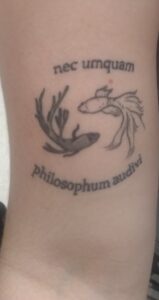
A tattoo on my right arm: one black beta fish and one white beta fish circling each other to form a yin yang symbol with the quote nec umquam philosophum audivi (“I never listened to a philosopher,” Petronius, Satyrica 71.12).

Throughout my academic career, ancient philosophers have occupied a great deal of the subject matter of my studies. I hate philosophy. I have never listened to a philosopher, and quite frankly, I don’t think I ever will. My experiences and the way I must live my life due to my disability cannot be mapped on to the philosophies that I am taught. Call me a pessimist if you must, but I prefer the term realist. To know oneself is the best thing that someone can do for themself, and for me that means accepting limitations and carving a path for myself, even though it will never be easy. And sometimes, to know yourself, you have to make a statement.

There is debate among the disabled community about disability first language and its use to refer to someone. I respect the opinions of others, but let me make mine clear. To use the language “person with a disability” erases who you are at your core. I am a disabled person. There is no taking the disability out of me. I am aware of the fact that when people meet me for the first time, the first thing they see is my wheelchair; they see the wheelchair rather than the person on the initial meeting. I am not saying that disability is what makes you who you are, I am saying that disability is part of you, whether you like it or not. There is no sense in chaining yourself with self-doubt and concern about how others may perceive you. I’m not saying that you are not allowed to be anxious, worried, or angry at the fact that you are not considered a typical person. But it is important to not let that consume you. Life is about the experiences that you have and the path that you forge for yourself. As a disabled person, I needed to forge a realistic path. I am aware how inconsistent I sound. Is this not philosophy? Is my thought process not the same type of doctrine that I despise? And you would be right, I am many things, and self-aware is one of them. This type of philosophy, one in which disability does not equate to incapability, is one that I hold close to my heart.

As I said earlier, I have learned to love the Classics, especially the Latin language. It is from this love of the Classics that I found an idea for my research project: the treatment of the disabled in ancient Rome. My original thought was to research physical disability in Rome, but I realized that it was too broad. I decided to research the treatment of the blind in Rome. I did this partly because of my father and partly because of my love of the Latin poet, Catullus. My dad runs a company that researches gene therapy for blindness caused by rare genetic diseases, Atsena. This, in combination with a few poems written by Catullus that state a variation of “I love you more than my own eyes,” led to this project. I would like to take a moment to acknowledge and appreciate Jason Morris (Dickinson ’00), who helped me throughout this project. If not for him, I would have never thought to look at the treatment of blind individuals in Rome from a philosophical perspective. I hate philosophy because it cannot be mapped on exactly to my life as a disabled person, therefore it never occurred to me, that perhaps a philosopher in antiquity tackled the issue of disability. Cicero’s Tusculan Disputations tackles philosophy from a Stoic point of view, which is interesting, but the most interesting content can be found in Book 5. Book 5 provides examples and analysis of how disability not only does not equate to incapability but also does not affect one’s ability to live a happy and virtuous life.

Book 5 teaches that virtue itself is sufficient for living happily (as Cicero himself summarizes it in De divinatione 2.2, docet enim ad beate vivendum virtutem se ipsa esse contentam). Cicero is firm during his defense of virtue as the key to happiness (Barney, 16). Virtue in Rome has multiple facets; it does not have a singular definition meaning that virtue is subjective to an individual’s experience. This is evident in the Latin language. The word for virtue is virtus which has a myriad of definitions. The main definitions of virtus are manliness and courage. Typically, virtue is defined in terms of one’s strength, specifically their physical strength. Most of the time virtus is used to describe manliness or warrior-like courage. However, virtue cannot be defined as just physical characteristics. If virtus refers to manliness, then does that make a person virtuous? The third definition for virtus is more ethical. Virtue can be based on the character of an individual. A virtuous person, someone who embodies virtus is courageous in both spirit and fortitude. A virtuous man can be judged on his manliness and battle, but it is the goodness of his spirit, and his relentless drive to improve himself that makes him worthy of the word. In terms of the disabled population in Rome, virtus could not be achieved via manliness or battle-based courage. For them, virtus was based on the goodness of their character, and the courage it took them to advocate for themselves and become a functioning member of society. The blind in Rome demonstrated courage daily by existing in an inaccessible world and attempting to lead the life of a happy man. The Disputations, specifically book five, teach that an individual has nothing to fear as long as they pursue a virtuous life by facing the challenges of life courageously (Barney, 13).

Cicero had a unique perspective regarding the blind. He argues it is the soul which receives the objects we see (animus accipit quae videmus, 5.111). His point is that a blind man sees through his soul, not his eyes, which implies that the lack of vision does not determine an individual’s capability to enrich his soul, which would metaphorically enrich his vision. He clarified this further by stating “Now the soul may have delight in many different ways, even without the use of sight; for I am speaking of an educated and instructed man with whom life is thought; and the thought of the wise man scarcely ever calls in the support of the eyes to aid his researches” (ibid.).

The use of animus is as interesting as his argument. The definition of animus can be interpreted as soul, mind, or spirit. It can be translated any of these three ways, meaning that Cicero made a choice to use such an ambiguous term to speak about blindness. The use of such an ambiguous term implies that Cicero wanted his readers to decide which definition fits best. He speaks of the education and pursuit of knowledge that blind man is capable of. In this context, the translation of animus as “mind” rather than “spirit” or “soul” is more relevant. However, the impact of translating animus as soul or spirit makes for a stronger statement. If a blind man is still able to enrich his soul and manipulate his spirit through the ways of philosophy and education, then perhaps they are not meant to be ridiculed in society as they were typically. Furthermore, an individual who was blind is still able to be virtuous utilizing their animus to fortify their virtus. A blind man’s soul can be enriched with courage from their mental fortitude and spiritual strength rather than a body capable of typical Roman virtus (manliness). This argument is uniquely Cicero’s, as most of Roman society typically found no use for disabled individuals.

The Stoic Diodotus, who was blind, lived for many years at my house. Now whilst—a thing scarcely credible—he occupied himself with philosophical study even far more untiringly than he did previously, and played upon the harp in the fashion of the Pythagoreans, and had books read aloud to him by night and day, in the study of which he had no need of eyes, he also did what seems scarcely possible without eyesight, he went on teaching geometry, giving his pupils verbal directions from and to what point to draw each line. (Cicero, Tusculan Disputations 5.113)

The language used in this section of Book 5 is extremely positive; there are no obvious negative connotations. The tone of the passage is not only admiring Diodotus but makes sure not to diminish his value simply because he is blind. Cicero emphasized his learnedness by claiming that he kept himself occupied with the study of philosophy and the study of music, both of which are seen as signs of a learned Roman. He also included a mention of his ability to teach geometry to students. That is pertinent, as it signifies that Diodotus not only had a strong education, but also that his patrons consisted of elite Romans. This is clear because, primarily, the elite and wealthy Romans were able to afford classes on theoretical mathematics such as geometry (Asper, 108).

Although his emphasis on learning clarifies the type of man Cicero admired, what is more interesting is how he discusses disability. The approach to blindness is clear: with reasonable accommodation, a blind man has no need for his eyes. Cicero wrote explicitly that Diodotus did not require vision as long as someone read to him during his personal time for study. He also stated that as a teacher, Diodotus was able to give instructions verbally to his students. Therefore, he was still capable of teaching without needing to have his eyesight. Using Diodotus as an example, Cicero argued that educated  blind men are capable of not only participating in Roman society but also thriving.

The typical attitude toward blindness and any disability in Rome is reminiscent of how today disability is treated. There were extreme restrictions on career opportunities for blind Roman citizens. Furthermore, there were many jokes made at their expense. Luckily, the Romans were not Christian at this time otherwise, like me, a random lady would pull out a rosary at a grocery store and start praying at them in pity. The prevalence of pity and uncomfortableness with disability has not changed from antiquity to now. However, Cicero was a breath of fresh air that I hadn’t ever considered before. I have read many of his works, but his philosophical work related to disability gave me some hope for philosophy in general. He believed that blind individuals were just as capable as those who could see. Cicero did not ridicule nor demean disabled individuals. In fact, he admired them for having the strength and resolve to do something with their lives. Cicero uses Diodotus, the blind Stoic, as an example of how disability did not equate to incapability; if accommodations were provided, a disabled the individual was just as capable as any other Roman.

References

Asper, M. 2009. “The two cultures of mathematics in ancient Greece.” In E. Robson, and J. Stedall (eds.), The Oxford Handbook of the History of Mathematics. Oxford: Oxford University Press.

Barney, R. 2025. “The Aims and Argument of the Tusculan Disputations,” in Brittain, Charles, James Warren, eds., Cicero’s Tusculan Disputations. Cambridge: Cambridge University Press.

On the Iliad and Excellence

Sophia Miretskiy (’20) discusses her changing understanding of the Iliad in relation to her own life and that of her immigrant parents.

Intaglio: Minerva throwing her aegis over Achilles early 19th century. Source: Metropolitan Museum
Intaglio: Minerva throwing her aegis over Achilles, early 19th century. Source: Metropolitan Museum

Every child has a “thing,” one irrational obsession, a subject in which they feel they are an expert. For some it is sharks or snakes, for me, as for many other children, it was classical mythology. I would pride myself on knowing every god in the Greek pantheon and memorized every Roman equivalent. In third grade, I set my sights on a career that I deemed perfect for my interests—archaeology. My family assumed that this was just a phase and humored my interests, gifting me mythology books and allowing me to pester them with my “fun facts.” However, the longer this phase lasted, the more concerned they became. They began encouraging me to choose a different, more prestigious career path, while pressuring me to strive to be better than my peers. Instead of taking their advice, I chose to dive deeper into my fascination with mythology. I found comfort in gruesome stories of extravagant heroes. A little later I discovered the works of Homer. The Iliad in particular became my favorite mythological work. It wasn’t until quite recently, however, that I discovered the reason behind my fascination with the story of Achilles. I realized that I see myself in Achilles, and the heroes in Homer, because my battle with the need for excellence, impressed upon me by my family, is reflected in the values of these heroes. The pursuit of excellence, being the greatest among my peers, was pushed upon me by my parents, and their parents. This mentality, however, is a product of their own environment and the lasting legacy of war that can also be seen through the Iliad.

My parents immigrated to the United States with their parents from the Soviet Union, fleeing lifetimes of persecution and institutionalized anti-Semitism, ingrained into society. They joined the waves of Soviet refugees, settling in a community where they would continue to be surrounded by people who were culturally similar. Though they left on the cusps of their adult lives, they were still not entitled to the same opportunities given to those who had lived here longer. They had the typical immigrant story: they, along with my grandparents, worked hard so that my siblings and I would have better lives. My family hoped to give me everything that they were deprived of—an education, financial stability, and the opportunity to be free and independent. Yet they themselves unintentionally hinder my freedom and independence by imposing their own notions of what my achievements and accomplishments should be.

As with most other children of immigrants, the mentality that I must be the best was something instilled on me from a young age. In school I was constantly compared to my peers and children of my parents’ friends, and I, of course, was never good enough. I was constantly reminded of the shame that I brought upon my family among their friends when I failed to live up to the expectations that they had set. Why was it that Tanya’s son got an A on his math test, when I got a B? However, I have realized that earning success was not simply about bragging rights for my family, but was something they used as a means of survival. They grew up, as many in the Soviet Union, impoverished in a failing economy, and though they have lived in the United States for almost 30 years, they retained their old mentality, living as though there is still a chance that they might walk into the grocery store and find the aisles empty. They subconsciously used my potential for success as a means to guarantee that they would never again have to experience the same conditions that they were raised in.

However, I soon began imposing the same notions of perfection on myself. My expectations of myself were different than those of my family. They expected excellence in a practical manner, hoping that I would be successful enough for financial stability, to provide for myself and all of them. I, however, strove to be like the heroes in the stories that I had become so fascinated with in my childhood, deciding that if my legacy was not as monumental as theirs that I have failed both myself and my family.

Much of the Iliad celebrates the competitive, toxic pursuit of excellence and perfection. Heroes strive for glory over survival, with the risk of being a detriment to their family legacy. In one famous exchange, the Lycian warrior Glaucus, fighting on the Trojan side, meets the Greek Diomedes. In response to a challenge from Diomedes asking who he is, Glaucus tells the long story of his descent from the hero Bellerophon, and concludes:

Hippolochus bore me, and I declare I am his son.

He sent me to Troy and charged me earnestly

to be the best always, superior to the others,

and not to bring shame on the line of my ancestors

who were the best men in Ephyre and wide Lycia (Iliad 6.206–210)

Ἱππόλοχος δέ μ᾽ ἔτικτε, καὶ ἐκ τοῦ φημι γενέσθαι:

πέμπε δέ μ᾽ ἐς Τροίην, καί μοι μάλα πόλλ᾽ ἐπέτελλεν

αἰὲν ἀριστεύειν καὶ ὑπείροχον ἔμμεναι ἄλλων,

μηδὲ γένος πατέρων αἰσχυνέμεν, οἳ μέγ᾽ ἄριστοι

ἔν τ᾽ Ἐφύρῃ ἐγένοντο καὶ ἐν Λυκίῃ εὐρείῃ.

Heroes must present themselves before battle, stating their father and grandfather’s name, ensuring that they continue the glory of their ancestors. This constant invocation of fathers and grandfathers by heroes in the Greek tradition, makes a powerful statement in presenting the values of the text. It seems that success in battle is always tied to family pride.

I found that, like myself, Achilles grapples with these ideas of honor and excellence. In the Iliad, Achilles’ fate was forced upon him from a young age. When he chooses to question the idea that he is destined to solidify his legacy at Troy, he is met with backlash and pleas to reconsider. After Briseis is taken from him my Agamemnon, Achilles decides that he would rather return home than continue to have his honor taken from him. He outlines his decisions and potential fates to Odysseus when he attempts to convince him to stay and fight, saying

If I remain here and fight beside the city of the Trojans,

then lost is my return home but my renown will be imperishable.

If I return home to my dear native land,

then lost is my glorious renown yet my life long will endure,

and the doom of death will not come so soon of me.

εἰ μέν κ᾽ αὖθι μένων Τρώων πόλιν ἀμφιμάχωμαι,

ὤλετο μέν μοι νόστος, ἀτὰρ κλέος ἄφθιτον ἔσται:

εἰ δέ κεν οἴκαδ᾽ ἵκωμι φίλην ἐς πατρίδα γαῖαν,

ὤλετό μοι κλέος ἐσθλόν, ἐπὶ δηρὸν δέ μοι αἰὼν

ἔσσεται, οὐδέ κέ μ᾽ ὦκα τέλος θανάτοιο κιχείη. (Iliad 9. 412–416)

He decides that he no longer needs glory and chooses to return home and live out the rest of his life in peace. However, Odysseus, sent by Agamemnon, begs him to reconsider his decision, claiming that the Greeks need the “greatest of the Achaeans” to win the war, pushing the narrative of excellence over survival. Though he holds steady in his decision, Achilles is later pushed into battle by the death of Patroclus, and ultimately fulfills his destiny and kills Hector, solidifying his legacy.

To the ancient Greeks, these events proved that no one was able to escape destiny, and portrayed the glory of their predecessors. For my younger self, however, they demonstrated that sacrificing yourself to leave the greatest legacy was always better than settling for healthy mediocracy. I focused on this outcome of the Iliad, and many of the other ancient myths that emulated these same themes, because these values were already stressed by my family.

It wasn’t until I analyzed the Iliad in an academic setting that I began to realize that the ancient Greek ideal of a hero should not be idolized. It was in the analysis of the aristeiai that I learned of the flaws of both Achilles and the Homeric concept of heroism. The aristeia was the climax of the ancient hero’s greatness, when he demonstrated his power in battle and destroyed his enemy, and was often what solidified his legacy. Achilles’ aristeia, for example, was him killing Hector. However, these feats of greatness were often war crimes in disguise. Achilles’ aristeia continued after the death of Hector, when he proceeded to mutilate the body of the hero, dragging him behind his chariot around the walls of Troy. These demonstrations of so-called greatness show an alternative side to perfection, demonstrating the toxic nature of the expectation of excellence.

Despite this realization, I continue to struggle with the expectations imparted on me by both my family and myself. I have long held the idea that I too must leave a legacy, in this overextending myself to the point of exhaustion and bending myself to the will of my family, in an attempt to meet their standards, and eventually my own. While at the same time, I have known from a young age that I will never live up to the expectations that my family set for me. I instead decided that perhaps if I am successful on my own terms, I would fulfill the dreams that all immigrant parents wish for their children. This however, has not proven to be effective. My accomplishments are not something that they can understand or accept.

My reading of the Iliad has allowed me to better cope with my upbringing and the expectations that I set for myself. My younger self was able to find comfort in Achilles’ story, and used it as an escape from my own world of expectations. I still find comfort in the Iliad, but a different kind of comfort. I now use it, not as escape, but as a way to understand that the achievements anticipated from me, and that I anticipate from myself, are not always feasible. It has helped me see that the pursuit of excellence can be dangerous, and that, since I am not a Homeric hero, I must find motivations other than perfection.

I feel that reading the Iliad will benefit my family, just as it allowed me to better understand my motivations, actions, and flaws. A closer reading of the Iliad has shown me that this drive to perfection and excellence stems from war, something that has had an immense impact on the mentality of the society that shaped my family. In his 2010 book Achilles in Vietnam, doctor and clinical psychiatrist Johnathan Shay captures this connection between the Iliad and themes of war. Focusing on veterans of the Vietnam War, with whom he has worked extensively, he analyses the lasting psychological effect that this catastrophic event had on those who saw combat, and connects those stories with the narrative of war in the Iliad. He interprets the Homeric text as an “account of men in war,” not in an attempt to modernize the ancient story, but as a way to both further understand the Iliad and legitimize the experiences of veterans.

In his analysis, he finds that, in many ways, Achilles’ psychological character is not unique. The motivation behind his decision to desert, his reliance on Patroclus, and his issues with authority are all characteristic of soldiers in combat. However, the Achilles’ aristeia is something that cannot be found in modern warfare. Though the death of a comrade could cause an American soldier to “go berserk,” on top of the grief that they were already suffering through, they were often pushed by their superiors to thirst for revenge. Achilles’ rampage, however, came solely out of grief, and was cruel even for Homer.

Shay finds that the Iliad is representative of many other aspects of war. In addition to the psychological impact of war on those facing combat, he also discusses the impact of war on civilians. He points out women and children face the risk of immense suffering and complete devastation upon defeat, something the Trojans knew during the war. The impact the lasting psychological effects of war, not only in veterans, but also in these civilians is dangerous.

These lasting psychological effects are ultimately what shaped the society that my parents and grandparents were born into. My grandfather, born in 1940, lived to see the aftermath of World War II, and constantly, to this day, recounts stories of famine and death. From an early age, I learned of the atrocities of the Holocaust and the effect that the war had on my predecessors. It seems that post-Soviet states have still not recovered from the memory of a war that took place over 70 years ago. Their governments idolize victory, not allowing their citizens to distance themselves from their war-torn past. It is in this environment where this mentality of excellence is able to thrive. My grandparents were raised in this environment, where glory and victory were worshiped. My parents were constantly pushed to be the best, with the reminder of the sacrifices that their predecessors had to make in order for them to have the opportunities that they had.

In reading the Iliad, my family may be able to finally understand where their values come from. Though they dwell on the atrocities of war that have affected them personally, they are unable to see that these lasting effects are dangerous. They praise success in war and see it as a necessity, rather than a danger. By reading the story of Achilles, and comparing their values to those of Homeric heroes, they may be able to recognize that war should be understood as something purely violent. They may also be able to see that their mentality, pushing toxic pursuit of excellence, is a remnant of war, and therefore itself is inherently dangerous and violent.

They might also find comfort in reading the Iliad, as I did, using it to look back on their own childhoods and cope with their experiences. They could even finally understand my obsession with classical mythology, and gain an appreciation for the stories that have always fascinated me.

This, of course, is all hypothetical. Realistically, even if my parents, or grandparents, do read the Iliad, they may not come to same conclusions as I have. Their interpretation of the text may be completely different than what I have come to understand. This, however, will not take away from the comfort that I find in reading the works of Homer. The Iliad has allowed for me to better understand myself and my environment. It has allowed me to look inward and find my flaws and motivations and has served as an escape from expectations when I needed it to. Though my parents may still hope that my love for the classical world is just a phase, I know that I will continue to read, and be fascinated by these texts, just as they will continue to help me understand myself and the world around me.


St. Augustine, Teaching, and Piety

Carl Hamilton (’21) discusses the impact on his life of reading Augustine’s Confessions.

Dickinson’s seal is emblazoned on mugs, envelopes, and Britton Plaza, but its Latin motto is little understood by the community at large. Pietate et doctrina tuta libertas, is simple Latin: “Through piety and learning liberty is (made) safe.” But the ease of translation belies the difficulty of understanding. What is piety? What is learning? And finally what is liberty itself? Such pregnant concepts lie in so few words.

photo of the college seal with Latin motto
In the summer of 1784, as the college’s founders discussed the formation of the college, Benjamin Rush and John Dickinson were asked to create a suitable seal for the institution. The resulting seal consists of an open bible, a telescope and a cap surrounded by the inscription “Pietate et Doctrina Tuta Libertas.”

“Liberty is made safe through character and learning” is the translation on a wall in the registrar’s office, and on the college website. There is no need to consult a Latin dictionary to be  struck by the 21st-century individualism of translating pietas (piety) as “character.” As if the ambiguity already present in the words properly translated was not enough, here the school itself is officially promulgating an incorrect translation of its motto.

To communicate my views on the motto, specifically the words doctrina and pietate, I must enlist the aid of St. Augustine through my personal experiences with his autobiography, Confessions. By reading this book, I learned that learning and piety, formerly two very separate concepts in my mind, depend wholly on each other, such that one cannot be separated from the other without losing the integrity of both.

Doctrina

Teaching, learning, academicism, however you may translate doctrina, has always been a prominent part of my life. From an early age I had loved books, learning to read The Cat in the Hat before ascending to more refined works such as Encyclopedia Brown and, later, Shakespeare. In elementary school, I was always excelling in the highest level classes. As I progressed in my schooling, math became a challenge. I failed a math final in tenth grade and gladly took a much lower level class as a junior; but, when it came to humanities, I was always performing at the highest levels.

And oh, how I delighted in such subjects! Nothing would please me more than causing aesthetic or literary conflagrations of opinions. As one of a conservative bent, my very liberal senior-year English class provided fertile ground for this squabbling.  If I left class shaking my head in disgust or victory, it had been a good day. Through sheer knowledge, I was able to dominate most arguments, or, as Quintilian quotes Cicero as saying, to “throw dust in the eyes of my jury.” I remember haughtily correcting someone across the class who claimed that Shakespeare lived under Queen Victoria with a snobbish, “Actually, you mean Elizabeth.”

In high school I found Latin, which subject shamefully became the primary outlet for this intellectual pride. At that time, I could think of nothing so pleasing as having others recognize my wide erudition. Although I loved learning, I desired academic mastery mainly for the sake of myself, not the material per se, and certainly not for any moral or intellectual good. I sought to understand so that I might show off for rewards on tests, in classroom competitions, or in discussions. In Latin 4, the other seniors and I so dominated discussions that on the mid-year evaluations one of the juniors wrote, “Why do the seniors have to be so intimidating?”

I question now whether I would have been as zealous for learning had those direct benefits not existed? If you had asked me the purpose of Latin and liberal learning at the time, I probably would have propounded lofty Arnoldian platitudes that learning enriches the soul with “the best that has been thought and said in the world.” But such would have been a deception: I was greatly advancing in doctrina, or so I thought, blind to any higher aims than my own success.

It was during high school in fact when I first picked up Confessions but stopped reading somewhere in the second or third book. The impact it had on my immature self was minimal, for I remember thinking, “How could he dare assert the vanity of Vergil and classical learning in general?” I recall expressing this alarming thought to my Latin teacher, who responded, “Well, I guess he realized he had found something greater.” I walked away unimpressed with his answer. The irony was mine though, for less than two years later I would take and read Augustine again, wherein I would find something far greater than Vergil indeed.

As to piety, religion certainly was not absent from my life at this time. I began attending the Latin Mass, the rite of Catholic Mass in effect from 1570 until 1969. Being very wary of the liberal reforms in the Church after Vatican II, I was constantly researching and trying to practice Her traditional ways. But my learning and my piety, except for the Latin connection at Mass, were almost entirely separate at this time. From Monday to Friday I boasted in the classroom; on Sundays I was humble at Mass, and never the twain shall meet.

Pietas

In the fall of 2017, my freshman year at college, I once again took and read the Confessions. I know not why, but I sat in the library and read the first book, getting lost in time as I got lost in the truth of what I was reading, with each sentence being a carefully mounted attack against the once impregnable fortifications of my pride.

Augustine, an academically talented boy, found himself, I realized, in a very similar situation to my own. Born in Thagaste, North Africa, in 354, he was raised in the Catholic faith by his mother, Monica (later St. Monica). In adolescence he drifted from the faith and came in adulthood to hold a chair of rhetoric in Rome. Eventually, hearing angelic voices in a garden telling him, tolle, lege, (“take and read”), he left his career to be welcomed back into the Church. He rose to become a priest and then in 396 a bishop in Hippo, less than 60 miles from his native Thagaste. In this position he wrote his theological masterpieces, On Christian Teaching, On the Trinity, and On the City of God against the Pagans. These, among his other works, did more to intellectually buttress the Church than probably any others until St. Thomas’ Summa in the 1200’s.

But while his theological works received the greatest attention in the Middle Ages, they present very little of Augustine the man. Only since the 19th century, the age of the Romantics, has Confessions received a large amount of attention (See Garry Wills’ 2011 book, Augustine’s Confessions: A Biography, p. 137). Nevertheless, much comment on Confessions neglects its personal aspects, or perverts its personal aspects for selfish ends, as the Freudians do whose “Psychobiography,” as Wills says, “found Confessions irresistible,” by asserting that his mother Monica was a dominating force throughout Augustine’s life. Some used the historical-critical method, such as Harnack in the 19th century and Courcelle in the 20th, to carp at the work for inconsistencies with his letters, ironically mirroring Augustine’s own meaningless historical fault-finding in the Old Testament (Wills, p. 141). Other philosophers focused on the abstract parts of Confessions, such as Wittgenstein on language acquisition, or Heidegger on the meaning of time as discussed in the last, non-autobiographical section of the book (pp. 145–146).

Most of these are important avenues of study, ones which Augustine encourages through Confessions and from which I have benefitted in my own theological thought. But in order to reach the noble heights of such works I needed the milk of Augustine’s personal reflection, not yet the strong meat of his theology. I found such reflection in the early books of his Confessions, where Augustine describes in lacerating detail his encounters with schooling during boyhood and adolescence. These meditations of his pierced my being on that day in the library.

In Book 1 Augustine expounds most fully his unpleasant schooling experience. He describes being taught grammar by the grammatici, the first teachers in a boy’s Roman education to “get on in the world and excel in the handling of words to gain honor among men and deceitful riches.” He continues in this condemnatory vein saying that, “the idling of men is called business; the idling of boys [ball playing], though exactly like, is punished by those same men” (1.9.15). While I agreed with these criticisms of his own political society, ambitious as ours is, the last point in this section brought the condemnation onto me: “if on some trifling point [the teacher] had the worst of the argument with some fellow-master, he was more torn with angry vanity than I when I was beaten with a game of ball.” (Confessions 1.9, trans. Sheed). What does that describe but my classroom experience, especially in high school, where I can think of countless times being either piqued by someone’s better knowledge, or proud that I had just displayed my own voluminous knowledge? Like Augustine, these bouts had earned me applause of “Well done! Well done!” (1.13.21). But it is a tragic irony that the external flatteries of the world cause the internal swollenness of the soul.

At this early stage in Augustine’s career, he was being taught the grammar of Latin and Greek, which, as most students attest, is a miserable and grueling process. But, when his class starts reading literature, especially Vergil, he becomes wholly taken and “weeps for the death that Dido suffered…and not for the death” which comes “through not loving God” (ibid.). This love of literature he counts as a worse evil than oratorical pride because an emotional immersion in Vergil turned his attention away from an emotional connection with God. What purpose, Augustine frustratingly asks, do the fictional stories of Aeneid serve? Nothing, he would say, save to avert attention from God. Hearing the harsh finality of this condemnation, I the reader stood doubly condemned. While he had loved Vergil for his poem, I loved Vergil both for his poem and for what he could give me, mainly academic honor and prestige, such as a 5 on the AP Latin test.

To remove myself from this condemnation of literary vanity, Augustine taught me to focus on teleology. Book 1 is essentially a study of these ends, a meditation upon why people take certain actions. He finds that, when he reads Cicero’s Hortensius, “Suddenly all the vanity [he] had hoped in [he] saw as worthless, and with an incredible intensity of desire [he] longed after immortal wisdom. [He] had begun the journey upwards by which [he] was to return to You [God]” (3.4.7). Thus, looking back, he condemns his reliance on Vergil and his schoolmasters’ pride because their teleology was misplaced in “superfluous and self-indulgent” fictions, as he calls them in On Christian Teaching, and useless desires of personal gain (On Christian Teaching 2.25.39, trans. Greene). Augustine realizes that he should have cherished the grammatical teaching, which he called “the surer,” because Truth can arise from writing, such as in the Scriptures or theological writings, but not from pagan works, especially fictional ones such as poems: “Which loss would be more damaging to human life-the loss…of reading and writing or the loss of these poetic imaginings-there can be no question…” (Conf. 1.13.22)

These readings showed me, so puffed up in intellectual pride, that I was putting my justification in “so much smoke and wind,” false stories and vain pride, not upon truth, which is God (3.4.7). Augustine’s Confessions was my Hortensius, showing me that Truth, as Christ said He is, should be the aim of all intellectual endeavor. I will be good, but there will always be some Latinist better than I. I will understand Vergil, but someone will always have more insight than I. It was only through Confessions that I truly saw the vanity of all my fruitless pride and anger from intellectual superiority.

It was easy for me to read all these ideas and replace academic pride with a sharp anti-intellectualism. As The Imitation of Christ, a medieval devotional work, states, “Learned words do not make anyone wise or holy: it is a good life which draws us closer to God” (The Imitation of Christ 1.1, trans. Jeffery). But, I thought, while my love of learning for my own sake was misdirected, certainly there had to be a place for learning? How else was I to apply my naturally eager mind? Surely the great intellectual saints, St. Thomas Aquinas, St. Anselm, St. John Henry Newman, and of course, St. Augustine, had found a way to use their active minds in a manner efficacious for the faith and for salvation, not for their own vanity. But I found it hard to balance piety and learning, for it seemed the deeper I went into the one, the further I got from the other.

Doctrina pietate

To work out my Augustinian dilemma we must return to Dickinson’s motto. I have realized that learning and piety, doctrina et pietate, cannot work separately. As Augustine and I can attest, learning without piety leads to vanity, and piety without learning causes an unformed, undisciplined faith. Rather, I must borrow the syntax of that venerable Ciceronian phrase, otium cum dignitate, (leisure with dignity), to formulate a new motto which says doctrina cum pietate tuta libertas (By teaching with piety, liberty is safe). Salvation and justification do not come by displaying academic achievements, how much Greek history I know, or how many epic similes of Vergil I recall. They have their place in this earthly life, but they must eventually give way to Truth. If I, through some writing or study, might elucidate or communicate to someone a mere morsel of that truth, then I will not have labored fruitlessly.

I expect a conscious reader to ask, “Why are you a budding Classicist? Why would you ever read another pagan word in your life?” I can indeed read such things, because I do not share Augustine’s very strict views on art, which seem to restrict any art not directly efficacious for salvation. Rather, taking his teleology which submits all things toward salvation, I think non-religious art and entertainment is acceptable so long as one does not allow it to distract from the faith, as Vergil distracted Augustine. Neither I, nor St. Augustine, profess Fideism, which seeks to sever the bonds between Athens and Jerusalem, pagan and Christian art. One only has to read On Christian Teaching to see how indebted indeed Augustine’s homiletic theory is to Cicero’s Orator. So, I shall study Vergil’s metrical brilliance, stand in awe of Bach’s counterpoint, marvel at Van Gough’s vital globs, but recognize that all of this will pass away, but the words of Christ, who is the Word incarnate, will not pass away.

Confessions taught me to understand why Augustine wrote all his other theological works: out of love of God, not personal ambition. His writings, as St. Francis’ asceticism, St. Monica’s prayers, and St. Francis Xavier’s missionary work, were his way of living that love, a love of God which he cultivated, not as a mere tradition blindly handed down, but as a gift which received him and which he strove all his life to pay back through writing. And in turn Augustine’s writing, though separated in a dark manner through centuries, is a gift which I myself have received face to face, and which anyone could receive, if he should be willing to, like St. Augustine in the garden, tolle, lege.