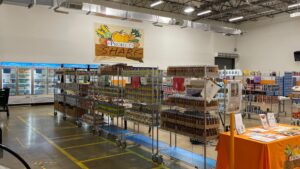
Fox 43 (2023). [Photo]. Project Share, Carlisle, PA. https://www.fox43.com/article/news/local/project-share-is-feeding-around-500-families-in-cumberland-county-for-thanksgiving/521-375e351d-ccff-4390-8a52-97db1cea2aea
Barriers to Assistance
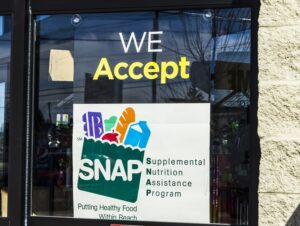
FRAC (2016). USA. https://frac.org/programs/supplemental-nutrition-assistance-program-snap
SNAP defines eligibility for their program by income: “… a household’s income (before any deductions) must be <130% of the poverty line” (Gunderson 2013). Due to the nature of a federal assistance program, they must outline eligibility even if it means excluding those who still struggle with affording and finding time to acquire groceries. In addition to income restrictions, SNAP, even for those who do meet requirements, can be challenging to apply to and navigate. Primarily, the application process can be confusing, time-consuming, and inaccessible to all populations (e.g. language barriers, attending in-person appointments, or making various phone calls) (Hossfeld 2018). Lower income individuals may be struggling with poorness in more than one aspect of their life, leading to both a lack of time and money to engage with otherwise beneficial assistance programs.
The Importance of Nonprofits
While SNAP does have widespread benefits to those enrolled (about 70 billion dollars of benefits per year), there are still gaps that need to be filled by other aid (Gunderson 2013). One of these groups that falls through the cracks of governmental assistance is the Asset Limited, Income Constrained, Employed (ALICE) population. Originally presented as an ‘emergency food source,’ food pantries based out of churches, warehouses, and vehicles provided short-term relief for families struggling to make their benefits last. Nonprofits such as Project SHARE which have developed permanent residence in the Carlisle area are among the few means of assistance for the ALICE population, as well as others who are eligible for SNAP. Project SHARE works with the community to boost these families into food security without the use of supplemental assistance.
More than Just Food Insecurity
While hunger and food insecurity are both challenges unto themselves, chronic food insecurity can lead to a variety of other complications that can permanently affect the livelihood of people and their families. These complications include but are not limited to higher chance of hospitalization, physical health problems, greater chance of developing diabetes and other chronic illnesses (Gunderson 2013). Recently, ‘hunger’ has been removed from many documentations referring to the access an individual has to food (Allen 2007). How do the words we use to refer to marginalized groups affect their real-life situations? In addition to the physical challenges a chronically hungry person may face, they are also not referenced to in a way that recognizes the difficulty and significance of their hardships. Ultimately, there is a disparity between the needs of lower-income groups and the provisions of local and federal governmental benefits.
Works Cited
Allen, P. (2007). The disappearance of hunger in America. Gastronomica the Journal of Food and Culture, 7(3), 19–23. https://doi.org/10.1525/gfc.2007.7.3.19
Gundersen, C. (2013). Food insecurity is an ongoing national concern. Advances in Nutrition, 4(1), 36–41. https://doi.org/10.3945/an.112.003244
Hossfeld, L. H., Kelly, E. B., & Waity, J. F. (2018). Food and poverty: Food Insecurity and Food Sovereignty Among America’s Poor.
Smith, T. A., & Gregory, C. A. (2023). Food insecurity in the United States: measurement, economic modeling, and food assistance effectiveness. Annual Review of Resource Economics, 15(1), 279–303. https://doi.org/10.1146/annurev-resource-101422-090409
Lily,
I agree that SNAP is definitely beneficial to many, but that it’s not adequate in addressing the scale of food insecurity in the U.S. In our class lecture we learned that the SNAP benefits only add up to around $2-3 a meal which makes it very difficult to afford a balanced, nutritional meal that’s not processed and is culturally appropriate for the recipient (Jenn Halpin, personal communication, September 22, 2025). In the movie, A Place at the Table by Lori Silverbush and Kristi Jacobson, we saw that often the SNAP benefits that were meant to last a month for households, only lasted two to three weeks causing a lot of anxiety in the weeks without SNAP provided food. Even if populations have access to food they may still be food insecure if they can’t access nutritional and culturally appropriate food. Today, there are 47 million Americans who are food insecure of which 13 million are children (Jenn Halpin, personal communication, September 22, 2025). We aren’t doing enough, we need to invest in the wellbeing of our society because hunger and food insecurity deeply affect people’s physical and mental health which has further implications on other elements of their lives.
Adleigh Franke
As previously mentioned, the aid provided by SNAP is often insufficient to remedy the food insecurity even among eligible households, adding additional stress. This is particularly significant given the governmental shutdown, which is forcing several states to halt SNAP (ABC News, 2025). Disapproval towards such social services stems from the value of self reliance in the US and resentment towards individuals considered “free loaders” (Wilkerson et al.). This perspective disregards the greater context of individuals enrolled in these programs.
One of the further effects of food insecurity mentioned previously manifests as entrapment in the cycle of poverty. Lower income individuals are forced to pay more attention to their food availability instead of academic and professional success (Project SHARE visit). This prevents lower income individuals from attaining a socioeconomic status that would enable reliable food access.
The strict eligibility requirements for SNAP remind me of how the redefinition of hunger gives scientists authority to define someone as hungry over the individuals themselves (Allen, 2007). This disregards the food insecurity experienced by other households, namely the ALICE population (one of the target groups of Project SHARE). Similarly, the minimal amount of funds provided by SNAP programs reflects how authoritative individuals are able to declare the severity of someone’s situation.
Lily,
Great job posing this really pervasive problem with a compelling opening and close. I like how you started with the evolution of the food insecurity definition and ended with the greater livelihood impacts of food insecurity. Your conclusion highlighting the health problems associated with chronic food insecurity, the impact of language, and the disparity between individual level needs and government level provisions was really strong and eye opening to me. Regarding food assistance, you highlighted the barriers well. One such issue you brought up is time poverty, which we read about in both Wilkerson et al. (2018) and Dubowitz et al. (2007). The Dubowitz et al. article also talked about transportation, a problem for food access that is common in rural areas but is likely increasing in urban areas too. I live outside of Philly and there have been a lot of recent issues with public transport, specifically vital Septa lines being shut down. I would expect this to worsen pre-existing food access barriers in the city. Finally, I really appreciate Hazel’s mention of the government shutdown and its impact on SNAP. It’s insightful and true that disapproval of food assistance stems in part from American values of independence. This made me think of a concept we have discussed in my WGSS class: the “welfare queen”, a stereotypical image of a self-indulgent Black woman who abuses public assistance. This harmful stereotype emerged in the 70s and was popularized during the Reagan era, but I bet it continues to impact perceptions of welfare and use of programs like SNAP.
Lily, you bring up great points about food insecurity in the US. One thing I did not know before learning about this topic in class is that the SNAP program neglects to support the people of the ALICE population. According to the Gundersen article, 14.5% of Americans were food insecure in 2010 and I wonder how that has differed since then (Gundersen, 2013). For example, Hazel and Emily mentioned the effects of the government shutdown halting SNAP benefits. There are also many issues associated with the SNAP program. As Adleigh mentioned above, by only providing $2-3 of aid per meal, it’s difficult for this help to last through the month and also for families to have access to healthy, non-processed foods.
That’s where non-profits like Project SHARE come in to help. One thing I took away from our visit to Project SHARE was how they are combatting the problem of stigma around food assistance. The food bank is set up like a grocery store to emphasize the element of choice while also encouraging a healthy, balanced selection of food. I appreciate that Project SHARE makes an extra effort to make sure families get the support they need.