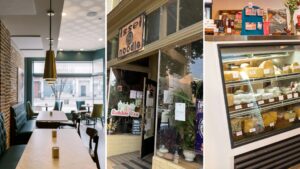
Sources (left to right): 1. Carlisle Design (n.d.) https://www.carlisledesigninteriors.com/commercial-index/one13-social\ 2. Wheree (n.d.) https://issei-noodle-1390967.wheree.com/ 3. Central Wedge Cheese Shop (2024) https://www.centralwedgecheese.com/post/say-cheese-and-it-s-yours
Environment of the Food Industry
According to the 2025 Independent Restaurant Industry Report, independent restaurants exist in a dynamic environment that is shaped by shifting customer expectations, and economic pressures (James Beard Foundation & Deloitte, 2025). This is also applicable for institutional dining operations. The economy of the United States has proven unpredictable (National Restaurant Association, 2025), which demands resilience and creativity in order to thrive (James Beard Foundation & Deloitte, 2025). This begs the question, how have members of the Carlisle food industry exhibited perseverance and innovation amidst the challenges of a changing world?
United States Food Culture
The food culture in the United States guides public perception of appropriate expenditures. This has presented a significant barrier for businesses such as the Central Wedge Cheese Shop, because Americans have been cultured to believe that it is unnecessary to get higher quality and thus more expensive food (S. Beeman, Personal Communication, November 17, 2025) Similarly, Issei Noodles had to overcome the assumption that the value of ramen is limited to a convenient packet (N. Pham, Personal Communication, November 17, 2025). This exemplifies the theme of convenience in our food system, which makes it difficult to view food consumption as an experience in itself.
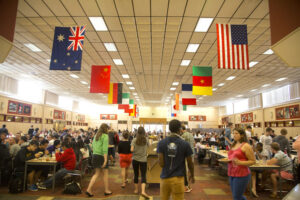
Source: Dickinson College (n.d.) https://www.dickinson.edu/homepage/657/locations
Vendor Decisions
Product source decisions reflect the ethos of a food business. Vendor decisions at Dickinson Dining Services (DDS) give preference to products that are local, sustainable, and in season (A. Telep, Personal Communication, November 20, 2025). However, the large quantity demanded by an institutional dining operation requires some sacrifices, such as sourcing chicken that is halal but not local (A. Telep, Personal Communication, November 20, 2025). Ingredient sourcing at RD is also based on a strong ethos. For example, it sources all beef from Carwood Farm, a small family farm located just seven miles away (K. Rockwood, Personal Communication, November 17, 2025). Local relationships help RD accommodate global instability while developing a strong business narrative (K. Rockwood, Personal Communication, November 17, 2025). This practice is not always applicable, because small producers often cannot produce the quantity and uniformity of product required by large dining operations like DDS.
Although both RD and DDS project themselves as sustainable businesses with locally-sourced ingredients, their motives vary. The decisions made by RD create a unique message to appeal to likeminded customers, whereas DDS is instead contributing to the existing reputation of Dickinson College. Within your household, what values influence your food purchase choices, and how often? Would this change if your reputation was on the line?
Labor Challenge

Source: Dickinson College (2024) https://www.dickinson.edu/news/article/5838/bringing_the_heat_dickinson_welcomes_new_executive_chef
Obtaining and retaining staff is a common challenge in the culinary industry (James Beard Foundation & Deloitte, 2025). According to Kevin Rockwood of RD, high standards and an extensive hospitality-based training process make staffing difficult (Personal Communication, November 17, 2025). On the contrary, institutional dining operations like DDS likely place more emphasis on the mechanics of food preparation alone. RD has found success in the genuine company culture attracting skilled and passionate employees, because it defies the narrative of disinterested food industry workers in the United States (K. Rockwood, Personal Communication, November 17, 2025).
Importance of Community
Community demographics shape collective responses to new restaurant concepts. Both Issei Noodles (N. Pham, Personal Communication, November 17, 2025) and Central Wedge Cheese Shop (S. Beeman, Personal Communication, November 17, 2025) brought new food cultures to Carlisle, and were met with open perspectives and curiosity fostered by its international community.
The value of authentic international cuisine is shared by students, as shown in a study that found ⅓ of college students want a greater variety (Mowreader, 2024). Ashley Telep, the executive chef at DDS, has followed this trend through the integration of new international cuisines (Personal Communication, November 20, 2025).
The success of food businesses is only as strong as the success of the community. This idea is embodied by RD. Through establishing its presence in culinary excellence, RD hopes to attract food-conscious individuals to Carlisle as a whole instead of its businesses alone (K. Rockwood, Personal Communication, November 17, 2025). In your opinion, how does the greater community impact customer experiences? And how can different dining businesses utilize their community relationships to enhance their business practices?
Citations
James Beard Foundation, Deloitte. (2025). “2025 Independent Restaurant Industry Report.” pp. 2-28.
https://cdn.sanity.io/files/2t27tguw/production/37d06a9c5a8e4693d873e4f1d53a71ce2718ee03.pdf
National Restaurant Association. (2025). “Economic Outlook.”
Mowreader, A. (2024). “Survey: Students Value Choice in Campus Dining Facilities.” Inside Higher Ed.
Dear Hazel,
Thank you for sharing your insightful information about these four cases within the industry, which is indeed facing issues in staffing, profitability, and guest retention. I find the desire for (culturally) varied food incredibly interesting. Generally speaking, humans seem to live in habits, and so does their consumption, do you expect that more variety of restaurants in Carlisle would attract a more interesting food scene?
Vending decisions are always a challenge in the industry, balancing price, quality, and sustainability. It is wonderful to read in your post that most of the business which you investigated now rely on local and pure sourcing, rather than profit-oriented mass production.
I think a community impacts guest experiences by having a more ‘lively scene’, which makes it more attractive for local, and other guests to visit. Community relations seem to be a great tool in guest attraction, and retention. Having repeated guests is a key factor in running a successful hospitality venue.
Thank you again for your insightful report!
Kind regards,
Knud
Hazel,
This is a very interesting look into the food industry at a local and large scale! The way that these two levels of food production have such complex challenges is very unique. I think you bring up a good point of balancing sourcing locally and maintaining a profitable business. Especially when large operations like Dickinson Dining Services makes compromises for quantity. It’s also really interesting to see how smaller businesses like Rogue Duck, with their strong local relationships, prioritize customer experience and satisfaction over profits. The point that you make about food culture in the U.S. is also very important. The idea that Americans often prioritize convenience over quality impacts businesses like Central Wedge Cheese Shop and Issei Noodles. Lastly, the role of community in shaping food choices and business success is such a significant factor. It’s amazing how local connections, like those Rogue Duck have cultivated, create community loyalty and ties throughout Carlisle. It shows that when dining businesses truly engage with their community, it can lead to a much more supportive and enduring customer base!
Hazel,
This is a really thoughtful reflection on the insider view of the values, successes, and challenges faced by individual restaurants and the Dickinson dining hall. It’s interesting to consider the impact of how society has normalized convenient low priced, low quality foods, making it hard for many to justify spending what seems like “too much” on quality food.
Shay at Issie Noodles talked about the importance of keeping prices low so customers would see Issie as an affordable place to go to weekly instead of every few weeks. The 2025 Independent Restaurant Industry Report, suggested that due to higher food costs and an increase in consumers that are more cautious of spending, restaurants have to find alternative ways to make their business successful such as fostering a strong community network, sharing their unique story, and creating a memorable dining experience. The Carlisle community and beyond was very receptive to Issie because Issie offered cuisine different from what was already being offered in Carlisle. Issie’s success is not just due to their delicious food but also the atmosphere of the restaurant and the unique dining experience they offer, as Shay mentioned. In the independent restaurant world, restaurants don’t have much control over external factors like the food costs/availability, consumer behavior, and the economy, but they do the best they can to manage the unpredictability.
Sincerely,
Adleigh
Hazel,
Thank you for your post, it is insightful and thought-provoking. Like Lily and Knud, I am particularly interested in how culture and community shapes food choices and how this affects the restaurant scene. As you mentioned, the owner of Central Wedge reflected on the ‘fast food’ culture in America: food should be cheap and easily accessible. The prioritization of these aspects over quailty and taste directly impacts the markets available for food in America. Despite this, however, shops such as Central Wedge still exist and survive. Perhaps, in spite of this prevailing culture of ‘fast food,’ there is still an underlying desire for quality and diversity in our food supply, and that desire is something that can be catered to.
The owner of Central Wedge, Stephanie Beeman, also discussed the importance of sourcing products locally, despite the difficulty this often presents. A thriving local market encourages quality and diversity without having to outsource. Beeman discussed her experience in France, where their prioritization of producing food for themselves before exporting it has resulted in a fresh and high quality food supply as well as a slower food culture. The local market can be unpredictable for smaller businesses, however, particularly with increases in tariffs as large corporations are now looking to source locally. Your discussion of DDS’ use of locally sourced items is interesting in that regard, and I would be intrigued to know of any changes in local products since tariff policies have changed.
Thank you again for your intriguing post!