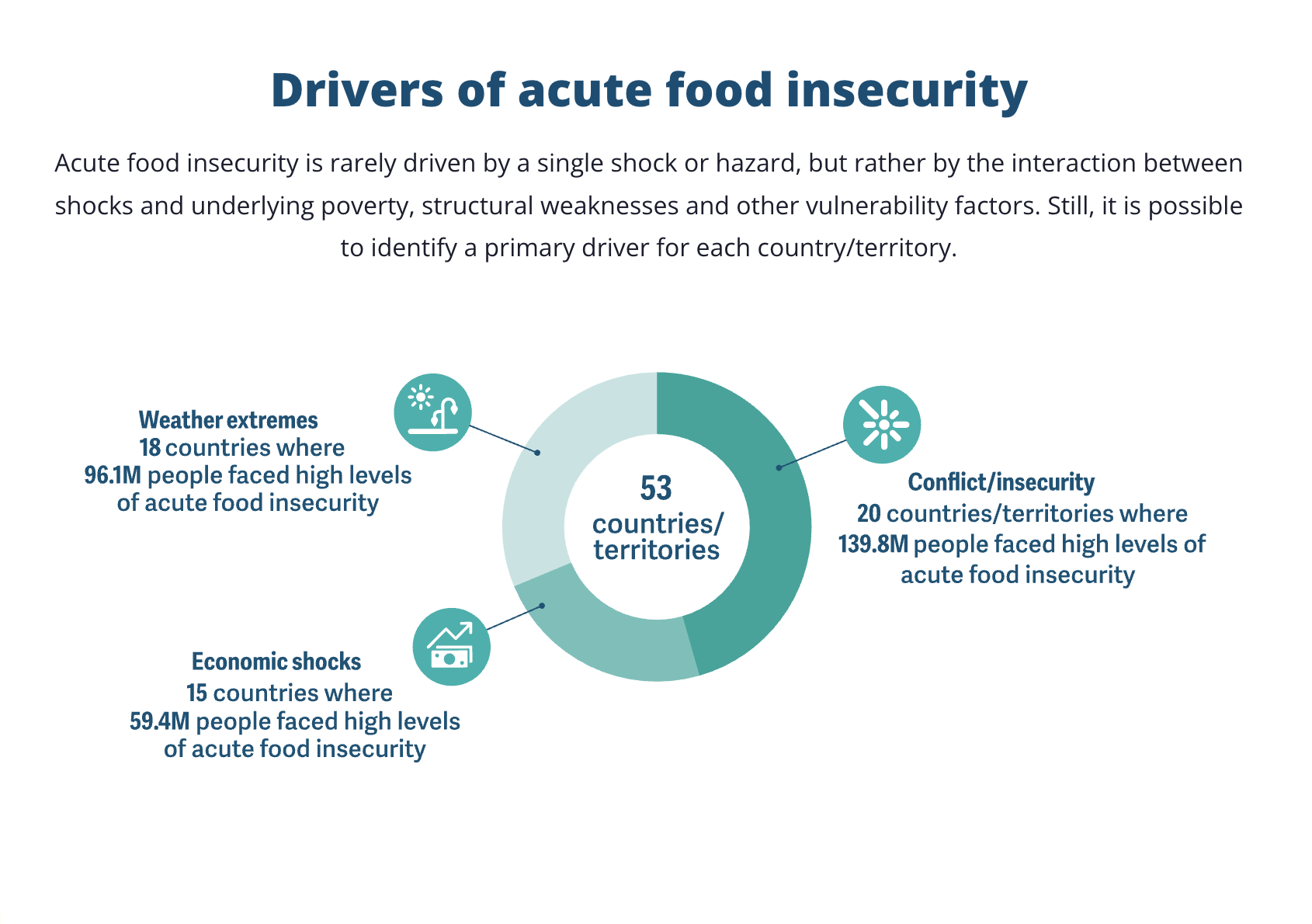
The global food crisis stems from food insecurity. The Office of the Assistant Secretary for Health (OSAH) defines food insecurity as “a household-level economic and social condition of limited or uncertain access to adequate food.” Some of the factors that lead to this insecurity on a global scale are: climate change, conflict, economic stress, and displacement (World Food Programme).
https://www.fightfoodcrises.net/report/global-report-food-crises-2025/
Climate change disrupts agriculture by exposing plants to new temperature extremes that prevent them from thriving. Conflict causes people to lose access to income. They could use it to buy food, and it would also disrupt the distribution of food that would normally enter the country. With economic stress, this could come from a country emerging from war, where little income is coming in, leading to higher food prices. Displacement occurs when someone is forcibly removed from their home, leaving them with limited access to food and shelter in the new area (World Food Programme).
The Global Network Against Food Crisis (GNAFC) released its annual Global Report on Food Crisis for 2025 in September. In this report, they highlighted countries experiencing food insecurity and the main factors driving it. They begin the report by investigating famines that have begun or persist in the Gaza Strip, Sudan, and South Sudan. These famines have sent from conflicts in these two countries. In Gaza, the conflict has damaged “98% of cropland” (GRFC 2), and there is a ban in place preventing access to the sea for fishing. The people generating this report recognize a lack of access to collect data on human welfare, so they use evidence from a previous report to strongly suggest that famine is continuing there. In South Sudan, there is a risk of famine starting since the conflict has forced the displacement of people. Additionally, this country was designated a “no-go zone,” meaning humanitarian aid cannot reach it.
https://www.fightfoodcrises.net/report/global-report-food-crises-2025/
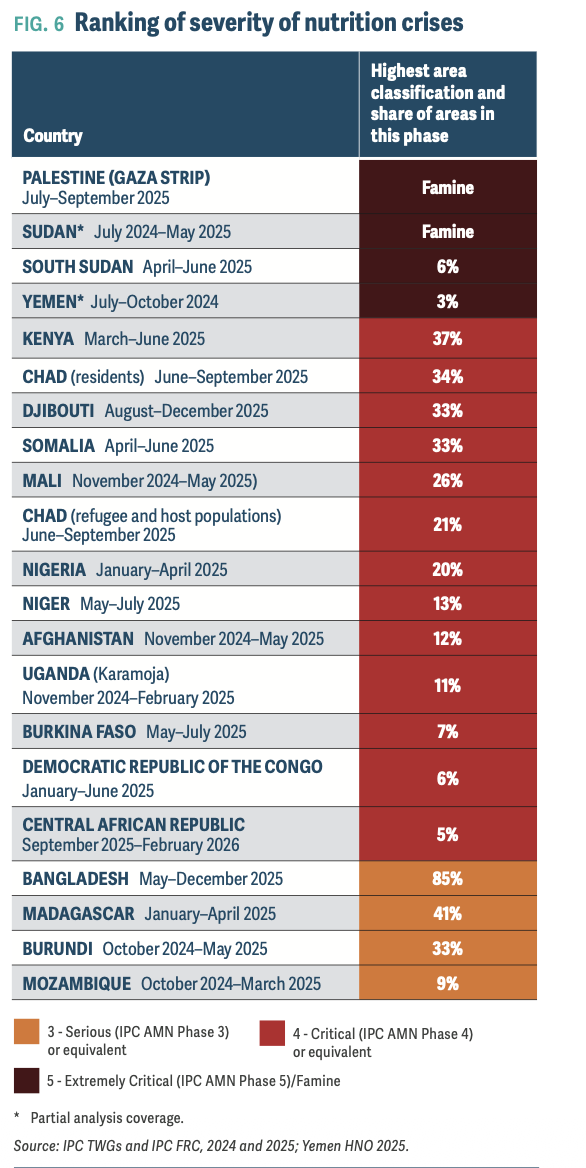
After the conflict section, the report highlights the nutrition crisis stemming from food insecurity. The report notes that the four countries most affected by the nutrition crisis are “the Gaza Strip, the Sudan, South Sudan, and Yemen” (GRFC 4). This nutrition crisis is linked to rising conflict in these countries and reduced assistance due to funding cuts.
The next topic is the decline in funding to support these countries in helping people in need. The report notes “major donors slashing their ODA budget by between 35 and 83 percent, affecting health, nutrition, and food security operations in over 100 countries” (GRFC 6). These limited funds drastically reduce the amount of food that can be provided to communities in need, the time organizations can spend in these countries, and the amount that can be distributed. In addition to these organizations helping countries in need, they also provide data that researchers can use to look for early signs of food insecurity and malnutrition, with the finding cup cuts limiting the amount of time the organizations can stay in a country, which also reduces them out of data they can collect to help generate reports such as the Global Report on Food Crisis.
Reports like the Global Report on Food Crisis can help people learn which countries are experiencing extreme levels of food insecurity and malnutrition. It also provides detailed explanations of the factors driving this food crisis and the extent to which they are responsible. Without these reports, most people would be unaware of this crisis, which could also affect support for organizations dedicated to helping countries in need.
If you are interested in which organizations help alleviate this crisis, some include World Central Kitchen, the UN World Food Programme, and Action Against Hunger.
References:
1. A Global Food Crisis: World Food Programme. UN World Food Programme. (2026).
https://www.wfp.org/global-hunger-crisis
2. Gliessman, S. (2022). Why is there a food crisis? Agroecology and Sustainable Food Systems,
46(9), 1301–1303. https://doi.org/10.1080/21683565.2022.2115187
3. Global report on food crises (GRFC) 2025. 2025 Global Report on Food Crisis. (2025).
https://www.fightfoodcrises.net/report/global-report-food-crises-2025/ and www.fsinplatform.org/grfc2025
4. OSAH. (n.d.). Food insecurity. Food Insecurity – Healthy People 2030.
https://odphp.health.gov/healthypeople/priority-areas/social-determinants-health/literature-summaries/food-insecurity