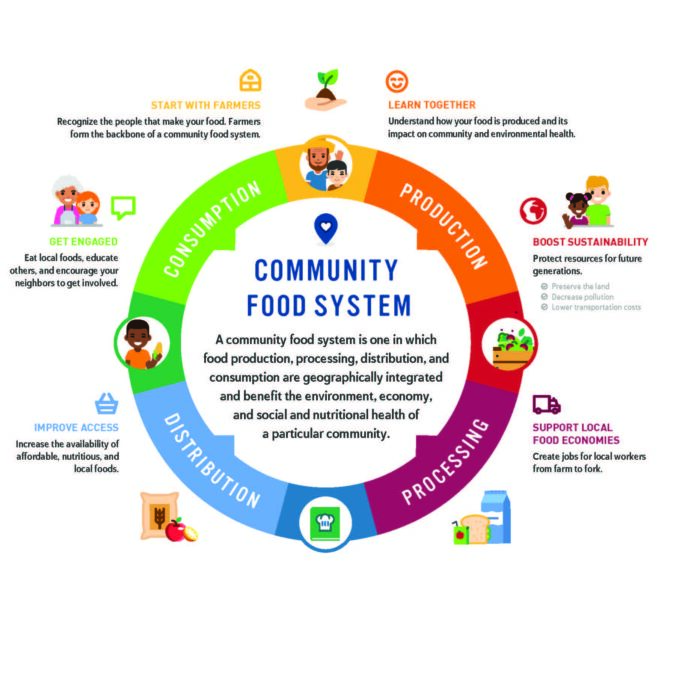
“Food identifies who we are, where we came from, and what we want to be” (Belasco, 2008, p.1).
This is the answer Warren Belasco gave to the question of “Why Study Food?”. Food is not only a source of life, the core to human existence, but also a way to identify a society’s history and culture. Studying food is particularly important now as we have become further estranged from food production to disposal. This week’s readings and discussions challenge us to think about how food both connects and distances us from one another, and push us to gain consciousness about what we eat as a responsibility, and even freedom from food industrialists.
Belasco’s explanation of why the food studies field was neglected draws on the popular Victorian belief of food being “uncivilized”, as well as the dichotomic association of food production being masculine and food consumption being feminine, making the subject not worthy of studying. Later on in the 20th century, as the feminist movement freed women from their patriarchally enslaved role in the kitchen, food preparation shifted from households to industry. While this was a step toward gender equity, it also widened the gap between supplier and consumer (Belasco, 2008, p4-5).
The estrangement from our food is also central in Wendell Berry’s “The Pleasure of Eating”, as he claims that “eating is an agricultural act” (Berry, 2002, p. 17) and proceeds to prove that consumers are a crucial part of the food system. He critiques the way food industrialists “persuaded” consumers to buy what they think they want within the limit of what they can get, which was decided by the industry through specialization of production. I noticed a commercialized lens that frames food is very prominent in this article, since everything is based on its profitable value in the food industry. As Berry argues “one reason to eat responsibly is to live free” (Berry, p. 18), he suggests readers to be independent from the food industry and not become an “industrial eater”, who is estranged, passive, and uncritical, a “victim”. This can be achieved through participating in food production, learning about origins, and engaging locally, all to the best extent.
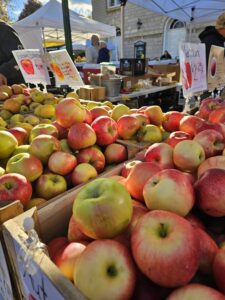
I took this photo at Farmers on the Square during the apple season in 2023.
The meal analyzing discussion in class has demonstrated this point. My breakfast includes chia seed pudding and coconut water from Walmart and an apple I got from Farmer’s Market, which is the only item I could clearly trace the origin of. I had lunch at the Dining Hall, and honestly, I had no clue about any part of the food’s journey in the food system before it hit my plate. The only detail I knew was that leftovers are composted into biogas. Eating at the dining hall is convenient, freeing me from the labor of making food, yet also alienating me from my food.
A statistic provided by Professor Halpin that only 2% of the U.S. population are involved in farming, with an average age of 50–60, further proved the point of estrangement with food. We also discussed how food packaging distances you from what part of an animal you are eating, what the fruit looks like on its tree, or what season does this vegetable grow. Comparing the two meals and listening to my classmate’s sharing, it is clear that it is a privilege to grow your own food, or even to just know your local producers instead of mere brand names. This also means that Berry’s suggestions are ideal, but not necessarily applicable to everyone due to multiple circumstances including time and wealth. It raised a question of if food awareness and freedom is a privilege only some can have, and how can we make it more inclusive and equitable?
Works Cited:
Belasco, Warren (2008). Why Study Food?. In Food: The Key Concepts. Berg Publisher, London.
Berry, Wendell (2002). The Pleasure of Eating, The Sun, 17-20.