
Fox 43 (2023). [Photo]. Project Share, Carlisle, PA. https://www.fox43.com/article/news/local/project-share-is-feeding-around-500-families-in-cumberland-county-for-thanksgiving/521-375e351d-ccff-4390-8a52-97db1cea2aea
Barriers to Assistance
FRAC (2016). USA. https://frac.org/programs/supplemental-nutrition-assistance-program-snap
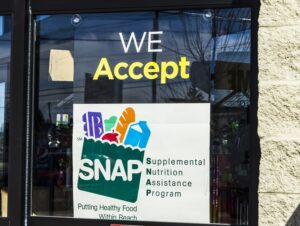
SNAP defines eligibility for their program by income: “… a household’s income (before any deductions) must be <130% of the poverty line” (Gunderson 2013). Due to the nature of a federal assistance program, they must outline eligibility even if it means excluding those who still struggle with affording and finding time to acquire groceries. In addition to income restrictions, SNAP, even for those who do meet requirements, can be challenging to apply to and navigate. Primarily, the application process can be confusing, time-consuming, and inaccessible to all populations (e.g. language barriers, attending in-person appointments, or making various phone calls) (Hossfeld 2018). Lower income individuals may be struggling with poorness in more than one aspect of their life, leading to both a lack of time and money to engage with otherwise beneficial assistance programs.
The Importance of Nonprofits
While SNAP does have widespread benefits to those enrolled (about 70 billion dollars of benefits per year), there are still gaps that need to be filled by other aid (Gunderson 2013). One of these groups that falls through the cracks of governmental assistance is the Asset Limited, Income Constrained, Employed (ALICE) population. Originally presented as an ‘emergency food source,’ food pantries based out of churches, warehouses, and vehicles provided short-term relief for families struggling to make their benefits last. Nonprofits such as Project SHARE which have developed permanent residence in the Carlisle area are among the few means of assistance for the ALICE population, as well as others who are eligible for SNAP. Project SHARE works with the community to boost these families into food security without the use of supplemental assistance.
More than Just Food Insecurity
While hunger and food insecurity are both challenges unto themselves, chronic food insecurity can lead to a variety of other complications that can permanently affect the livelihood of people and their families. These complications include but are not limited to higher chance of hospitalization, physical health problems, greater chance of developing diabetes and other chronic illnesses (Gunderson 2013). Recently, ‘hunger’ has been removed from many documentations referring to the access an individual has to food (Allen 2007). How do the words we use to refer to marginalized groups affect their real-life situations? In addition to the physical challenges a chronically hungry person may face, they are also not referenced to in a way that recognizes the difficulty and significance of their hardships. Ultimately, there is a disparity between the needs of lower-income groups and the provisions of local and federal governmental benefits.
Works Cited
Allen, P. (2007). The disappearance of hunger in America. Gastronomica the Journal of Food and Culture, 7(3), 19–23. https://doi.org/10.1525/gfc.2007.7.3.19
Gundersen, C. (2013). Food insecurity is an ongoing national concern. Advances in Nutrition, 4(1), 36–41. https://doi.org/10.3945/an.112.003244
Hossfeld, L. H., Kelly, E. B., & Waity, J. F. (2018). Food and poverty: Food Insecurity and Food Sovereignty Among America’s Poor.
Smith, T. A., & Gregory, C. A. (2023). Food insecurity in the United States: measurement, economic modeling, and food assistance effectiveness. Annual Review of Resource Economics, 15(1), 279–303. https://doi.org/10.1146/annurev-resource-101422-090409