The Food Waste Problem
The Food and Agriculture Organization defines food waste as “the decrease in the quality or quantity of food resulting from decisions and actions by retailers, food service providers, and consumers.” In the United States – as well as globally – we waste approximately 30-40% of our food (Canon, 2023). This tendency has significant implications for the climate, from growing landfills to increased greenhouse gas emissions. But how did we get here in the first place? Where do these steep numbers come from?
Sources of Food Waste
There are four main pathways of food waste: production, post-harvest/post-handling, processing, and distribution/consumption. Food can be wasted at any point in the food supply chain. At the production level, food may be lost due to overproduction and surplus. At the post-harvest/post-handling level, food may be thrown away if it does not meet industry cosmetic standards. At the processing level, consumer preferences (e.g., pre-peeled, pre-chopped) lead to the waste of viable produce parts. Last but not least, distribution houses a particularly pervasive problem: food labels. Contrary to popular belief, these labels actually have nothing to do with food safety (Tanigawa, 2017). If we can’t trust labels, then, how do we know when to throw things out?
Food Waste Solutions
While each pathway of food waste contributes to the wider problem, we can look to each pathway for solutions as well. On the consumer level, we can spread awareness to adjust behavior. With the case of food labels, we can teach individuals how to assess food safety and expiration using qualities like smell, texture, color, and taste. On the processing level, we can modify expectations to increase acceptance of cosmetically “imperfect” products. In terms of production and distribution, Pennsylvania has some excellent local initiatives. The Pennsylvania Agriculture Surplus System reimburses farmers for donating their surplus goods. Pennsylvania is also home to many Amish “Bent n’ Dent” grocery stores, which sell damaged products at discounted prices. Dickinson College students interested in a local Bent n’ Dent can check out BB’s Grocery Outlet, just 18 miles away in Newburg!
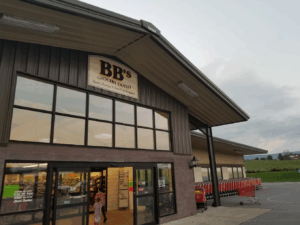
BB’s Grocery Outlet – “Bents, Bumps, and a Bunch of Bargains”, Kirb Witmer
Innovative Solution: Biodigesters
Biodigesters are a unique and growing solution to food waste. These systems use anaerobic digestion to break down organic material and convert it into two reusable resources: biogas and digestate. These byproducts have numerous utilities. Biogas can be used for cooking, heating, electricity, and even vehicle fuel. Digestate can be used as a nutrient rich fertilizer – a much more sustainable alternative to synthetics. The benefits of biodigester implementation are vast, and they go beyond the environment. Women and children in developing countries, for example, can be significantly advantaged in terms of health and life satisfaction with the help of biogas (Steiman, 2020).
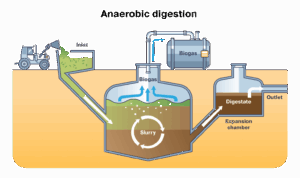
Diagram of anaerobic digestion in a biodigester, Power Knot
The Dickinson College Farm has a biodigester of its own, taking waste from college dining locations, local restaurants, and livestock to generate electricity. This project is a prime example of preventing waste by turning it into something valuable!
Generating Change
While food waste initiatives are highly necessary, it can be hard to foster engagement and participation. This is where we have to get creative. A 2019 study of an Austrian food sharing program explored member’s motivations for participating and found that they were influenced by the following: emotions and morality, identity and sense of community, reward, social influence, and instrumentality (e.g., desire to save food from being wasted) (Schanes & Stagl, 2019). Using what we know about consumer desires and drives, we can make intentional program design choices to shape the most effective programs. In this way, food studies can harness consumer and market psychology to understand and shape our food-related choices.
References
Canon, G. (2023, May 14). Has this food actually expired? Why label dates don’t mean what you think. The Guardian. https://www.theguardian.com/environment/2023/may/13/food-labels-expiration-dates-safe-to-eat
Dickinson College (Director). (2022). From beer to biogas: Creating green energy using brewer’s grain & farm waste [Video recording]. https://www.youtube.com/watch?v=jz1aBf7CTR0
Gunders, D., & Bloom, J. (2017). Wasted: How America is losing up to 40 percent of its food from farm to fork to landfill. Natural Resources Defense Council. https://www.nrdc.org/sites/default/files/wasted-2017-report.pdf
Schanes, K., & Stagl, S. (2019). Food waste fighters: What motivates people to engage in food sharing? Journal of Cleaner Production, 211, 1491–1501. https://doi.org/10.1016/j.jclepro.2018.11.162
Steiman, M. (2020). Women and home-scale biogas: Benefits, barriers and insights from US-based innovators.
Tanigawa, S. (2017). Biogas: Converting waste to energy (J. Stolark, Ed.). Environmental and Energy Study Institute. https://www.eesi.org/papers/view/fact-sheet-biogasconverting-waste-to-energy