Nutrition: From the Individual to the Whole Picture
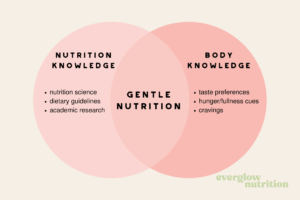
Source: Rachel Helfferich, Everglow Nutrition, “5 Examples of Gentle Nutrition in Real Life”, 2022.
This week, our class explored food studies through the lens of nutrition and health. Discussing popular and oftentimes controversial topics like global diet recommendations and intuitive eating, we learned about how what we eat connects to our wellbeing not only individuals but as a species. Our class readings for Monday, 10/27 focused on issues like obesity and social determinants of health, topics that have political, social, as well as personal connotations for many. I gained immense insight from Alice Julier’s 2008 article, “The Political Economy of Obesity: The Fat Pay All”, which frames the issue of obesity within a sociological and political context, rather than an individual one. Julier insists that blaming individuals for the leading factors of obesity, from lack of access to healthy foods to the social constructs in the United States promoting consumption, is unproductive and misplaced. Instead, she suggests the federal government take a more active role in hunger prevention and combating food insecurity, because the “unsteady flow of federal funds” assisting non-profit organizations such as food banks “makes good food, leisure, and physical exercise into commodities that are only affordable to those who have disposable income, time, and cultural capital” (Julier, 2008).
Social Determinants of Health and Dietary Guidelines
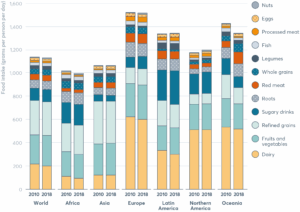
Source: Dr Marco Springmann (Lead author), Dr Dariush Mozaffarian, Dr Cynthia Rosenzweig, Dr Renata Micha. “Food intake by food group, year and region (grams per person per day), 2010 and 2018”. Global Nutrition Report. (2021). https://globalnutritionreport.org/e67d6e#2039f4ec.
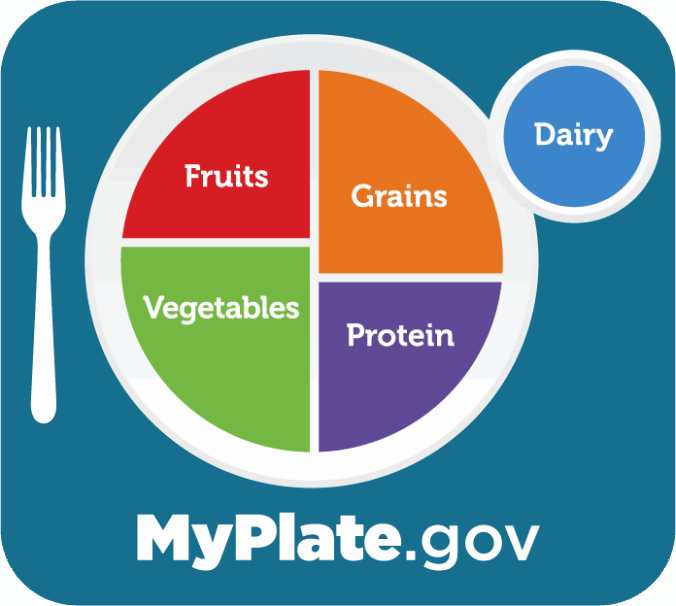
This perspective connects with our reading on Social Determinants of Health, which according to Jiao, are the “non-medical conditions in which people are born, grow, work, live, worship, and age” (Jiao, 2024). Both Jiao and Julier emphasize a necessity for holistic action by governing bodies to craft culturally and dietarily appropriate nutrition policy. In class, we talked about our different experiences with nutritional education growing up, with some recalling federal programs such as MyPlate, and others mentioning that programs like First Lady Michelle Obama’s ‘Let’s Move!’ initiative made them feel overly responsible for their food choices as individuals despite many school lunches including ultraprocessed foods (The Lancet Regional Health – Americas, 2022). During our Thursday, 10/30 class, we met with Dickinson College’s nutritionist Courtney Hager to learn more about dietary recommendations and how they’re communicated in the U.S. One example we explored was the USDA’s MyPlate website (https://www.myplate.gov), which provides tools to calculate the recommended quantities of fruits, vegetables, grains, protein, and dairy or soy products each individual requires depending on various factors.
MyPlate, Intuitive Eating, and the Future of Nutritional Education
U.S. Department of Agriculture. (2025). MyPlate (infographic). https://www.myplate.gov/.
While I recall the MyPlate image from secondary school, it has been interesting to see how the USDA’s recommendations have evolved to include diets such as vegan and dietary restrictions like lactose intolerance. In fact, the deeply nuanced and personal quality of diet was made clearer to me through another reading from Week Nine by Jackson et. al., “Intuitive eating and dietary intake”, which highlights four areas of eating that factor in physical signs of hunger and satisfaction over other reasons why we eat. These areas include “unconditional permission to eat (UPE)”, “eating for physical rather than emotional reasons (EPR)”, “reliance on hunger and satiety cues (RHSC)”, and “body-food choice congruence (B-FCC)” (Jackson, et. al., 2022). As exemplified in Chapter 2 of the 2021 Global Nutrition Report, most adults in the United States are not meeting dietary intake recommendations, specifically those for fruits and vegetables. Considering this, our class discussion on intuitive eating touched on the difficulty in balancing personal practices with the global dietary recommendations. How do we as individuals reconcile our wants and needs when it comes to food and nutrition, considering both social determinants of health and federal nutritional education programs? After all, a study as recent as last year found that “nearly 1 in 3 U.S. adults reported knowing about the MyPlate plan” but that “only about 1 in 7 U.S. adults reported knowing about and trying to follow MyPlate plan recommendations” (Restrepo, 2024). Perhaps the answer lies in improving the quality of nutritional education for future generations, by ensuring it encompasses diverse experiences with food – from social determinants of health, allergies, other dietary restrictions, and beyond.
References
Helfferich, R. (n.d.) 5 Examples of Gentle Nutrition IRL. Everglow Nutrition. https://everglownutrition.com/category/intuitive-eating/page/2/.
Jackson, A., Y. Sano, L. Parker, A. E. Cox, J. Lanigan. (2022). Intuitive eating and dietary intake. Eating Behaviors, 45. https://doi.org/10.1016/j.eatbeh.2022.101606.
Jiao, L. (2024). Social Determinants of Health, Diet, and Health Outcome. Nutrients, 16, 3642. https://doi.org/10.3390/nu16213642.
Julier, A. (2008). The Political Economy of Obesity: The Fat Pay All. Food and Culture, 2019. Edited by Carole Counihan and Penny van Esterik.
Restrepo, B. (2024). Awareness and Use of MyPlate Among U.S. Adults: Evidence From Nationally Representative Data, 2024. American Journal of Preventive Medicine, Volume 69, Issue 5. https://www.ajpmonline.org/article/S0749-3797(25)00503-3/abstract.
The Lancet Regional Health – Americas (edit.). (2022, Dec. 8). Unhealthy school meals: A solution to hunger or a problem for health? Lancet Reg Health Am, Volume 16. https://www.sciencedirect.com/science/article/pii/S2667193X22002307?via%3Dihub.
The Original Intuitive Eating Pros. (n.d.) 10 Principles of Intuitive Eating. The Original Intuitive Eating Pros. https://www.intuitiveeating.org/about-us/10-principles-of-intuitive-eating/.
Springmann, et. al. (2022). Chapter 2: What we eat matters: Health and environmental impacts of diets worldwide. 2021 Global Nutrition Report: Stronger commitments for greater action. Bristol, UK: Development Initiatives. https://globalnutritionreport.org/reports/2021-global-nutrition-report/health-and-environmental-impacts-of-diets-worldwide/#section-2-8.
U.S. Department of Agriculture. (2025). Eat Healthy with MyPlate. MyPlate U.S. Department of Agriculture. https://www.myplate.gov/.