Dickinson College Food Studies Certificate Program

Author: Lena Rimmer

Alumni Spotlight: Elizabeth Gallo ’20

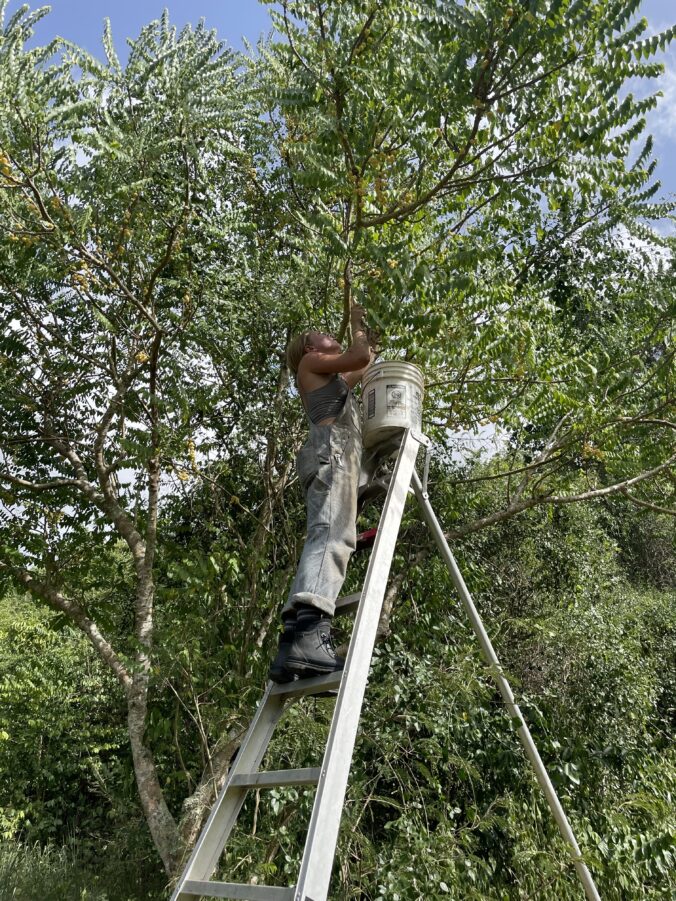
Elizabeth Gallo graduated from Dickinson College in 2020 with a degree in Studio Art and French and Francophone Studies, as well as the Food Studies Certificate. When choosing Dickinson, she was drawn to the College Farm and the emphasis on sustainability.

Growing up, Elizabeth and her family had their own small garden, where she credits her obsession with growing her own food. In High School, Elizabeth learned about an urban farm in her area from a peer and knew she wanted to get involved. Through the rest of her High School career and several summers in college, Elizabeth worked at Boone Street Farm in Baltimore, Maryland.  This farm worked with the city to use plots of unused land as agricultural space and was very ingrained in the community. The leaders of the farm were locals themselves, and kids from around the neighborhood would frequently stop by to learn more about what was happening or just see what was going on.

During her time at Dickinson, Elizabeth noted how well her three programs meshed together; Studio Art fulfilled her tactical need, and during her time abroad in France, she was able to become involved with a community gardening program with her knowledge of French. She reflected that having a language program with the Food Studies Certificate makes a lot of sense; it is so much easier to get involved and learn about foreign farming and agriculture policies.

After graduation, Elizabeth moved to St. Croix, USVI, to work at Ridge to Reef Farm, the only USDA Certified Organic farm on St. Croix. After moving up in management and working at a few other farms on St. Croix, Elizabeth moved to St. John last year. Now she works on an organic (although not certified organic) commercial farm. This farm follows organic farming practices and provides greens and herbs to restaurants on the island. This farm and the woman who runs it have an incredible business model that Elizabeth looks to learn from and hopefully implement in her own business one day. The USVI have a year-long growing season and good soil with ample farming space too.  Still, businesses and grocery stores rely heavily on the importation of food, which is becoming more difficult as tariffs continue to be implemented. Elizabeth strives to one day own her own land and be able to farm. to provide for her community, saying how cool it would be for people to buy kale from her local farm instead of imported kale from the grocery store that would mold in two days.
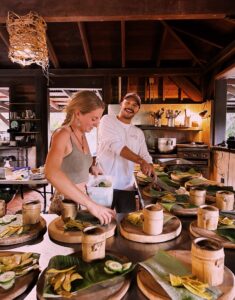
In addition to working on the commercial organic farm, Elizabeth also works with the VI Department of Agriculture, visiting other farms and helping to write land management plans. Although she did not focus much on forestry and ecology in her time at Dickinson, she says that the Food Studies Certificate and her farm experience were great foundations that made it easier to learn new aspects of Food Studies.
Food Deserts and Processed Foods

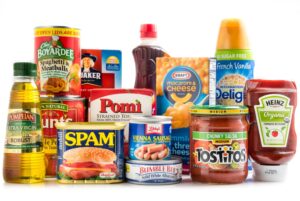
Processed and Ultra-Processed Foods (UPFs) have, in recent years, become a highly contested issue among Americans. The reliance on processed foods in the American diet, specifically the forced reliance of people living in ‘food deserts,’ has called into question many elements of processed foods, including nutritional content. Processed foods cover more than the average American might think, and do make up a lot of the foundational nutrition in American diets. 

The American Society for Nutrition defines processed food as “the alteration of foods from the state in which they are harvested or raised to better preserve them and feed consumers.” This is perhaps a broader and less invasive definition than many Americans expect. There are many foods considered ‘healthy’ that fall under the category of processed foods. There are certainly more negative connotations toward processed foods, which can more broadly describe food items like sliced fruits or vegetables. Processed foods, on their own, actually contain more nutritional value than they are credited for in the minds of the American public. In their simplest forms, food processing dates back to prehistory, and only in the past 100 years has it grown to an industrial level. Processed foods are actually instrumental to both food and nutrition security in American diets. Many of these negative thoughts are perhaps more applicable to ultra-processed foods. 

https://fountainavenuekitchen.com/nutrition/what-are-ultra-processed-foods/

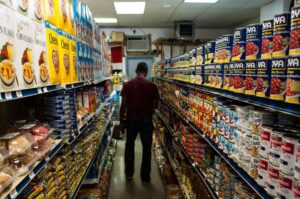
Ultra-processed foods take the definition of processed foods to the next level, being defined in an article by the American Heart Association as foods or products created in part or whole from extracts of foods with little to no intact food. These products are often cheaper than processed or fresh foods and also higher in calories. Since processed and ultra-processed foods tend to have a higher shelf life than fresh foods, they are often more accessible in places that supplement grocery stores, such as convenience stores, in so-called food deserts. 

A food desert is a term used to describe locations where consumers face barriers (often distance) in order to purchase affordable and nutritious foods. Commonly, these food deserts affect communities on the lower end of the socioeconomic chain or extremely rural areas of the world. These consumers, in turn, are more reliant on processed and UPFs in their diets. Due to this trend, the term ‘food swamp’ has been invented to apply to areas with higher access to less healthy foods compared with access to healthy foods. An article published by the United States Department of Agriculture credits the term to

https://news.uchicago.edu/story/food-deserts-not-blame-growing-nutrition-gap-between-rich-and-poor-study-finds

 Professor Donald Rose at Tulane University. This article examines an interesting food paradox wherein the population existing in the lowest income bracket actually spends more money on food than those in the next highest bracket.  This is due to many consumers with lower incomes lacking time or resources to shop at grocery stores with lower prices, and were instead victims of price inflation due to limited access. The prices of items like milk, cereal, and bread were inflated 5, 25, and 10%, respectively, in convenience stores. It is price inflation and the risk of expired food that these items are often foregone for energy-dense ultra-processed options in more unconventional locations, such as convenience stores. 

There are several organizations and communities around the United States aiming to shrink these food deserts and food swamps, implementing programs like urban gardens in cities that are tied to local education programs. One example of this is Green Roofs NYC.

In Carlisle, PA, there are several resources that classify the area as a food oasis. This term is the inverse of a food desert and refers to communities with abundant access to supermarkets, community gardens (like the Dickinson College Community Garden), and farmers’ markets (like Farmers on the Square).

References

  1. Weaver, C. Dwyer, J. Fulgoni, V. King, J. Leveille, G. MacDonald, R. Ordovas, J. & Schnakenberg, D.(2014) Processed Foods: Contributions to Nutrition. American Society for Nutrition; 99, 1525-42.
  2. Ver Ploeg, M., Breneman, V., Farrigan, T., Hamrick, K., Hopkins, D., Lin, B., Nord, M., Smith, T.A., Williams, R., Kinnison, K., Olander, C., Singh, A. & Tuckermanty, E. (2009). Access to Affordable and Nutritious Food-Measuring and Understanding Food Deserts and Their Consequences: Report to Congress. U.S. Department of Agriculture, Economic Research Service. AP-036.
  3. American Heart Association News (2020). Processed vs. Ultra-processed Food, and Why it Matters to Your Health. American Heart Association.
  4. Jin, H., & Lu, Y. (2021). Evaluating Consumer Nutrition Environment in Food Deserts and Food Swamps. International journal of environmental research and public health, 18(5), 2675.

© 2026 Food Studies


Academic Technology services: GIS | Media Center | Language Exchange

Theme by Anders NorenUp ↑